
Lecture 1 Random Numbers Linear congruential generator LCG
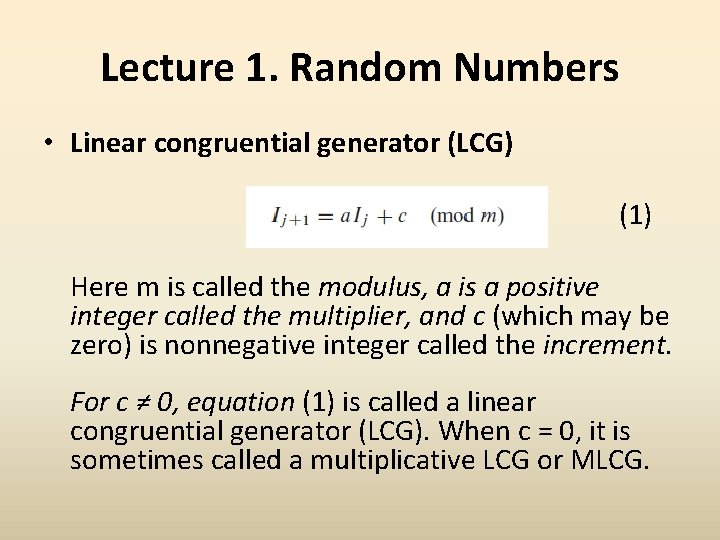
Lecture 1. Random Numbers • Linear congruential generator (LCG) (1) Here m is called the modulus, a is a positive integer called the multiplier, and c (which may be zero) is nonnegative integer called the increment. For c ≠ 0, equation (1) is called a linear congruential generator (LCG). When c = 0, it is sometimes called a multiplicative LCG or MLCG.
• The recurrence (1) must eventually repeat itself, with a period that is obviously no greater than m. • If m, a and c are properly chosen, then the period will be of maximal length, i. e. , of length m. In that case, all possible integers between 0 and m - 1 occur at some point, so any initial “seed” choice of I 0 is as good as any other: The sequence just takes off from that point, and successive values Ij are the returned “random” values.
• The idea of LCGs goes back to the dawn of computing, and they were widely used in the 1950 s and thereafter. The trouble in paradise first began to be noticed in the mid 1960 s: If k random numbers at a time are used to plot points in kdimensional space (with each coordinate between 0 and 1), then the points will not tend to “fill up” the k-dimensional space, but rather will lie on (k – 1)-dimensional “planes. ” There will be at most about m 1/k such planes. If the constants m and a are not very carefully chosen, there will be many fewer than that. The number m was usually close to the machine’s largest representable integer, often ~ 232. So, for example, the number of planes on which triples of points lie in threedimensional space can be no greater than about the cube root of 232, about 1600.
• Even worse, many early generators happened to make particularly bad choices for m and a. One infamous such routine, RANDU, with a = 65539 and m = 231, was widespread on IBM mainframe computers for many years, and widely copied onto other systems. It produced a “random” plot with only 11 planes: “We guarantee that each number is random individually, but we don’t guarantee that more than one of them is random. ” • LCGs and MLCGs have additional weaknesses: When m is chosen as a power of 2 (e. g. , RANDU), then the low-order bits generated are hardly random at all. In particular, the least significant bit has a period of at most 2, the second at most 4, the third at most 8, and so on. But, if you don’t choose m as a power of 2 (in fact, choosing m prime is generally a good thing), then you generally need access to double-length registers to do the multiplication and modulo functions in equation (1).
Recommended Methods for Use in Combined Generators • As a minimal empirical standard, can be used Diehard battery of statistical tests. An alternative test suite, NIST-STS, might be used instead, or in addition. • Consider methods that use 64 -bit unsigned arithmetic (what we call Ullong, that is, unsigned long in the Linux/Unix world, or unsigned __int 64 on planet Microsoft). • (A) 64 -bit Xorshift Method. In just three XORs and three shifts (generally fast operations) it produces a full period of 264 - 1 on 64 bits. High and low bits pass Diehard. A generator can use either the three-line update rule, below, that starts with <<, or the rule that starts with >>.
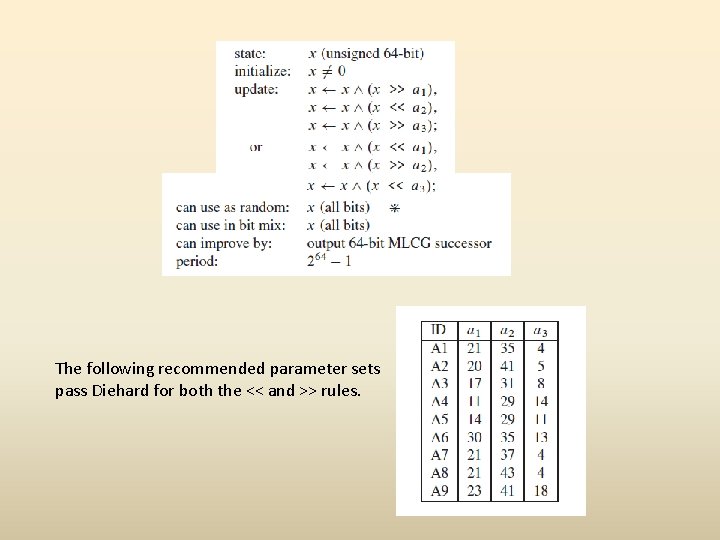
The following recommended parameter sets pass Diehard for both the << and >> rules.
• Here is a very brief outline of theory behind these generators: Consider the 64 bits of the integer as components in a vector of length 64, in a linear space where addition and multiplication are done modulo 2. Noting that XOR (^) is the same as addition, each of the three lines in the updating can be written as the action of a 64 x 64 matrix on a vector, where the matrix is all zeros except for ones on the diagonal, and on exactly one super- or subdiagonal (corresponding to << or >>). Denote this matrix as Sk, where k is the shift argument (positive for left-shift, say, and negative for right-shift). Then, one full step of updating (three lines of the updating rule, above) corresponds to multiplication by the matrix T = Sk 3 Sk 2 Sk 1. • One next needs to find triples of integers (k 1; k 2; k 3), for example (21; -35; 4), that give the full M = 264 - 1 period. Necessary and sufficient conditions are that TM = 1 (the identity matrix) and that TN ≠ 1 for these seven values of N: M / 6700417, M / 65537, M / 641, M / 257, M / 17, M / 5, and M / 3, that is, M divided by each of its seven distinct prime factors. One can find full-period triples (k 1; k 2; k 3) by exhaustive search, at a reasonable cost.
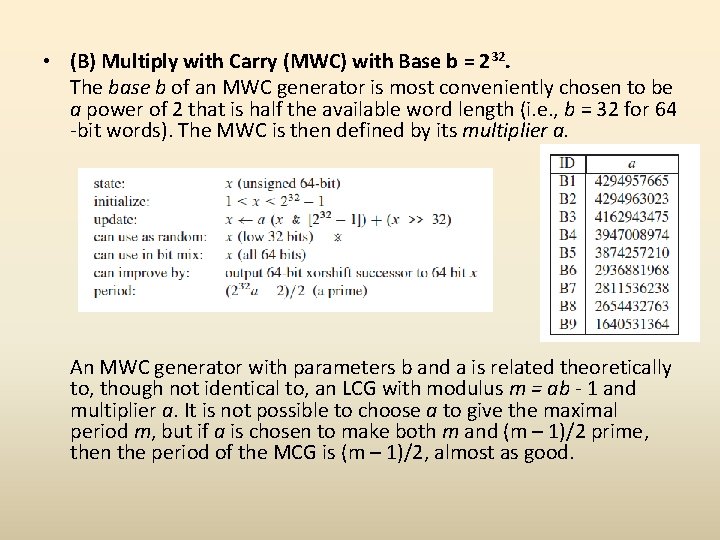
• (B) Multiply with Carry (MWC) with Base b = 232. The base b of an MWC generator is most conveniently chosen to be a power of 2 that is half the available word length (i. e. , b = 32 for 64 -bit words). The MWC is then defined by its multiplier a. An MWC generator with parameters b and a is related theoretically to, though not identical to, an LCG with modulus m = ab - 1 and multiplier a. It is not possible to choose a to give the maximal period m, but if a is chosen to make both m and (m – 1)/2 prime, then the period of the MCG is (m – 1)/2, almost as good.
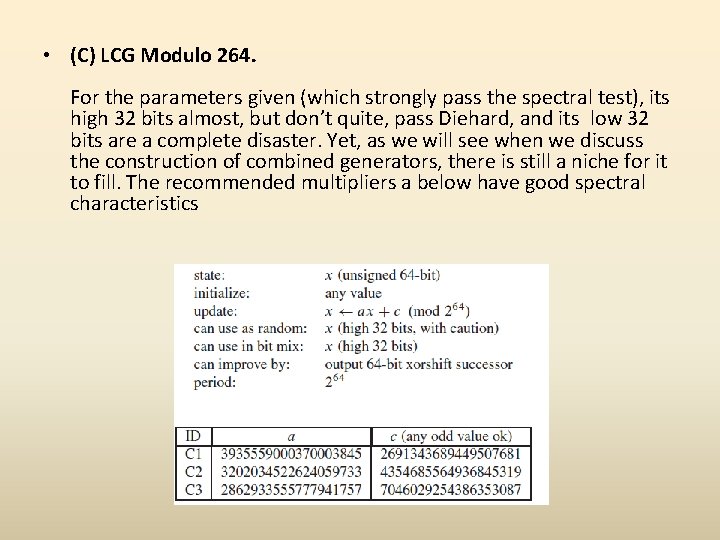
• (C) LCG Modulo 264. For the parameters given (which strongly pass the spectral test), its high 32 bits almost, but don’t quite, pass Diehard, and its low 32 bits are a complete disaster. Yet, as we will see when we discuss the construction of combined generators, there is still a niche for it to fill. The recommended multipliers a below have good spectral characteristics
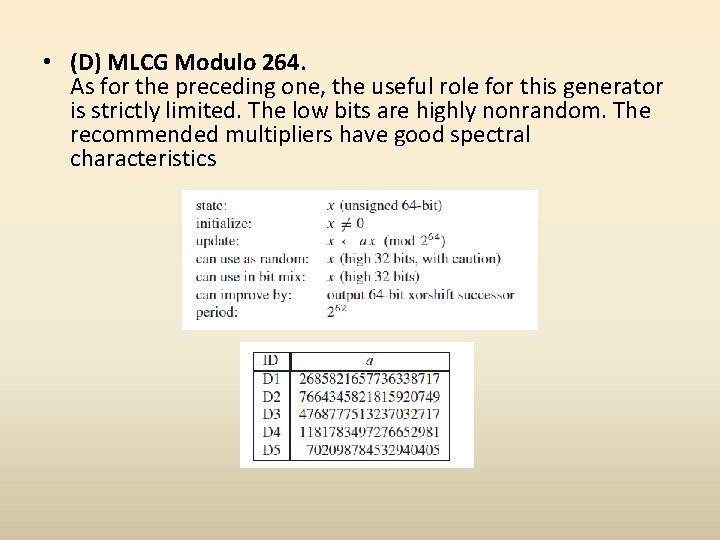
• (D) MLCG Modulo 264. As for the preceding one, the useful role for this generator is strictly limited. The low bits are highly nonrandom. The recommended multipliers have good spectral characteristics
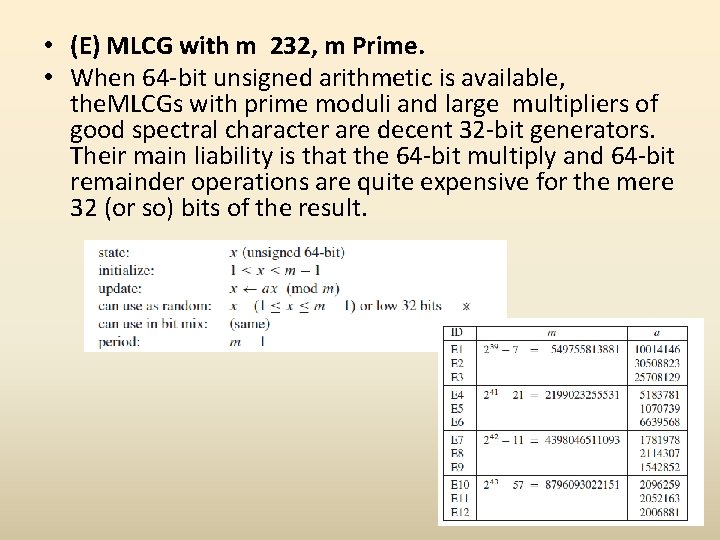
• (E) MLCG with m 232, m Prime. • When 64 -bit unsigned arithmetic is available, the. MLCGs with prime moduli and large multipliers of good spectral character are decent 32 -bit generators. Their main liability is that the 64 -bit multiply and 64 -bit remainder operations are quite expensive for the mere 32 (or so) bits of the result.
• How to Construct Combined Generators • The methods being combined should be independent of one another. They must share no state (although their initializations are allowed to derive from some convenient common seed). They should have different, incommensurate, periods. And, ideally, they should “look like” each other algorithmically as little as possible. This latter criterion is where some art necessarily enters. The output of the combination generator should in no way perturb the independent evolution of the individual methods, nor should the operations effecting combination have any side effects. The methods should be combined by binary operations whose output is no less random than one input if the other input is held fixed. For 32 - or 64 -bit unsigned arithmetic, this in practice means that only the + and ^ operators can be used. As an example of a forbidden operator, consider multiplication: If one operand is a power of 2, then the product will end in trailing zeros, no matter how random is the other operand. All bit positions in the combined output should depend on high-quality bits from at least two methods, and may also depend on lower-quality bits from additional methods. In the tables above, the bits labeled “can use as random” are considered high quality; those labeled “can use in bit mix” are considered low quality, unless they also pass a statistical suite such as Diehard. • • •
• There is one further trick at our disposal, the idea of using a method as a successor relation instead of as a generator in its own right. Each of the methods described above is a mapping from some 64 bit state xi to a unique successor state xi+1. For a method to pass a good statistical test suite, it must have no detectable correlations between a state and its successor. If, in addition, the method has period 264 or 264 - 1, then all values (except possibly zero) occur exactly once as successor states. • Suppose we take the output of a generator, say C 1 above, with period 264, and run it through generator A 6, whose period is 264 - 1, as a successor relation. This is conveniently denoted by “A 6(C 1), ” which we will call a composed generator. • The composed generator A 6(C 1) has the period of C 1, not, unfortunately, the product of the two periods. But its random mapping of C 1’s output values effectively fixes C 1’s problems with short-period low bits. And, A 6(C 1) will also fix A 6’s weakness that a bit depends only on a few bits of the previous state. We will thus consider a carefully constructed composed generator as being a combined generator, on a par with direct combining via + or ^.
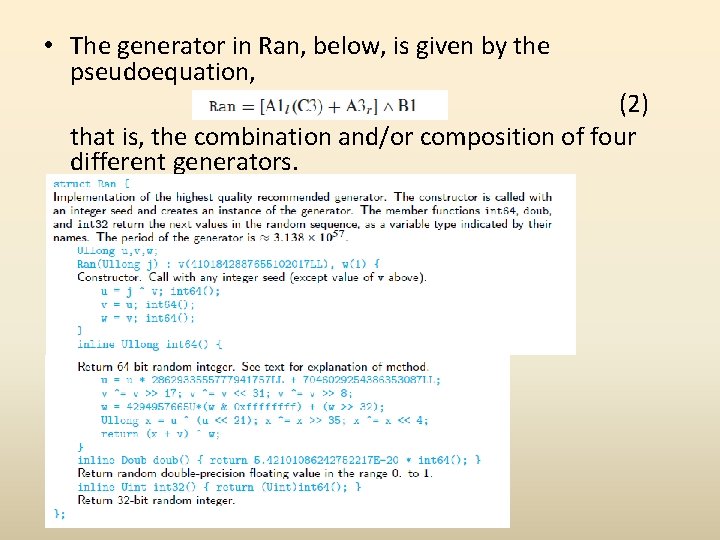
• The generator in Ran, below, is given by the pseudoequation, (2) that is, the combination and/or composition of four different generators.
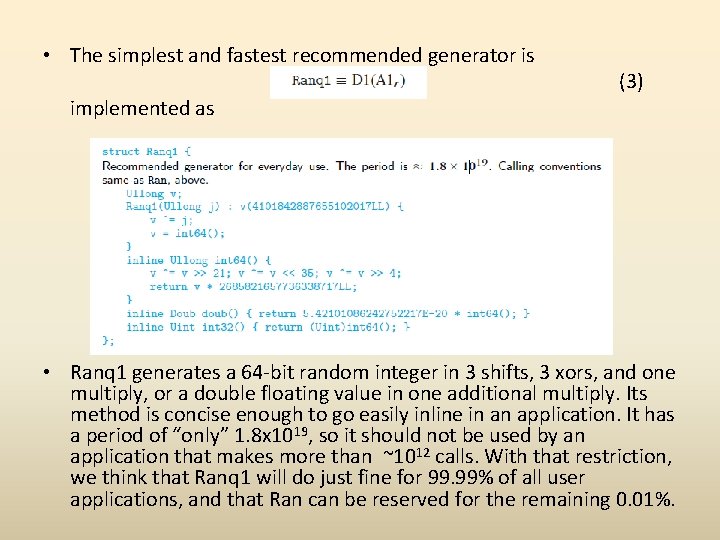
• The simplest and fastest recommended generator is implemented as (3) • Ranq 1 generates a 64 -bit random integer in 3 shifts, 3 xors, and one multiply, or a double floating value in one additional multiply. Its method is concise enough to go easily inline in an application. It has a period of “only” 1. 8 x 10¹⁹, so it should not be used by an application that makes more than ~1012 calls. With that restriction, we think that Ranq 1 will do just fine for 99. 99% of all user applications, and that Ran can be reserved for the remaining 0. 01%.
• The greatest lurking danger for a user today is that many out-of-date and inferior methods remain in general use. Here are some traps to watch for: • Never use a generator principally based on a linear congruential generator (LCG) or a multiplicative LCG (MLCG). • Never use a generator with a period less than ~264 ≈ 2 x 10¹⁹, or any generator whose period is undisclosed. • Never use a generator that warns against using its low-order bits as being completely random. That was good advice once, but it now indicates an obsolete algorithm (usually a LCG). • Never use the built-in generators in the C and C++ languages, especially rand srand. These have no standard implementation and are often badly flawed. • If all scientific papers whose results are in doubt because of one or more of the above traps were to disappear from library shelves, there would be a gap on each shelf about as big as your fist.
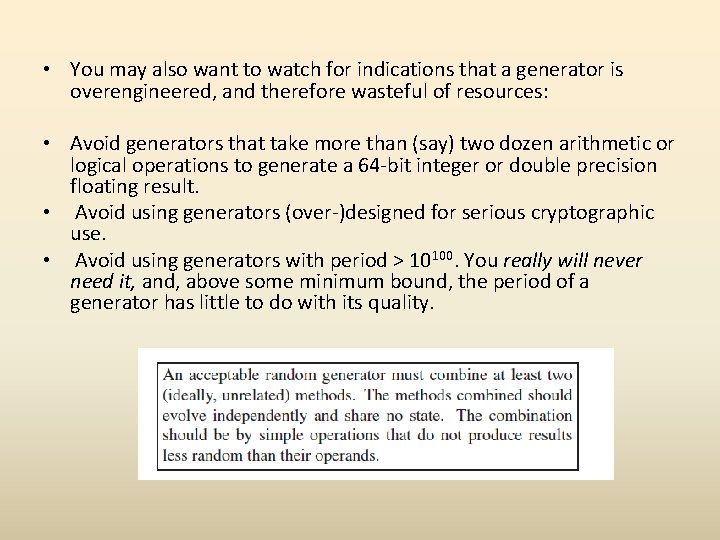
• You may also want to watch for indications that a generator is overengineered, and therefore wasteful of resources: • Avoid generators that take more than (say) two dozen arithmetic or logical operations to generate a 64 -bit integer or double precision floating result. • Avoid using generators (over-)designed for serious cryptographic use. • Avoid using generators with period > 10100. You really will never need it, and, above some minimum bound, the period of a generator has little to do with its quality.
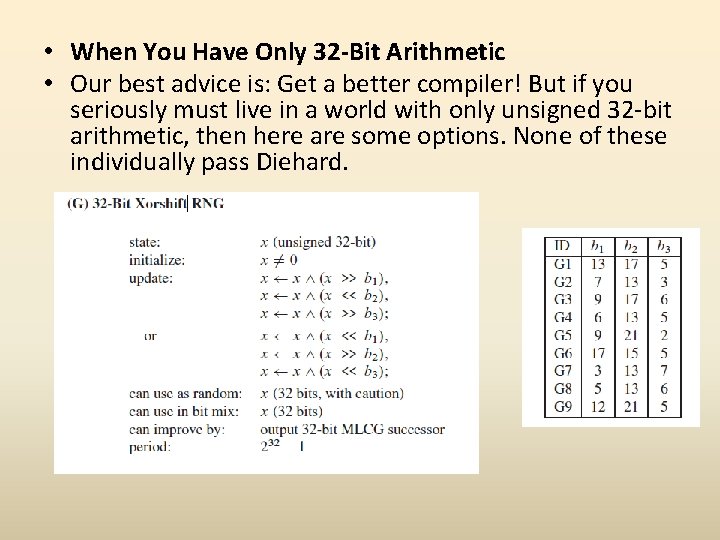
• When You Have Only 32 -Bit Arithmetic • Our best advice is: Get a better compiler! But if you seriously must live in a world with only unsigned 32 -bit arithmetic, then here are some options. None of these individually pass Diehard.
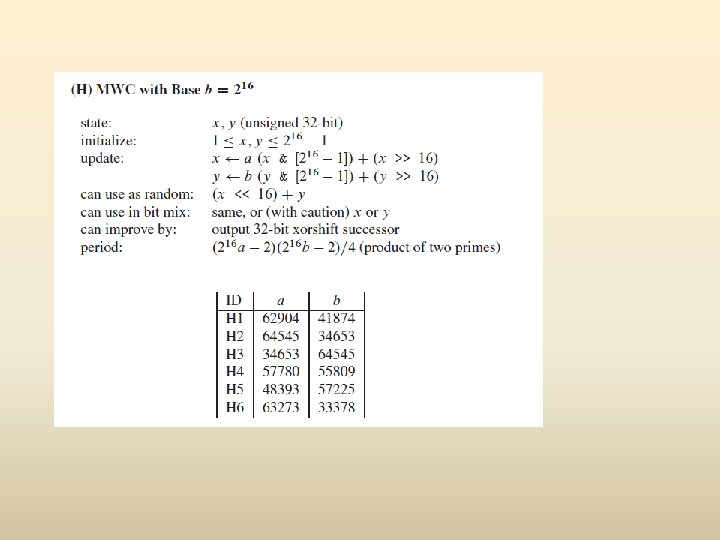
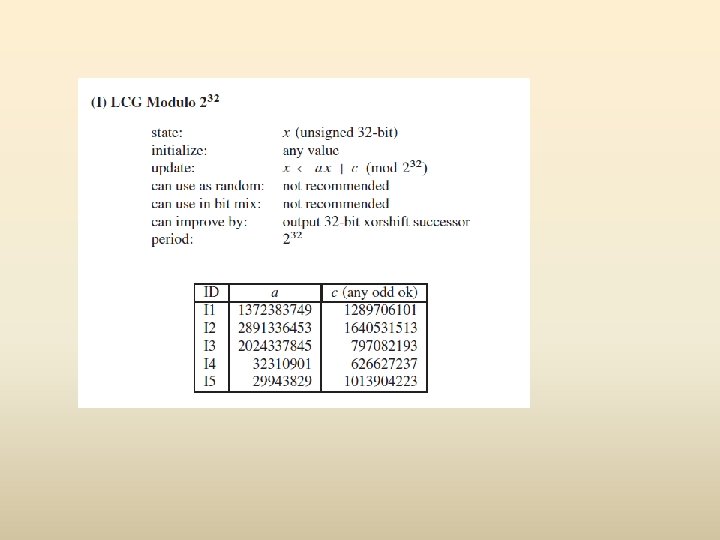
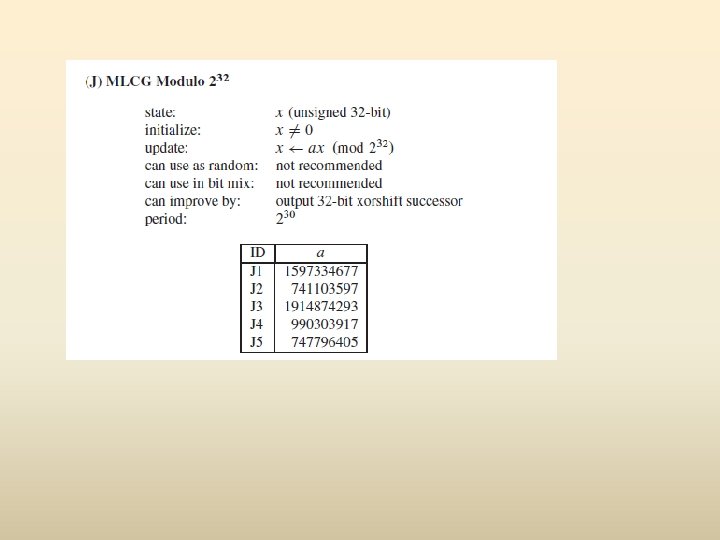
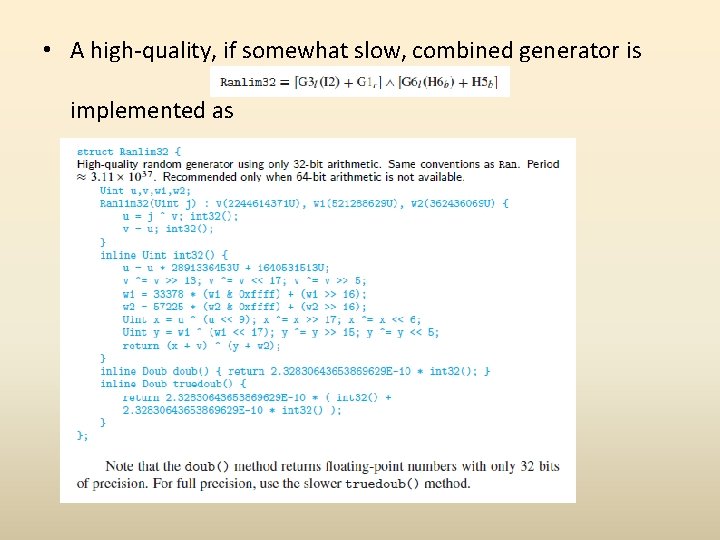
• A high-quality, if somewhat slow, combined generator is implemented as
![Recommended literature • [1] Numerical recipes C++ https: //drive. google. com/open? id=0 B 6](http://slidetodoc.com/presentation_image_h2/718b62720d5f391c4720aedc68167e0f/image-23.jpg "Recommended literature • [1] Numerical recipes C++ https: //drive. google. com/open? id=0 B 6")
Recommended literature • [1] Numerical recipes C++ https: //drive. google. com/open? id=0 B 6 ce. AAm x-Kb 9 c 056 YS 1 ke. Vl. BVFE • [2] A statistical test suite for random and pseudorandom number generators for cryptographic applications. http: //nvlpubs. nist. gov/nistpubs/Legacy/SP/ni stspecialpublication 800 -22 r 1 a. pdf
- Slides: 23