
Lecture 1 Problem From an E coli cell
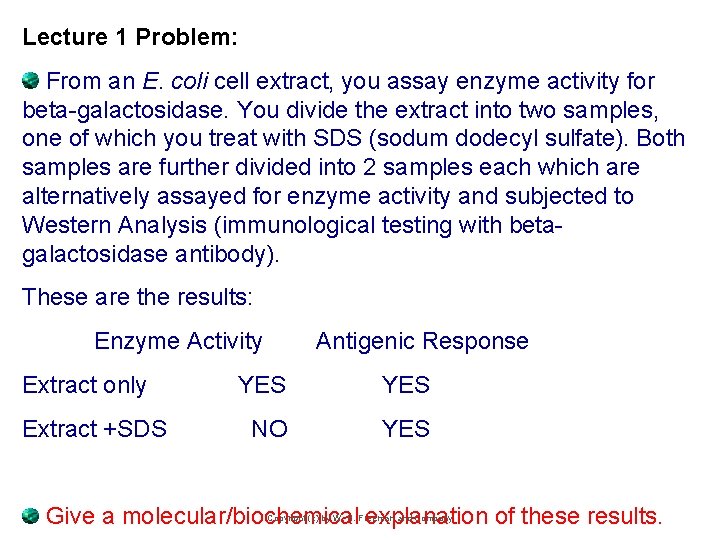
Lecture 1 Problem: From an E. coli cell extract, you assay enzyme activity for beta-galactosidase. You divide the extract into two samples, one of which you treat with SDS (sodum dodecyl sulfate). Both samples are further divided into 2 samples each which are alternatively assayed for enzyme activity and subjected to Western Analysis (immunological testing with betagalactosidase antibody). These are the results: Enzyme Activity Extract only Extract +SDS Antigenic Response YES NO YES Give a molecular/biochemical explanation of these results. Copyright (c) by W. H. Freeman and Company
Lecture 2 DNA Structure and Replication Topics: Structure Synthesis DNA Sequencing & PCR Reading: Chapter 4: 101 -6; 131 -7 Chapter 9: 372 -5 Molecular Biology syllabus web site Copyright (c) by W. H. Freeman and Company
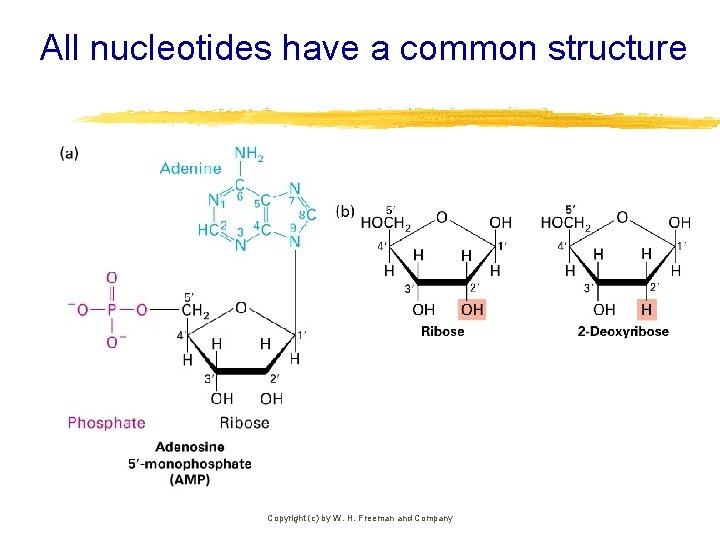
All nucleotides have a common structure Copyright (c) by W. H. Freeman and Company
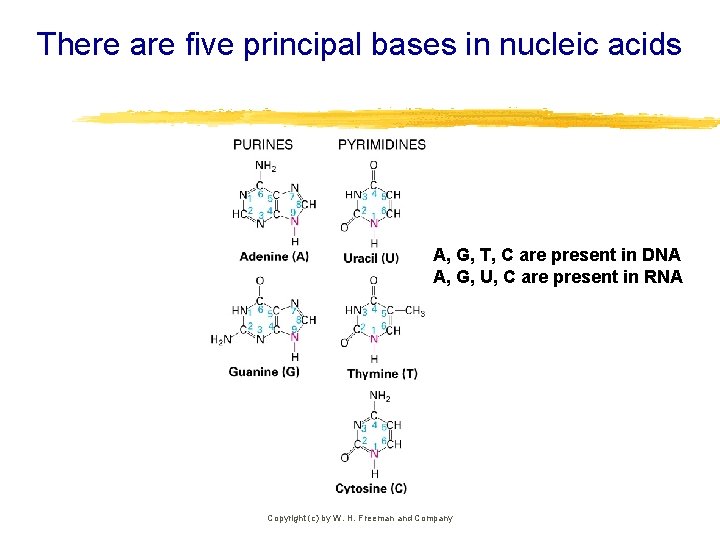
There are five principal bases in nucleic acids A, G, T, C are present in DNA A, G, U, C are present in RNA Copyright (c) by W. H. Freeman and Company
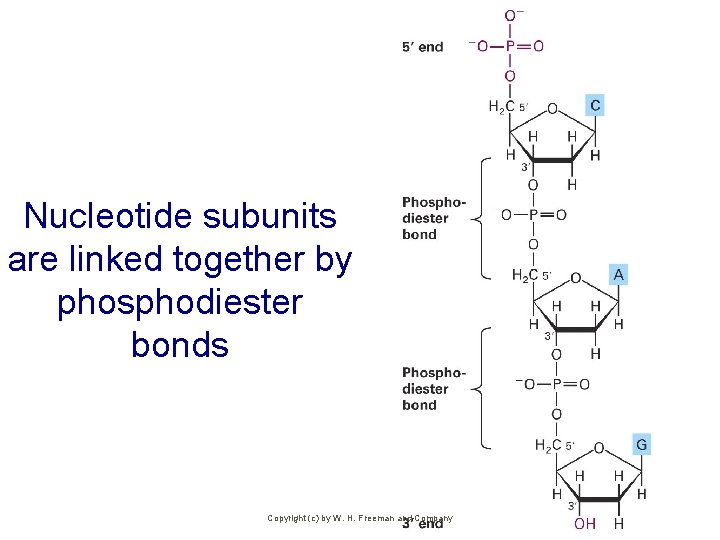
Nucleotide subunits are linked together by phosphodiester bonds Copyright (c) by W. H. Freeman and Company
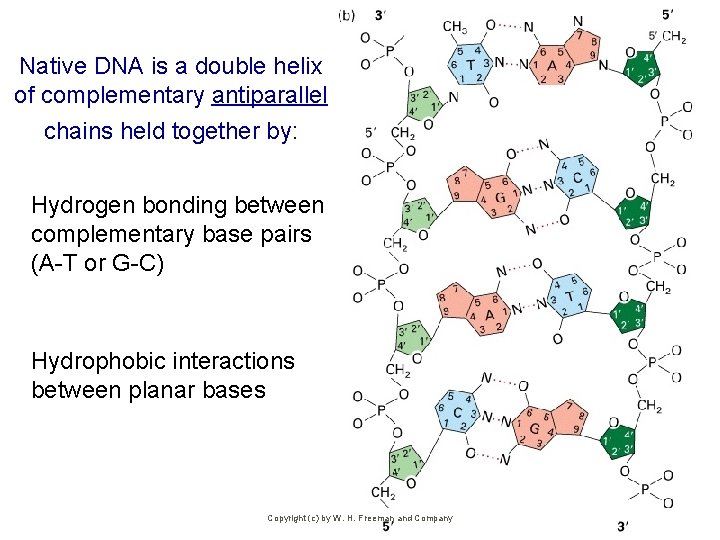
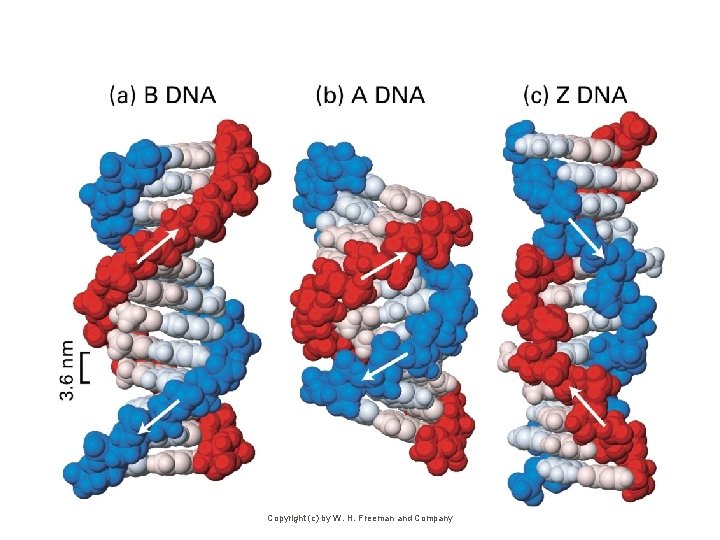
Native DNA is a double helix of complementary antiparallel chains held together by: Hydrogen bonding between complementary base pairs (A-T or G-C) Hydrophobic interactions between planar bases Copyright (c) by W. H. Freeman and Company
Forces that maintain DNA as a double strand…. H-bonding Hydrophobic interactions (cooperative base stacking) are destroyed by formamide, high p. H (Na. OH), high temperature Copyright (c) by W. H. Freeman and Company
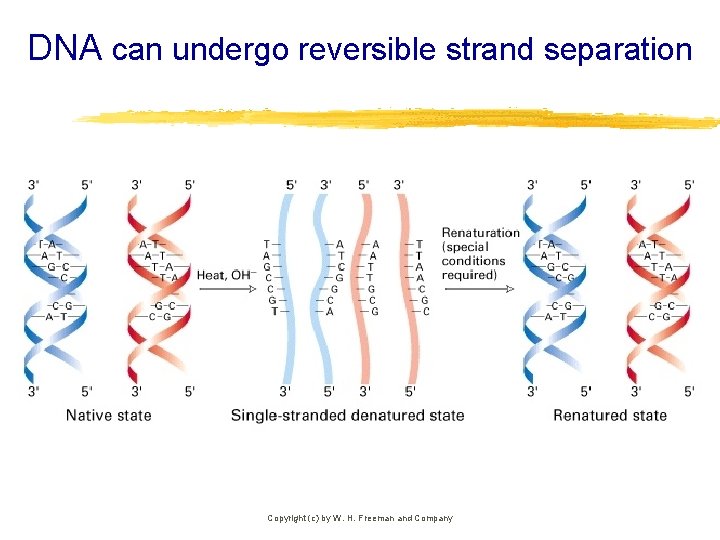
DNA can undergo reversible strand separation Copyright (c) by W. H. Freeman and Company
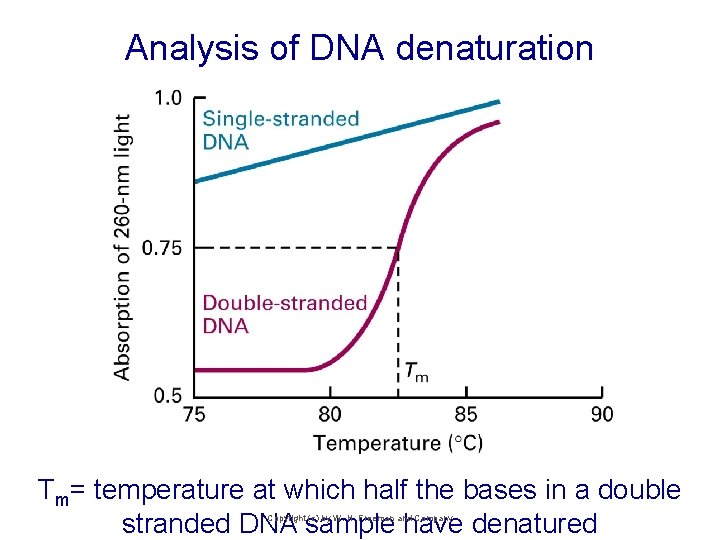
Analysis of DNA denaturation Tm= temperature at which half the bases in a double stranded DNA sample have denatured Copyright (c) by W. H. Freeman and Company
Copyright (c) by W. H. Freeman and Company
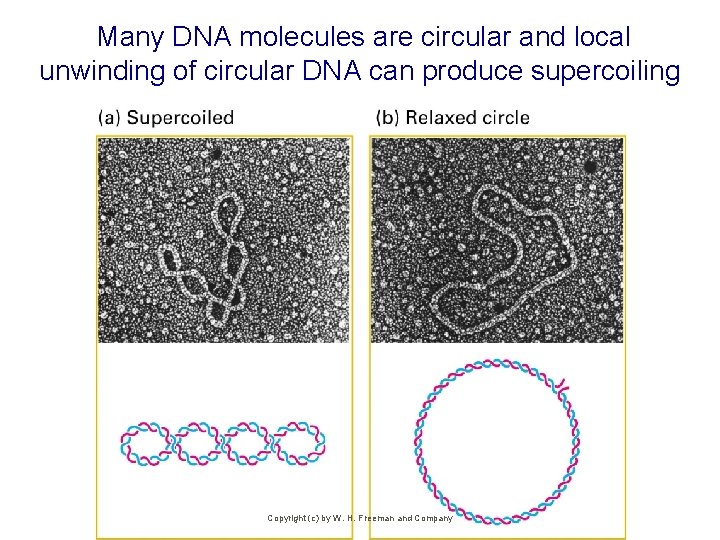
Many DNA molecules are circular and local unwinding of circular DNA can produce supercoiling supercoiled relaxed Copyright (c) by W. H. Freeman and Company
DNA Synthesis 1. 2. 3. 4. 5. Requirements Enzyme: DNA Polymerase DNA Template 3’ OH (primer of DNA or RNA) Deoxynucleoside triphosphates: d. ATP, d. GTP, d. CTP, d. TTP Synthesis is 5’ to 3’ Copyright (c) by W. H. Freeman and Company
DNA Synthesis Copyright (c) by W. H. Freeman and Company
Features of DNA Polymerases activity polymerase Copyright (c) by W. H. Freeman and Company function synthesis
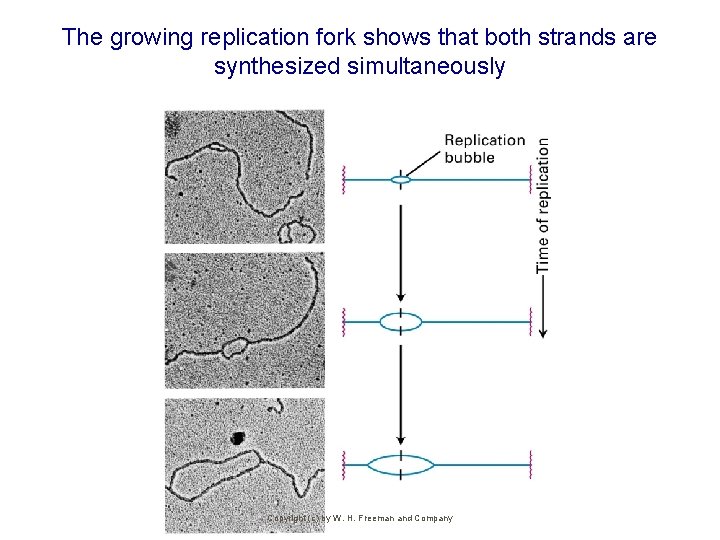
The growing replication fork shows that both strands are synthesized simultaneously Copyright (c) by W. H. Freeman and Company
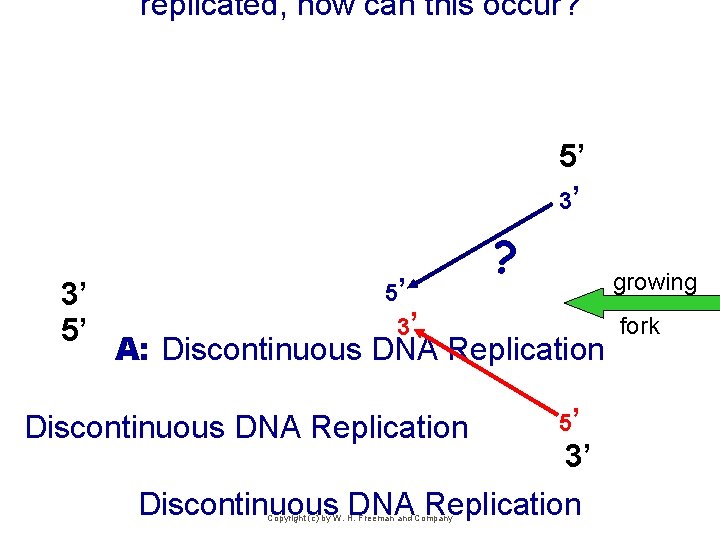
replicated, how can this occur? 5’ 3’ 3’ 5’ 5’ 3’ ? growing A: Discontinuous DNA Replication 5’ 3’ Discontinuous DNA Replication Copyright (c) by W. H. Freeman and Company fork
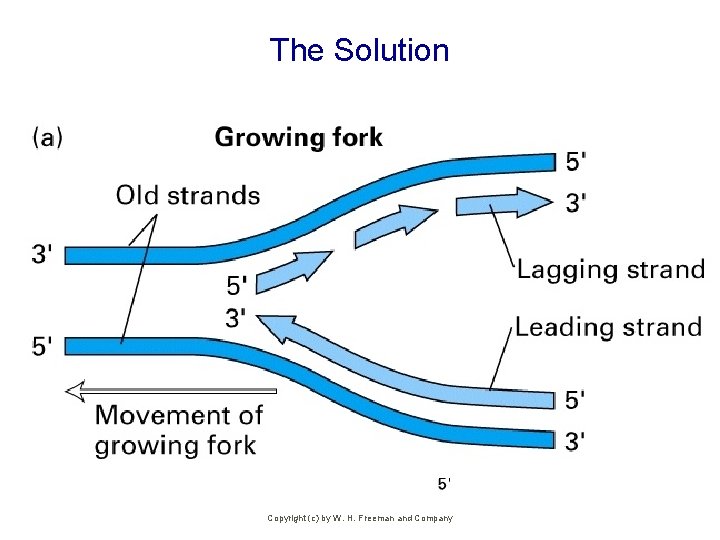
The Solution Copyright (c) by W. H. Freeman and Company
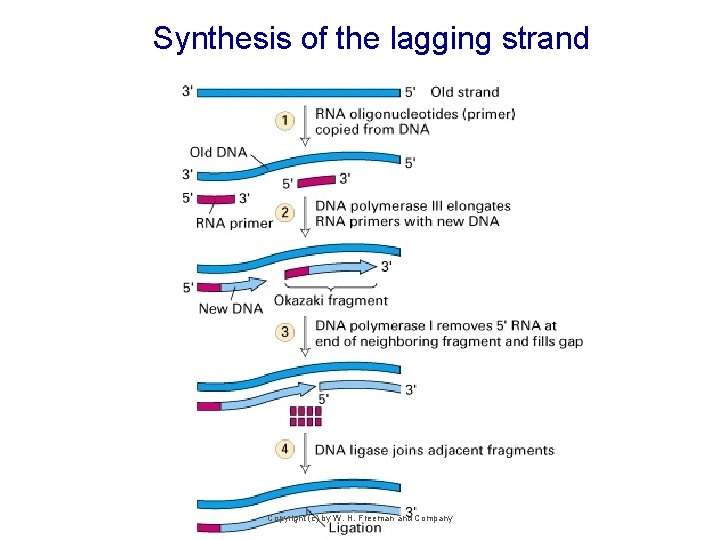
Synthesis of the lagging strand Copyright (c) by W. H. Freeman and Company
DNA Replication Animation Copyright (c) by W. H. Freeman and Company
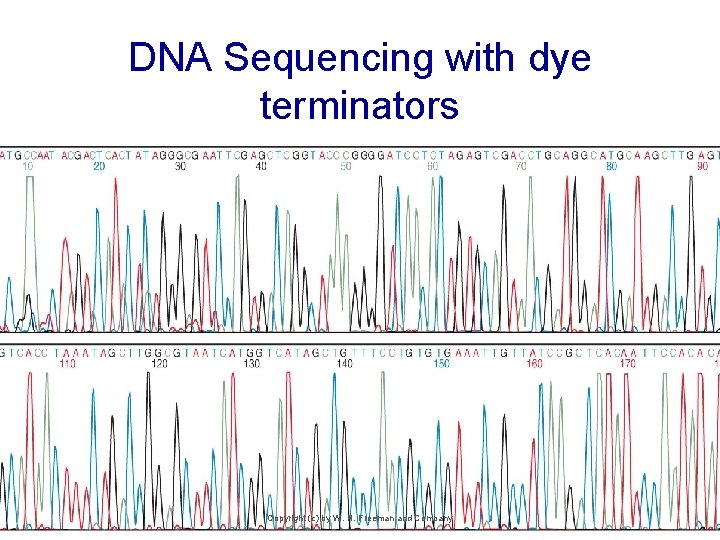
DNA Sequencing with dye terminators Copyright (c) by W. H. Freeman and Company
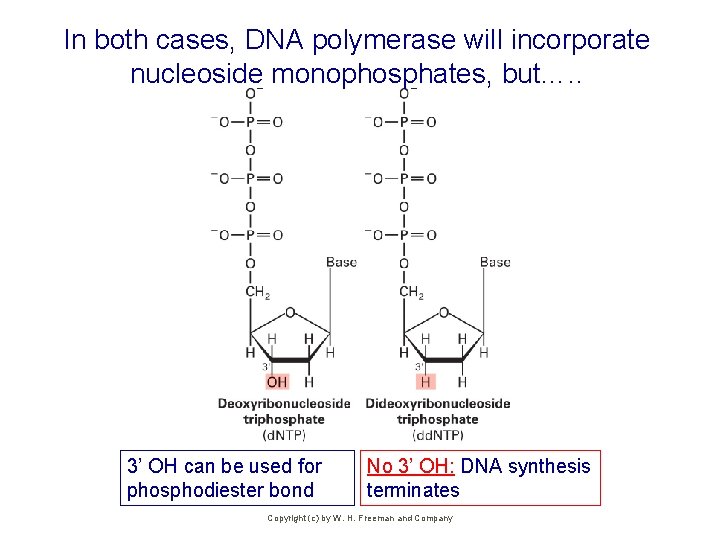
In both cases, DNA polymerase will incorporate nucleoside monophosphates, but…. . 3’ OH can be used for phosphodiester bond No 3’ OH: DNA synthesis terminates Copyright (c) by W. H. Freeman and Company
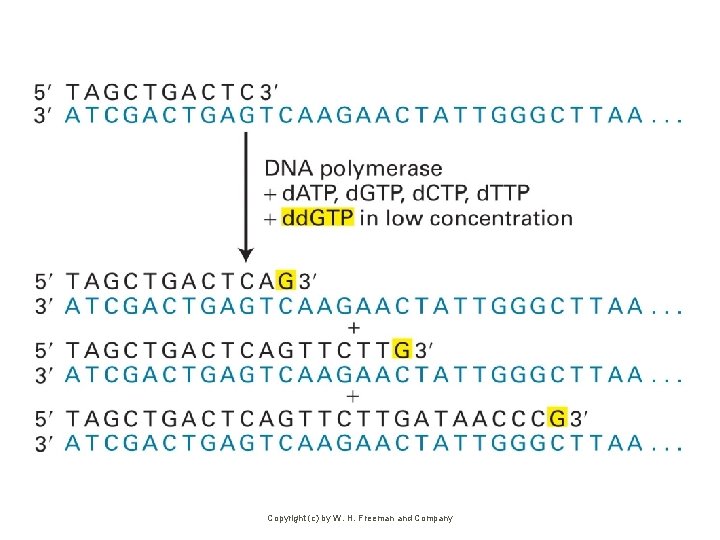
Copyright (c) by W. H. Freeman and Company
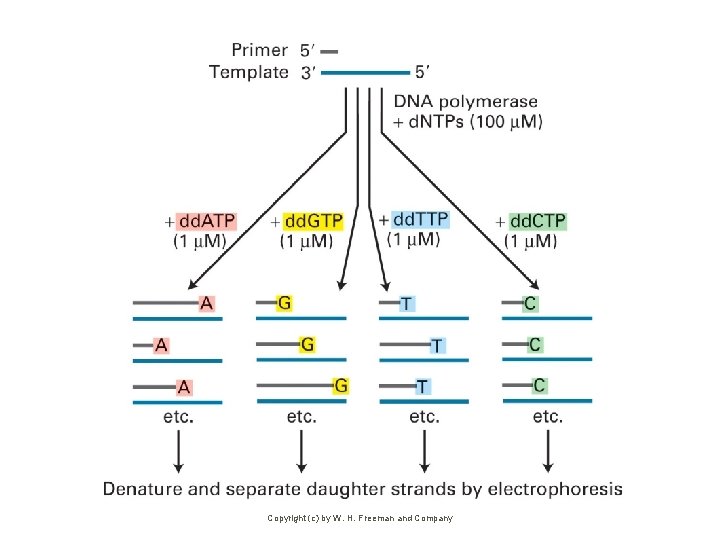
Copyright (c) by W. H. Freeman and Company
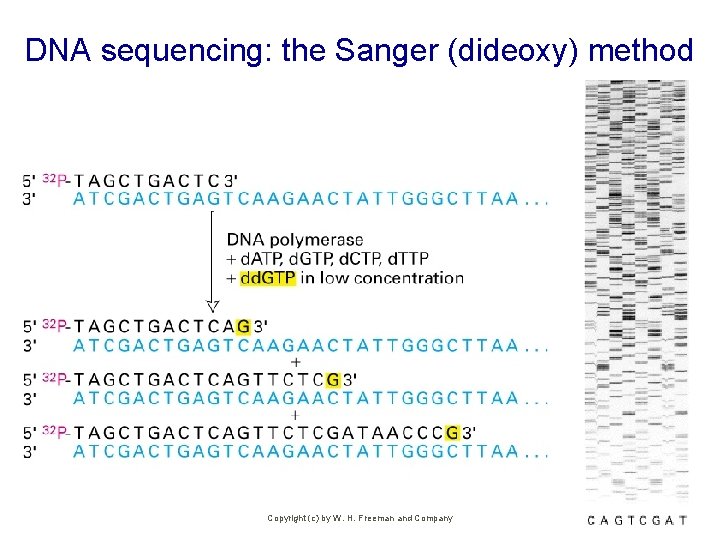
DNA sequencing: the Sanger (dideoxy) method Copyright (c) by W. H. Freeman and Company
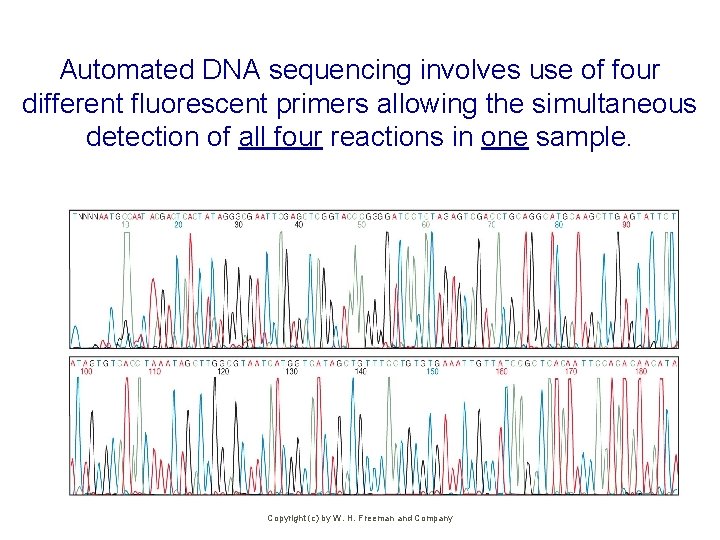
Automated DNA sequencing involves use of four different fluorescent primers allowing the simultaneous detection of all four reactions in one sample. Copyright (c) by W. H. Freeman and Company
DNA Sequencing Animation Copyright (c) by W. H. Freeman and Company
Polymerase Chain Reaction (PCR) Copyright (c) by W. H. Freeman and Company
PCR Animation Copyright (c) by W. H. Freeman and Company
- Slides: 28