
Lecture 1 Part 1 Didactics and Pedagogy 1

- Slides: 14
Lecture 1 (Part 1) Didactics and Pedagogy
1. Didactics �The term 'didactic‘, etymologically adjective, has long characterized all "that is specific to teaching". �It originates from the Greek verb Didaskein, which means to teach, to educate.
1. Didactics �However, the term can also mean: having the ability to teach, the content taught, teaching aids, including methods and media, the school and the classroom where learning takes place, and learning as the main activity of students.
1. Didactics �One of the important landmarks here was the publication of John Amos Comenius’ book The Great Didactics [Didactica Magna] (first published in Czech in 1648, in Latin in 1657, and in English in 1896).
1. Didactics �Comenius is a Czech educator of the seventeenth century who was the first to develop language textbooks; his goal was to structure explicitly the teaching of languages. �Today, more than 360 years after the publication of The Great Didactics the noun, didactics, has two meanings:
1. Didactics � 1. In its common meaning, the terms "language didactics", "didactics of mathematics", "didactics of mechanics" etc. , refer to the use of teaching techniques and methods specific to each discipline. The techniques used are, of course, different depending on subjectmatter, since they depend directly on the content to be taught.
1. Didactics � For example, language teaching uses audio-oral techniques, teaching the physical sciences requires the experimental approach, teaching economics focuses on case studies.
1. Didactics �The selected teaching techniques, their adaptation to the characteristics of the subject-matter, are the didactics of the discipline (i. e subject-matter); so the term is not specific only to languages.
1. Didactics � 2. In its modern sense, didactics studies the interactions that can establish themselves in a teaching/learning situation between an identified content, a provider of this knowledge and a receiver.
1. Didactics �The concept of language didactics has particularly been used in the seventies, since the Dictionnaire de Didactique des Langues got published by Robert Galisson and Daniel Coste in 1976, and this helped to spread the term "language didactics" in France and in some francophone countries.
1. Didactics �Language didactics is a research discipline that analyzes content (knowledge, skills, . . . ) and its concomitant learning processes as object of teaching. �It consists of all the procedures used to select, analyze, organize knowledge (content) and adapt it to the type of students i. e the conditions for its selection.
1. Didactics � As a discipline, language didactics is not only about knowledge acquisition but also the acquisition of a 'know-how': the expertise or the ability to communicate with others i. e. to understand be understood. � Since teaching is to mobilize means to ensure the transmission and appropriation of content, teaching results from the interactive combination of didactics and pedagogy.
2. Pedagogy: Art, science or craft? �Of Greek origin, the word 'pedagogy' is said to have appeared in 1485. �Broadly, just like didactics, while there are many who argue that pedagogy can be approached as a science (see, for example, the discussions in Kornbeck and Jensen 2009), others look at it more as an art or craft.
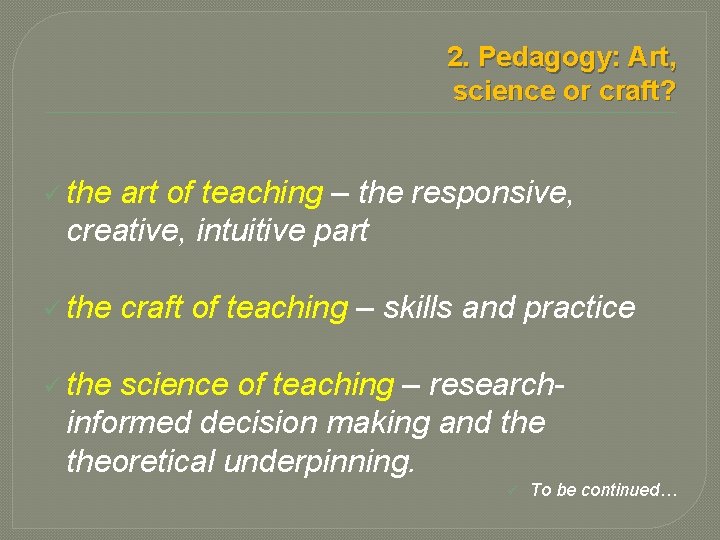
2. Pedagogy: Art, science or craft? ü the art of teaching – the responsive, creative, intuitive part ü the craft of teaching – skills and practice ü the science of teaching – researchinformed decision making and theoretical underpinning. ü To be continued…