
Lecture 1 OUTLINE Important Quantities Semiconductor Fundamentals General
![Crystallographic Notation Miller Indices: Notation (hkl) {hkl} [hkl] Interpretation crystal plane equivalent planes crystal](https://slidetodoc.com/presentation_image/81c57947d14e172574f84cdc9a6fe1bf/image-10.jpg "Crystallographic Notation Miller Indices: Notation (hkl) {hkl} [hkl] Interpretation crystal plane equivalent planes crystal")
- Slides: 18
Lecture 1 OUTLINE • Important Quantities • Semiconductor Fundamentals – General material properties – Crystal structure – Crystallographic notation – Electrons and holes Reading: Pierret 1. 1 -1. 2, 2. 1; Hu 1. 1 -1. 2
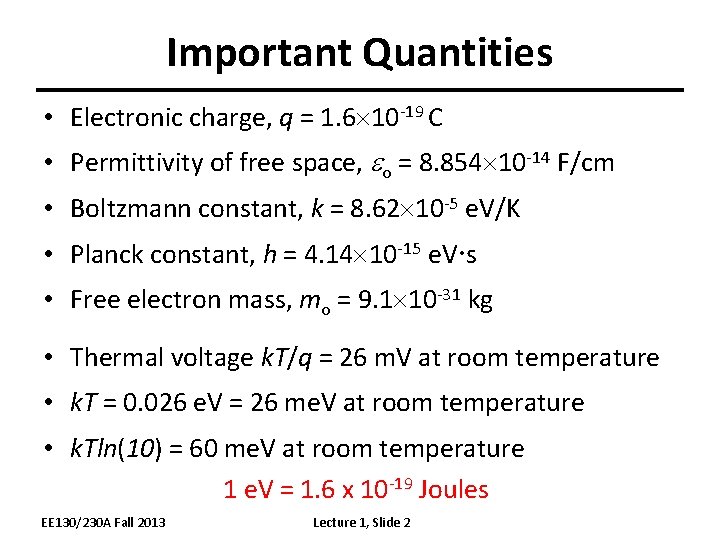
Important Quantities • Electronic charge, q = 1. 6 10 -19 C • Permittivity of free space, eo = 8. 854 10 -14 F/cm • Boltzmann constant, k = 8. 62 10 -5 e. V/K • Planck constant, h = 4. 14 10 -15 e. V s • Free electron mass, mo = 9. 1 10 -31 kg • Thermal voltage k. T/q = 26 m. V at room temperature • k. T = 0. 026 e. V = 26 me. V at room temperature • k. Tln(10) = 60 me. V at room temperature 1 e. V = 1. 6 x 10 -19 Joules EE 130/230 A Fall 2013 Lecture 1, Slide 2
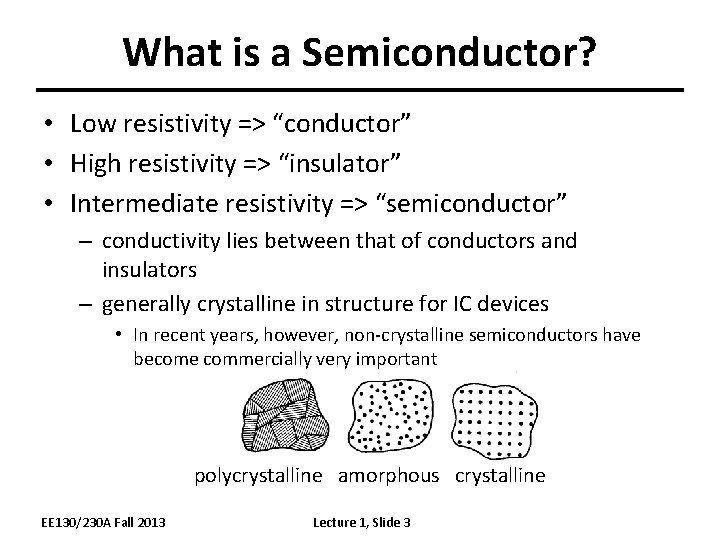
What is a Semiconductor? • Low resistivity => “conductor” • High resistivity => “insulator” • Intermediate resistivity => “semiconductor” – conductivity lies between that of conductors and insulators – generally crystalline in structure for IC devices • In recent years, however, non-crystalline semiconductors have become commercially very important polycrystalline amorphous crystalline EE 130/230 A Fall 2013 Lecture 1, Slide 3
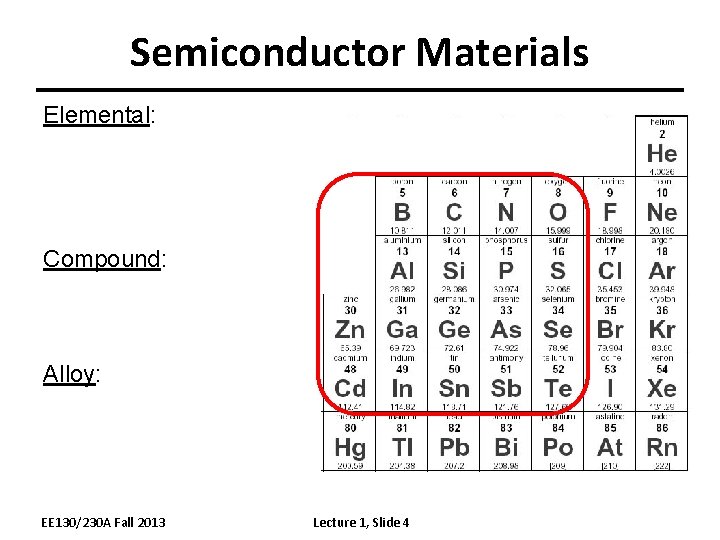
Semiconductor Materials Elemental: Compound: Alloy: EE 130/230 A Fall 2013 Lecture 1, Slide 4
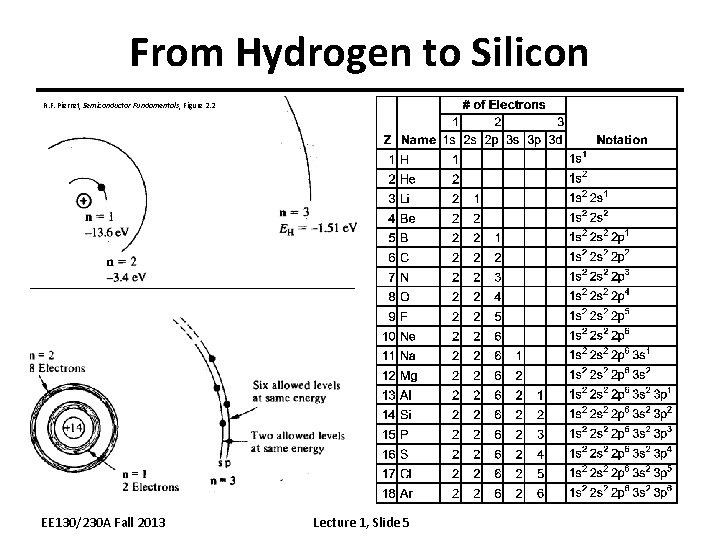
From Hydrogen to Silicon R. F. Pierret, Semiconductor Fundamentals, Figure 2. 2 EE 130/230 A Fall 2013 Lecture 1, Slide 5
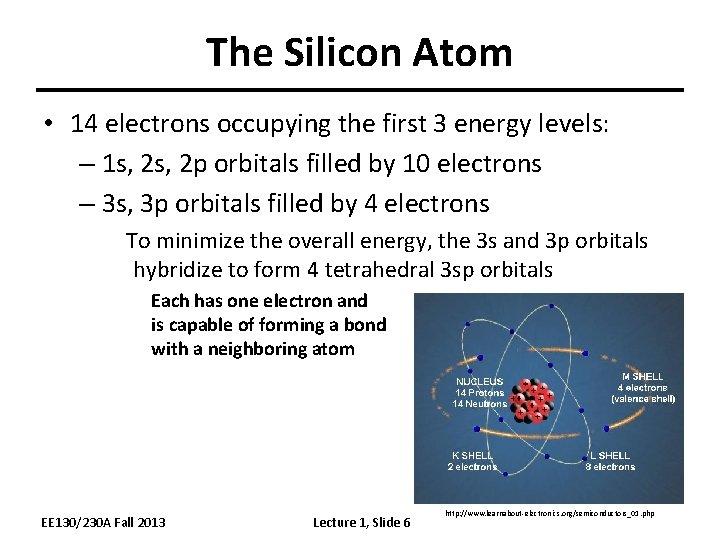
The Silicon Atom • 14 electrons occupying the first 3 energy levels: – 1 s, 2 p orbitals filled by 10 electrons – 3 s, 3 p orbitals filled by 4 electrons To minimize the overall energy, the 3 s and 3 p orbitals hybridize to form 4 tetrahedral 3 sp orbitals Each has one electron and is capable of forming a bond with a neighboring atom EE 130/230 A Fall 2013 Lecture 1, Slide 6 http: //www. learnabout-electronics. org/semiconductors_01. php
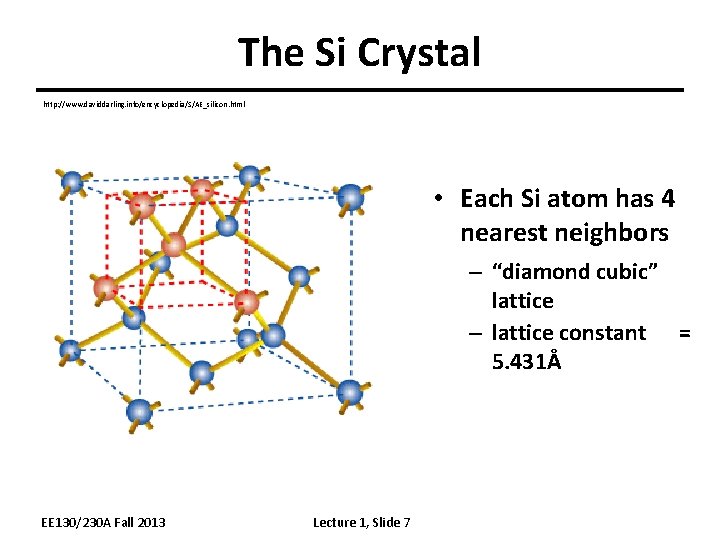
The Si Crystal http: //www. daviddarling. info/encyclopedia/S/AE_silicon. html • Each Si atom has 4 nearest neighbors – “diamond cubic” lattice – lattice constant = 5. 431Å EE 130/230 A Fall 2013 Lecture 1, Slide 7
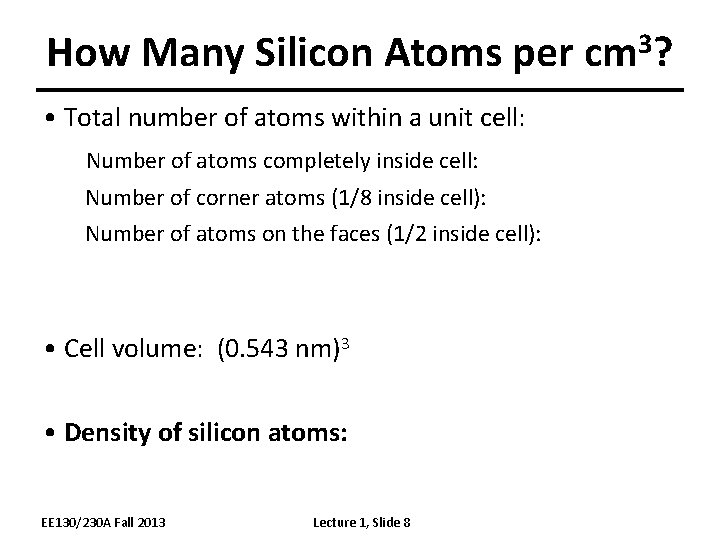
How Many Silicon Atoms per cm 3? • Total number of atoms within a unit cell: Number of atoms completely inside cell: Number of corner atoms (1/8 inside cell): Number of atoms on the faces (1/2 inside cell): • Cell volume: (0. 543 nm)3 • Density of silicon atoms: EE 130/230 A Fall 2013 Lecture 1, Slide 8
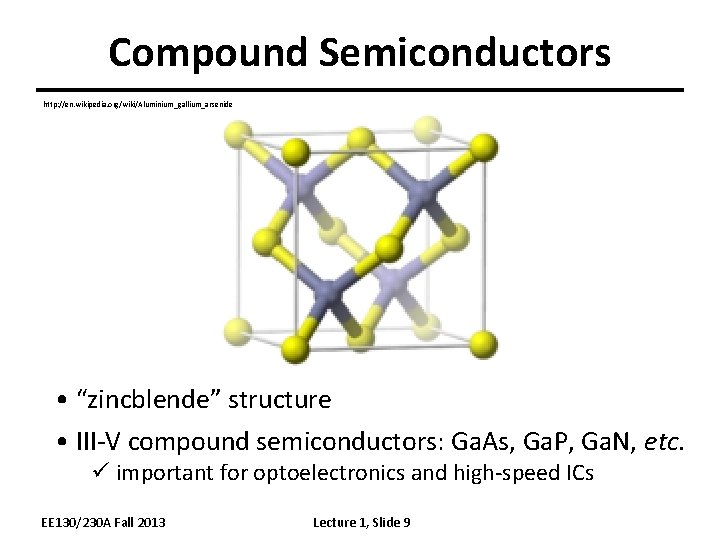
Compound Semiconductors http: //en. wikipedia. org/wiki/Aluminium_gallium_arsenide • “zincblende” structure • III-V compound semiconductors: Ga. As, Ga. P, Ga. N, etc. ü important for optoelectronics and high-speed ICs EE 130/230 A Fall 2013 Lecture 1, Slide 9
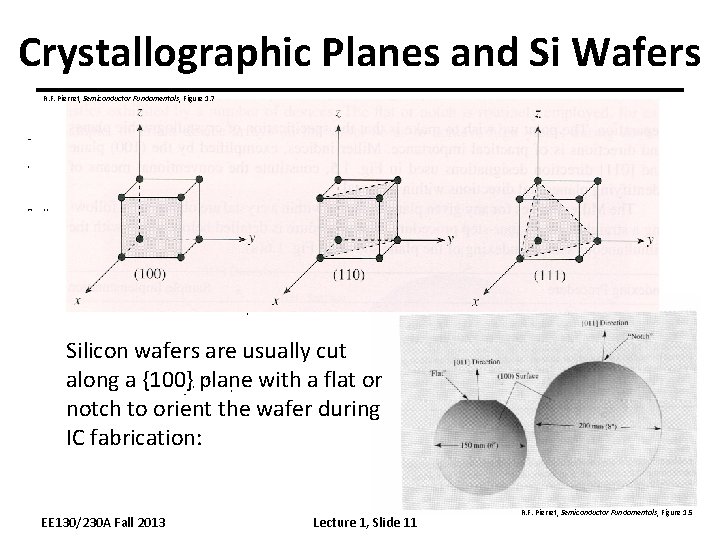
Crystallographic Notation Miller Indices: Notation (hkl) {hkl} [hkl] Interpretation crystal plane equivalent planes crystal direction <hkl> equivalent directions h: inverse x-intercept of plane k: inverse y-intercept of plane l: inverse z-intercept of plane (Intercept values are in multiples of the lattice constant; h, k and l are reduced to 3 integers having the same ratio. ) EE 130/230 A Fall 2013 Lecture 1, Slide 10
Crystallographic Planes and Si Wafers R. F. Pierret, Semiconductor Fundamentals, Figure 1. 7 Silicon wafers are usually cut along a {100} plane with a flat or notch to orient the wafer during IC fabrication: EE 130/230 A Fall 2013 Lecture 1, Slide 11 R. F. Pierret, Semiconductor Fundamentals, Figure 1. 5
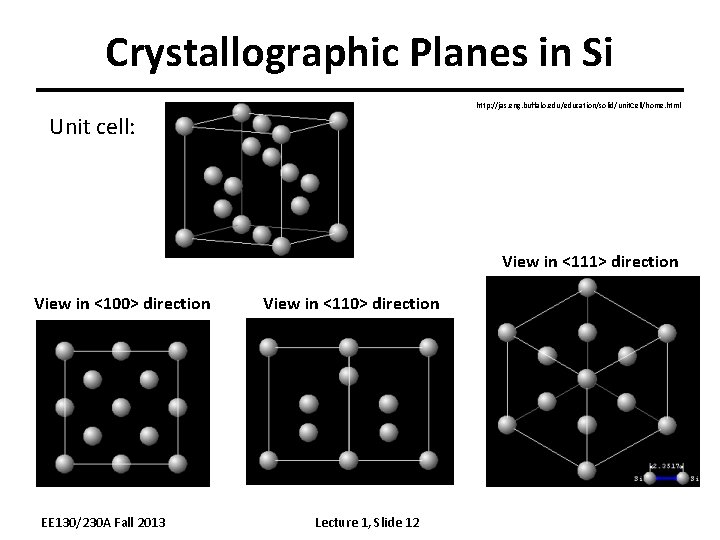
Crystallographic Planes in Si http: //jas. eng. buffalo. edu/education/solid/unit. Cell/home. html Unit cell: View in <111> direction View in <100> direction EE 130/230 A Fall 2013 View in <110> direction Lecture 1, Slide 12
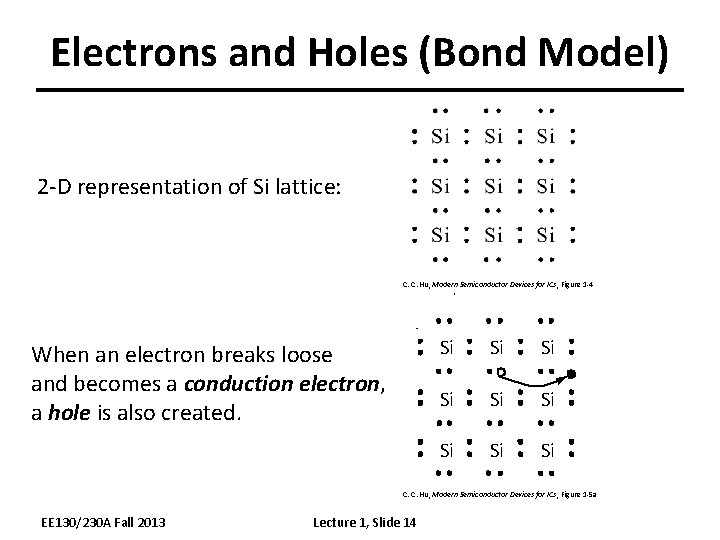
Electronic Properties of Si • Silicon is a semiconductor material. – Pure Si has relatively high electrical resistivity at room temp. • There are 2 types of mobile charge-carriers in Si: – Conduction electrons are negatively charged – Holes are positively charged • The concentration (#/cm 3) of conduction electrons & holes in a semiconductor can be changed: 1. by changing the temperature 2. by adding special impurity atoms ( dopants ) 3. by applying an electric field 4. by irradiation EE 130/230 A Fall 2013 Lecture 1, Slide 13
Electrons and Holes (Bond Model) 2 -D representation of Si lattice: C. C. Hu, Modern Semiconductor Devices for ICs, Figure 1 -4 When an electron breaks loose and becomes a conduction electron, a hole is also created. Si Si Si C. C. Hu, Modern Semiconductor Devices for ICs, Figure 1 -5 a EE 130/230 A Fall 2013 Lecture 1, Slide 14
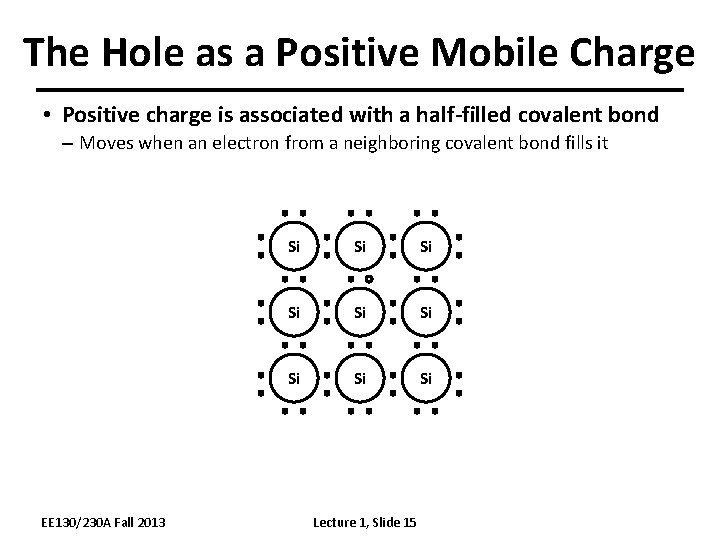
The Hole as a Positive Mobile Charge • Positive charge is associated with a half-filled covalent bond – Moves when an electron from a neighboring covalent bond fills it EE 130/230 A Fall 2013 Si Si Si Lecture 1, Slide 15
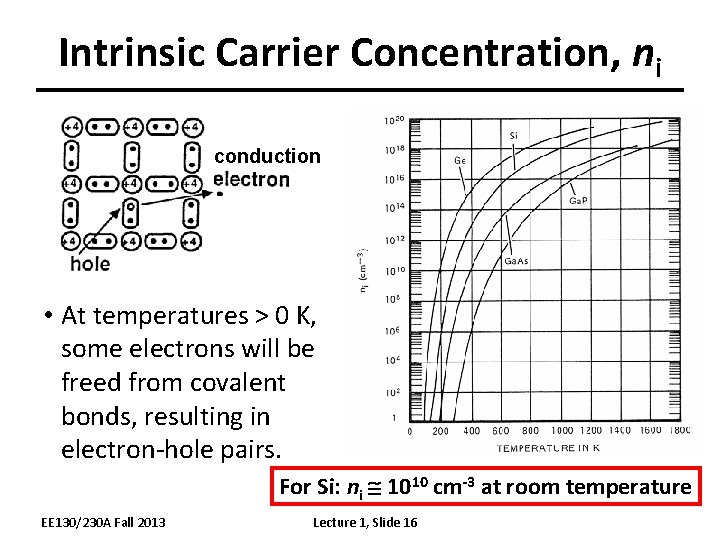
Intrinsic Carrier Concentration, ni conduction • At temperatures > 0 K, some electrons will be freed from covalent bonds, resulting in electron-hole pairs. For Si: ni 1010 cm-3 at room temperature EE 130/230 A Fall 2013 Lecture 1, Slide 16
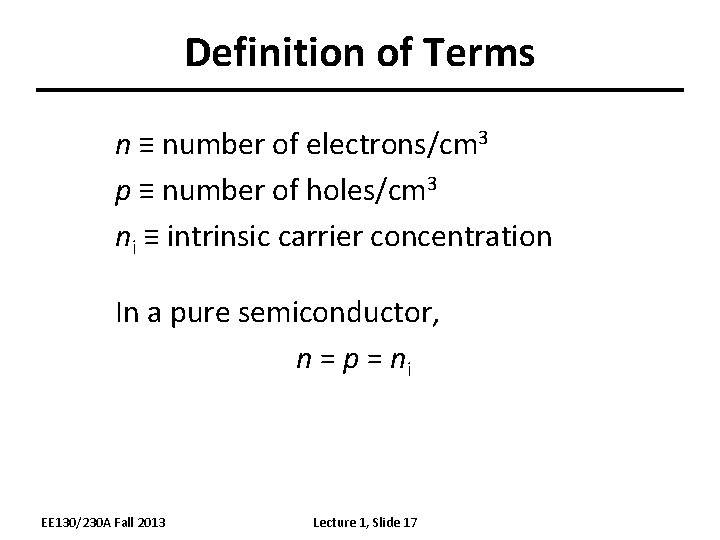
Definition of Terms n ≡ number of electrons/cm 3 p ≡ number of holes/cm 3 ni ≡ intrinsic carrier concentration In a pure semiconductor, n = p = ni EE 130/230 A Fall 2013 Lecture 1, Slide 17
Summary • Crystalline Si: – – – 4 valence electrons per atom diamond lattice (each atom has 4 nearest neighbors) atomic density = 5 x 10²² atoms/cm 3 intrinsic carrier concentration ni = 1010 cm-3 Miller indices are used to designate planes and directions within a crystalline lattice • In a pure Si crystal, conduction electrons and holes are formed in pairs. – Holes can be considered as positively charged mobile particles. – Both holes and electrons can conduct current. EE 130/230 A Fall 2013 Lecture 1, Slide 18