
Lecture 1 OUTLINE Basic Semiconductor Physics Semiconductors Intrinsic
Lecture 1 OUTLINE • Basic Semiconductor Physics – Semiconductors – Intrinsic (undoped) silicon – Doping – Carrier concentrations Reading: Chapter 2. 1 EE 105 Fall 2007 Lecture 1, Slide 1
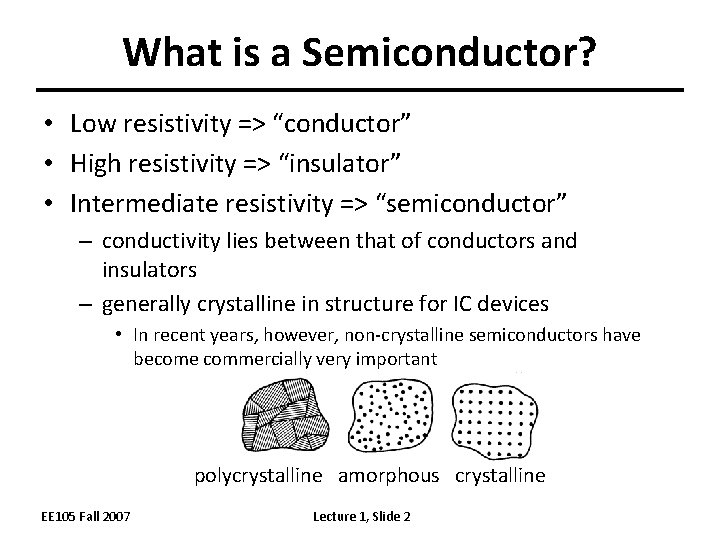
What is a Semiconductor? • Low resistivity => “conductor” • High resistivity => “insulator” • Intermediate resistivity => “semiconductor” – conductivity lies between that of conductors and insulators – generally crystalline in structure for IC devices • In recent years, however, non-crystalline semiconductors have become commercially very important polycrystalline amorphous crystalline EE 105 Fall 2007 Lecture 1, Slide 2
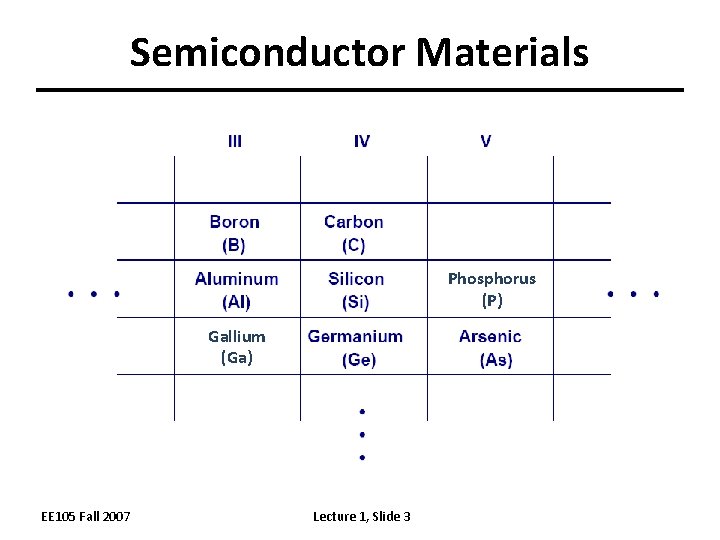
Semiconductor Materials Phosphorus (P) Gallium (Ga) EE 105 Fall 2007 Lecture 1, Slide 3
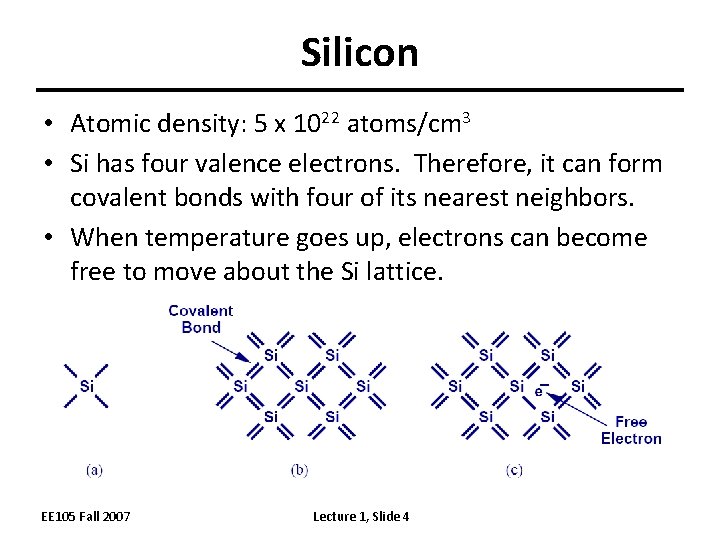
Silicon • Atomic density: 5 x 10²² atoms/cm 3 • Si has four valence electrons. Therefore, it can form covalent bonds with four of its nearest neighbors. • When temperature goes up, electrons can become free to move about the Si lattice. EE 105 Fall 2007 Lecture 1, Slide 4
Electronic Properties of Si Silicon is a semiconductor material. – Pure Si has a relatively high electrical resistivity at room temperature. There are 2 types of mobile charge-carriers in Si: – – Conduction electrons are negatively charged; Holes are positively charged. The concentration (#/cm 3) of conduction electrons & holes in a semiconductor can be modulated in several ways: 1. 2. 3. 4. EE 105 Fall 2007 by adding special impurity atoms ( dopants ) by applying an electric field by changing the temperature by irradiation Lecture 1, Slide 5

Electron-Hole Pair Generation • When a conduction electron is thermally generated, a “hole” is also generated. • A hole is associated with a positive charge, and is free to move about the Si lattice as well. EE 105 Fall 2007 Lecture 1, Slide 6
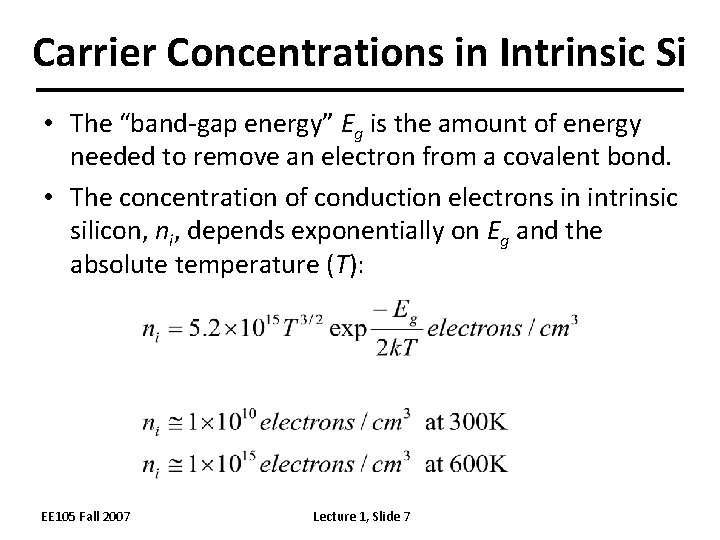
Carrier Concentrations in Intrinsic Si • The “band-gap energy” Eg is the amount of energy needed to remove an electron from a covalent bond. • The concentration of conduction electrons in intrinsic silicon, ni, depends exponentially on Eg and the absolute temperature (T): EE 105 Fall 2007 Lecture 1, Slide 7
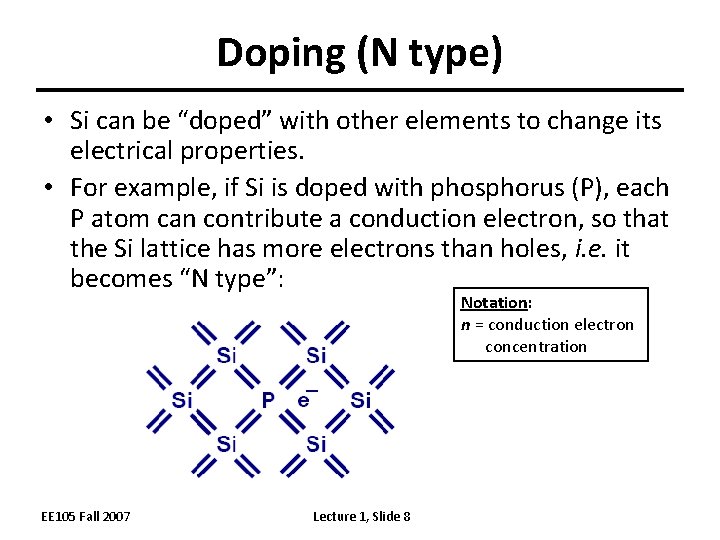
Doping (N type) • Si can be “doped” with other elements to change its electrical properties. • For example, if Si is doped with phosphorus (P), each P atom can contribute a conduction electron, so that the Si lattice has more electrons than holes, i. e. it becomes “N type”: Notation: n = conduction electron concentration EE 105 Fall 2007 Lecture 1, Slide 8
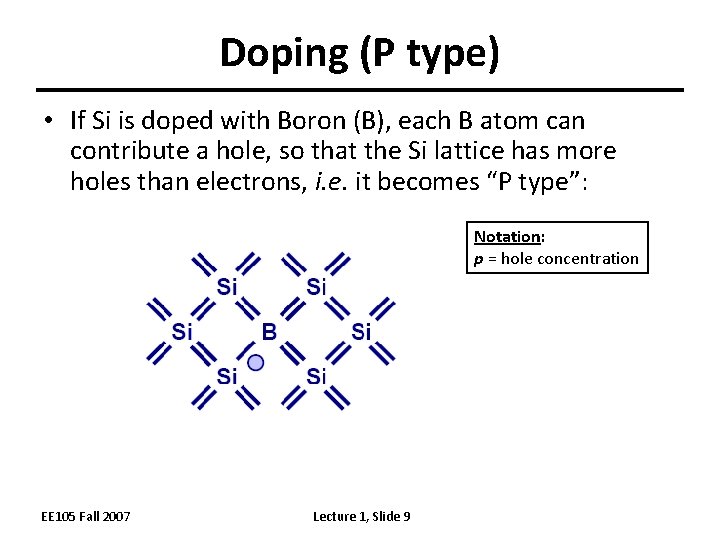
Doping (P type) • If Si is doped with Boron (B), each B atom can contribute a hole, so that the Si lattice has more holes than electrons, i. e. it becomes “P type”: Notation: p = hole concentration EE 105 Fall 2007 Lecture 1, Slide 9
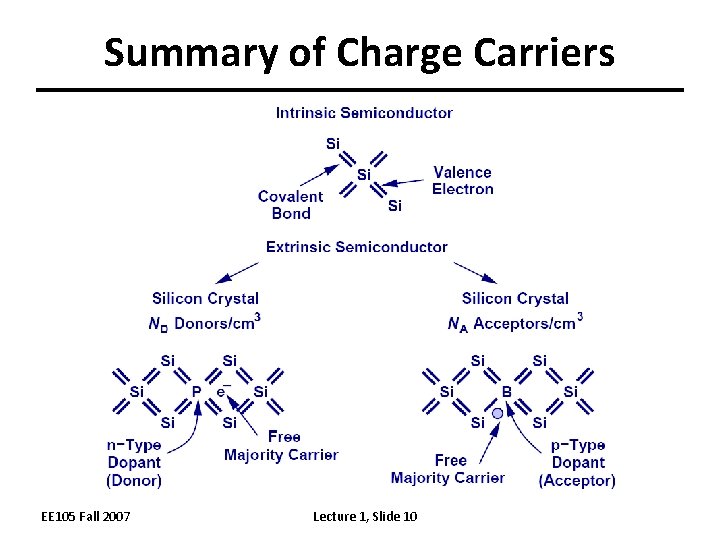
Summary of Charge Carriers EE 105 Fall 2007 Lecture 1, Slide 10
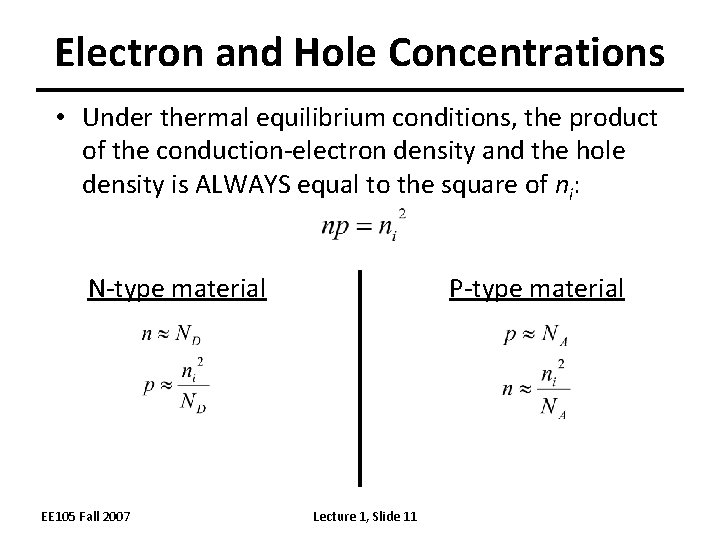
Electron and Hole Concentrations • Under thermal equilibrium conditions, the product of the conduction-electron density and the hole density is ALWAYS equal to the square of ni: N-type material EE 105 Fall 2007 P-type material Lecture 1, Slide 11
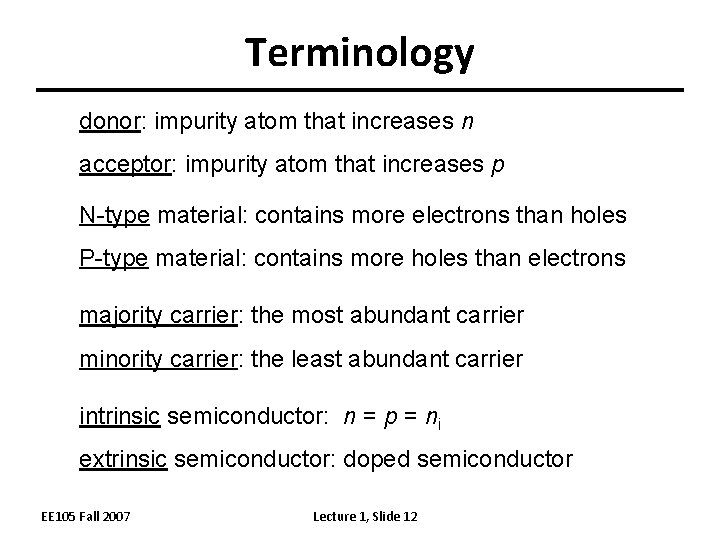
Terminology donor: impurity atom that increases n acceptor: impurity atom that increases p N-type material: contains more electrons than holes P-type material: contains more holes than electrons majority carrier: the most abundant carrier minority carrier: the least abundant carrier intrinsic semiconductor: n = p = ni extrinsic semiconductor: doped semiconductor EE 105 Fall 2007 Lecture 1, Slide 12
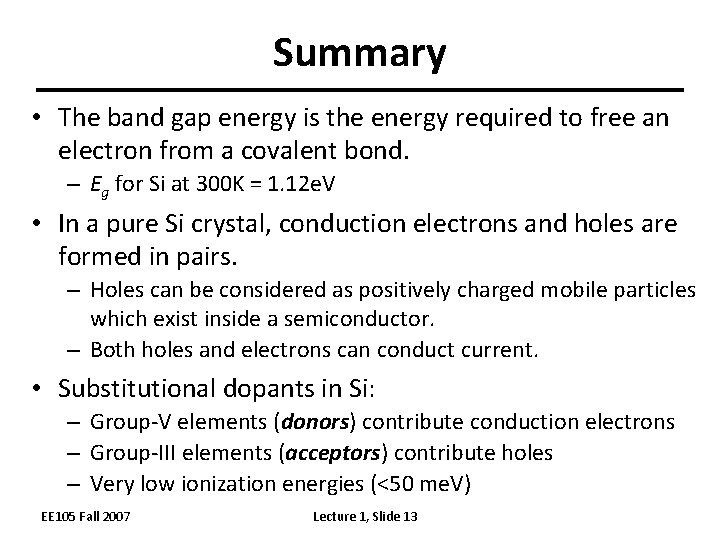
Summary • The band gap energy is the energy required to free an electron from a covalent bond. – Eg for Si at 300 K = 1. 12 e. V • In a pure Si crystal, conduction electrons and holes are formed in pairs. – Holes can be considered as positively charged mobile particles which exist inside a semiconductor. – Both holes and electrons can conduct current. • Substitutional dopants in Si: – Group-V elements (donors) contribute conduction electrons – Group-III elements (acceptors) contribute holes – Very low ionization energies (<50 me. V) EE 105 Fall 2007 Lecture 1, Slide 13
- Slides: 13