
Lecture 1 Occupational Health Definition occupational health Dr
![Bernardo Ramazzini, an Italian physician, circa 1700 published [[The Diseases of Workers]] considered the](https://slidetodoc.com/presentation_image_h2/babb4191ea506a5e8074a302fd3f91fb/image-6.jpg "Bernardo Ramazzini, an Italian physician, circa 1700 published [[The Diseases of Workers]] considered the")
- Slides: 13
Lecture (1): Occupational Health Definition occupational health Dr: Alshebli Ahmed Health Sciences at Al leith
Lecture (1): Occupational Health Definition The objectives of this lecture: 1. To know the occupational health definition. 2. To recognized the development of occupational health. 3. To know the integrated occupational health concept. Occupational Health Dr: Alshebli Ahmed Health Sciences at Al leith
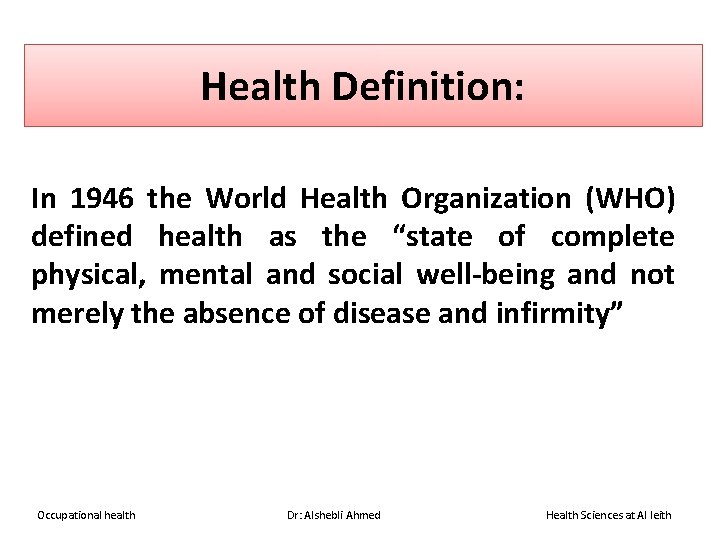
Health Definition: In 1946 the World Health Organization (WHO) defined health as the “state of complete physical, mental and social well-being and not merely the absence of disease and infirmity” Occupational health Dr: Alshebli Ahmed Health Sciences at Al leith
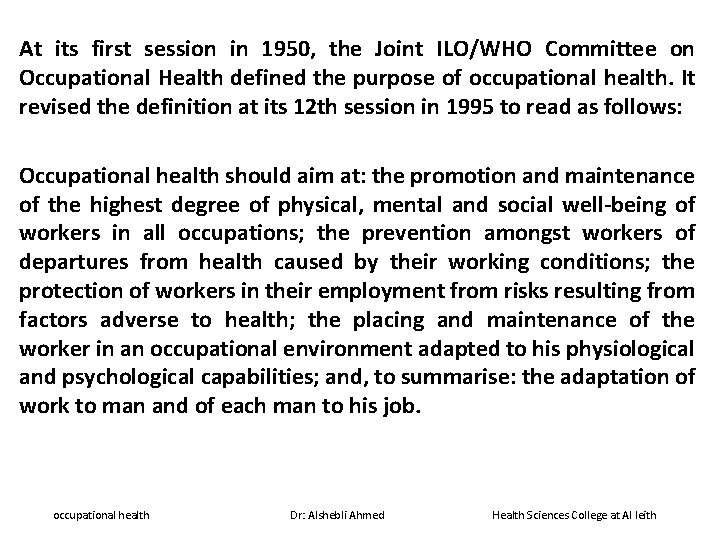
At its first session in 1950, the Joint ILO/WHO Committee on Occupational Health defined the purpose of occupational health. It revised the definition at its 12 th session in 1995 to read as follows: Occupational health should aim at: the promotion and maintenance of the highest degree of physical, mental and social well-being of workers in all occupations; the prevention amongst workers of departures from health caused by their working conditions; the protection of workers in their employment from risks resulting from factors adverse to health; the placing and maintenance of the worker in an occupational environment adapted to his physiological and psychological capabilities; and, to summarise: the adaptation of work to man and of each man to his job. occupational health Dr: Alshebli Ahmed Health Sciences College at Al leith
Background Ulrich Ellenborg recognized, identified, and reported on ‘‘the poisonous and noxious vapors and fumes of metals. ’’ In 1437, he recognized that the vapors of some metals, including lead and mercury, were dangerous and described the symptoms of industrial poisoning from these sources. Occupational health Dr: Alshebli Ahmed Health Sciences College at Al leith
Bernardo Ramazzini, an Italian physician, circa 1700 published [[The Diseases of Workers]] considered the first treatise on occupational disease. Considered by some to be the Father of Occupational Medicine and by others as the Father of Industrial Hygiene, he recommended physicians ask their patients, [[What is your trade]]. occupational health Dr: Alshebli Ahmed Health Sciences College at Al leith
Occupational hygiene is defined as the science of anticipation, recognition, evaluation and control of hazards in the workplace. occupational health Dr: Alshebli Ahmed Health Sciences College at Al leith
• Anticipation of problems is considered a vital skill, but while this usually requires considerable experience, assistance is now provided by material safety data sheets (MSDSs) and abundant advice available in the literature, various databases and electronic sites. • Recognition—knowing the hazards, the processes or identifying them through adverse health effects. • Evaluation—measuring exposures, comparing against standards, evaluating risk. • Control—providing contaminant or hazard control; the level of protection is based on knowledge of the toxicology or adverse effects produced by known quantitative exposures to the hazard. occupational health Dr: Alshebli Ahmed Health Sciences College at Al leith
The integrated occupational health concept: At the beginning of the twentieth century, occupational health was a matter for physicians. By and by, however, new groups became involved: nurses, engineers and hygienists. Today, topics within ergonomics and work organization are included, and the ‘integrated’ occupational health area even extends to labour market issues. It is easy to understand the inter-relationships between medicine, hygiene and ergonomics. Work organization defines the contents of the work and how it is distributed among the employees (‘right person for the right work. More practical ‘projects’ may include ‘stress and health’, ‘conditions for human service work’, ‘industry and the human resource’, ‘gender and work’, ‘lifelong learning’ and ‘work and culture’. Labour market issues are somewhat more peripheral, however important for the employee. occupational health Dr: Alshebli Ahmed Health Sciences College at Al leith
Occupational health international standards: Safety and health at work – A human right: The right to safety and health at work is enshrined in the United Nations Universal Declaration of Human Rights, 1948, which states: Everyone has the right to work, to free choice of employment, to just and favourable conditions of work … (Article 23) The United Nations International Covenant on Economic, Social and Cultural Rights, 1976, reaffirms this right in the following terms: The States Parties to the present Covenant recognize the right of everyone to the enjoyment of just and favourable conditions of work, which ensure, in particular: … (b) Safe and healthy working conditions … (Article 7) occupational health Dr: Alshebli Ahmed Health Sciences at Al leith
1/ OHSAS 18000: Ø OHSAS 18000 is an international occupational health and safety management system specification. It comprises two parts, 18001 and 18002 and embraces BS 8800 and a number of other publications. Ø OHSAS 18001 was created via a concerted effort from a number of the worlds leading national standards bodies, certification bodies, and specialist consultancies. Ø OHSAS helps in a variety of respects. . . it helps: minimise risk to employees/etc; improve an existing OH&S management system; demonstrate diligence; gain assurance; etc. occupational health Dr: Alshebli Ahmed Health Sciences at Al leith
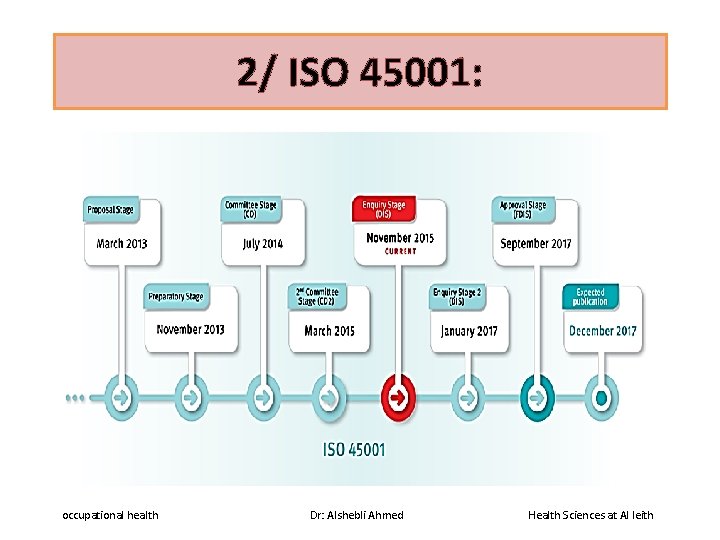
2/ ISO 45001: The standard is currently being developed by a committee of occupational health and safety experts, and will follow other generic management system approaches such as ISO 14001 and ISO 9001. It will take into account other International Standards in this area such as OHSAS 18001, the International Labour Organization's ILO-OSH Guidelines, various national standards and the ILO's international labour standards and conventions. ISO 45001 is intended for use by any organization, regardless of its size or the nature of its work. occupational health Dr: Alshebli Ahmed Health Sciences at Al leith
2/ ISO 45001: occupational health Dr: Alshebli Ahmed Health Sciences at Al leith