
Lecture 1 Introduction to the cytoskeleton Outline Major



- Slides: 37
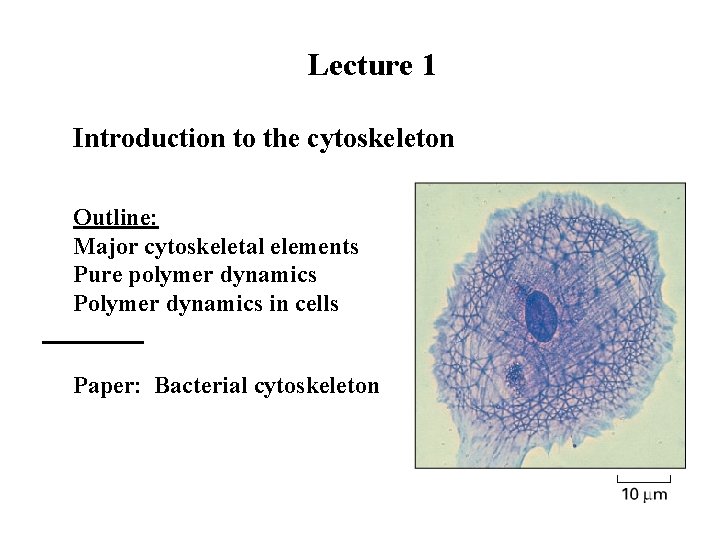
Lecture 1 Introduction to the cytoskeleton Outline: Major cytoskeletal elements Pure polymer dynamics Polymer dynamics in cells Paper: Bacterial cytoskeleton
Roles of cytoskeleton: 1) Structural scaffold - cell shape, spatial organization 2) Dynamic assemblies - movement and force production: Cell migration Cell division Intracellular traffic Contraction Cytoskeletal functions often involve motor proteins
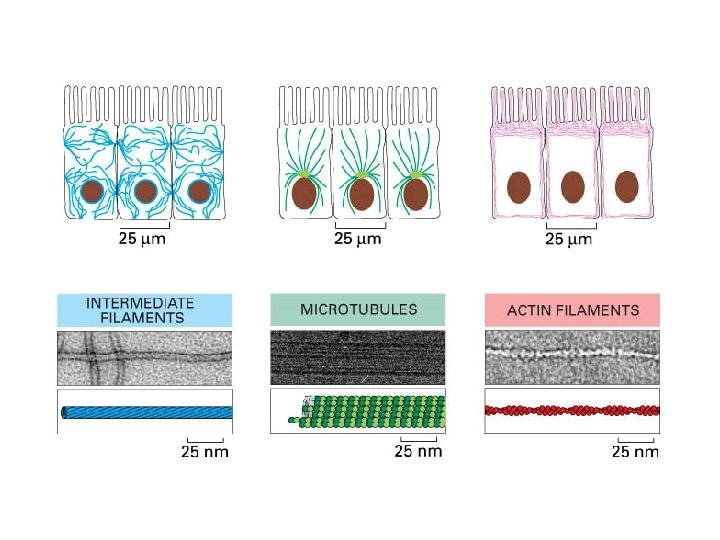
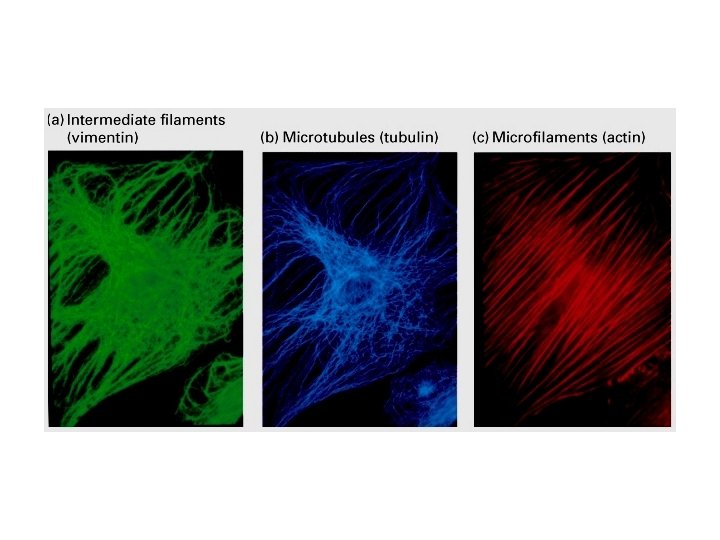
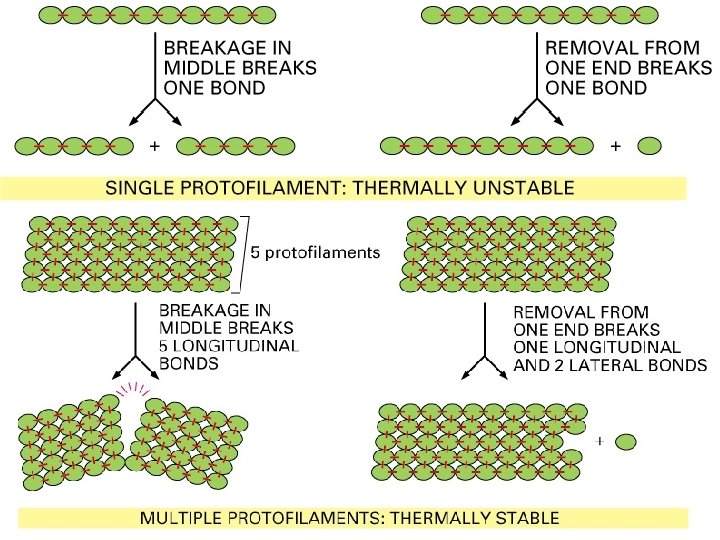
3 major elements of the cytoskeleton 1) microtubules – a/b tubulin dimers - 25 nm diameter relatively stiff – hollow, 13 protofilaments 2) microfilaments = actin filaments - 7 nm diameter actin monomers –more flexible – 2 helicies 3) intermediate filaments – 10 nm diameter fibrous – resistant to shear forces structural, prominent in cells subject to mechanical stress; vimentin, nuclear lamins
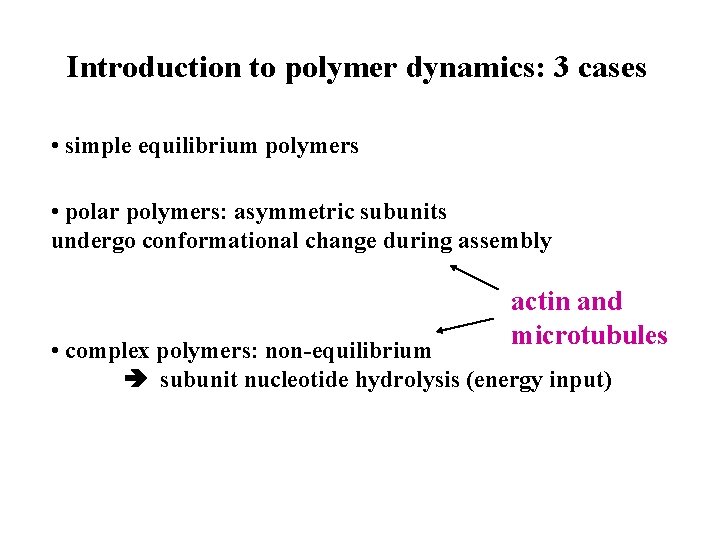
Introduction to polymer dynamics: 3 cases • simple equilibrium polymers • polar polymers: asymmetric subunits undergo conformational change during assembly actin and microtubules • complex polymers: non-equilibrium subunit nucleotide hydrolysis (energy input)
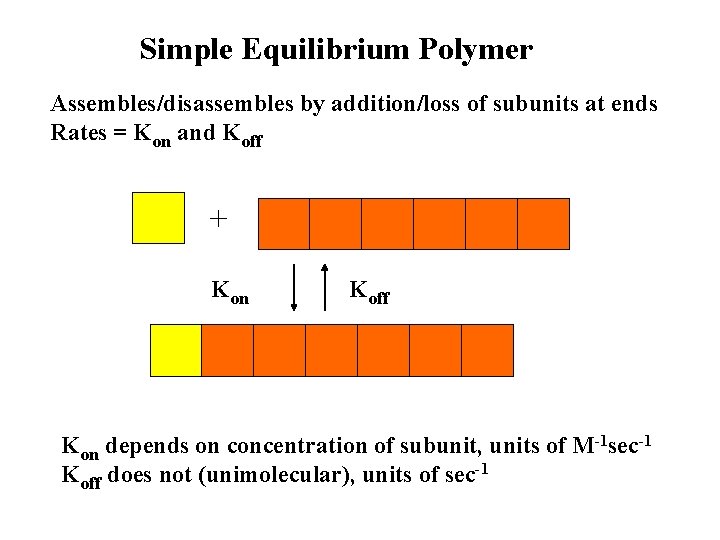
Simple Equilibrium Polymer Assembles/disassembles by addition/loss of subunits at ends Rates = Kon and Koff Kon depends on concentration of subunit, units of M-1 sec-1 Koff does not (unimolecular), units of sec-1
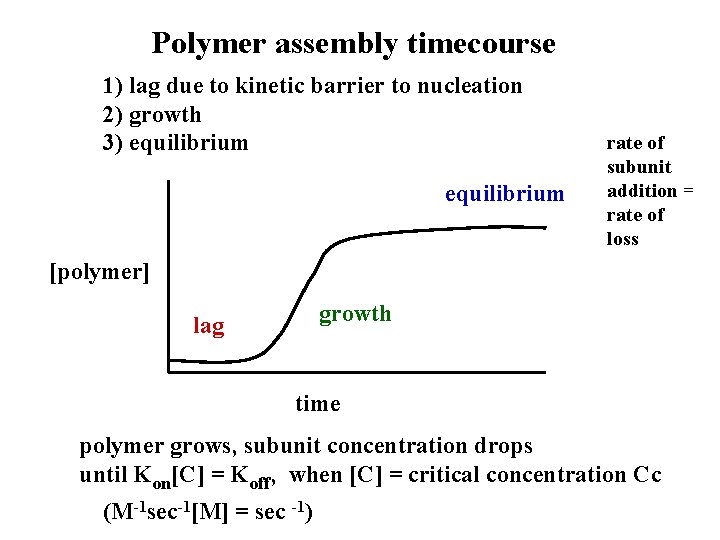
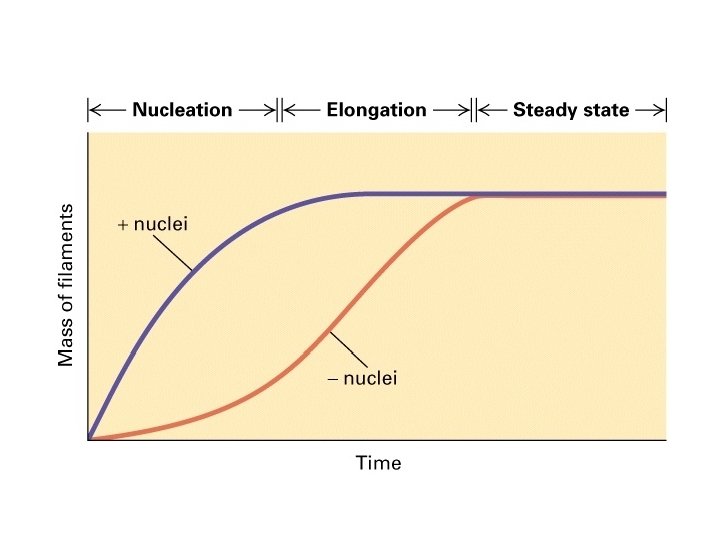
Polymer assembly timecourse 1) lag due to kinetic barrier to nucleation 2) growth 3) equilibrium rate of subunit addition = rate of loss [polymer] growth lag time polymer grows, subunit concentration drops until Kon[C] = Koff, when [C] = critical concentration Cc (M-1 sec-1[M] = sec -1)
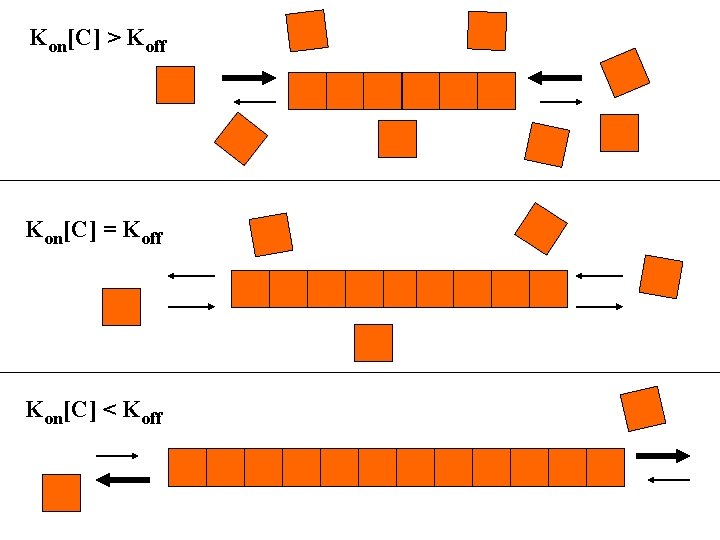
Kon[C] > Koff Kon[C] = Koff Kon[C] < Koff
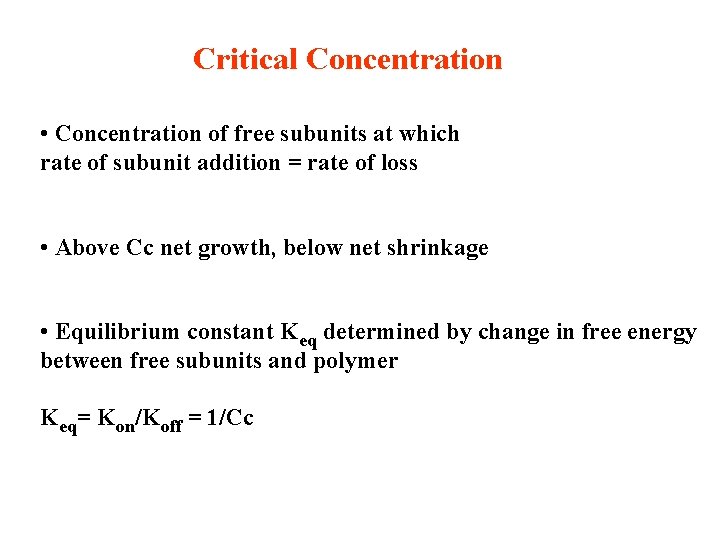
Critical Concentration • Concentration of free subunits at which rate of subunit addition = rate of loss • Above Cc net growth, below net shrinkage • Equilibrium constant Keq determined by change in free energy between free subunits and polymer Keq= Kon/Koff = 1/Cc
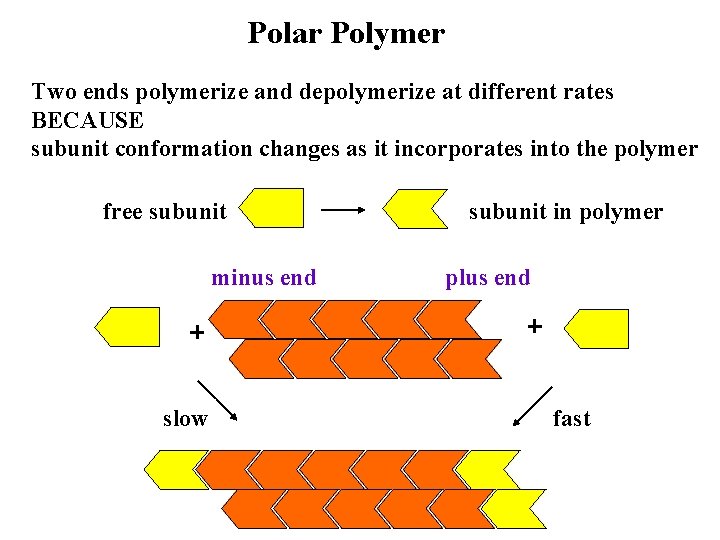
Polar Polymer Two ends polymerize and depolymerize at different rates BECAUSE subunit conformation changes as it incorporates into the polymer free subunit minus end slow subunit in polymer plus end fast
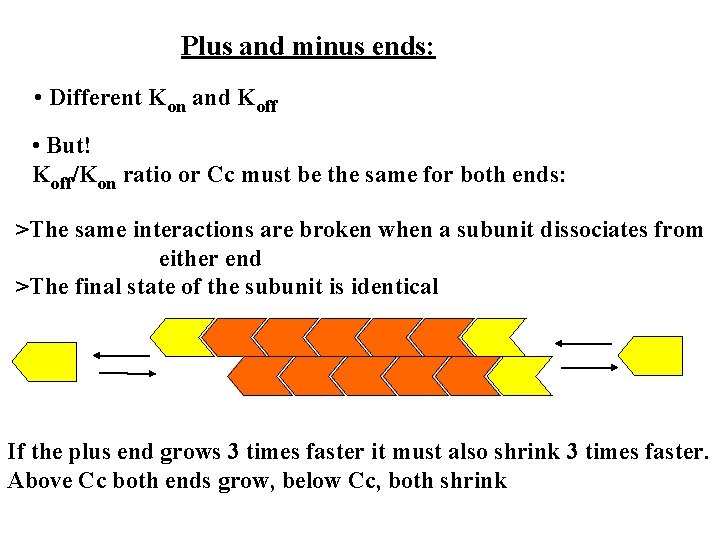
Plus and minus ends: • Different Kon and Koff • But! Koff/Kon ratio or Cc must be the same for both ends: >The same interactions are broken when a subunit dissociates from either end >The final state of the subunit is identical If the plus end grows 3 times faster it must also shrink 3 times faster. Above Cc both ends grow, below Cc, both shrink
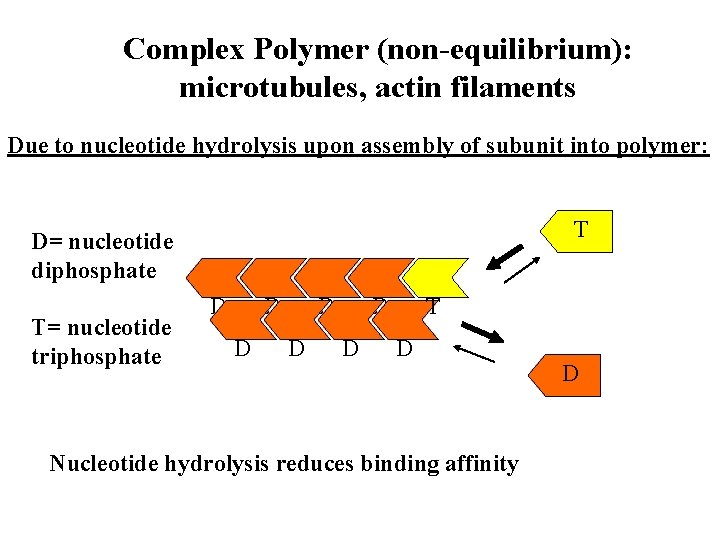
Complex Polymer (non-equilibrium): microtubules, actin filaments Due to nucleotide hydrolysis upon assembly of subunit into polymer: T D= nucleotide diphosphate T= nucleotide triphosphate D D D D T D Nucleotide hydrolysis reduces binding affinity D
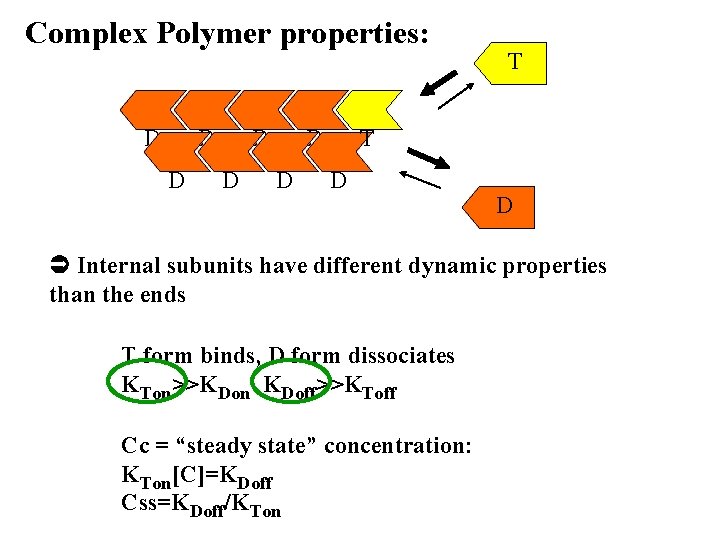
Complex Polymer properties: D D D D T T D D Internal subunits have different dynamic properties than the ends T form binds, D form dissociates KTon>>KDon KDoff>>KToff Cc = “steady state” concentration: KTon[C]=KDoff Css=KDoff/KTon
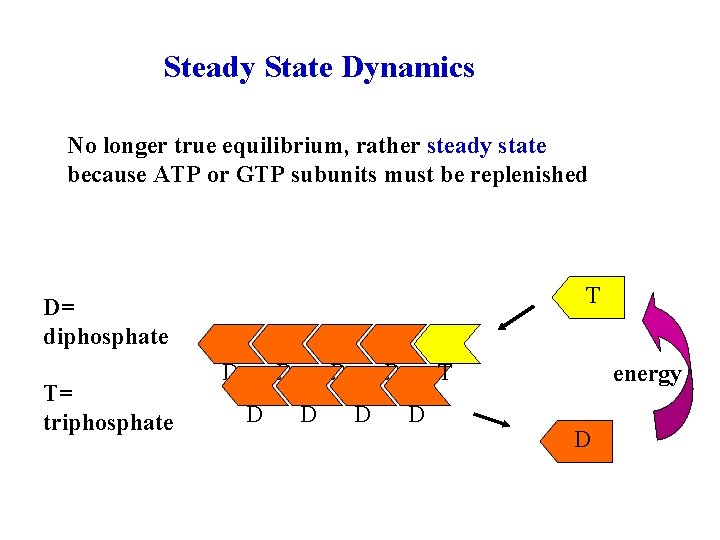
Steady State Dynamics No longer true equilibrium, rather steady state because ATP or GTP subunits must be replenished T D= diphosphate T= triphosphate D D D D T D energy D
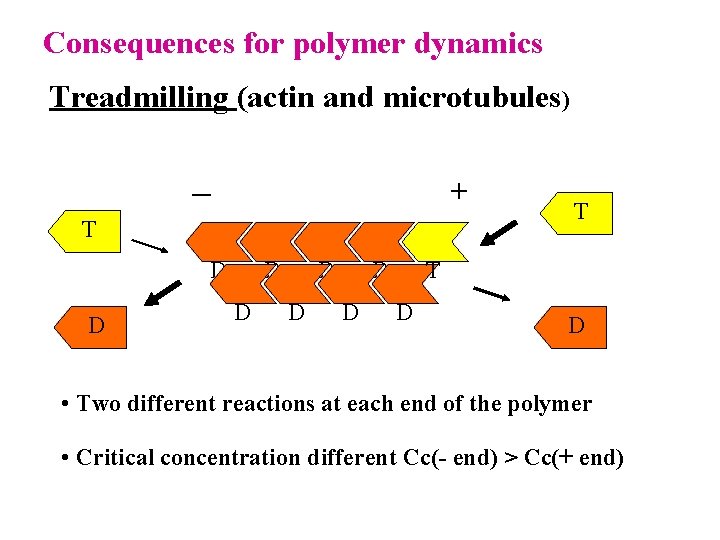
Consequences for polymer dynamics Treadmilling (actin and microtubules) _ + T D D D D T T D D • Two different reactions at each end of the polymer • Critical concentration different Cc(- end) > Cc(+ end)
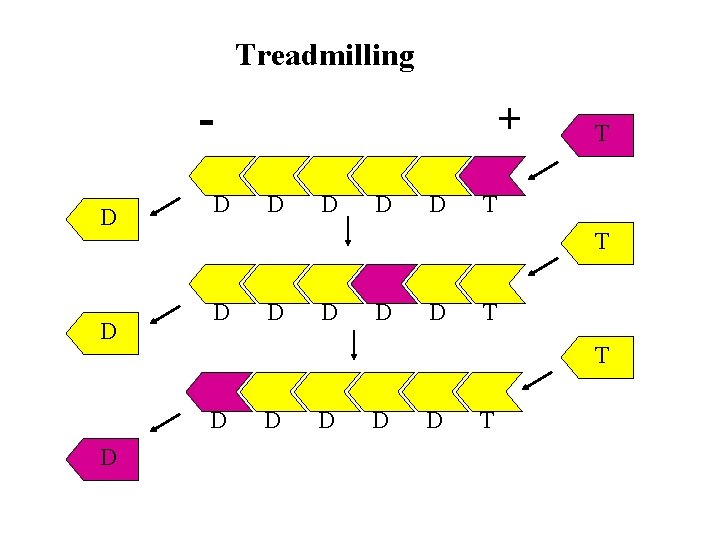
Treadmilling Both ends exposed: Steady state occurs at concentration between Cc(- end) and Cc(+ end) net assembly at the plus end net disassembly at the minus end subunits “flux” through the polymer
Treadmilling D D D D T T T D D D T T D D + D D T
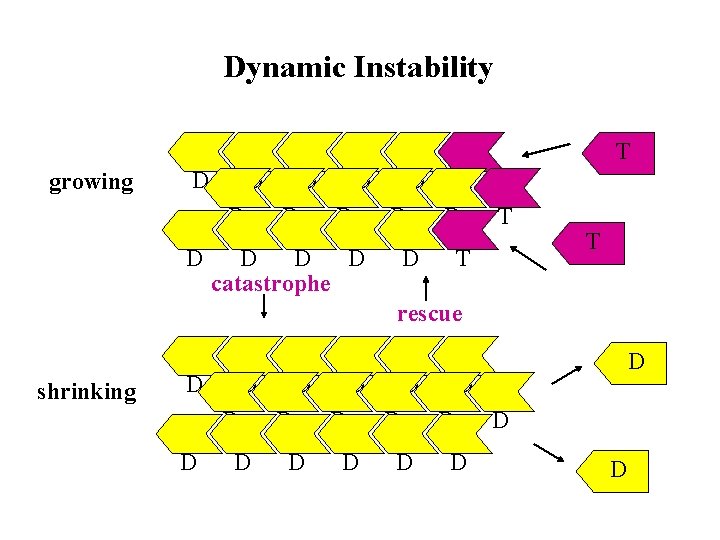
Dynamic instability (microtubules): • subunit addition is faster than nucleotide hydrolysis • cap of GTP-tubulin on polymer ends KDoff>>KToff: GTP cap favors growth GTP Cap present: Growth GTP Cap lost: rapid disassembly • stochastic (unpredictable) transitions • frequency correlates with tubulin concentration
Dynamic Instability T growing D D D D catastrophe T D D T T T rescue shrinking D D D D D
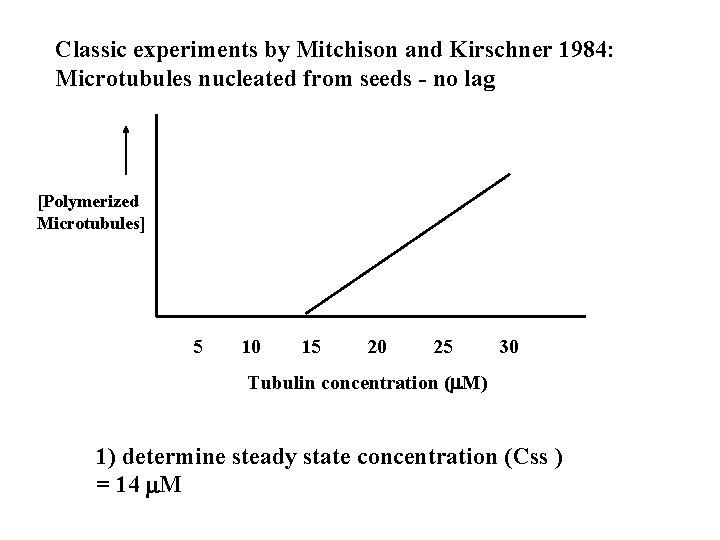
Classic experiments by Mitchison and Kirschner 1984: Microtubules nucleated from seeds - no lag [Polymerized Microtubules] 5 10 15 20 25 30 Tubulin concentration (m. M) 1) determine steady state concentration (Css ) = 14 m. M
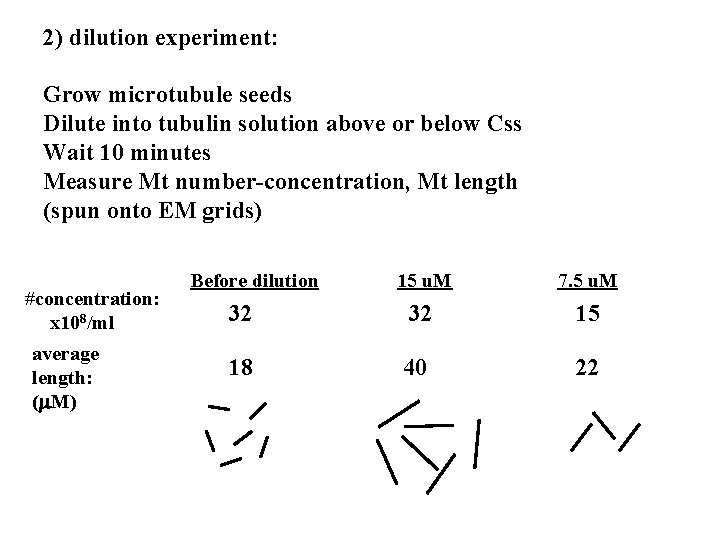
2) dilution experiment: Grow microtubule seeds Dilute into tubulin solution above or below Css Wait 10 minutes Measure Mt number-concentration, Mt length (spun onto EM grids) #concentration: x 108/ml average length: (m. M) Before dilution 15 u. M 7. 5 u. M 32 32 15 18 40 22
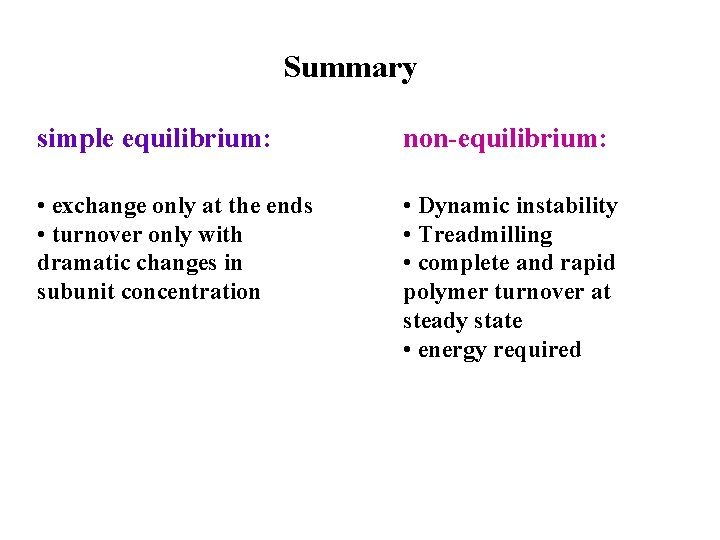
Summary simple equilibrium: non-equilibrium: • exchange only at the ends • turnover only with dramatic changes in subunit concentration • Dynamic instability • Treadmilling • complete and rapid polymer turnover at steady state • energy required
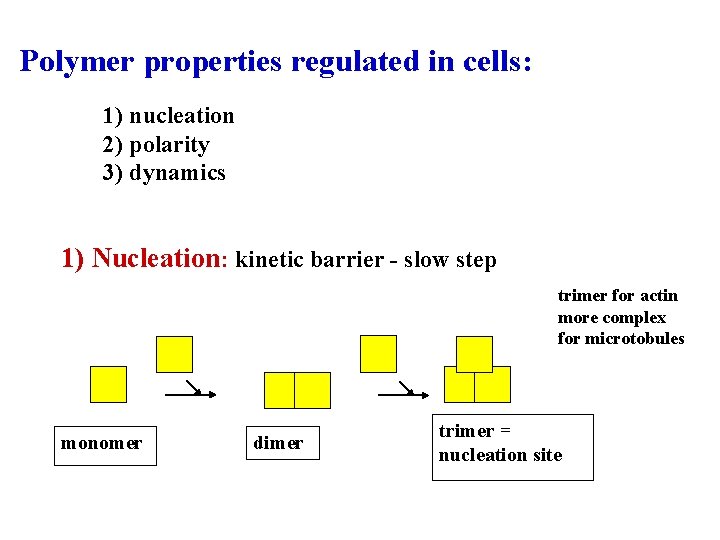
Polymer properties regulated in cells: 1) nucleation 2) polarity 3) dynamics 1) Nucleation: kinetic barrier - slow step trimer for actin more complex for microtobules monomer dimer trimer = nucleation site
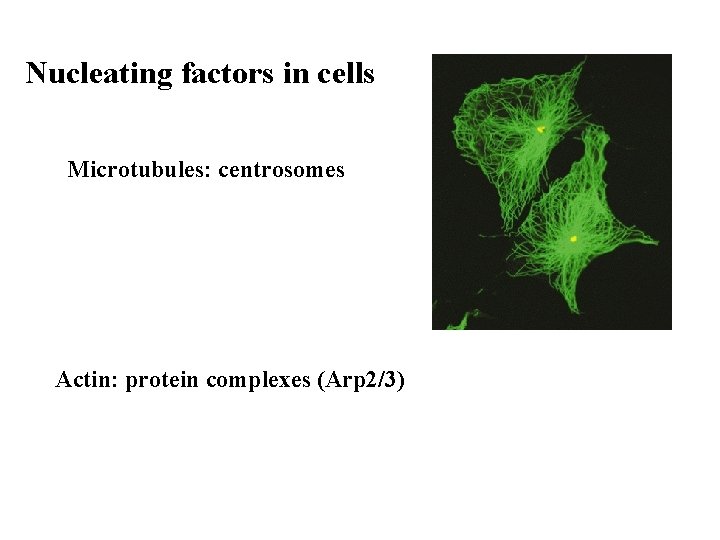
Nucleating factors in cells Microtubules: centrosomes Actin: protein complexes (Arp 2/3)
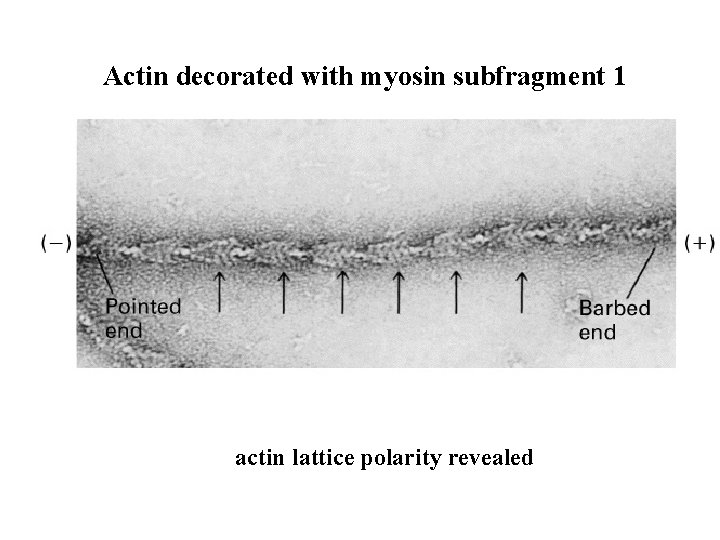
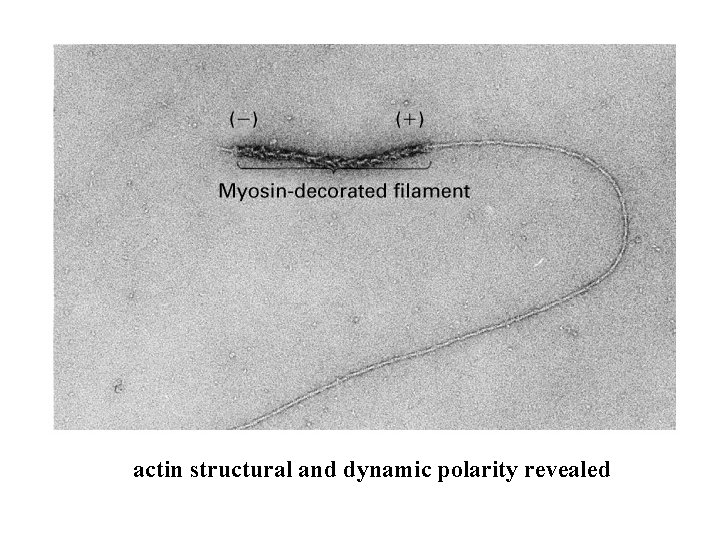
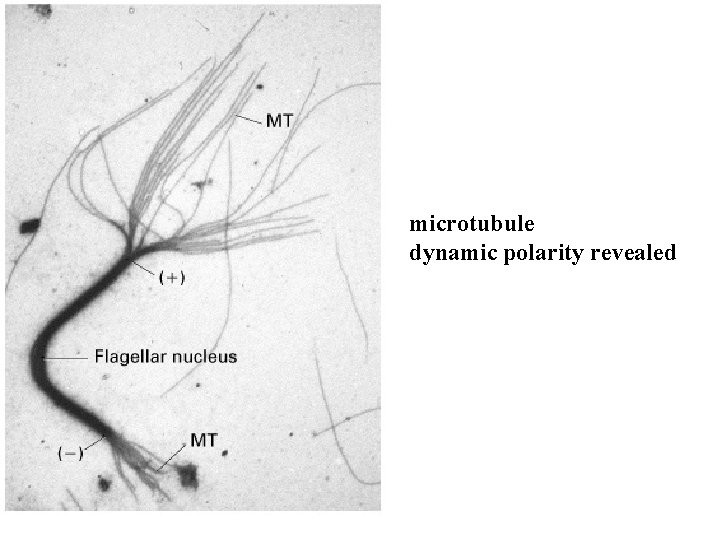
2) Polarity: due to asymmetry of subunits structural polarity of polymer lattice visualized by decoration of actin filaments and microtubules allows cell to generate asymmetric structures and shapes basis of motility
Actin decorated with myosin subfragment 1 actin lattice polarity revealed
actin structural and dynamic polarity revealed
Microtubules decorated and viewed in cross section microtubule lattice polarity revealed by hook direction
microtubule dynamic polarity revealed
Motor proteins recognize polymer asymmetry mechanochemical enzymes hydrolyze ATP to move along filament produce force or carry cargo polarity generates directionality
3) dynamics regulated by many cellular factors end-capping subunit sequestering polymer binding proteins regulators also regulated
microtubules in interphase Tournebize and Hyman
microtubules in mitosis Tournebize and Hyman