
Lecture 1 Introduction to Project Management Prof S
- Slides: 46
Lecture 1: Introduction to Project Management Prof. S. M. Kang’ethe samuel. kangethe@jkuat. ac. ke
Definitions ISO 8402/British Standards BS 607 -2: 2000 n Project is a unique process , consisting of a set of coordinated and controlled activities with a start and finish dates, undertaken to achieve an objective conforming to specific requirements including constraints of time , cost and resources
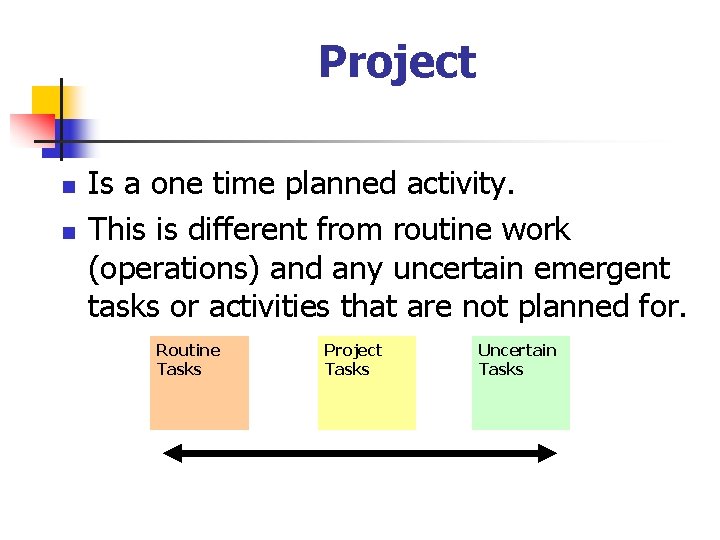
Project n n Is a one time planned activity. This is different from routine work (operations) and any uncertain emergent tasks or activities that are not planned for. Routine Tasks Project Tasks Uncertain Tasks
Project A projects comprises: n A defined Goal or set of objectives n A defined beginning and end -Time span. n A systematic means of moving from a problem to a solution. n An integrated system of complex but interdependent related tasks or activities n Consist of planned set of activities to be performed: Defined in advance,
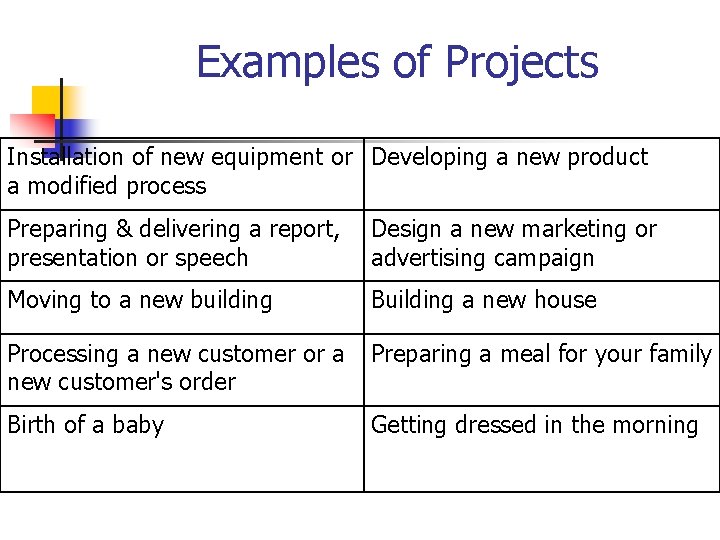
Examples of Projects Installation of new equipment or Developing a new product a modified process Preparing & delivering a report, presentation or speech Design a new marketing or advertising campaign Moving to a new building Building a new house Processing a new customer or a new customer's order Preparing a meal for your family Birth of a baby Getting dressed in the morning
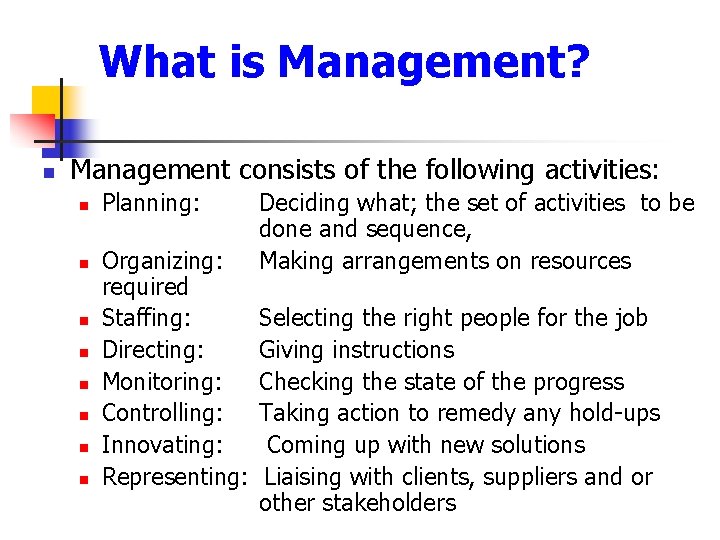
What is Management? n Management consists of the following activities: n n n n Planning: Organizing: required Staffing: Directing: Monitoring: Controlling: Innovating: Representing: Deciding what; the set of activities to be done and sequence, Making arrangements on resources Selecting the right people for the job Giving instructions Checking the state of the progress Taking action to remedy any hold-ups Coming up with new solutions Liaising with clients, suppliers and or other stakeholders
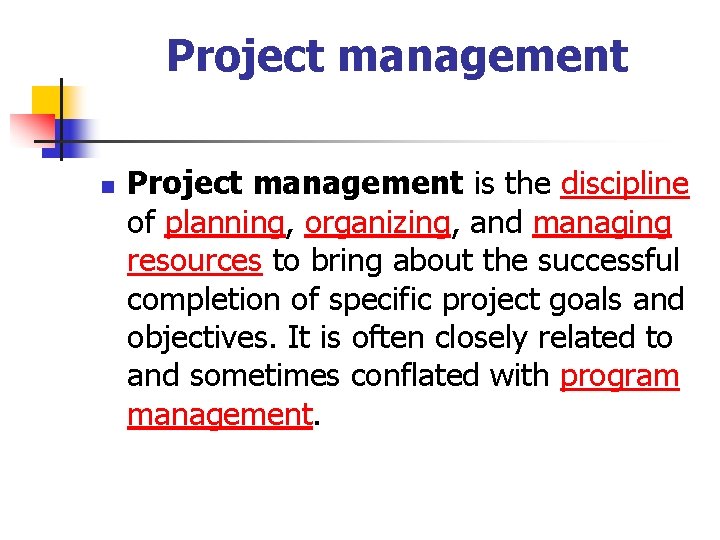
Project management n Project management is the discipline of planning, organizing, and managing resources to bring about the successful completion of specific project goals and objectives. It is often closely related to and sometimes conflated with program management.
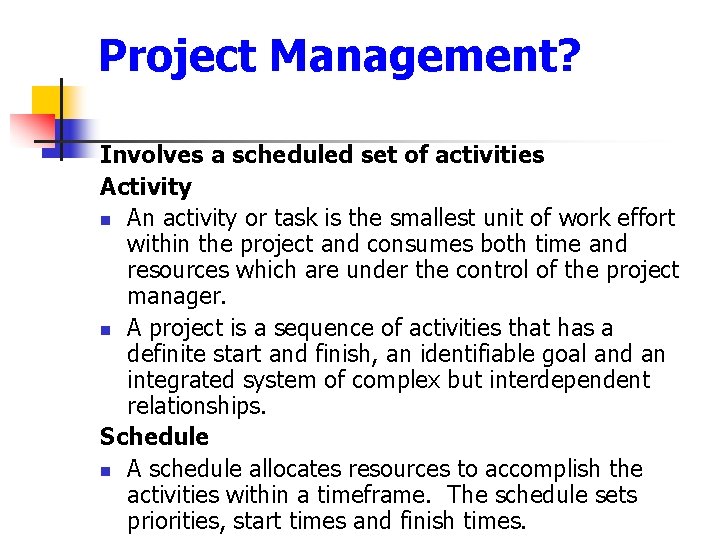
Project Management? Involves a scheduled set of activities Activity n An activity or task is the smallest unit of work effort within the project and consumes both time and resources which are under the control of the project manager. n A project is a sequence of activities that has a definite start and finish, an identifiable goal and an integrated system of complex but interdependent relationships. Schedule n A schedule allocates resources to accomplish the activities within a timeframe. The schedule sets priorities, start times and finish times.
Project Management n n Project management is the discipline of planning, organizing, and managing resources to bring about the successful completion of specific project goals and objectives. It is often closely related to and sometimes confused with program management. Program management is the process of managing several related projects, often with the intention of improving an organization's performance. In practice and in its aims it is often closely related to Systems engineering.
Project Management? Defn: n Project management is the application of knowledge, skills, tools and techniques to project activities in order to meet or exceed stakeholder needs and expectations of a project. n n The project manager, sometimes referred to as the project coordinator or leader, manages the details of the project on a day-today basis. This is an ongoing challenge that requires an understanding of the broader contextual environment of the project and the ability to balance conflicting demands between: n n Available resources and expectations; Differing stakeholder priorities; Identified needs and project scope; Quality and quantity.
Project Management? A projects comprises n n A defined Goal or set of objectives A defined beginning and end: - Time span. A means of moving from a problem to a solution. Processes, Methods/Techniques Consist of Planned set of activities , defined in advance, to be performed A successful project is one where a project achieves the desired results/goals: n n n Within the required quality of the desired product and/or service as required by customer Within the estimated Budget Within the estimated time frame
Key Players n Stakeholders n n n Project Team n n n Anyone actively involved, or have an interest at stake in the project May have influence, responsibility, and authority over the project Individuals that are performing the project work Typically involves the use of cross-functional teams Project Management Team n Project team members that have management responsibilities for the project
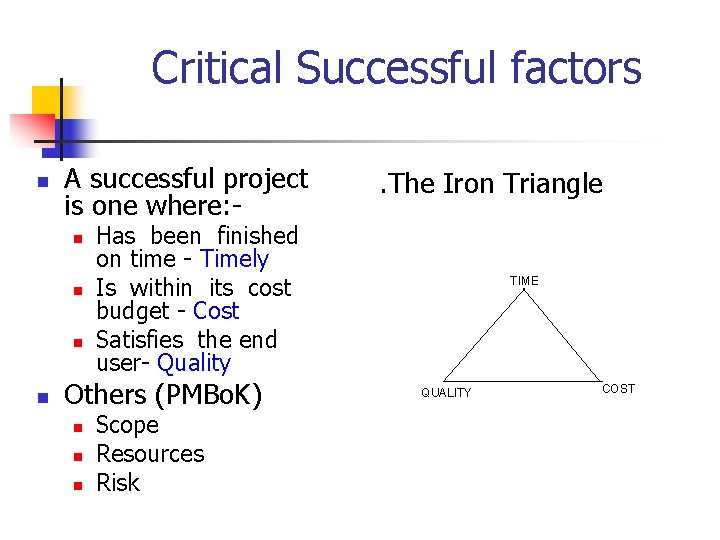
Critical Successful factors n A successful project is one where: n n Has been finished on time - Timely Is within its cost budget - Cost Satisfies the end user- Quality Others (PMBo. K) n n n . The Iron Triangle Scope Resources Risk TIME QUALITY COST
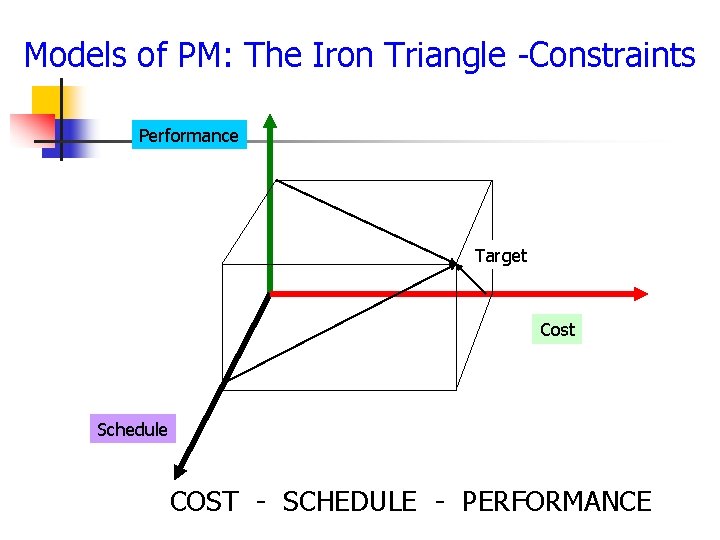
Models of PM: The Iron Triangle -Constraints Performance Target Cost Schedule COST - SCHEDULE - PERFORMANCE
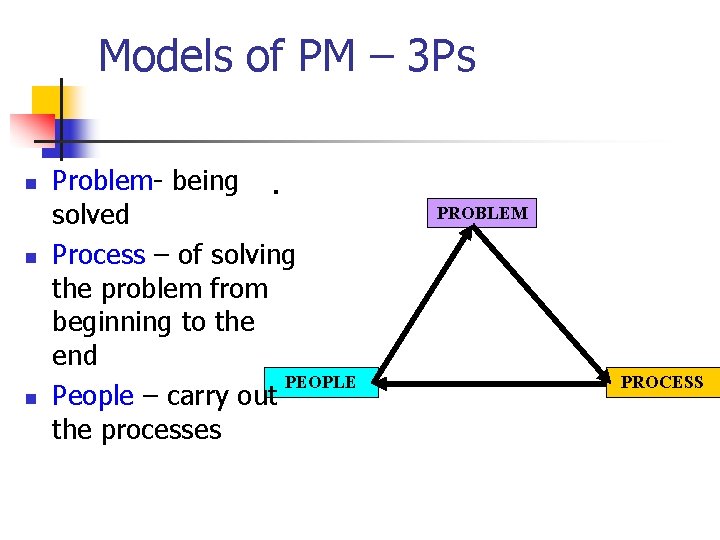
Models of PM – 3 Ps n n n Problem- being. solved Process – of solving the problem from beginning to the end PEOPLE People – carry out the processes PROBLEM PROCESS
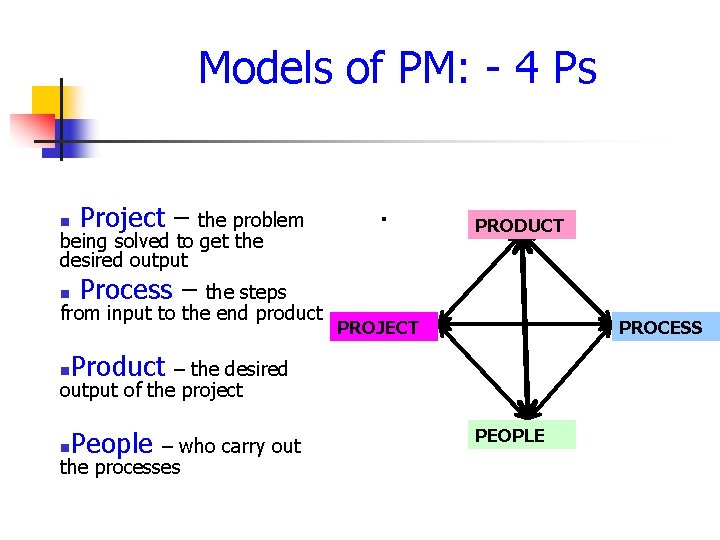
Models of PM: - 4 Ps Project – the problem being solved to get the desired output n PRODUCT Process – the steps from input to the end product n . PROJECT PROCESS Product – the desired output of the project n People – who carry out the processes n PEOPLE
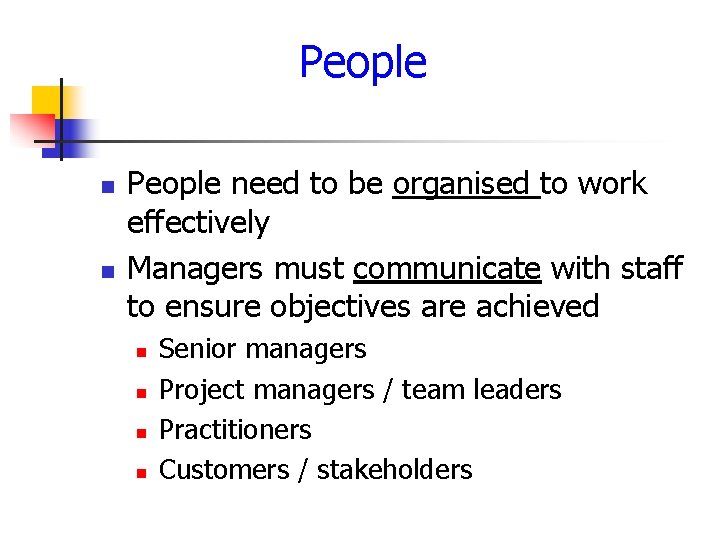
People n n People need to be organised to work effectively Managers must communicate with staff to ensure objectives are achieved n n Senior managers Project managers / team leaders Practitioners Customers / stakeholders
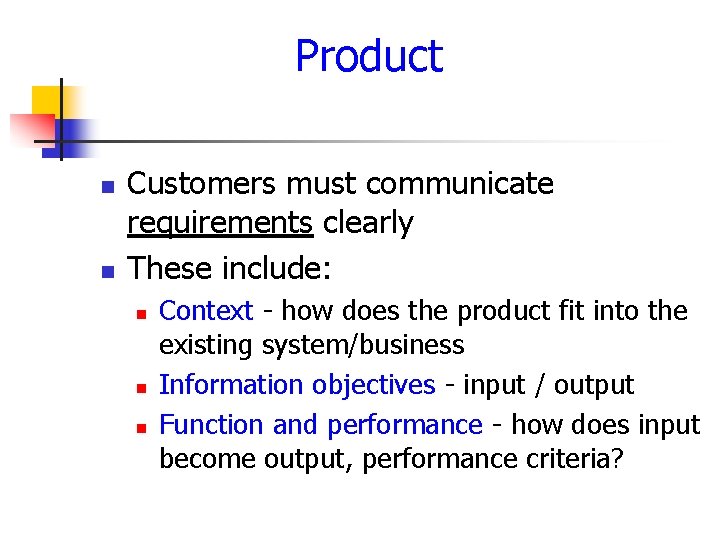
Product n n Customers must communicate requirements clearly These include: n n n Context - how does the product fit into the existing system/business Information objectives - input / output Function and performance - how does input become output, performance criteria?
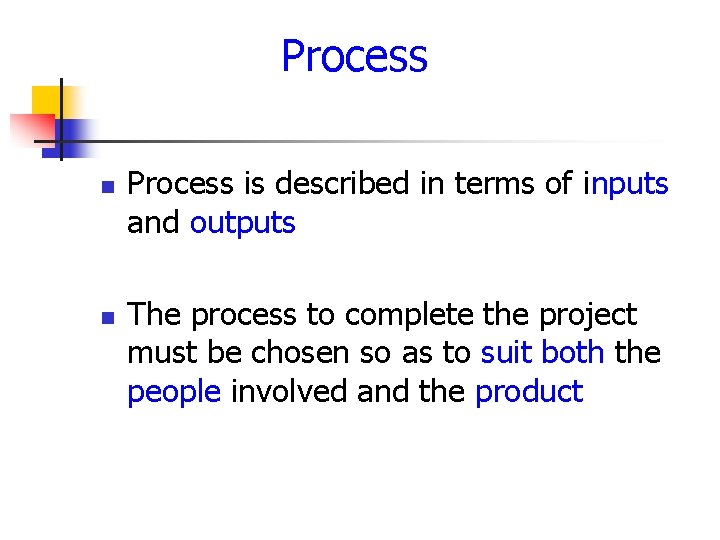
Process n n Process is described in terms of inputs and outputs The process to complete the project must be chosen so as to suit both the people involved and the product
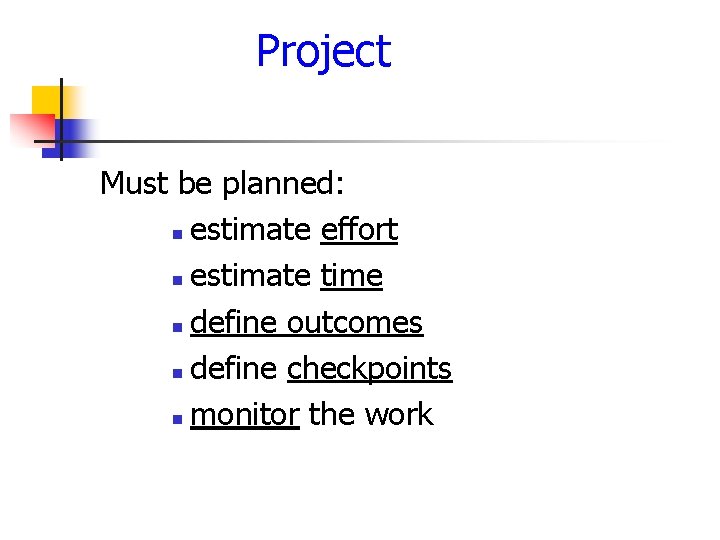
Project Must be planned: n estimate effort n estimate time n define outcomes n define checkpoints n monitor the work
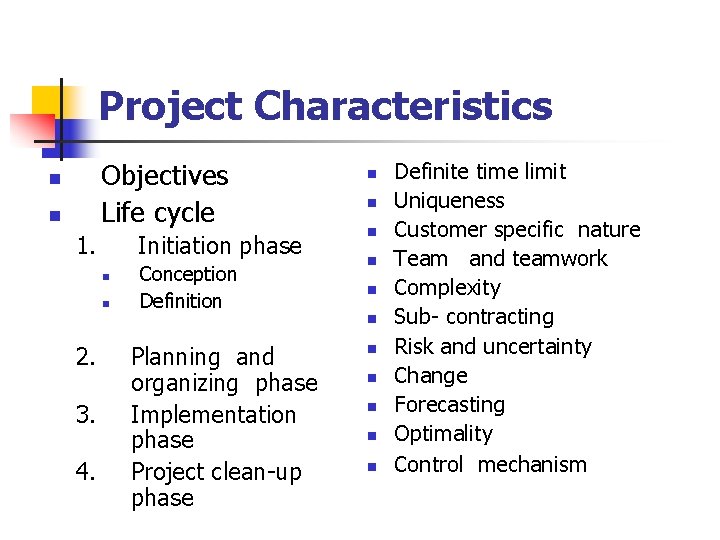
Project Characteristics Objectives Life cycle n n 1. Initiation phase n n Conception Definition n n n 2. 3. 4. Planning and organizing phase Implementation phase Project clean-up phase n n n Definite time limit Uniqueness Customer specific nature Team and teamwork Complexity Sub- contracting Risk and uncertainty Change Forecasting Optimality Control mechanism
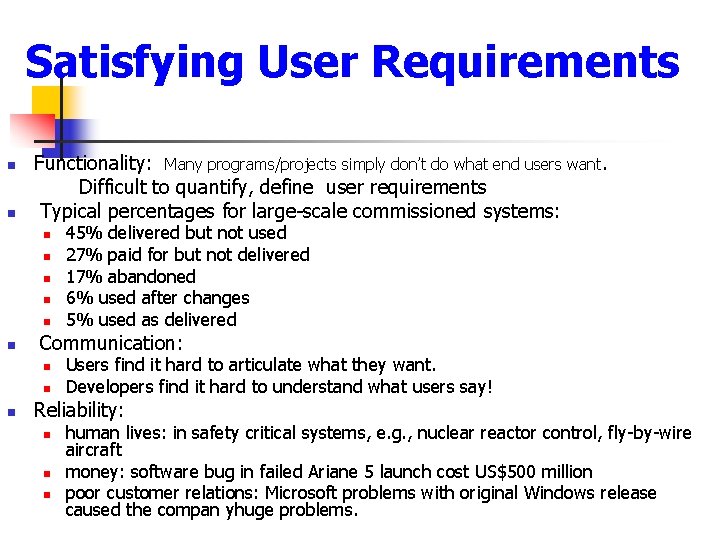
Satisfying User Requirements n n Functionality: Many programs/projects simply don’t do what end users want. Difficult to quantify, define user requirements Typical percentages for large-scale commissioned systems: n n n Communication: n n n 45% delivered but not used 27% paid for but not delivered 17% abandoned 6% used after changes 5% used as delivered Users find it hard to articulate what they want. Developers find it hard to understand what users say! Reliability: n n n human lives: in safety critical systems, e. g. , nuclear reactor control, fly-by-wire aircraft money: software bug in failed Ariane 5 launch cost US$500 million poor customer relations: Microsoft problems with original Windows release caused the compan yhuge problems.
Reasons Why Projects Go Wrong Project goals/Objectives are not clearly defined Complaints arising from: n n n short time scale resource availability quality factors human factors
Problems With Project goals n n Inadequate understanding of project by the client communication Breakdown between client and the project manager unrealistic and unachievable project goals Projects may be highly complex
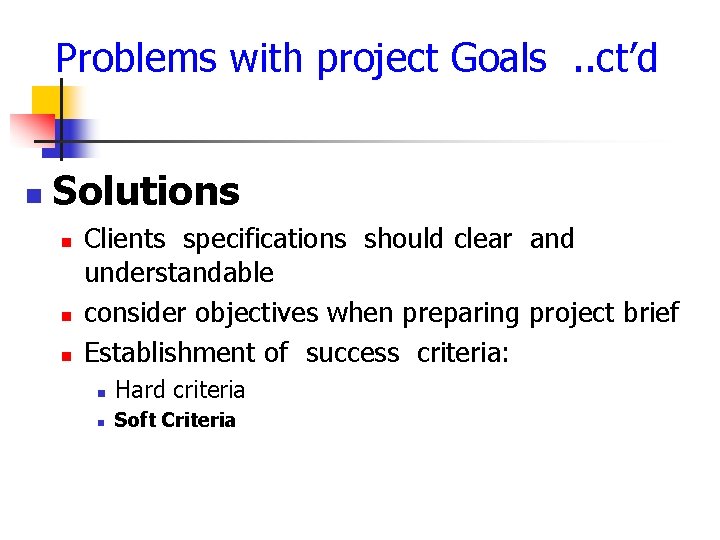
Problems with project Goals. . ct’d n Solutions n n n Clients specifications should clear and understandable consider objectives when preparing project brief Establishment of success criteria: n Hard criteria n Soft Criteria
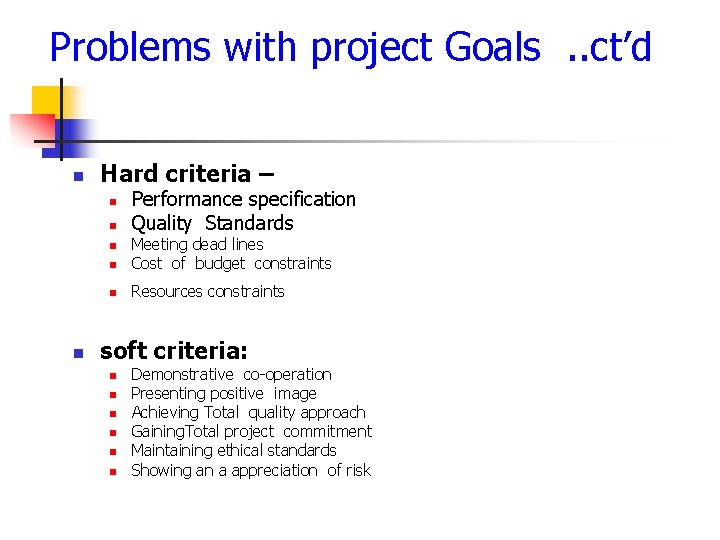
Problems with project Goals. . ct’d n Hard criteria – n n n Meeting dead lines Cost of budget constraints n Resources constraints n n Performance specification Quality Standards soft criteria: n n n Demonstrative co-operation Presenting positive image Achieving Total quality approach Gaining. Total project commitment Maintaining ethical standards Showing an a appreciation of risk
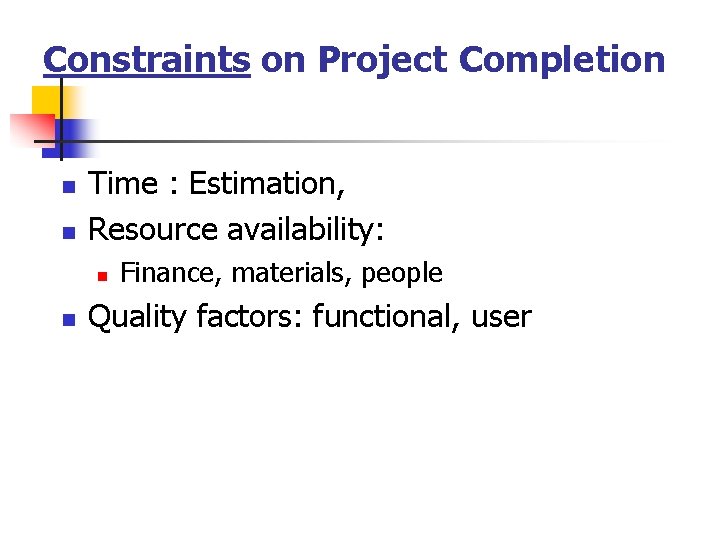
Constraints on Project Completion n n Time : Estimation, Resource availability: n n Finance, materials, people Quality factors: functional, user
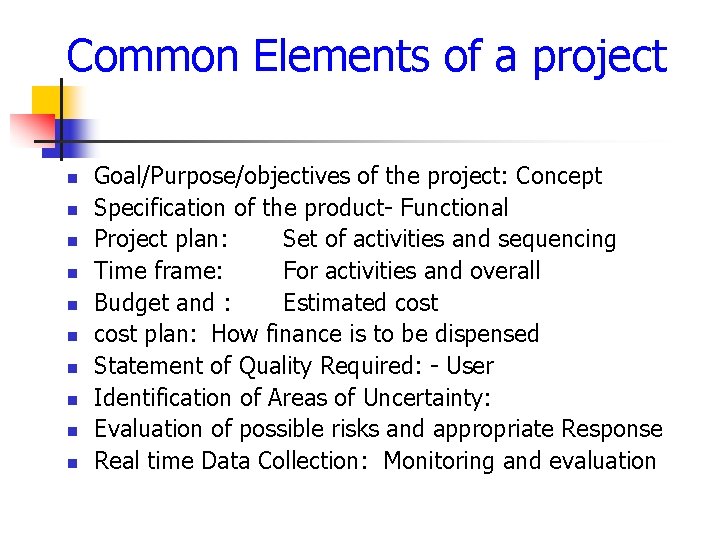
Common Elements of a project n n n n n Goal/Purpose/objectives of the project: Concept Specification of the product- Functional Project plan: Set of activities and sequencing Time frame: For activities and overall Budget and : Estimated cost plan: How finance is to be dispensed Statement of Quality Required: - User Identification of Areas of Uncertainty: Evaluation of possible risks and appropriate Response Real time Data Collection: Monitoring and evaluation
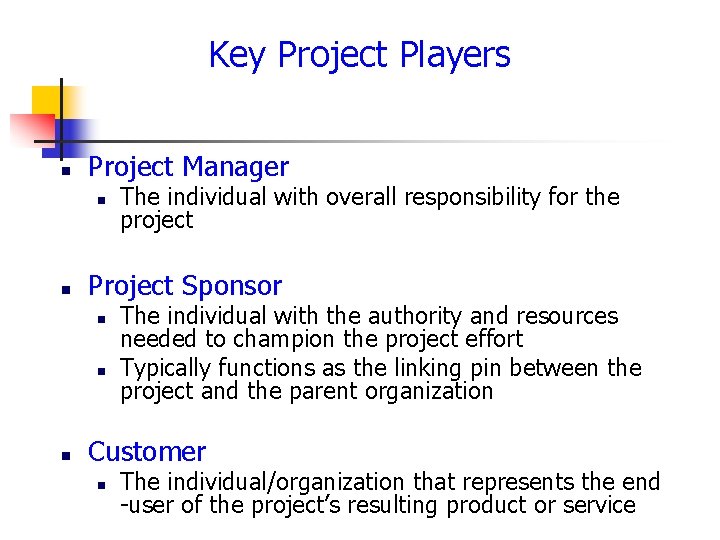
Key Project Players n Project Manager n n Project Sponsor n n n The individual with overall responsibility for the project The individual with the authority and resources needed to champion the project effort Typically functions as the linking pin between the project and the parent organization Customer n The individual/organization that represents the end -user of the project’s resulting product or service
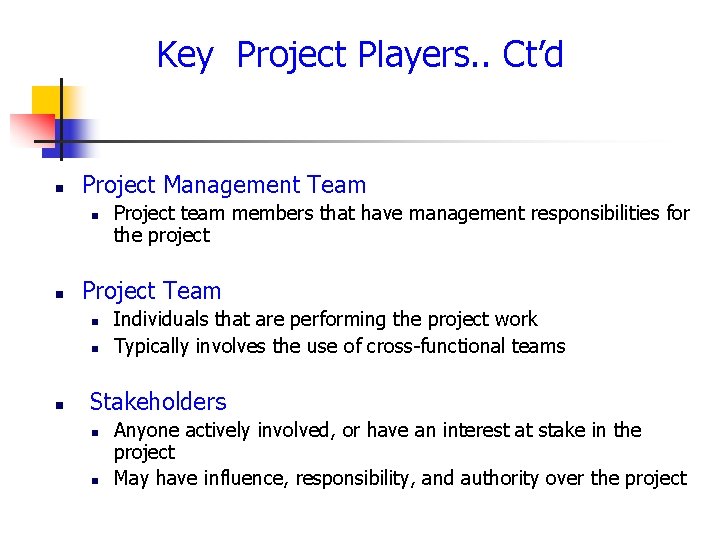
Key Project Players. . Ct’d n Project Management Team n n Project Team n n n Project team members that have management responsibilities for the project Individuals that are performing the project work Typically involves the use of cross-functional teams Stakeholders n n Anyone actively involved, or have an interest at stake in the project May have influence, responsibility, and authority over the project
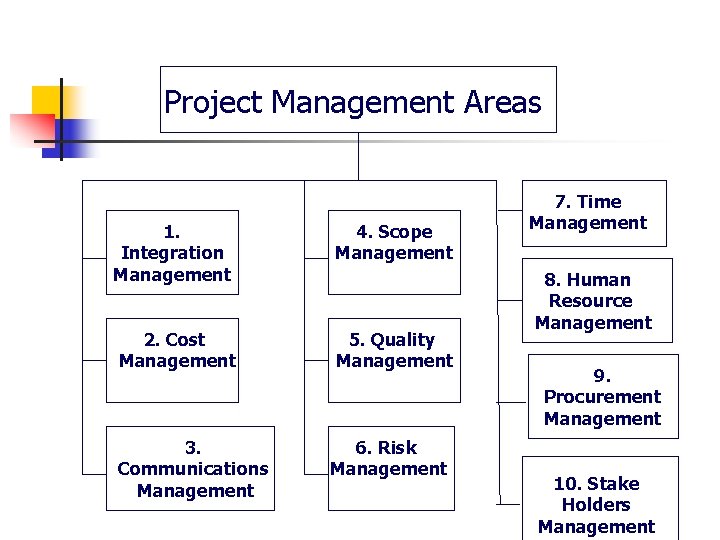
Project Management Areas 1. Integration Management 4. Scope Management 2. Cost Management 5. Quality Management 3. Communications Management 6. Risk Management 7. Time Management 8. Human Resource Management 9. Procurement Management 10. Stake Holders Management
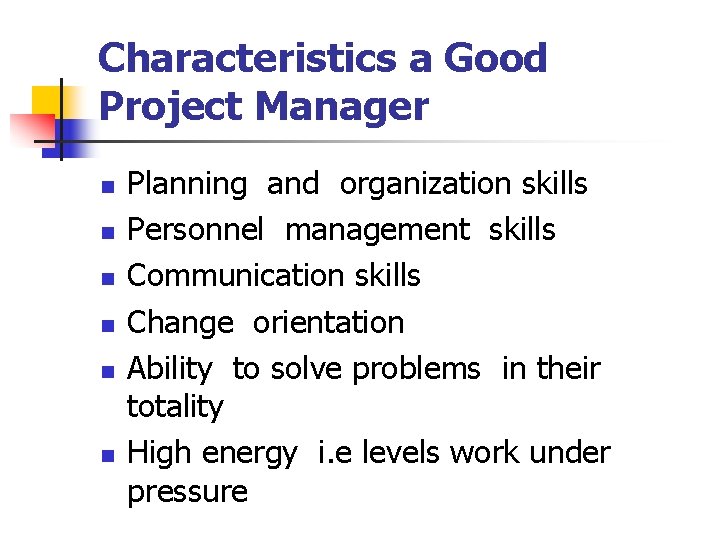
Characteristics a Good Project Manager n n n Planning and organization skills Personnel management skills Communication skills Change orientation Ability to solve problems in their totality High energy i. e levels work under pressure
Good Project Manager. . Ct’d n n n n Ambition for achievements Ability to take suggestions Understanding the views of the project team members Ability to develop alternative actions quickly Knowledge of project management methods and tools Ability to make self evaluation Effective time management
Good Project Manager. . Ct’d n n n n n Knowledge of technology Conflict resolving capacity Capacity to relate current events to project management Ability to handle project management software tools /packages Flair for sense of humour Solving issues /problems immediately without postponing them Initiative and risk taking ability Familiarity with the organization Tolerance for difference of opinion , delay ambiguity
Responsibilities Project Manager n n n Plan aspects of the project Control manpower and ensure optimization of resources needed by the project lead the people and organs assigned to the project at any given point in time Monitor performance and take corrective measures when necessary Complete the project on schedule and within costs
PROJECT LIFE CYCLE Five phases of Project life cycle: 1. Initiation : Conception &Definition phase 2. Planning phase 3. Executing/Implementation phase 4. Controlling and monitoring Phase 5. Closing phase
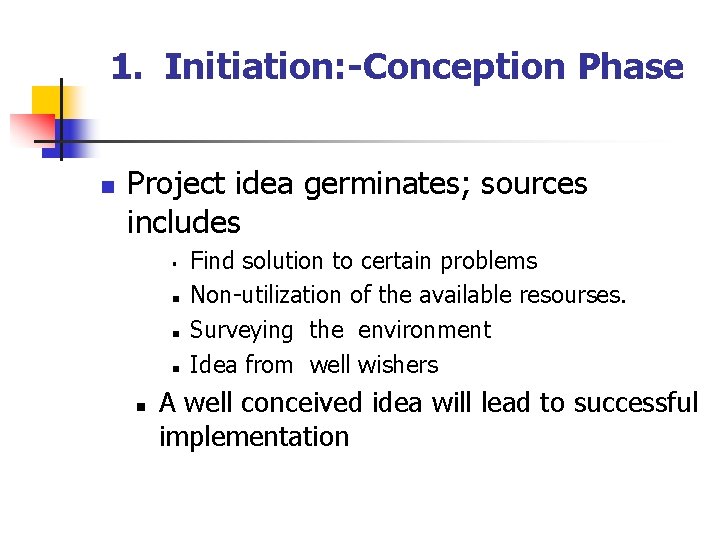
1. Initiation: -Conception Phase n Project idea germinates; sources includes § n n Find solution to certain problems Non-utilization of the available resourses. Surveying the environment Idea from well wishers A well conceived idea will lead to successful implementation
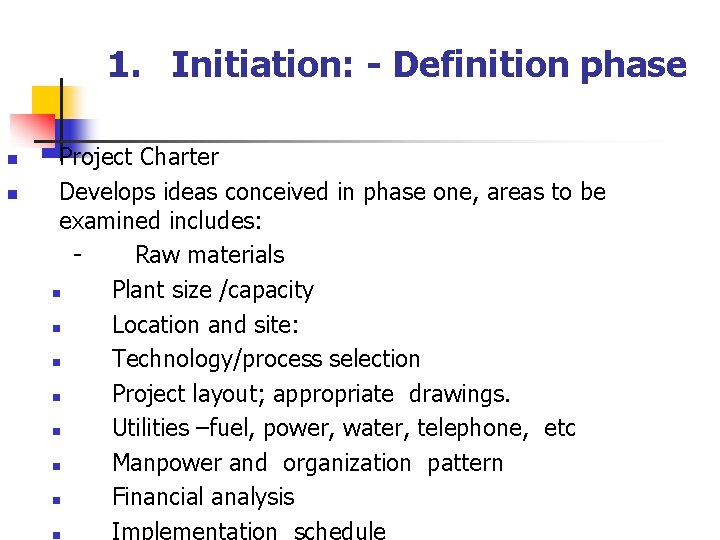
1. Initiation: - Definition phase n n Project Charter Develops ideas conceived in phase one, areas to be examined includes: Raw materials n Plant size /capacity n Location and site: n Technology/process selection n Project layout; appropriate drawings. n Utilities –fuel, power, water, telephone, etc n Manpower and organization pattern n Financial analysis n Implementation schedule
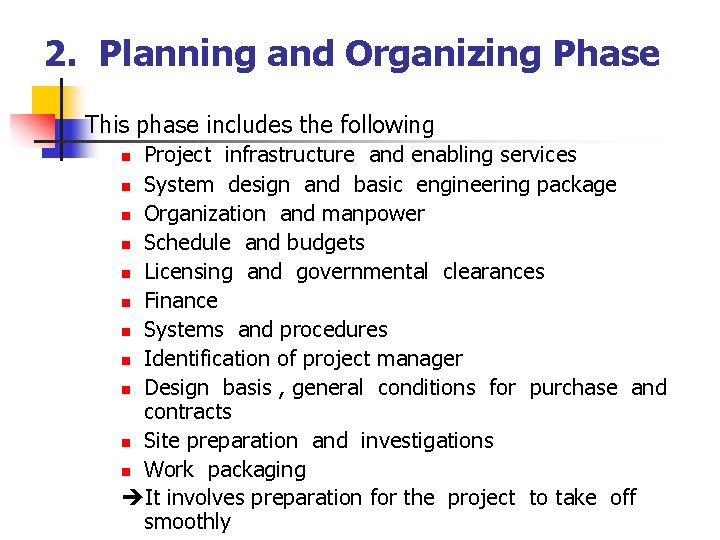
2. Planning and Organizing Phase This phase includes the following Project infrastructure and enabling services n System design and basic engineering package n Organization and manpower n Schedule and budgets n Licensing and governmental clearances n Finance n Systems and procedures n Identification of project manager n Design basis , general conditions for purchase and contracts n Site preparation and investigations n Work packaging It involves preparation for the project to take off smoothly n
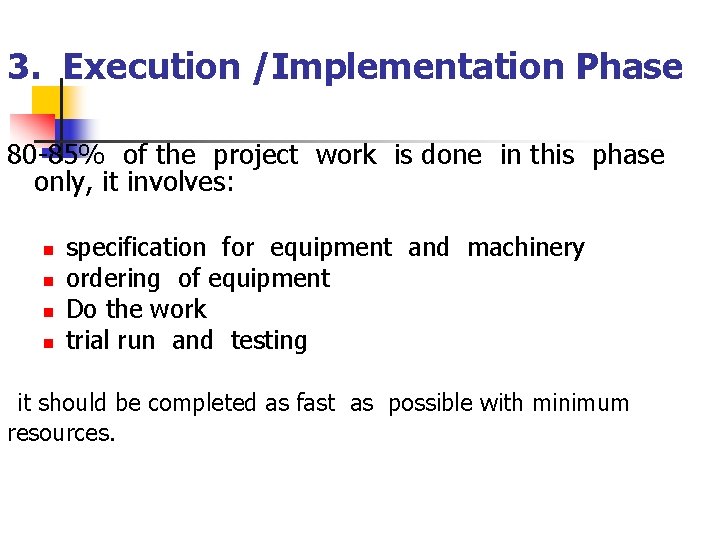
3. Execution /Implementation Phase 80 -85% of the project work is done in this phase only, it involves: n n specification for equipment and machinery ordering of equipment Do the work trial run and testing it should be completed as fast as possible with minimum resources.
4. Controlling and Monitoring n n Do the work tasks Monitor against the plan Report progress Manage the Change
5. Close-out Phase n n Evaluation by: n Customer n Stakeholders n Lessons learnt This is the handing over, the following are handed over to the client; n Drawings, Plans n Documents, files, operation manuals. n Maintenance manuals n Project accounts are closed, materials reconciliation carried out, outstanding payments made and dues collected.
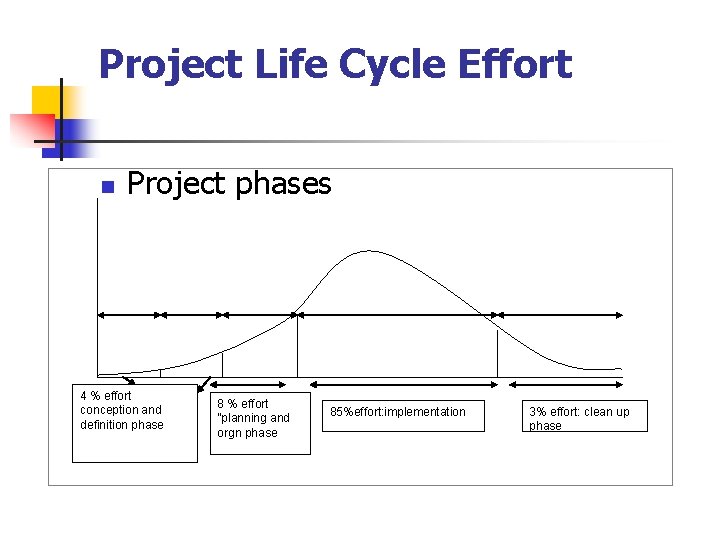
Project Life Cycle Effort n Project phases 4 % effort conception and definition phase 8 % effort ”planning and orgn phase 85%effort: implementation 3% effort: clean up phase
Tools and Techniques For PM n Project selection technologies n n n Project execution planning technologies n n n Cost benefit analysis Risk and sensitivity analysis Work break down structure (WBS) Project execution plan (PEP) Project responsibility matrix Project management manner Project scheduling and Coordinating techniques n n Bar charts Life cycle charts Line of balance (LOB) Networking techniques (PERT/ CPM)
Tools and Techniques For PM. . Ct’d n Project monitoring and progress techniques n n Project cost and Productivity Control Techniques n n n Project measurement technique (PROMPT) Performance monitoring techniques (PERMIT) Updating , renewing and reporting techniques (URT) productivity budgeting techniques value engineering (VE) and Project Communication and clean-up Techniques n n Control room and Computerized information systems.
Discussion n Consider and plan for yourmasters coursework study: n n What are the objectives and goal? Who are the stakeholders? Prepare a list and sequence plan of the activities, milestones. What are the risks?