
Lecture 1 Introduction to Population Genetics August 20
- Slides: 21
Lecture 1: Introduction to Population Genetics August 20, 2012
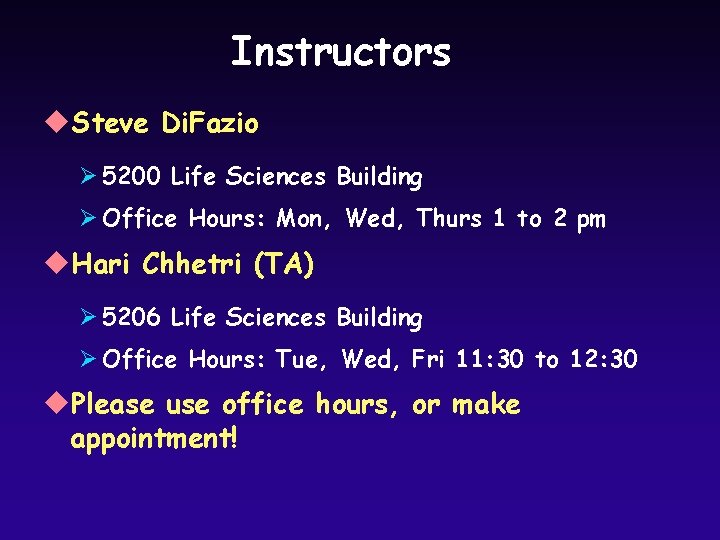
Instructors u. Steve Di. Fazio Ø 5200 Life Sciences Building Ø Office Hours: Mon, Wed, Thurs 1 to 2 pm u. Hari Chhetri (TA) Ø 5206 Life Sciences Building Ø Office Hours: Tue, Wed, Fri 11: 30 to 12: 30 u. Please use office hours, or make appointment!
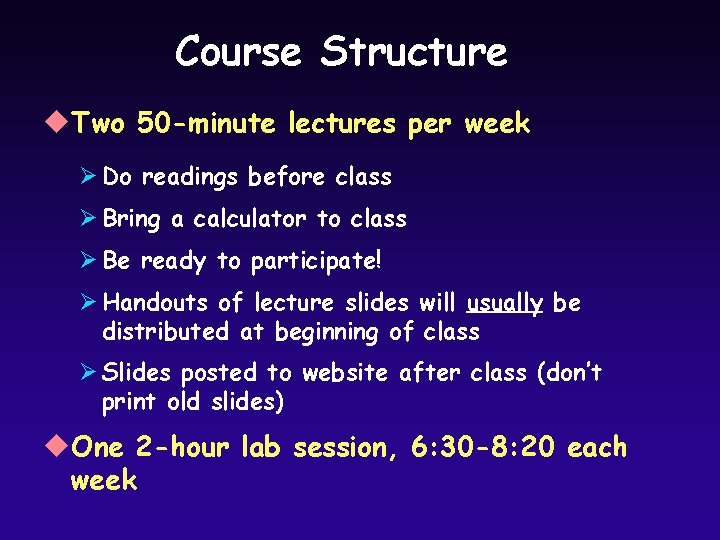
Course Structure u. Two 50 -minute lectures per week Ø Do readings before class Ø Bring a calculator to class Ø Be ready to participate! Ø Handouts of lecture slides will usually be distributed at beginning of class Ø Slides posted to website after class (don’t print old slides) u. One 2 -hour lab session, 6: 30 -8: 20 each week
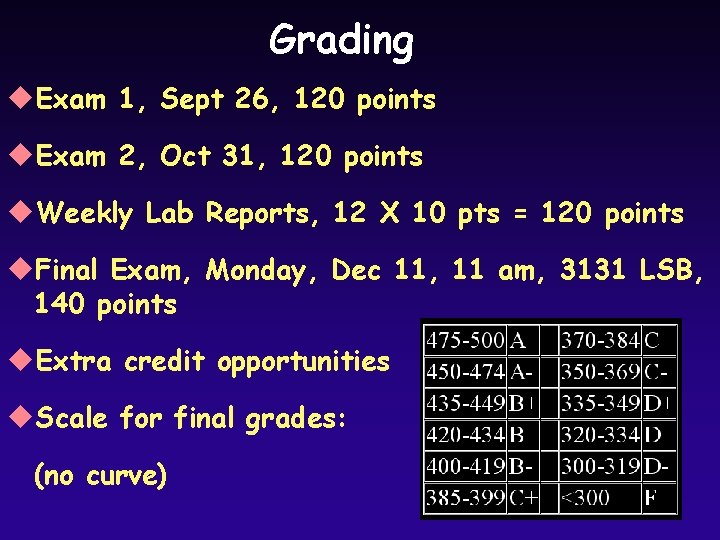
Grading u. Exam 1, Sept 26, 120 points u. Exam 2, Oct 31, 120 points u. Weekly Lab Reports, 12 X 10 pts = 120 points u. Final Exam, Monday, Dec 11, 11 am, 3131 LSB, 140 points u. Extra credit opportunities u. Scale for final grades: (no curve)
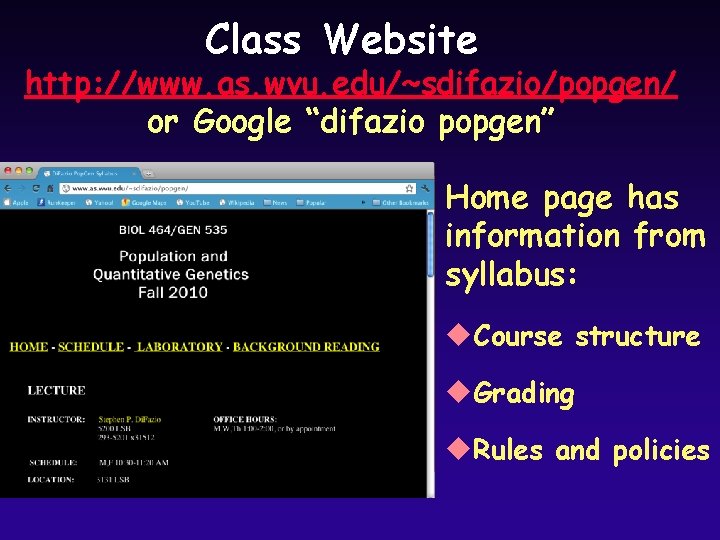
Class Website http: //www. as. wvu. edu/~sdifazio/popgen/ or Google “difazio popgen” Home page has information from syllabus: u. Course structure u. Grading u. Rules and policies
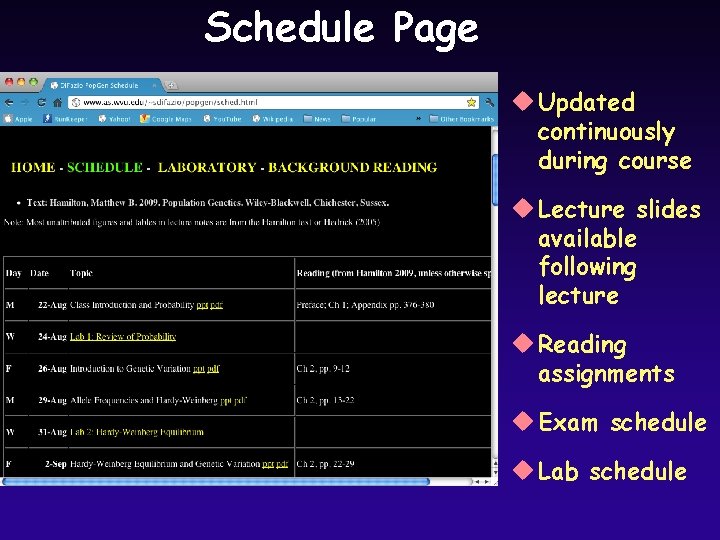
Schedule Page u Updated continuously during course u Lecture slides available following lecture u Reading assignments u Exam schedule u Lab schedule
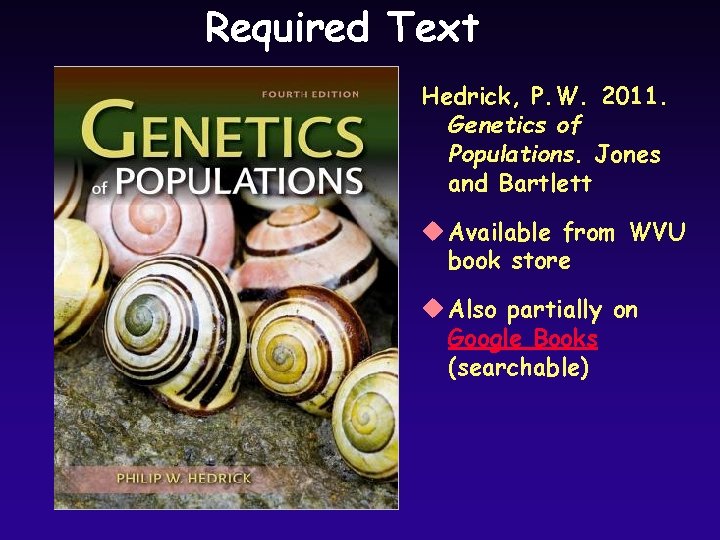
Required Text Hedrick, P. W. 2011. Genetics of Populations. Jones and Bartlett u Available from WVU book store u Also partially on Google Books (searchable)
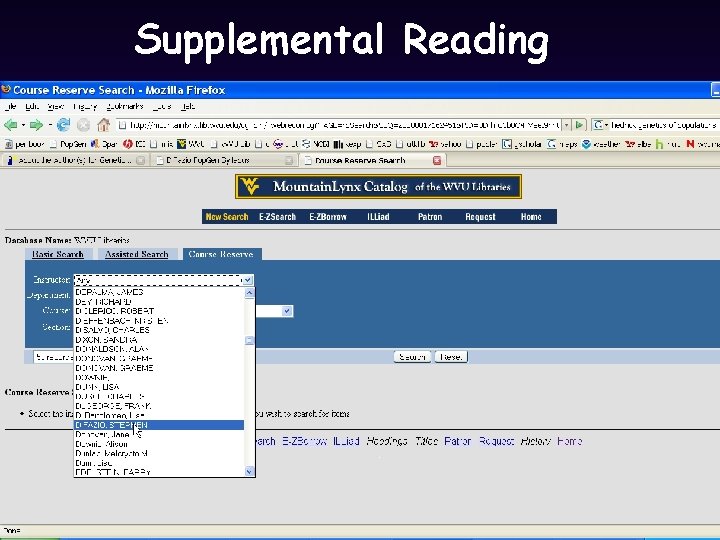
Supplemental Reading Three books on reserve in WVU downtown library: Mountain Lynx u Hamilton, M. 2009. Population Genetics. u Gillespie, J. H. 2004. Population Genetics: A Concise Guide. u Falconer, D. S. , and T. F. C. Mackay. 1996. Introduction to Quantitative Genetics.
Supplemental Reading
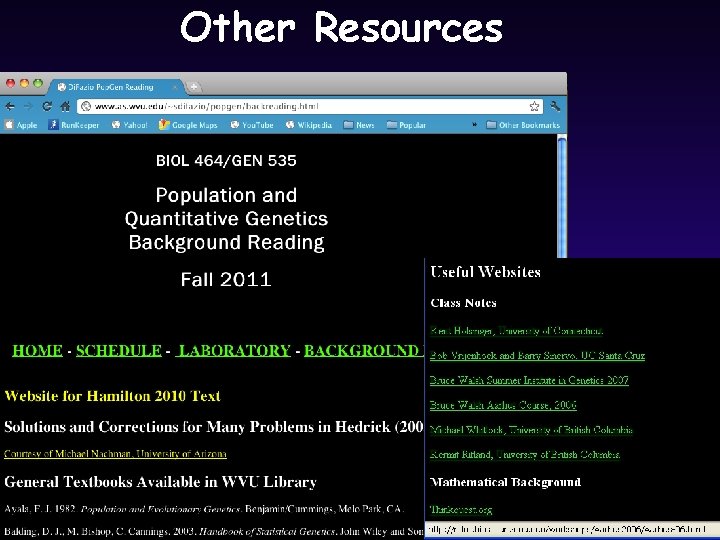
Other Resources
Laboratory u. TA: Hari Chhetri u. Tightly linked to lectures u. Intended as “Active Learning” modules Ø Enhance understanding of concepts and principles Ø Provide hands-on introduction to Population Genetics software u. Every Wednesday evening, 6: 30 to 8: 20 pm u 3306 Life Sciences Building (Biology computer lab) u. Bring a calculator and your lab manual
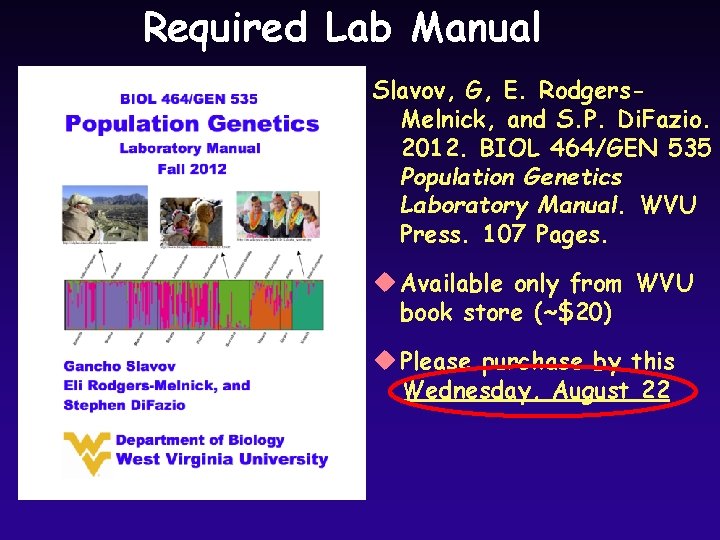
Required Lab Manual Slavov, G, E. Rodgers. Melnick, and S. P. Di. Fazio. 2012. BIOL 464/GEN 535 Population Genetics Laboratory Manual. WVU Press. 107 Pages. u Available only from WVU book store (~$20) u Please purchase by this Wednesday, August 22
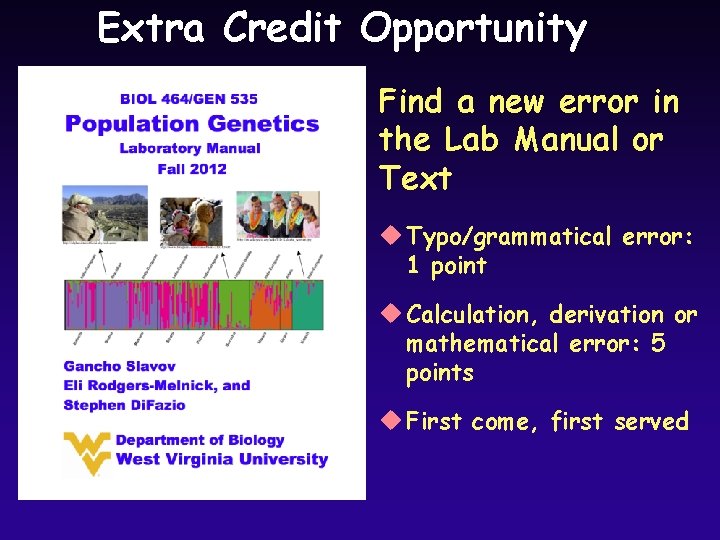
Extra Credit Opportunity Find a new error in the Lab Manual or Text u Typo/grammatical error: 1 point u Calculation, derivation or mathematical error: 5 points u First come, first served
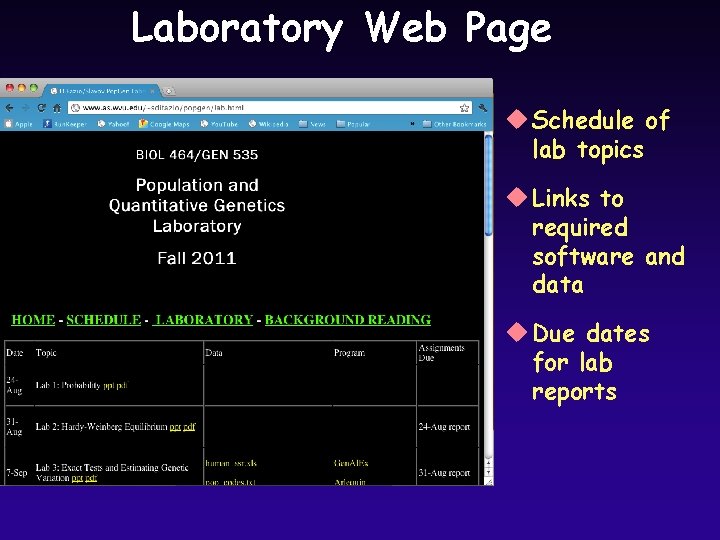
Laboratory Web Page u Schedule of lab topics u Links to required software and data u Due dates for lab reports
Lab Reports u Lab reports due at beginning of lab period Ø 12 total, worth 10 points each Ø Deduct 0. 5 points for each day late Ø Last report is optional: up to 10 pts extra credit u Guidelines for lab report are in lab manual u Email and/or paper versions are fine u Most weeks require a write-up with interpretations for each calculation or simulation u Please be careful to fully answer questions, including explanations of results from biological standpoint
Working Together and Academic Honesty u. Group work in laboratory is optional but encouraged u. It is fine to discuss lab problems and work on them together u. HOWEVER, your lab report must be your original work Ø See academic honesty policy on class website u. Exams are based primarily on the lab exercises and examples worked in class
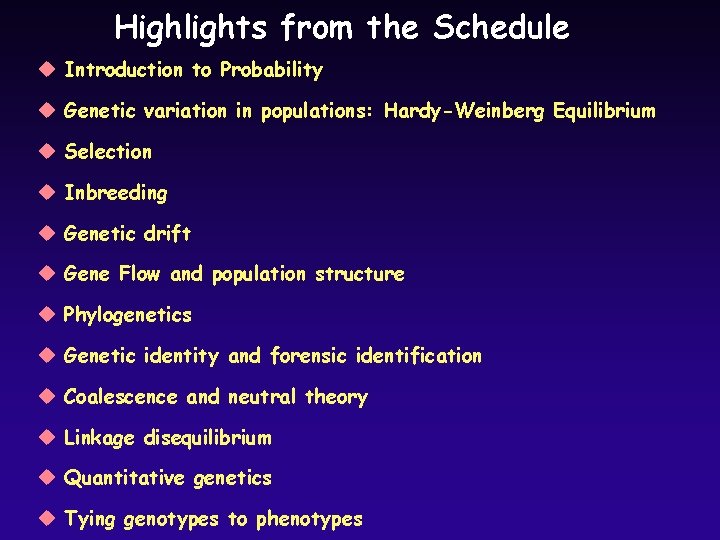
Highlights from the Schedule u Introduction to Probability u Genetic variation in populations: Hardy-Weinberg Equilibrium u Selection u Inbreeding u Genetic drift u Gene Flow and population structure u Phylogenetics u Genetic identity and forensic identification u Coalescence and neutral theory u Linkage disequilibrium u Quantitative genetics u Tying genotypes to phenotypes
What is Evolution?
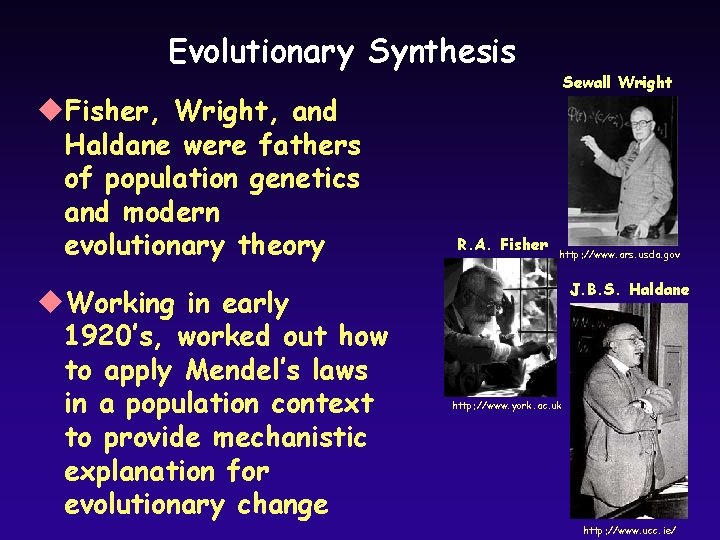
Evolutionary Synthesis u. Fisher, Wright, and Haldane were fathers of population genetics and modern evolutionary theory u. Working in early 1920’s, worked out how to apply Mendel’s laws in a population context to provide mechanistic explanation for evolutionary change R. A. Fisher Sewall Wright http: //www. ars. usda. gov J. B. S. Haldane http: //www. york. ac. uk http: //www. ucc. ie/
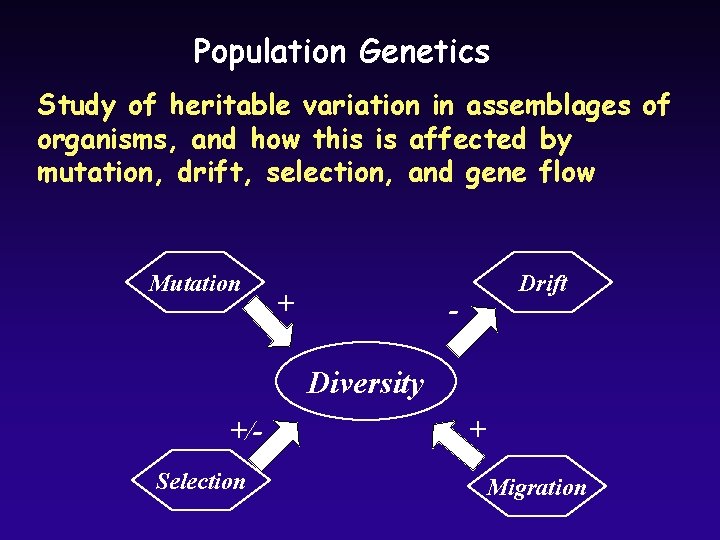
Population Genetics Study of heritable variation in assemblages of organisms, and how this is affected by mutation, drift, selection, and gene flow Mutation + Drift - Diversity +/Selection + Migration
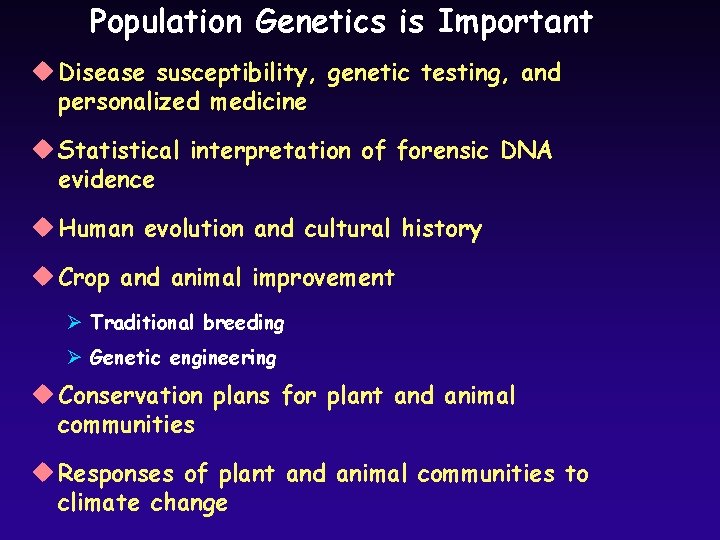
Population Genetics is Important u Disease susceptibility, genetic testing, and personalized medicine u Statistical interpretation of forensic DNA evidence u Human evolution and cultural history u Crop and animal improvement Ø Traditional breeding Ø Genetic engineering u Conservation plans for plant and animal communities u Responses of plant and animal communities to climate change