
Lecture 1 Introduction to Mineralogy Mineralogy The study
- Slides: 42
Lecture 1 Introduction to Mineralogy
Mineralogy The study of the chemistry, atomic structure, physical properties, and genesis of minerals
Some Mineralogy Topics l Crystal Chemistry – relationship of chemical composition to atomic structure l Descriptive Mineralogy – documenting physical and optical properties l Crystallography – relationship of crystal symmetry and form to atomic structure l Mineral Genesis – interpreting the geologic setting in which a mineral forms from its physical, chemical, and structural attributes and its associated minerals
Mineralogy is fundamental to an understanding of Geology l Petrology – the origin of rocks, evaluating the structure, texture, and chemistry of their minerals. l Geochemistry – study of the chemistry of minerals at the surface and at high P-T l Structural Geology– Deformation of a rock and the orientation and crystal structure of its minerals l Weathering – the study of how the biosphere, hydrosphere, and atmosphere interact with minerals l Economic Geology – study of the origin and concentration of ore deposits
Definition A mineral is a naturally occurring solid with a highly ordered atomic arrangement and a definite (but not fixed) chemical composition. It is usually formed by inorganic processes
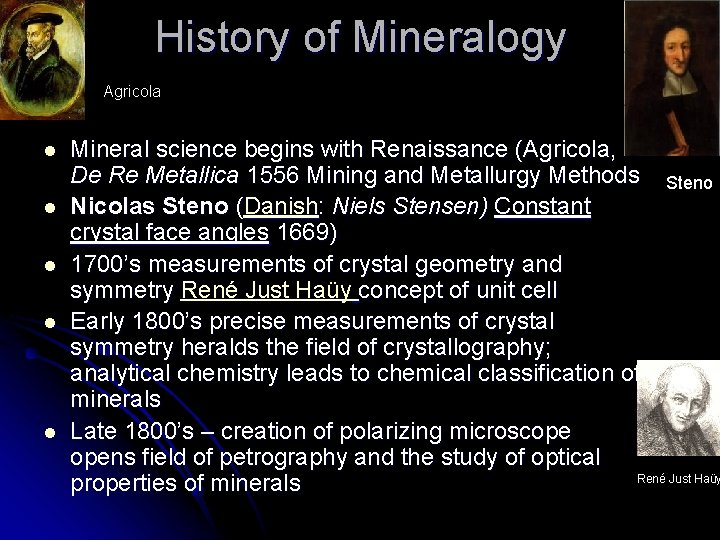
History of Mineralogy Agricola l l l Mineral science begins with Renaissance (Agricola, De Re Metallica 1556 Mining and Metallurgy Methods Steno Nicolas Steno (Danish: Niels Stensen) Constant crystal face angles 1669) 1700’s measurements of crystal geometry and symmetry René Just Haüy concept of unit cell symmetry Early 1800’s precise measurements of crystal symmetry heralds the field of crystallography; analytical chemistry leads to chemical classification of minerals Late 1800’s – creation of polarizing microscope opens field of petrography and the study of optical René Just Haüy properties of minerals
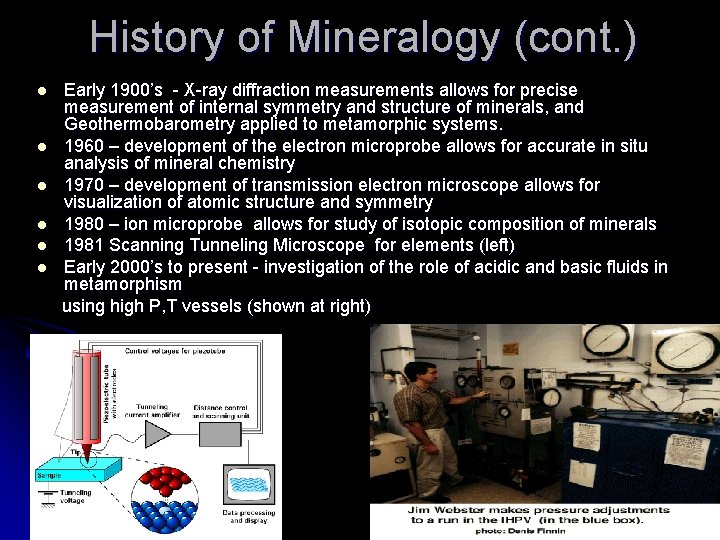
History of Mineralogy (cont. ) Early 1900’s - X-ray diffraction measurements allows for precise measurement of internal symmetry and structure of minerals, and Geothermobarometry applied to metamorphic systems. l 1960 – development of the electron microprobe allows for accurate in situ analysis of mineral chemistry l 1970 – development of transmission electron microscope allows for visualization of atomic structure and symmetry l 1980 – ion microprobe allows for study of isotopic composition of minerals l 1981 Scanning Tunneling Microscope for elements (left) l Early 2000’s to present - investigation of the role of acidic and basic fluids in metamorphism using high P, T vessels (shown at right) l
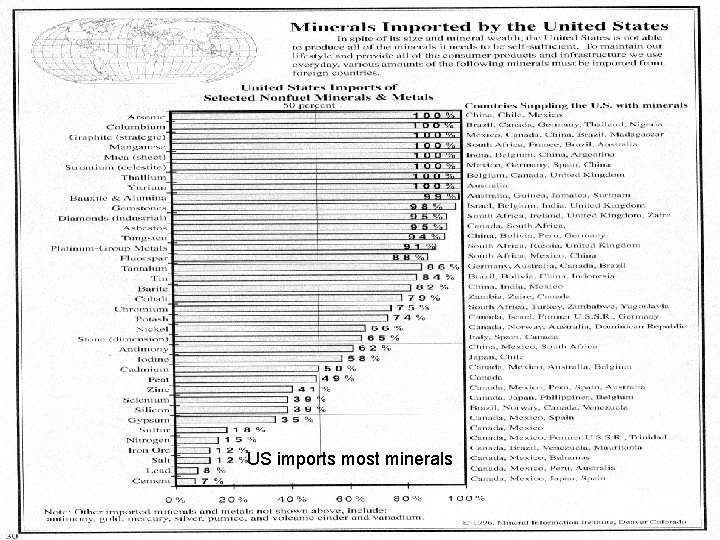
US imports most minerals
Classification & Naming of Minerals l Classified by anion (oxides, silicates, sulfides, halides, phosphates, …. ) l Classified by internal crystal structure l Named for places, people, chemistry
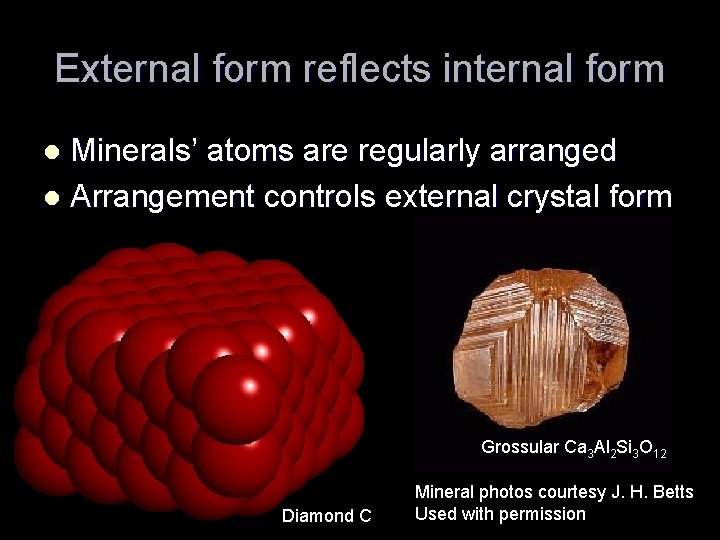
External form reflects internal form Minerals’ atoms are regularly arranged l Arrangement controls external crystal form l Grossular Ca 3 Al 2 Si 3 O 12 Diamond C Mineral photos courtesy J. H. Betts Used with permission
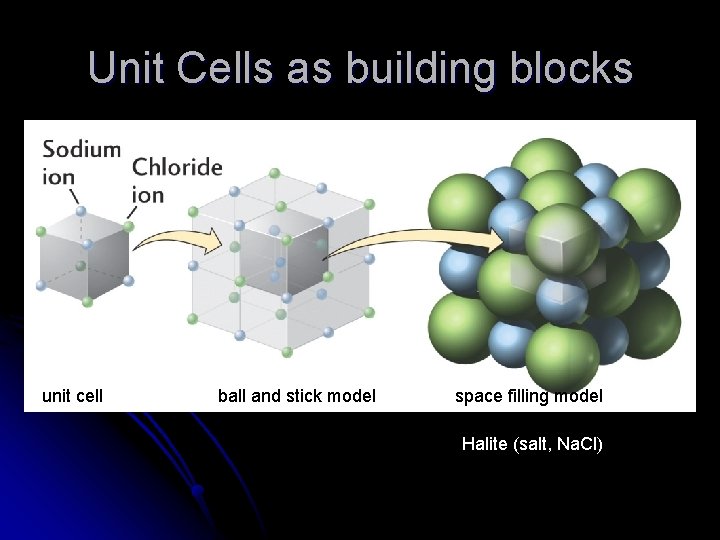
Unit Cells as building blocks unit cell ball and stick model space filling model Halite (salt, Na. Cl)
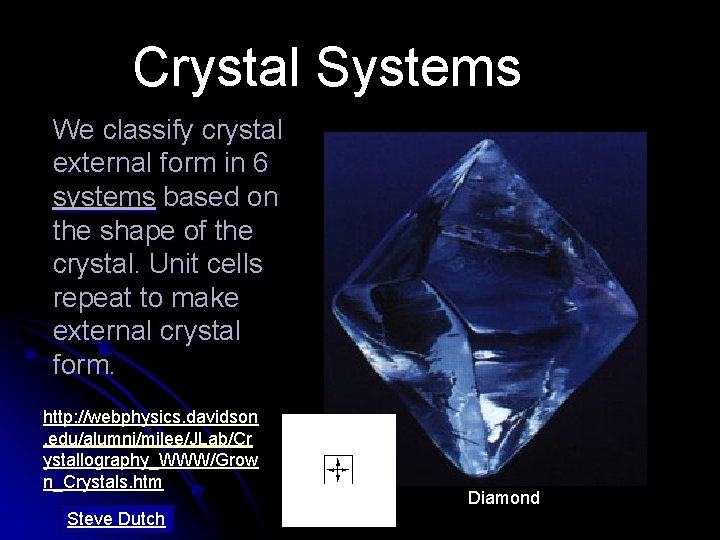
Crystal Systems We classify crystal external form in 6 systems based on the shape of the crystal. Unit cells repeat to make external crystal form. http: //webphysics. davidson. edu/alumni/milee/JLab/Cr ystallography_WWW/Grow n_Crystals. htm Steve Dutch Diamond
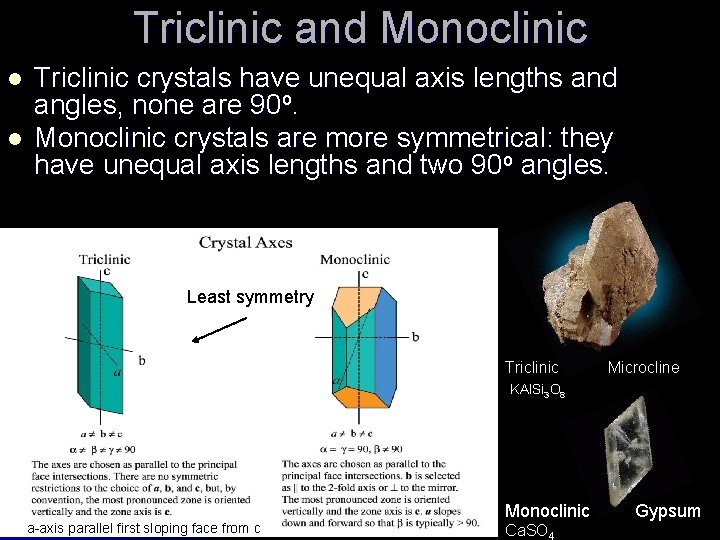
Triclinic and Monoclinic l l Triclinic crystals have unequal axis lengths and angles, none are 90 o. Monoclinic crystals are more symmetrical: they have unequal axis lengths and two 90 o angles. Least symmetry Triclinic Microcline KAl. Si 3 O 8 a-axis parallel first sloping face from c Monoclinic Gypsum Ca. SO
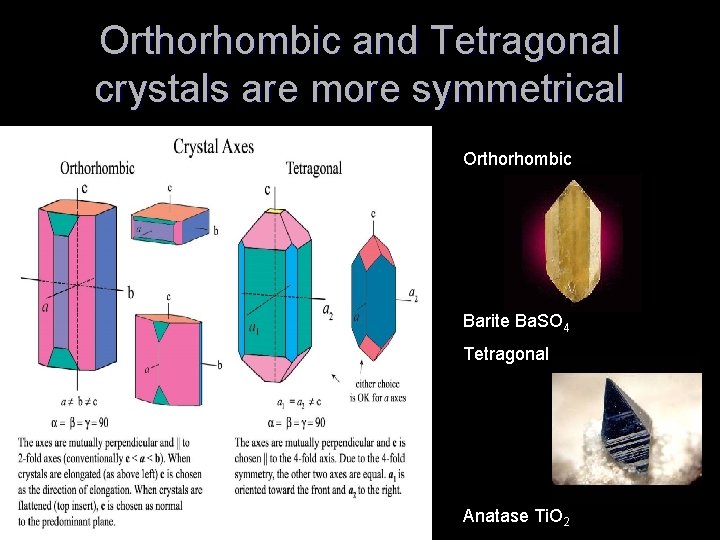
Orthorhombic and Tetragonal crystals are more symmetrical Orthorhombic Barite Ba. SO 4 Tetragonal Anatase Ti. O 2
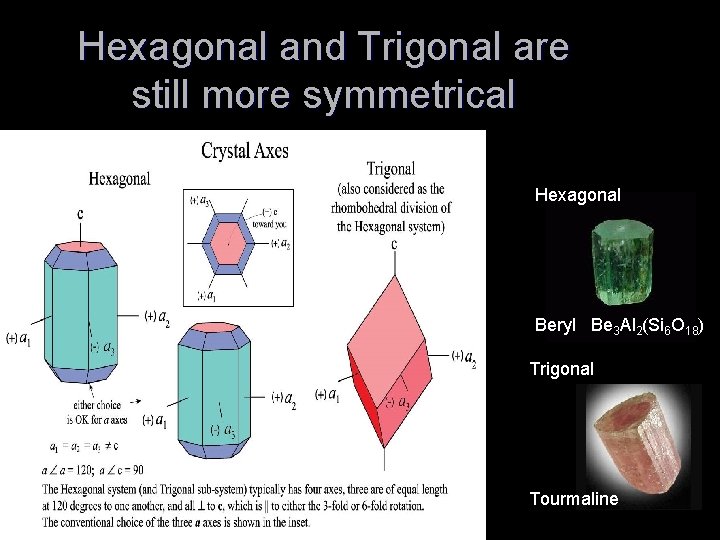
Hexagonal and Trigonal are still more symmetrical Hexagonal Beryl Be 3 Al 2(Si 6 O 18) Trigonal Tourmaline
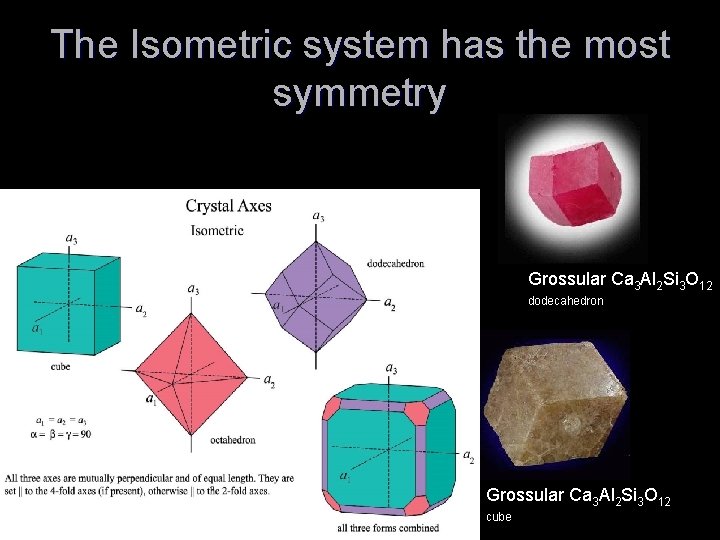
The Isometric system has the most symmetry Grossular Ca 3 Al 2 Si 3 O 12 dodecahedron Grossular Ca 3 Al 2 Si 3 O 12 cube
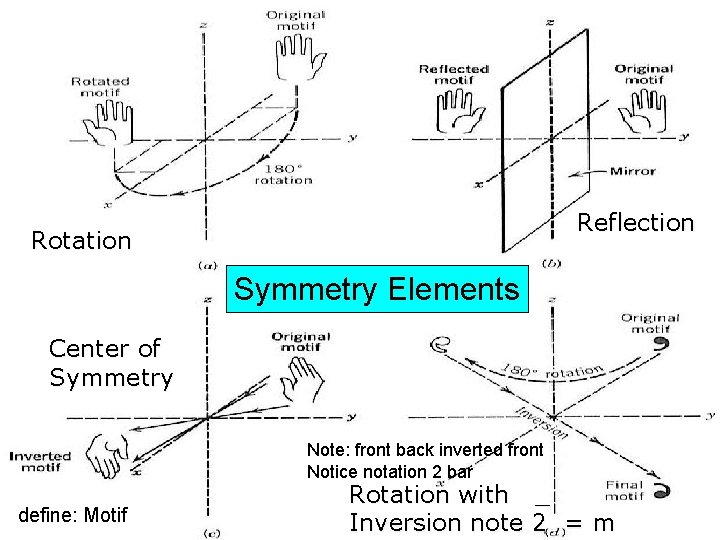
Reflection Rotation Symmetry Elements Center of Symmetry Note: front back inverted front Notice notation 2 bar define: Motif Rotation with _ Inversion note 2 = m
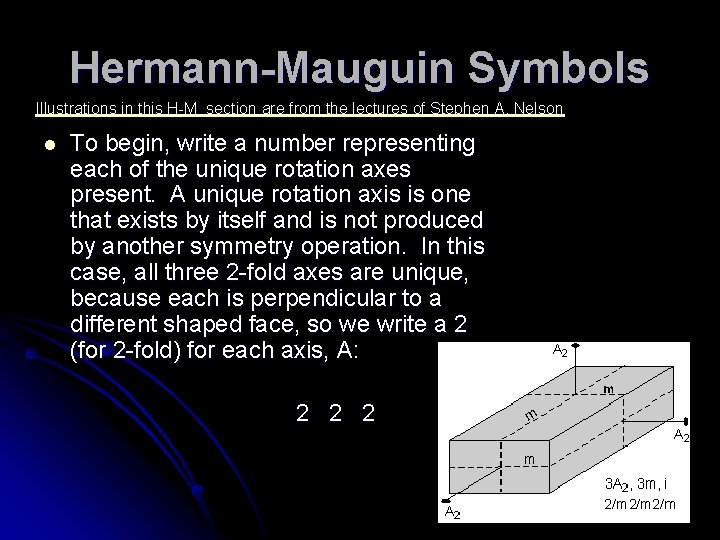
Hermann-Mauguin Symbols Illustrations in this H-M section are from the lectures of Stephen A. Nelson l To begin, write a number representing each of the unique rotation axes present. A unique rotation axis is one that exists by itself and is not produced by another symmetry operation. In this case, all three 2 -fold axes are unique, because each is perpendicular to a different shaped face, so we write a 2 (for 2 -fold) for each axis, A: 2 2 2
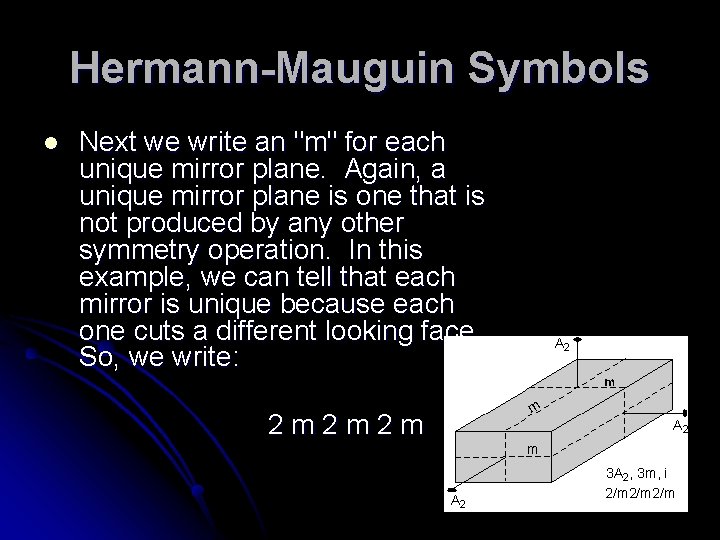
Hermann-Mauguin Symbols l Next we write an "m" for each unique mirror plane. Again, a unique mirror plane is one that is not produced by any other symmetry operation. In this example, we can tell that each mirror is unique because each one cuts a different looking face. So, we write: 2 m 2 m
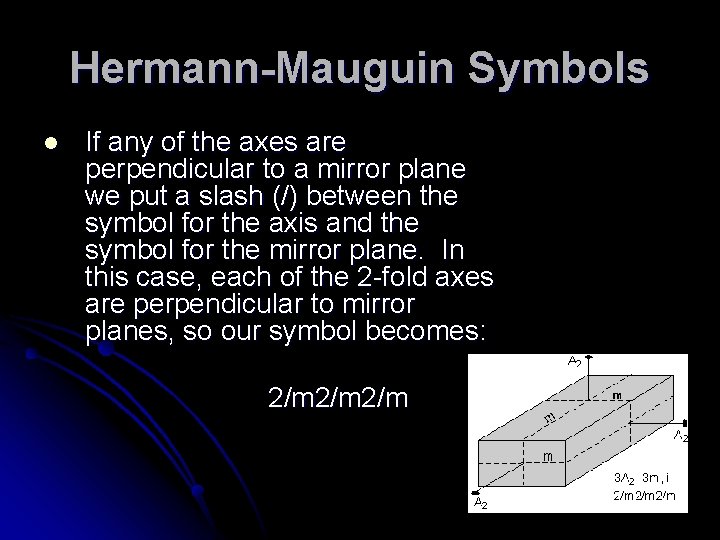
Hermann-Mauguin Symbols l If any of the axes are perpendicular to a mirror plane we put a slash (/) between the symbol for the axis and the symbol for the mirror plane. In this case, each of the 2 -fold axes are perpendicular to mirror planes, so our symbol becomes: 2/m 2/m
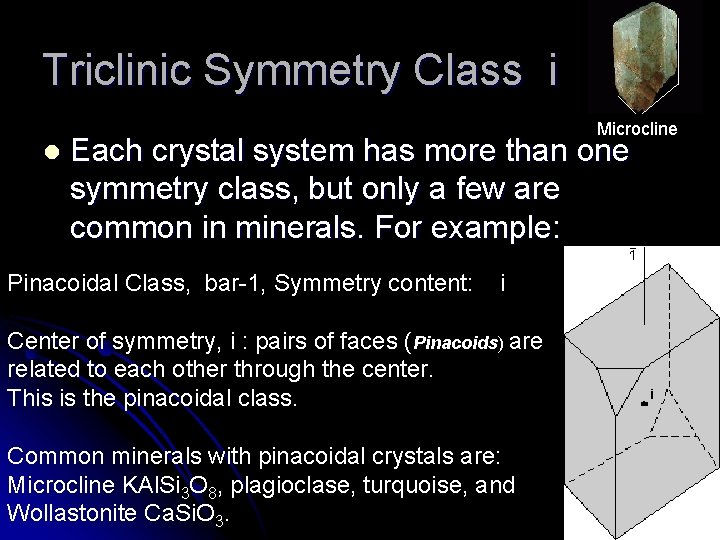
Triclinic Symmetry Class i l Microcline Each crystal system has more than one symmetry class, but only a few are common in minerals. For example: Pinacoidal Class, bar-1, Symmetry content: i Center of symmetry, i : pairs of faces (Pinacoids) are related to each other through the center. This is the pinacoidal class. Common minerals with pinacoidal crystals are: Microcline KAl. Si 3 O 8, plagioclase, turquoise, and Wollastonite Ca. Si. O 3.
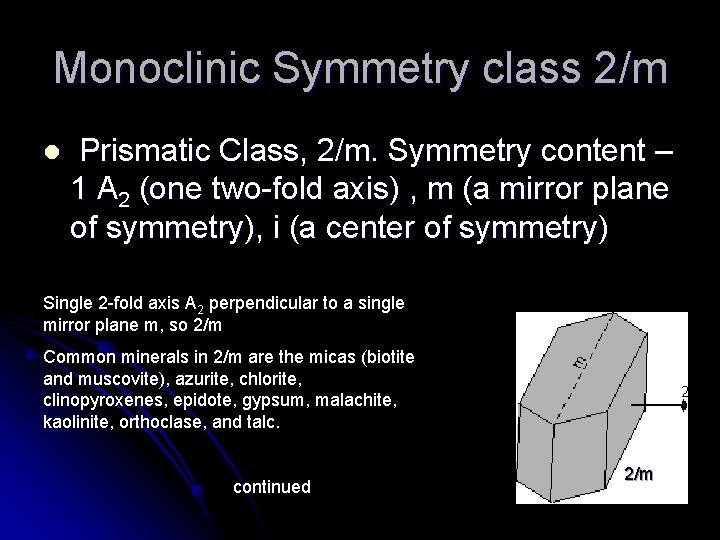
Monoclinic Symmetry class 2/m l Prismatic Class, 2/m. Symmetry content – 1 A 2 (one two-fold axis) , m (a mirror plane of symmetry), i (a center of symmetry) Single 2 -fold axis A 2 perpendicular to a single mirror plane m, so 2/m Common minerals in 2/m are the micas (biotite and muscovite), azurite, chlorite, clinopyroxenes, epidote, gypsum, malachite, kaolinite, orthoclase, and talc. continued 2/m
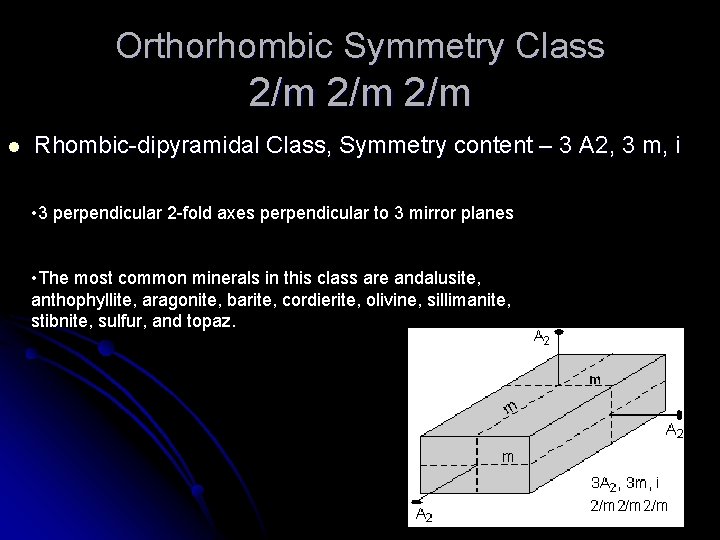
Orthorhombic Symmetry Class 2/m 2/m l Rhombic-dipyramidal Class, Symmetry content – 3 A 2, 3 m, i • 3 perpendicular 2 -fold axes perpendicular to 3 mirror planes • The most common minerals in this class are andalusite, anthophyllite, aragonite, barite, cordierite, olivine, sillimanite, stibnite, sulfur, and topaz.
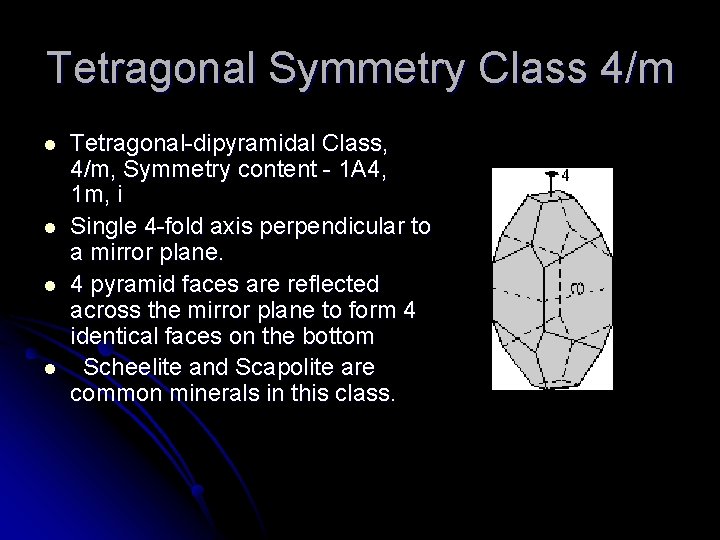
Tetragonal Symmetry Class 4/m l l Tetragonal-dipyramidal Class, 4/m, Symmetry content - 1 A 4, 1 m, i Single 4 -fold axis perpendicular to a mirror plane. 4 pyramid faces are reflected across the mirror plane to form 4 identical faces on the bottom Scheelite and Scapolite are common minerals in this class.
You get the idea l As we get to more symmetric crystals they get more difficult to draw and describe. l For Hexagonal (including Trigonal) and Isometric crystal classes, please refer to your text
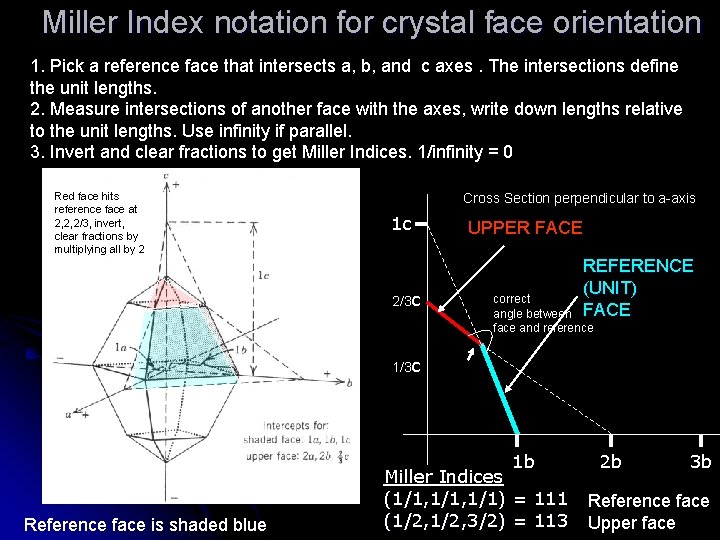
Miller Index notation for crystal face orientation 1. Pick a reference face that intersects a, b, and c axes. The intersections define the unit lengths. 2. Measure intersections of another face with the axes, write down lengths relative to the unit lengths. Use infinity if parallel. 3. Invert and clear fractions to get Miller Indices. 1/infinity = 0 Red face hits reference face at 2, 2, 2/3, invert, clear fractions by multiplying all by 2 Cross Section perpendicular to a-axis 1 c 2/3 c UPPER FACE REFERENCE (UNIT) FACE correct angle between face and reference 1/3 c 1 b Reference face is shaded blue Miller Indices (1/1, 1/1) = 111 (1/2, 3/2) = 113 2 b 3 b Reference face Upper face
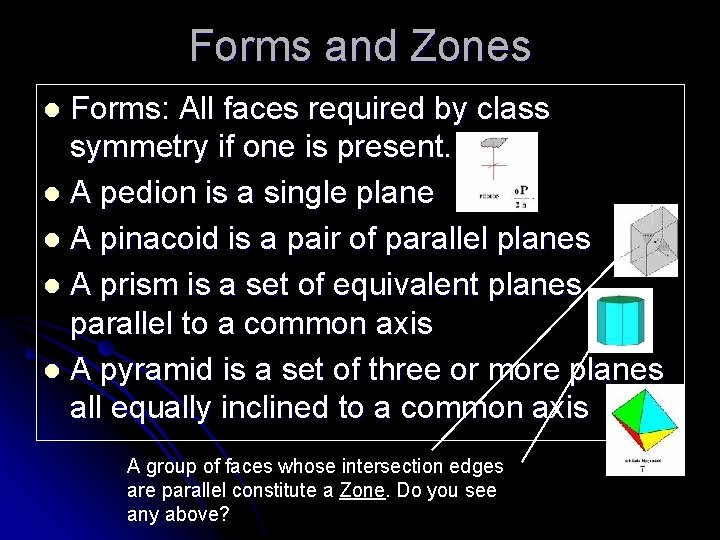
Forms and Zones Forms: All faces required by class symmetry if one is present. l A pedion is a single plane l A pinacoid is a pair of parallel planes l A prism is a set of equivalent planes parallel to a common axis l A pyramid is a set of three or more planes all equally inclined to a common axis l A group of faces whose intersection edges are parallel constitute a Zone. Do you see any above?
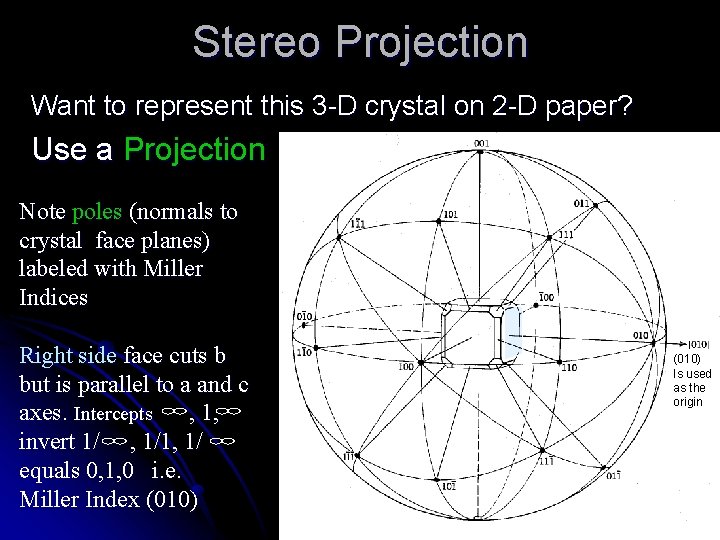
Stereo Projection Want to represent this 3 -D crystal on 2 -D paper? Use a Projection Note poles (normals to crystal face planes) labeled with Miller Indices Right side face cuts b but is parallel to a and c axes. Intercepts , 1, invert 1/ , 1/1, 1/ equals 0, 1, 0 i. e. Miller Index (010) Is used as the origin
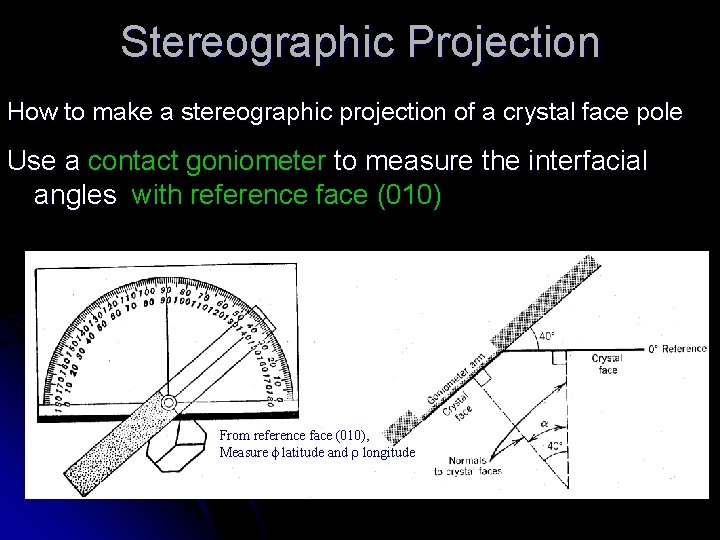
Stereographic Projection How to make a stereographic projection of a crystal face pole Use a contact goniometer to measure the interfacial angles with reference face (010) From reference face (010), Measure f latitude and r longitude
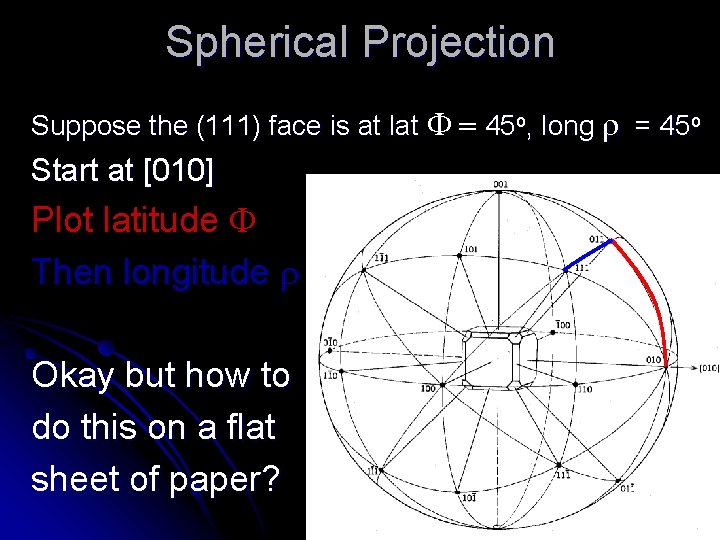
Spherical Projection Suppose the (111) face is at lat F = 45 o, long r = 45 o Start at [010] Plot latitude F Then longitude r Okay but how to do this on a flat sheet of paper?
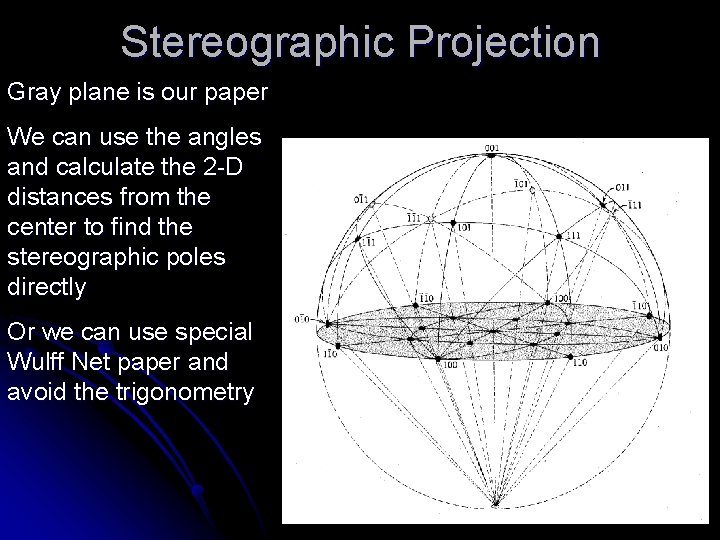
Stereographic Projection Gray plane is our paper We can use the angles and calculate the 2 -D distances from the center to find the stereographic poles directly Or we can use special Wulff Net paper and avoid the trigonometry
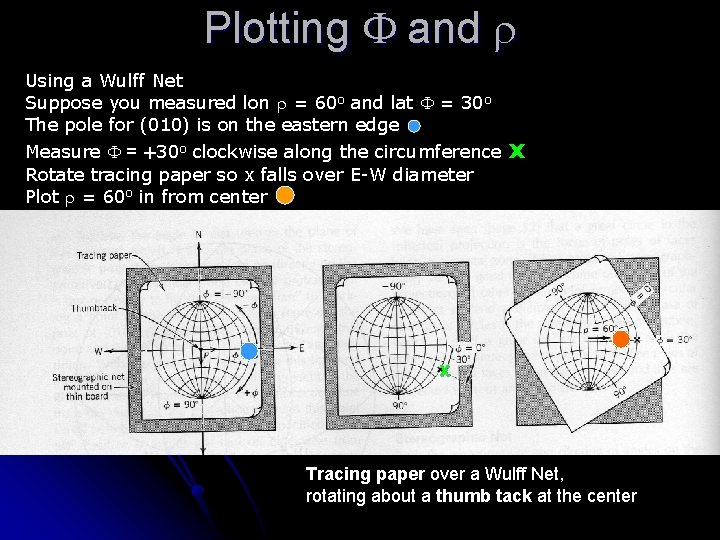
Plotting F and r Using a Wulff Net Suppose you measured lon r = 60 o and lat F = 30 o The pole for (010) is on the eastern edge Measure F = +30 o clockwise along the circumference Rotate tracing paper so x falls over E-W diameter Plot r = 60 o in from center x x Tracing paper over a Wulff Net, rotating about a thumb tack at the center
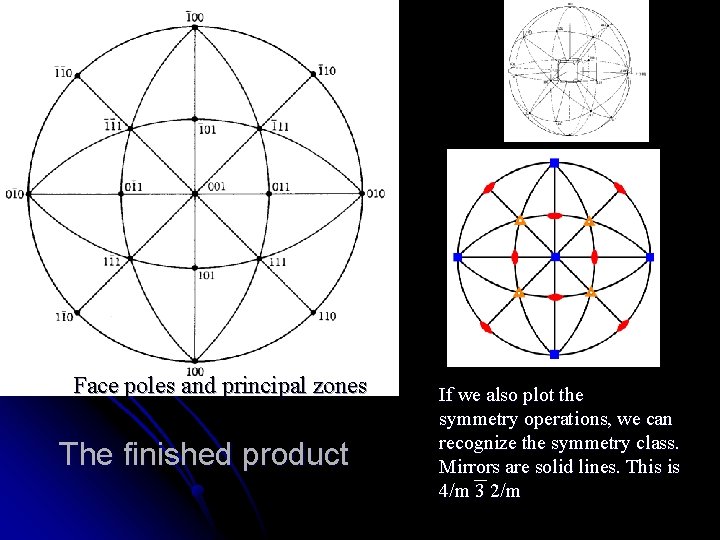
Face poles and principal zones The finished product If we also plot the symmetry operations, we can recognize the symmetry class. Mirrors are solid lines. This is 4/m 3 2/m
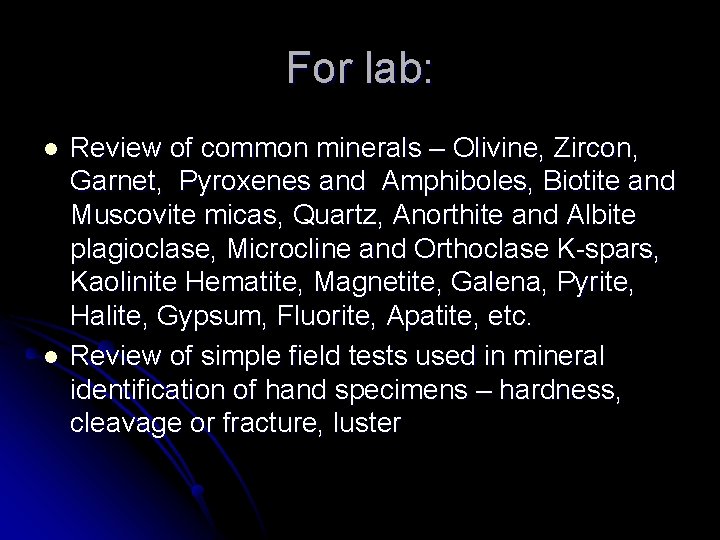
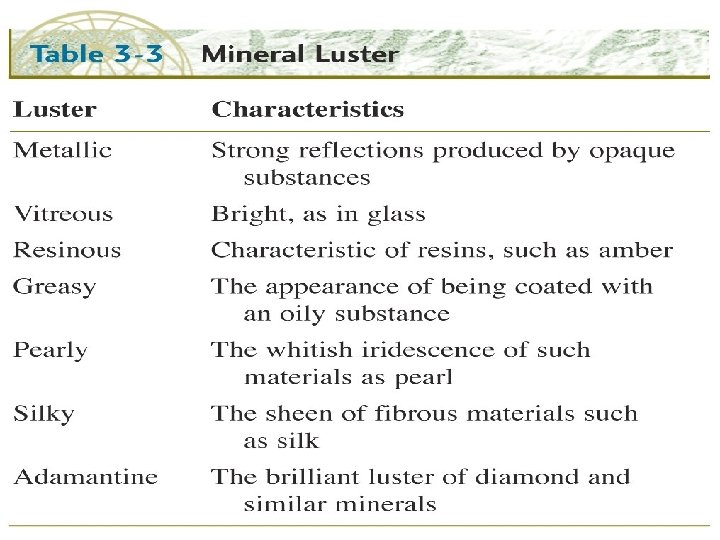
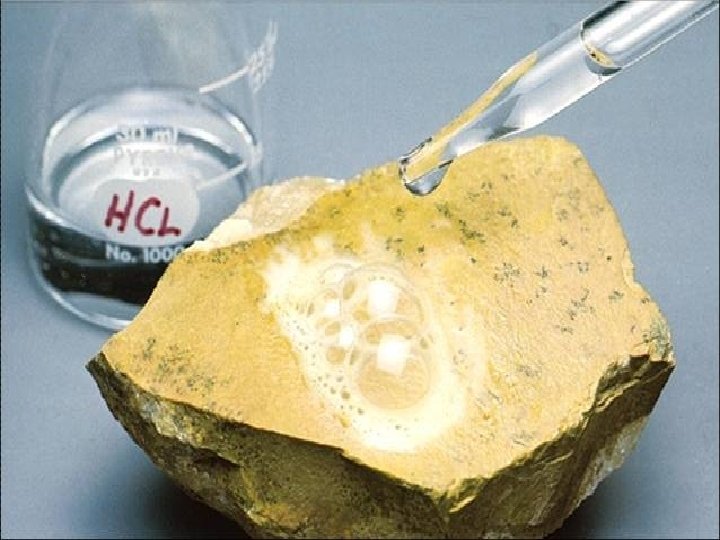
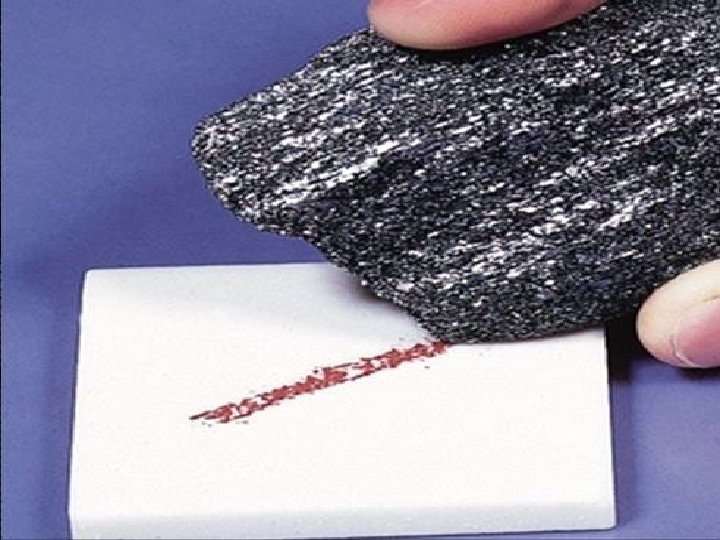
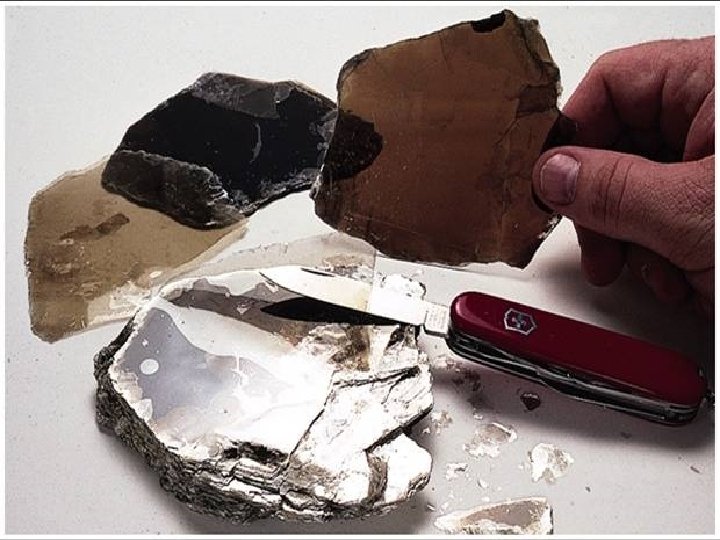
For lab: l l Review of common minerals – Olivine, Zircon, Garnet, Pyroxenes and Amphiboles, Biotite and Muscovite micas, Quartz, Anorthite and Albite plagioclase, Microcline and Orthoclase K-spars, Kaolinite Hematite, Magnetite, Galena, Pyrite, Halite, Gypsum, Fluorite, Apatite, etc. Review of simple field tests used in mineral identification of hand specimens – hardness, cleavage or fracture, luster
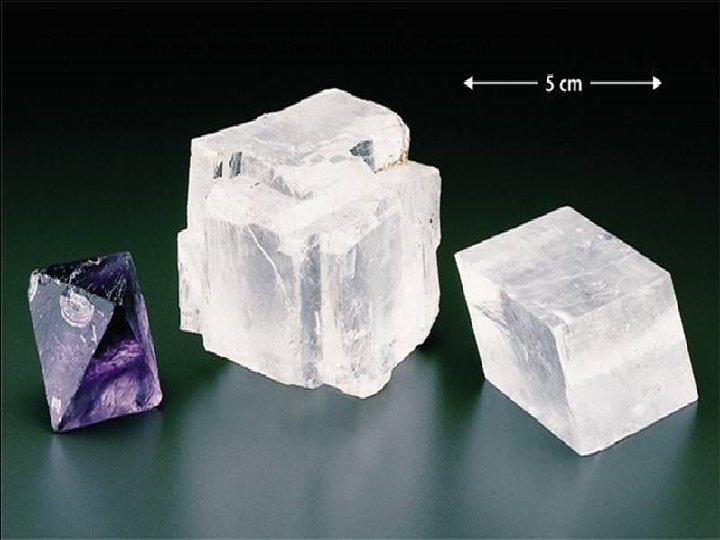
3 Cleavage planes, Fluorite, Halite, Calcite
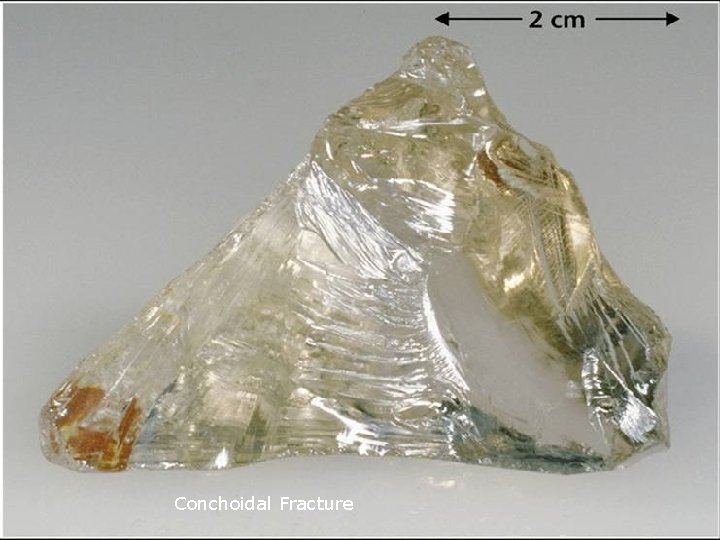
Conchoidal Fracture