
Lecture 1 Introduction To Infrastructure Urban Infrastructure Water

Lecture 1 Introduction To Infrastructure
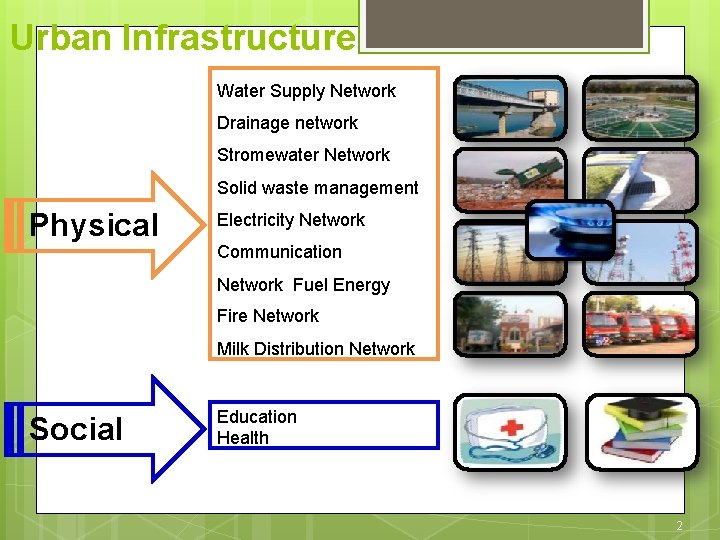
Urban Infrastructure Water Supply Network Drainage network Stromewater Network Solid waste management Physical Electricity Network Communication Network Fuel Energy Fire Network Milk Distribution Network Social Education Health 2
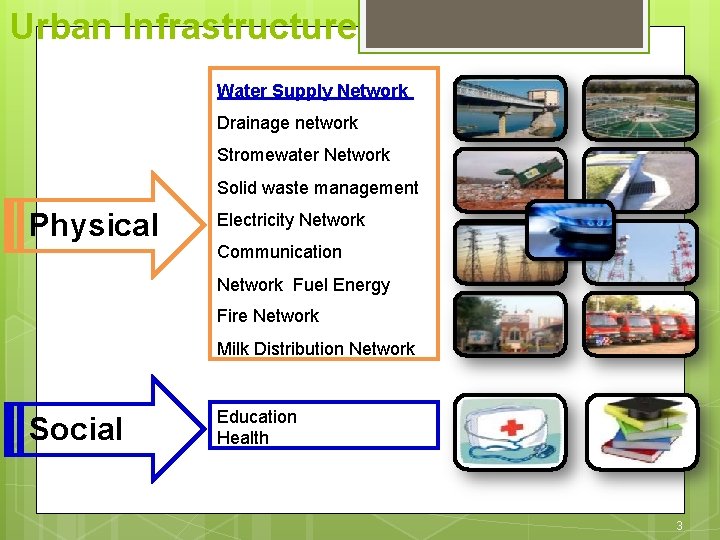
Urban Infrastructure Water Supply Network Drainage network Stromewater Network Solid waste management Physical Electricity Network Communication Network Fuel Energy Fire Network Milk Distribution Network Social Education Health 3
INFRASTRUCTURE It can be technically defined as the physical components of interrelated systems providing commodities and services essential to enable, sustain, or enhance societal living conditions. The term typically refer to the technical structures that support a society , such as roads, bridges, water supply, sewers, electrical grids, telecommunications and waste management system. Infrastructure, in functional terms, facilitates the production of goods, and services, and also the distribution of finished products to markets, as well as basic social services such as schools and hospitals. For example, road enable the transport of raw materials to a factory

Infrastructure, in general, is the physical and organizational framework of an institution or organization. It defines in full details the basic components that keep the organization operational. It can also serve as a guide for an organization to efficiently work. This must be therefore, carefully structured in such a way as to attain ultimate efficiency for maximum output and to achieve the highest possible productivity level.
ATTRIBUTES OF INFRASTRUCTURE Infrastructure can be defined through the set of characteristics that are attributed to it. Some of these characteristics that are popularly associated with infrastructure are Infrastructure facilities are generally available to large group of people. Infrastructure helps deliver essential services for the functioning of an organization or society. Infrastructure helps achieve economic and social objectives and is an important term for judging a country or region’s development. Infrastructure is the base upon which society and its activities rest.
FIELDS OF STUDY Mostly infrastructure is designed by engineers, urban planners and architects. Generally road and rail transport networks as well as water and waste management infrastructure are designed by civil engineers, electrical power and lighting networks are designed by power engineers and electrical engineers, and telecommunication, computing and monitoring networks are designed by system engineers.
Cont. . In case of urban infrastructure, the general layout of roads, sidewalks and public places may sometimes be designed by urban planners or architects, although detailed design will still be performed by civil engineers. If a building is required, it is designed by an architects, and if an industrial or processing plant is required , it may be designed by industrial engineer or a process engineers.

THE ROLE OF INFRASTRUCTURE IN DEVELOPMENT Infrastructure is instrumental in promoting economic growth; the more physical infrastructure a country has, the greater the economic stability and vice versa. Infrastructure also plays a role in alleviating poverty.

IMPORTANCE OF INFRASTRUCTURE Infrastructure investment in the development of communications, IT, roads, schools, ports, and hospitals is important to both economic development and quality of life. Failure to invest means a failure to sustain and develop our social and economic well being. Poor infrastructure impedes a nation’s economic growth and international competitiveness. (The World Bank 2006). Infrastructure has a bearing on a country’s attractiveness to foreign investors and on its ability to compete with other jurisdictions.

Cont. . It includes the basic services and facilities required for businesses to compete and grow. Business require infrastructure; therefore, business growth can be limited by poor infrastructure development. Infrastructure is a key of a country’s position on a global stage; it is the second pillar that is assessed by World Economic Forum when determining the competitiveness of a nation (institutions, being the first). Surveys by The World Bank reveal investors citing reliable infrastructure as an important consideration in their investment decisions of quality of life, illness and death (Willoughby 2004).
INFRASTRUCTUR E RELATED ISSUES Infrastructure in developing countries is old, unreliable, inefficient, in need of replacement and often not available. Large portion of urban and rural populations in developing countries have inadequate access to water and sanitation. Power supply is non-existent or unreliable and people are faced with frequent power cuts. Quality of road infrastructure is often bad, leading to long travel times and increased vehicle maintenance costs. Width of roads is also often a constraining factor leading to traffic jams and blocks.
- Slides: 13