
Lecture 1 Introduction to biodiversity Review of current
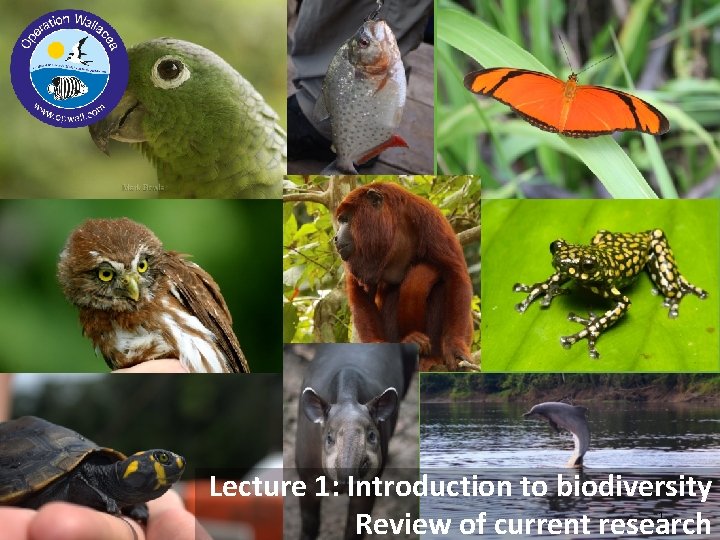
Lecture 1: Introduction to biodiversity Review of current research 1
Lecture Overview What is biodiversity? Different scales of diversity What is a species? Diversity gradients Measuring diversity Is Biodiversity important? Amazonian Biodiversity Others things to know about: • IUCN Red list • Biodiversity Hotspots • Current research in Peru • • 2
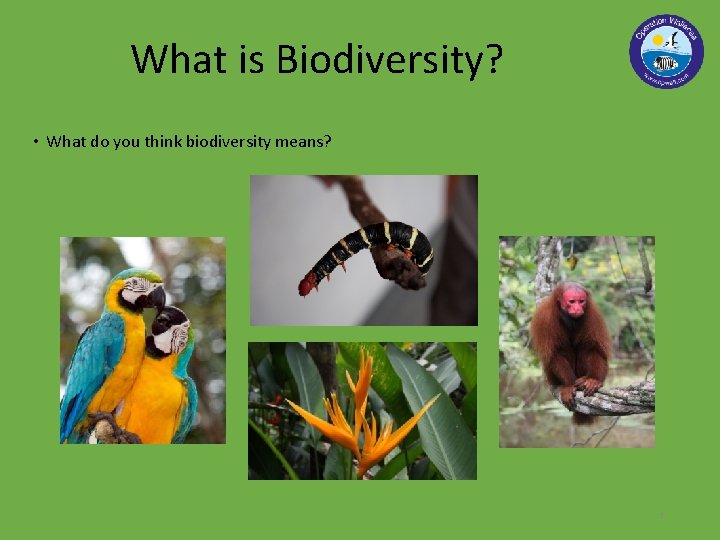
What is Biodiversity? • What do you think biodiversity means? 3
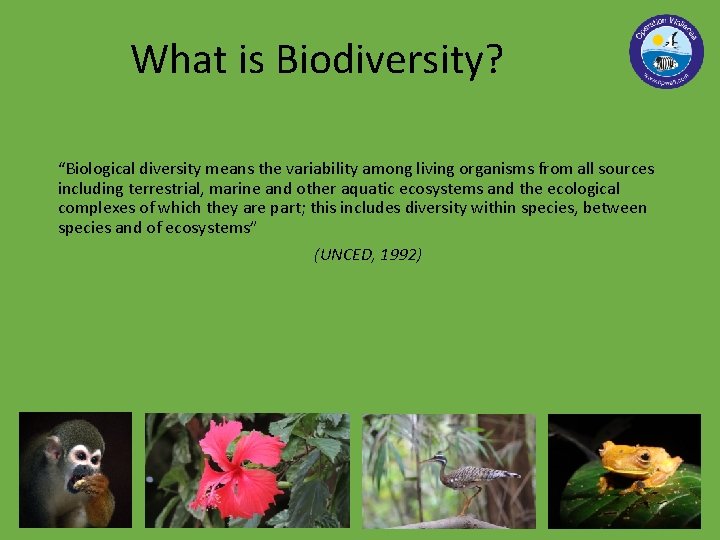
What is Biodiversity? “Biological diversity means the variability among living organisms from all sources including terrestrial, marine and other aquatic ecosystems and the ecological complexes of which they are part; this includes diversity within species, between species and of ecosystems” (UNCED, 1992) 4
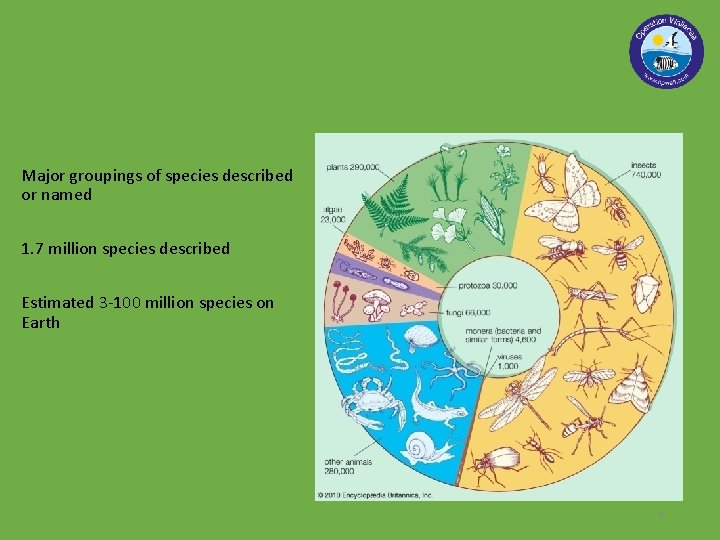
Major groupings of species described or named 1. 7 million species described Estimated 3 -100 million species on Earth 5

What is Biodiversity? • Biological diversity occurs at the level of: - Genetic diversity within species - Species diversity within an ecosystem - Ecosystem diversity within a region • Interaction of scales that become important 6
What is a species? ‘A species is a group of organisms with similar morphology, physiology and behaviour, which can interbreed to produce fertile offspring, and which are reproductively isolated (in place, time or behaviour) from other species. ’ Species is the most common classification used to describe diversity 7
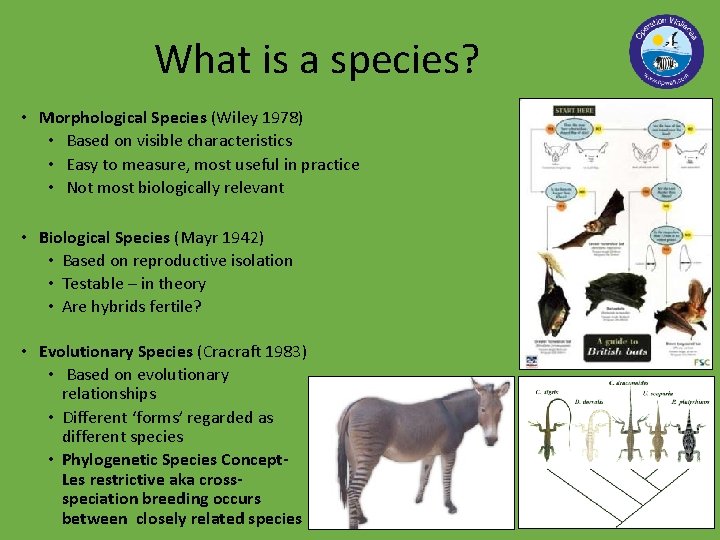
What is a species? • Morphological Species (Wiley 1978) • Based on visible characteristics • Easy to measure, most useful in practice • Not most biologically relevant • Biological Species (Mayr 1942) • Based on reproductive isolation • Testable – in theory • Are hybrids fertile? • Evolutionary Species (Cracraft 1983) • Based on evolutionary relationships • Different ‘forms’ regarded as different species • Phylogenetic Species Concept. Les restrictive aka crossspeciation breeding occurs between closely related species 8

Temporal (time) Scales Evolution and extinction events occur over different time scales and in different magnitudes • Evolution: species alter over time to form new species • Speciation (a form of evolution): the formation of new species alongside the original species • Extinction: the species is unable to reproduce successfully and therefore dies out Darwin’s finches are an example of speciation 9

Diversity Gradients • Species are not distributed evenly over the earth. • The existence of gradients in biodiversity implies that diversity has accumulated differentially over evolutionary time from one location to another. 10

Latitudinal Diversity Gradients • For most groups of plants and animals diversity is lowest near the poles and increases towards the tropics, reaching a peak in the tropical rain forests such as the Amazon. • Theories: - Species energy - Climate Stability - Geographical area 11

Latitudinal Diversity Gradients 12

Other Diversity Gradients • Temperature • diversity increases with temperature • Patterns of seasonality • tropical regions have less variation in seasons than temperate regions (often referred to as stability) and tend to be more biodiverse • Precipitation • areas with higher precipitation show greater diversity than areas with lower precipitation • Altitudinal gradients – Diversity generally decreases with an increase in altitude, and this has been shown in plants, birds and mammals 13

Measuring Diversity Three types of indices to measure species diversity are: 1. species richness indices: these use the number of species as the sample unit. 2. species abundance models: these describe the distribution of species abundances. 3. indices based on the proportional abundance of species: these seek to put richness and evenness into a single calculation. 14

Measuring Biodiversity • Measuring organisms in the field (such as the work carried out by Operation Wallacea). -Mainly used to compare biodiversity in the same habitat. • by using formulae such as the: • Simpson index D=1 - [ Σ(n/N)2 ] (n = number of individuals of a species, N = total number of all species) These formulae help to ‘quantify’ biodiversity but there is NO one formulae that truly represents a figure for biodiversity. Issues: When is an individual not an individual? Species richness: is the number of species in a given area. Species evenness: is a measure of the relative abundance of the different species making up the richness of an area. 15

Species Richness and Evenness Two communities may have the same number of species but the proportions of the community made up of each species may be different. E. g. a natural meadow and a wheat field may both have 25 species. In the meadow all 25 species may be equally abundant, whereas in the wheat field 95% of the plants may be a single species. 16
Measuring Diversity-Sources of Error • Sampling effort- does sampling intensity change with altitude or temperature? • Does the area available vary? • How are the regions classified-biomes, ecosystems, ecoregions- is everyone using the same methodology? • Some species may have been described several times • Confusion over what a species really is leads to variation in descriptions, again resulting in duplicate records • All estimates of biodiversity can be altered by the way in which they are calculatedexact figures will be impossible to achieve………. 17
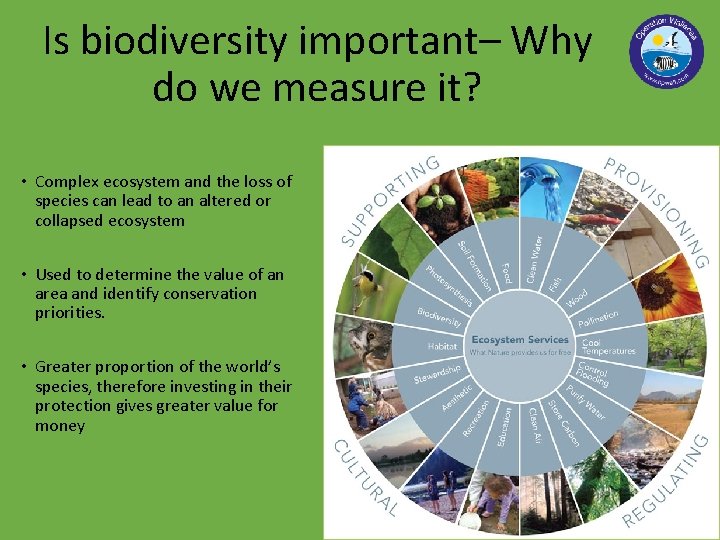
Is biodiversity important– Why do we measure it? • Complex ecosystem and the loss of species can lead to an altered or collapsed ecosystem • Used to determine the value of an area and identify conservation priorities. • Greater proportion of the world’s species, therefore investing in their protection gives greater value for money 18
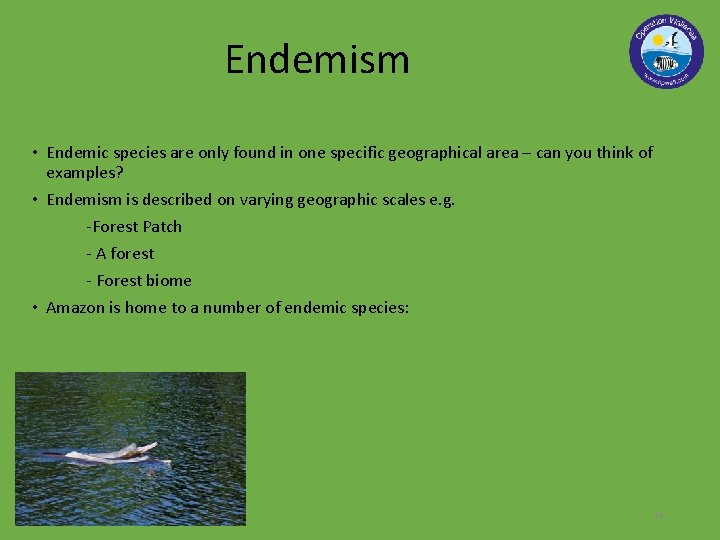
Endemism • Endemic species are only found in one specific geographical area – can you think of examples? • Endemism is described on varying geographic scales e. g. -Forest Patch - A forest - Forest biome • Amazon is home to a number of endemic species: 19
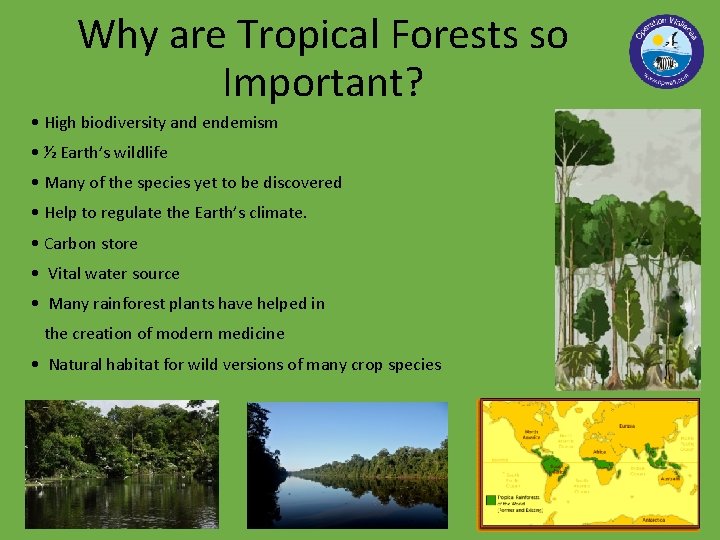
Why are Tropical Forests so Important? • High biodiversity and endemism • ½ Earth’s wildlife • Many of the species yet to be discovered • Help to regulate the Earth’s climate. • Carbon store • Vital water source • Many rainforest plants have helped in the creation of modern medicine • Natural habitat for wild versions of many crop species 20
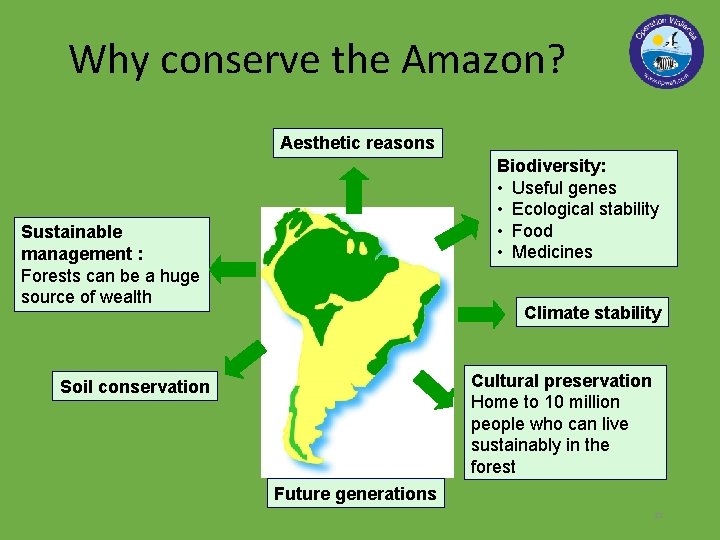
Why conserve the Amazon? Aesthetic reasons Biodiversity: • Useful genes • Ecological stability • Food • Medicines Sustainable management : Forests can be a huge source of wealth Climate stability Cultural preservation Home to 10 million people who can live sustainably in the forest Soil conservation Future generations 21
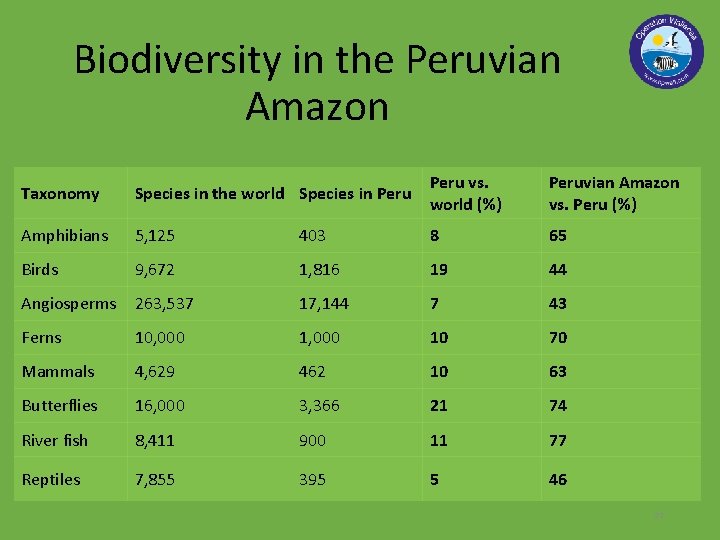
Biodiversity in the Peruvian Amazon Taxonomy Species in the world Species in Peru vs. world (%) Peruvian Amazon vs. Peru (%) Amphibians 5, 125 403 8 65 Birds 9, 672 1, 816 19 44 Angiosperms 263, 537 17, 144 7 43 Ferns 10, 000 10 70 Mammals 4, 629 462 10 63 Butterflies 16, 000 3, 366 21 74 River fish 8, 411 900 11 77 Reptiles 7, 855 395 5 46 22
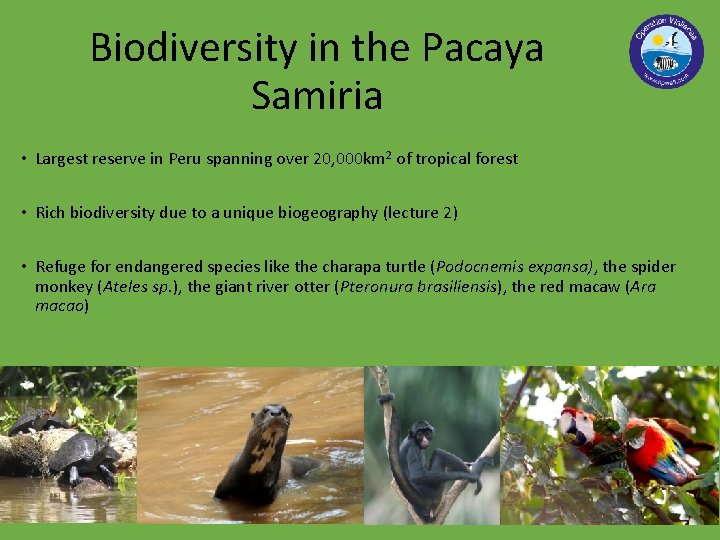
Biodiversity in the Pacaya Samiria • Largest reserve in Peru spanning over 20, 000 km 2 of tropical forest • Rich biodiversity due to a unique biogeography (lecture 2) • Refuge for endangered species like the charapa turtle (Podocnemis expansa), the spider monkey (Ateles sp. ), the giant river otter (Pteronura brasiliensis), the red macaw (Ara macao) 23
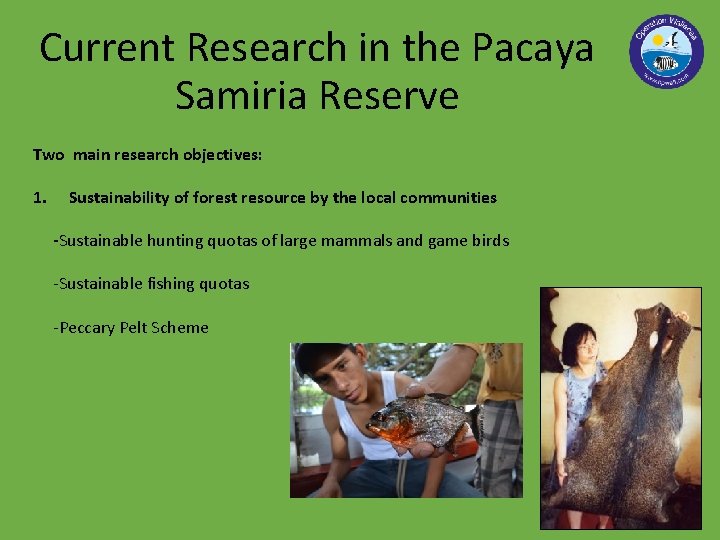
Current Research in the Pacaya Samiria Reserve Two main research objectives: 1. Sustainability of forest resource by the local communities -Sustainable hunting quotas of large mammals and game birds -Sustainable fishing quotas -Peccary Pelt Scheme 24
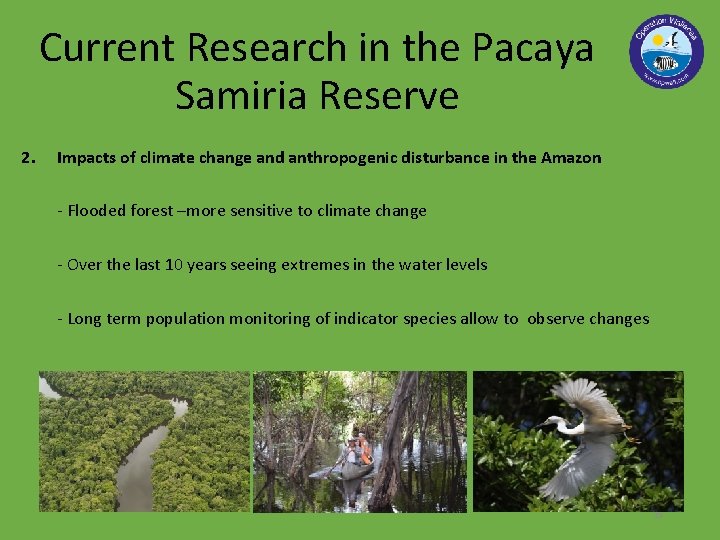
Current Research in the Pacaya Samiria Reserve 2. Impacts of climate change and anthropogenic disturbance in the Amazon - Flooded forest –more sensitive to climate change - Over the last 10 years seeing extremes in the water levels - Long term population monitoring of indicator species allow to observe changes 25
Other important things to know • International Union for Conservation of Nature. • IUCN is a membership organization made up of more than 1, 000 organizations, as well as 10, 000 individual scientists and experts structured in six Commissions. They have created the IUCN Red List: ‘The IUCN Red List of Threatened Species (also known as the IUCN Red List or Red Data List), founded in 1963, is the world's most comprehensive inventory of the global conservation status of biological species. ’ 26
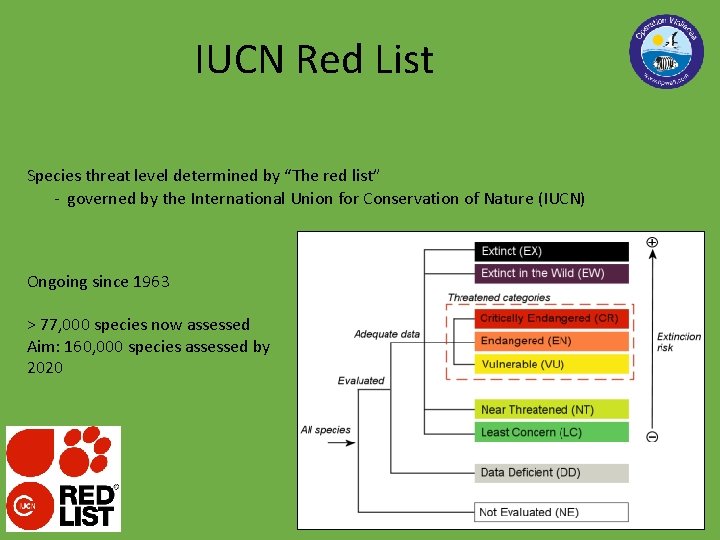
IUCN Red List Species threat level determined by “The red list” - governed by the International Union for Conservation of Nature (IUCN) Ongoing since 1963 > 77, 000 species now assessed Aim: 160, 000 species assessed by 2020 27
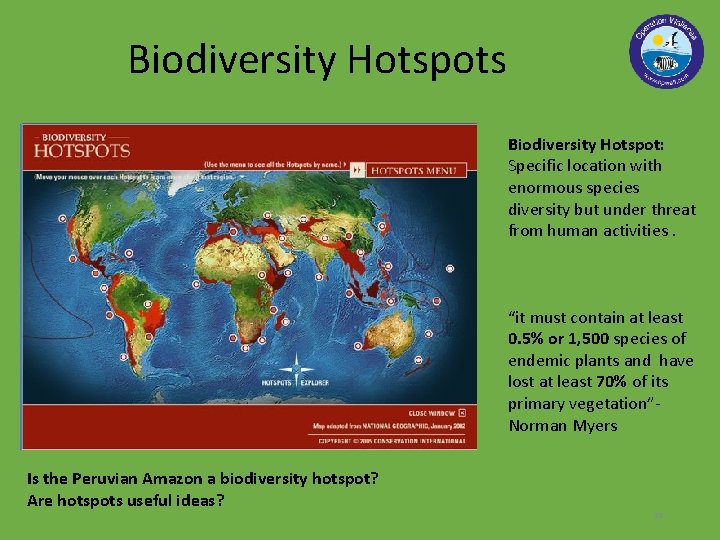
Biodiversity Hotspots Biodiversity Hotspot: Specific location with enormous species diversity but under threat from human activities. “it must contain at least 0. 5% or 1, 500 species of endemic plants and have lost at least 70% of its primary vegetation”Norman Myers Is the Peruvian Amazon a biodiversity hotspot? Are hotspots useful ideas? 28
UN Decade of Biodiversity Watch the video! 29
Questions? 30
- Slides: 30