
Lecture 1 Engineering Software Constructing Poetry and Dancing
- Slides: 39
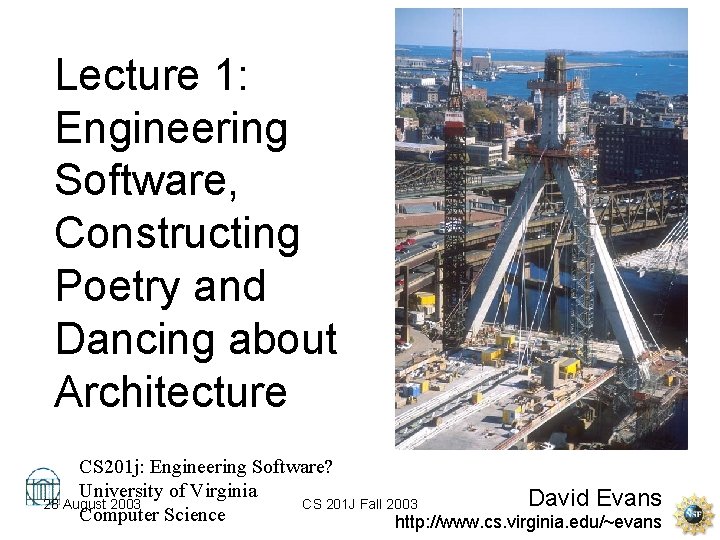
Lecture 1: Engineering Software, Constructing Poetry and Dancing about Architecture CS 201 j: Engineering Software? University of Virginia David Evans 28 August 2003 CS 201 J Fall 2003 Computer Science http: //www. cs. virginia. edu/~evans
Menu • What is Engineering? – Can we engineer software? • Small, Fun Programs vs. Big, Important Programs • Managing Complexity • Course Mechanics • PS 1, Java Introduction 28 August 2003 CS 201 J Fall 2003 2
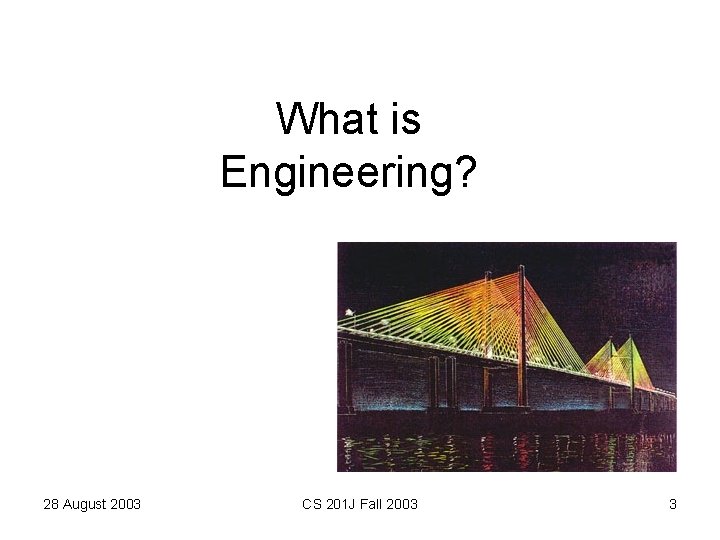
What is Engineering? 28 August 2003 CS 201 J Fall 2003 3
Webster’s Definitions en·gi·neer·ing ( n j -nîr ng) n. 1 a. The application of scientific and mathematical principles to practical ends such as the design, manufacture, and operation of efficient and economical structures, machines, processes, and systems. b. The profession of or the work performed by an engineer. 2. Skillful maneuvering or direction: geopolitical engineering; social engineering. 28 August 2003 CS 201 J Fall 2003 4
Design Under Constraint “Engineering is design under constraint… Engineering is synthetic - it strives to create what can be, but it is constrained by nature, by cost, by concerns of safety, reliability, environmental impact, manufacturability, maintainability and many other such 'ilities. '. . . ” William Wulf 28 August 2003 CS 201 J Fall 2003 5
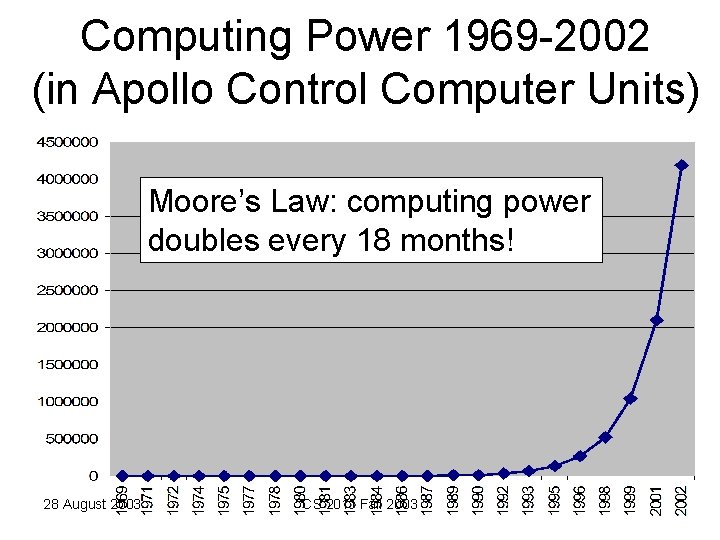
Computing Power 1969 -2002 (in Apollo Control Computer Units) Moore’s Law: computing power doubles every 18 months! 28 August 2003 CS 201 J Fall 2003
Constraints Software Engineers Face • Not like those for “real” engineers: – Cost, weight, physics, etc. – Lab machines have ~ 5 million times what the Apollo Guidance Computer needed to get to the Moon • Complexity of what we can understand • Most important constraint is cost of human effort to get reliability, safety, maintainability This class is about managing complexity to produce reliable complex systems efficiently. 28 August 2003 CS 201 J Fall 2003 7
How is engineering software different from engineering bridges? 28 August 2003 CS 201 J Fall 2003 8
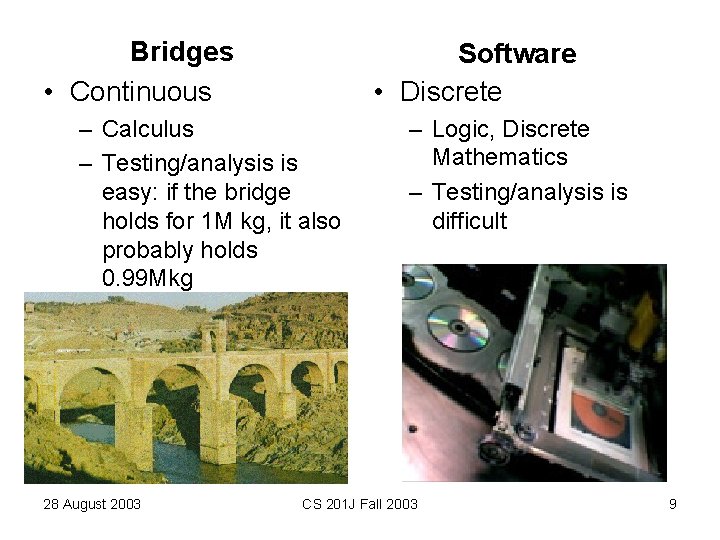
Bridges • Continuous Software • Discrete – Calculus – Testing/analysis is easy: if the bridge holds for 1 M kg, it also probably holds 0. 99 Mkg 28 August 2003 – Logic, Discrete Mathematics – Testing/analysis is difficult CS 201 J Fall 2003 9
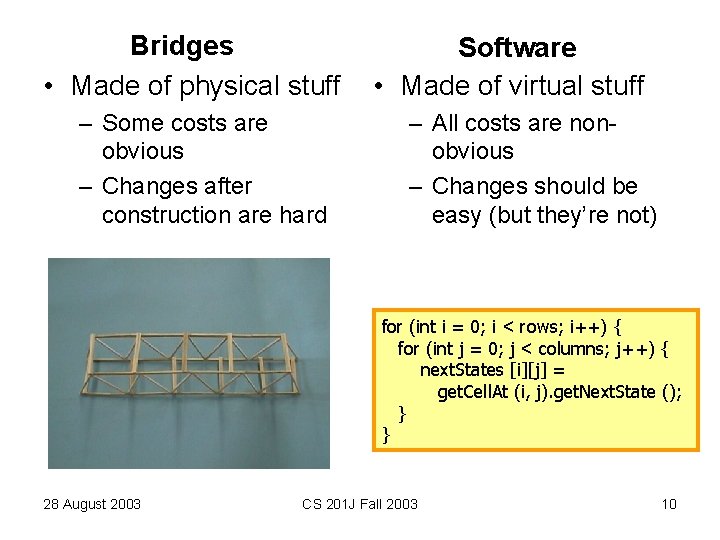
Bridges • Made of physical stuff – Some costs are obvious – Changes after construction are hard Software • Made of virtual stuff – All costs are nonobvious – Changes should be easy (but they’re not) for (int i = 0; i < rows; i++) { for (int j = 0; j < columns; j++) { next. States [i][j] = get. Cell. At (i, j). get. Next. State (); } } 28 August 2003 CS 201 J Fall 2003 10
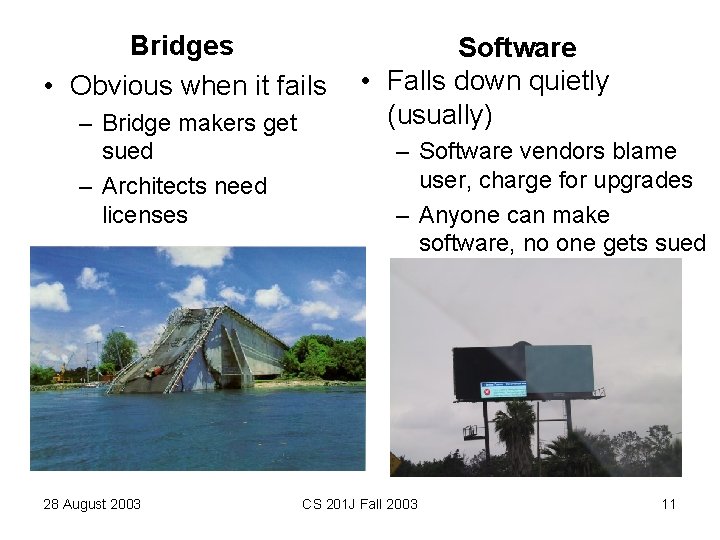
Bridges • Obvious when it fails – Bridge makers get sued – Architects need licenses 28 August 2003 Software • Falls down quietly (usually) – Software vendors blame user, charge for upgrades – Anyone can make software, no one gets sued CS 201 J Fall 2003 11
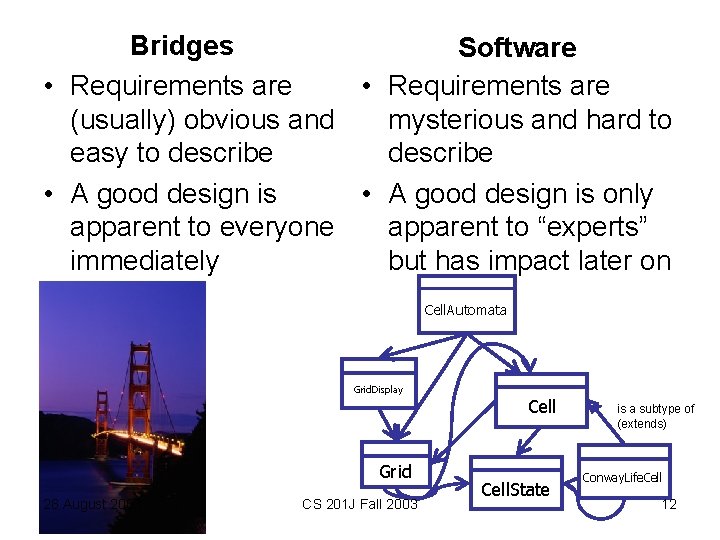
Bridges Software • Requirements are mysterious and hard to (usually) obvious and describe easy to describe • A good design is only • A good design is apparent to “experts” apparent to everyone but has impact later on immediately Cell. Automata Grid. Display Cell Grid 28 August 2003 CS 201 J Fall 2003 Cell. State is a subtype of (extends) Conway. Life. Cell 12
Small, Fun Programs vs. Big, Important Programs 28 August 2003 CS 201 J Fall 2003 13
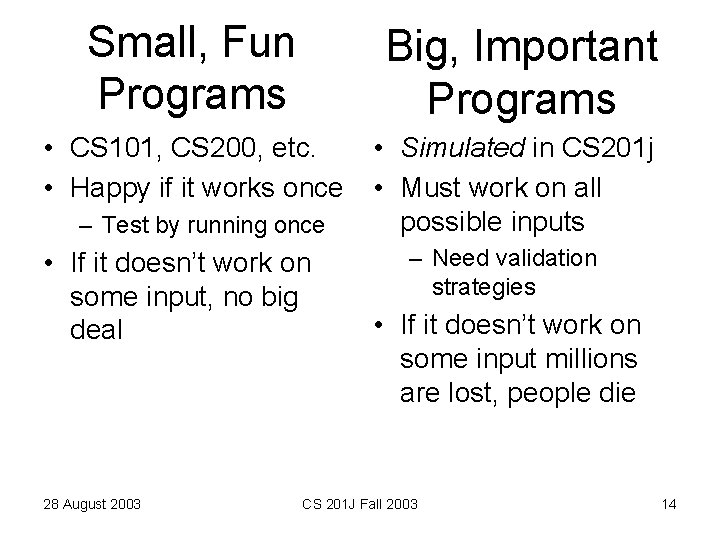
Small, Fun Programs Big, Important Programs • CS 101, CS 200, etc. • Happy if it works once • Simulated in CS 201 j • Must work on all possible inputs – Test by running once • If it doesn’t work on some input, no big deal 28 August 2003 – Need validation strategies • If it doesn’t work on some input millions are lost, people die CS 201 J Fall 2003 14
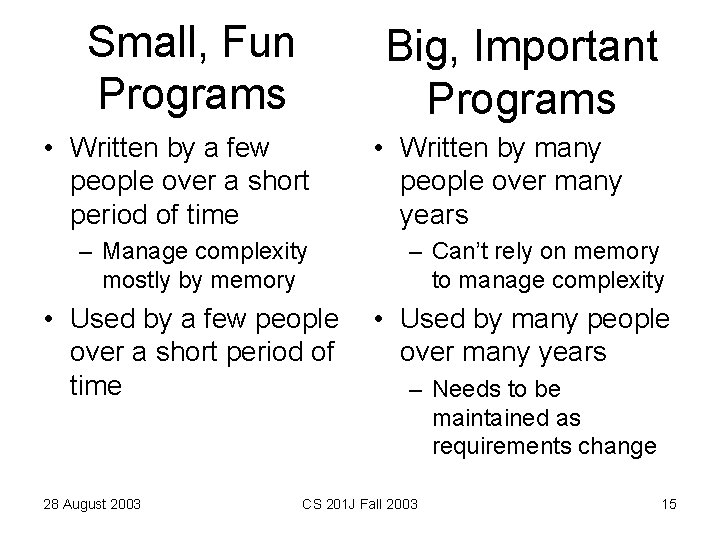
Small, Fun Programs Big, Important Programs • Written by a few people over a short period of time – Manage complexity mostly by memory • Used by a few people over a short period of time 28 August 2003 • Written by many people over many years – Can’t rely on memory to manage complexity • Used by many people over many years – Needs to be maintained as requirements change CS 201 J Fall 2003 15
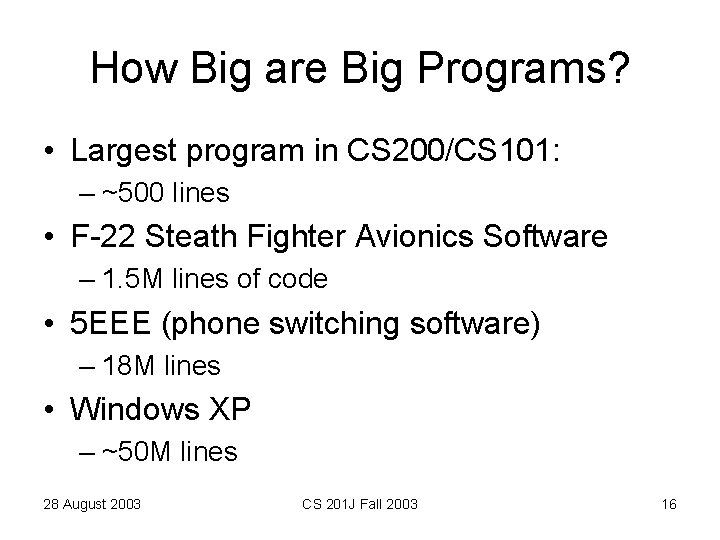
How Big are Big Programs? • Largest program in CS 200/CS 101: – ~500 lines • F-22 Steath Fighter Avionics Software – 1. 5 M lines of code • 5 EEE (phone switching software) – 18 M lines • Windows XP – ~50 M lines 28 August 2003 CS 201 J Fall 2003 16
How can we manage Complexity? 28 August 2003 CS 201 J Fall 2003 17
Modularity • Divide complex systems into many components • Develop components independently • Assemble them to solve the problem What is needed to make modularization work? 28 August 2003 CS 201 J Fall 2003 18
Abstraction and Specification • Ignore details • Separate what from how • Need a specification – description of what a component should do • Components can be built based on what they should do, not how they should do it 28 August 2003 CS 201 J Fall 2003 19
How can we make systems dependable? 28 August 2003 CS 201 J Fall 2003 20
Analysis • Use reasoning and tools to check a design is sound • Use reasoning and tools to check an implementation is sound • Test systematically 28 August 2003 CS 201 J Fall 2003 21
Redundancy • Express things in more than one way and check they are consistent • Common example: variable declarations • Extreme example: – Space Shuttle • 5 on-board computers – 4 duplicates running same software – 1 running completely separate implementation (to same specifications) 28 August 2003 CS 201 J Fall 2003 22
Design There are two ways of constructing a software design. One way is to make it so simple that there are obviously no deficiencies. And the other way is to make it so complicated that there are no obvious deficiencies. Tony Hoare 28 August 2003 CS 201 J Fall 2003 23
Course Overview • This course is about constructing dependable software systems – Managing complexity: modularity, abstraction, specification – Achieving dependability: analysis, redundancy • Good design is key – How to divide problems into modules – How to hide details 28 August 2003 CS 201 J Fall 2003 24
Course Mechanics Take pictures! 28 August 2003 CS 201 J Fall 2003 25
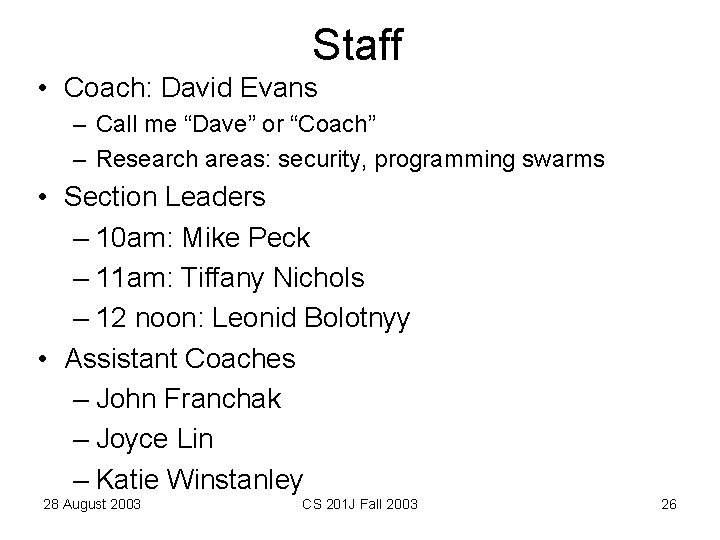
Staff • Coach: David Evans – Call me “Dave” or “Coach” – Research areas: security, programming swarms • Section Leaders – 10 am: Mike Peck – 11 am: Tiffany Nichols – 12 noon: Leonid Bolotnyy • Assistant Coaches – John Franchak – Joyce Lin – Katie Winstanley 28 August 2003 CS 201 J Fall 2003 26
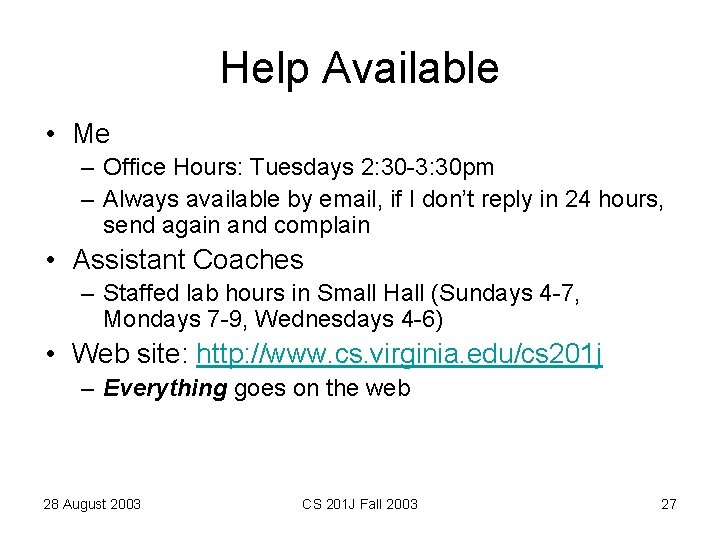
Help Available • Me – Office Hours: Tuesdays 2: 30 -3: 30 pm – Always available by email, if I don’t reply in 24 hours, send again and complain • Assistant Coaches – Staffed lab hours in Small Hall (Sundays 4 -7, Mondays 7 -9, Wednesdays 4 -6) • Web site: http: //www. cs. virginia. edu/cs 201 j – Everything goes on the web 28 August 2003 CS 201 J Fall 2003 27
CS 201 J • Experimental Course – National Science Foundation sponsorship – Focus on using lightweight analysis tools – Second time offered • Counts as CS 201, but doesn’t cover everything in CS 201 – You will need to learn some things on your own for CS 216 28 August 2003 CS 201 J Fall 2003 28
Course Pledge • Classroom Pledge is Horrible! • The whole point of being at a University is so you can: – Learn from your classmates – Learn better by teaching your classmates • READ, sign and return the CS 201 j Pledge on Friday 28 August 2003 CS 201 J Fall 2003 29
Grading A+: I would be willing to fly in a plane running software you designed and wrote A: I would trust you to design and implement important (but not life critical) software B: I would trust you to manage programmers working on important software (See syllabus for grading details. ) 28 August 2003 CS 201 J Fall 2003 30
Java 28 August 2003 CS 201 J Fall 2003 31
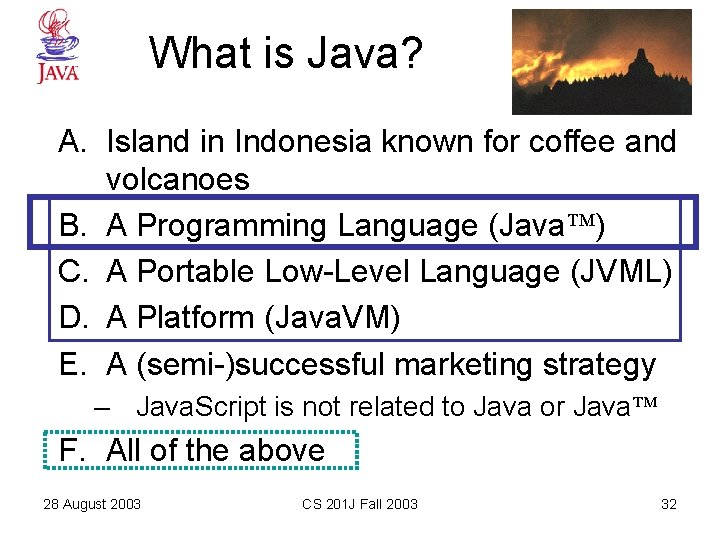
What is Java? A. Island in Indonesia known for coffee and volcanoes B. A Programming Language (Java ) C. A Portable Low-Level Language (JVML) D. A Platform (Java. VM) E. A (semi-)successful marketing strategy – Java. Script is not related to Java or Java F. All of the above 28 August 2003 CS 201 J Fall 2003 32
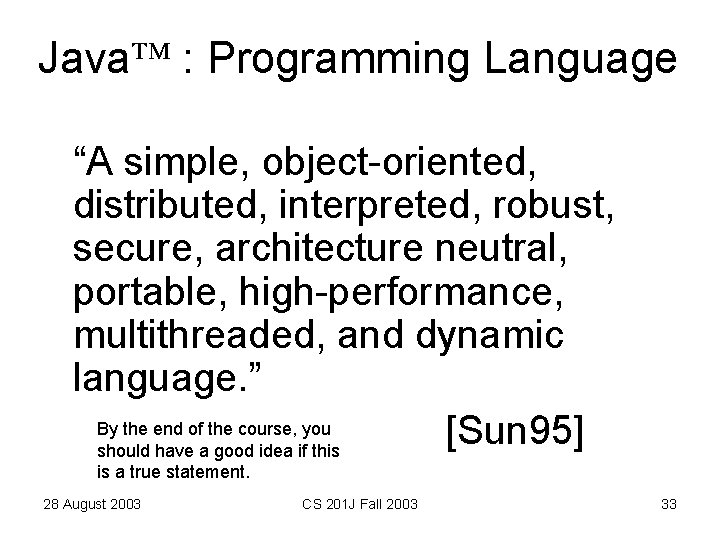
Java : Programming Language “A simple, object-oriented, distributed, interpreted, robust, secure, architecture neutral, portable, high-performance, multithreaded, and dynamic language. ” By the end of the course, you [Sun 95] should have a good idea if this is a true statement. 28 August 2003 CS 201 J Fall 2003 33
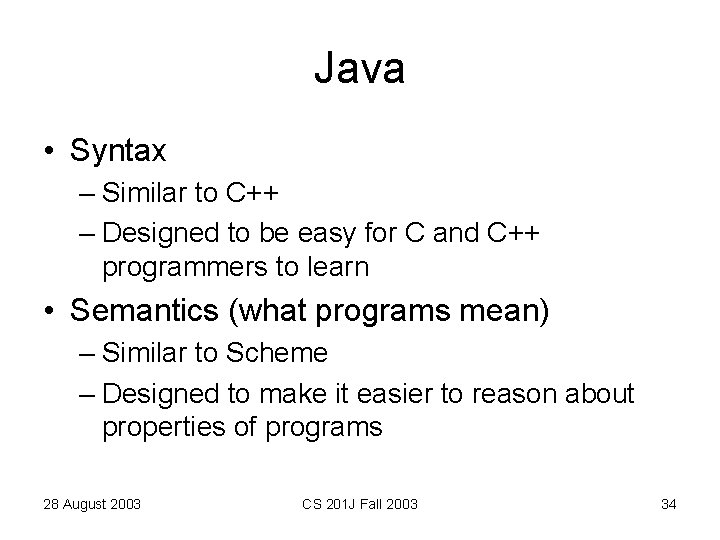
Java • Syntax – Similar to C++ – Designed to be easy for C and C++ programmers to learn • Semantics (what programs mean) – Similar to Scheme – Designed to make it easier to reason about properties of programs 28 August 2003 CS 201 J Fall 2003 34
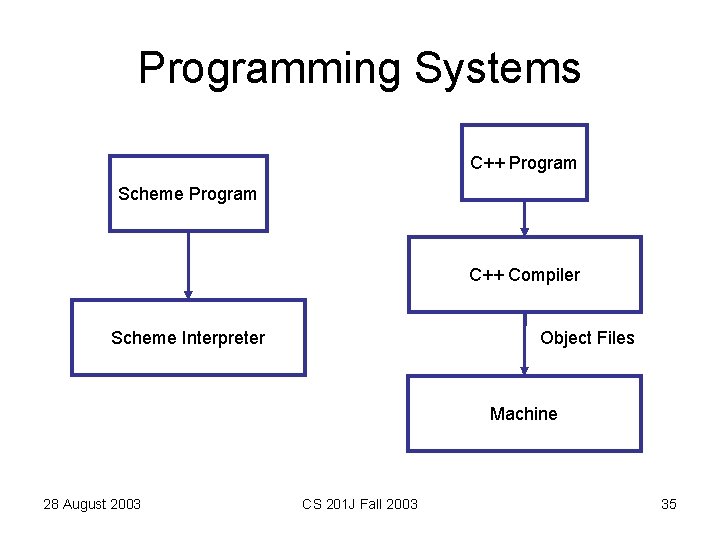
Programming Systems C++ Program Scheme Program C++ Compiler Object Files Scheme Interpreter Machine 28 August 2003 CS 201 J Fall 2003 35
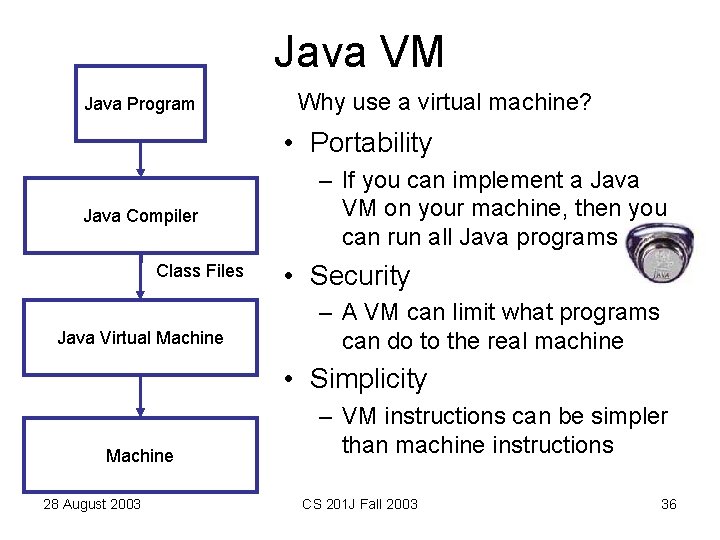
Java VM Java Program Why use a virtual machine? • Portability Java Compiler Class Files Java Virtual Machine – If you can implement a Java VM on your machine, then you can run all Java programs • Security – A VM can limit what programs can do to the real machine • Simplicity Machine 28 August 2003 – VM instructions can be simpler than machine instructions CS 201 J Fall 2003 36
Programming in Java • Program is divided into classes • A class: – Defines a new datatype – Defines methods and state associated with that datatype • We call a value of a class datatype an object – Objects package state and code 28 August 2003 CS 201 J Fall 2003 37
Problem Set 1 • Lots of new concepts, but only a few lines of code • Implement a class that simulates Conway’s Game of Life: – If a cell is alive and it has 2 or 3 live neighbors, it stays alive – Otherwise it dies (overcrowding or isolation) – If dead cell has exactly 3 live neighbors, it becomes alive 28 August 2003 CS 201 J Fall 2003 38
Charge • This class is about: – Managing complexity: modularity, abstraction, specification – Engineering dependability: analysis, redundancy, design • In Section tomorrow: – Return CS 201 J Pledge – Problem Set 1: read it through before section • Before 5 pm Friday email registration survey • Before class Tuesday: – Problem Set 1 Due 28 August 2003 CS 201 J Fall 2003 39