
Lecture 1 CSECE 3810 Introduction Todays topics logistics

- Slides: 20
Lecture 1: CS/ECE 3810 Introduction • Today’s topics: § logistics § why computer organization is important § modern trends 1
Logistics • See class web-page http: //www. cs. utah. edu/classes/cs 3810 • Sign up for the cs 3810 mailing list !! • TAs: Devyani Ghosh, Josh Mc. Kee Email: teach-cs 3810 Office hours: TBA • Textbook: Computer Organization – HW/SW Interface, Patterson and Hennessy, 3 rd edition 2
Course Organization • 30% midterm, 40% final, 30% assignments • ~10 assignments – you may skip one; assignments due at the start of class (either paper or electronic) • Co-operation policy: you may discuss – you may not see someone else’s written matter when writing your solution • Print slides just before class 3
Why Computer Organization • Yes, I know, required class… 4
Why Computer Organization • Embarrassing if you are a BS in CS/CE and can’t make sense of the following terms: DRAM, pipelining, cache hierarchies, I/O, virtual memory • Embarrassing if you are a BS in CS/CE and can’t decide which processor to buy: 3 GHz P 4 or 2. 5 GHz Athlon (helps us reason about performance/power) • Obvious first step for chip designers, compiler/OS writers • Will knowledge of the hardware help me write better programs? 5
Must a Programmer Care About Hardware? • Memory management: if we understand how/where data is placed, we can help ensure that relevant data is nearby • Thread management: if we understand how threads interact, we can write smarter multi-threaded programs Why do we care about multi-threaded programs? 6
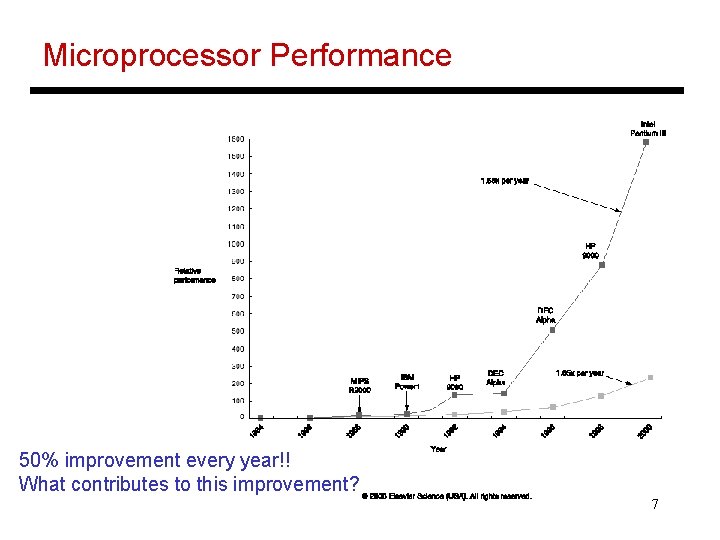
Microprocessor Performance 50% improvement every year!! What contributes to this improvement? 7
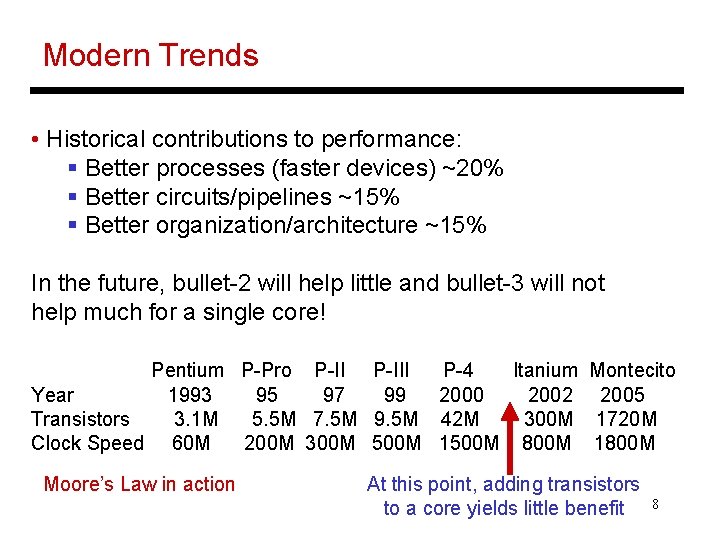
Modern Trends • Historical contributions to performance: § Better processes (faster devices) ~20% § Better circuits/pipelines ~15% § Better organization/architecture ~15% In the future, bullet-2 will help little and bullet-3 will not help much for a single core! Pentium P-Pro P-III P-4 Itanium Montecito Year 1993 95 97 99 2000 2002 2005 Transistors 3. 1 M 5. 5 M 7. 5 M 9. 5 M 42 M 300 M 1720 M Clock Speed 60 M 200 M 300 M 500 M 1500 M 800 M 1800 M Moore’s Law in action At this point, adding transistors to a core yields little benefit 8
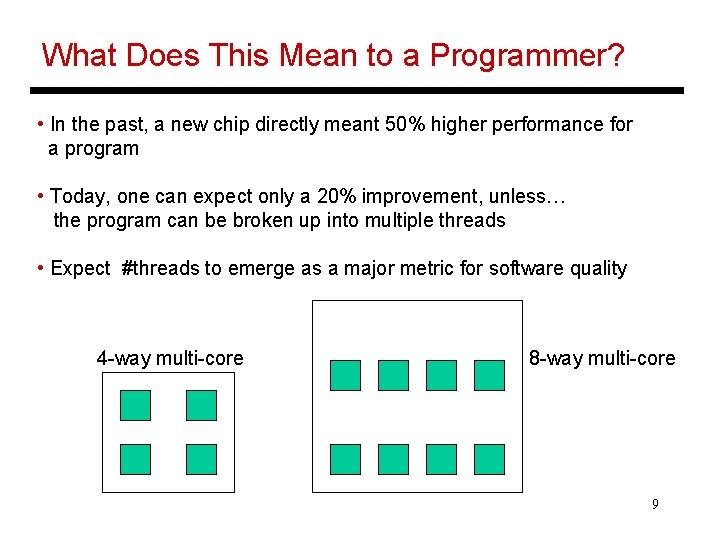
What Does This Mean to a Programmer? • In the past, a new chip directly meant 50% higher performance for a program • Today, one can expect only a 20% improvement, unless… the program can be broken up into multiple threads • Expect #threads to emerge as a major metric for software quality 4 -way multi-core 8 -way multi-core 9
Challenges for the Hardware Designers 10
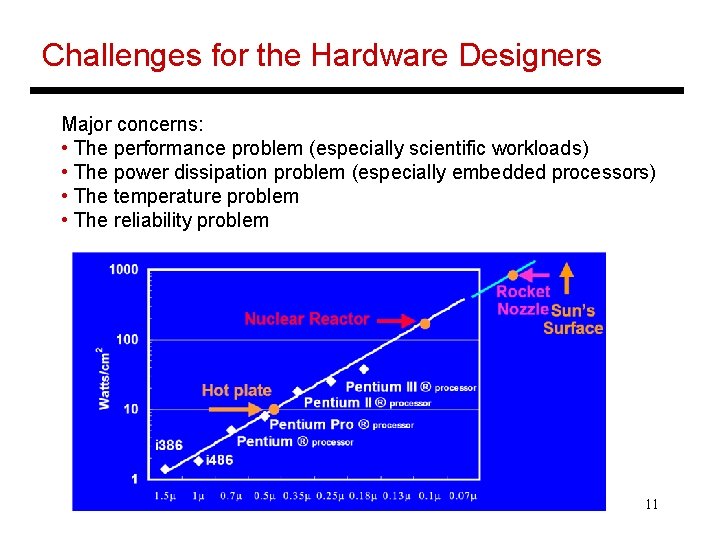
Challenges for the Hardware Designers Major concerns: • The performance problem (especially scientific workloads) • The power dissipation problem (especially embedded processors) • The temperature problem • The reliability problem 11
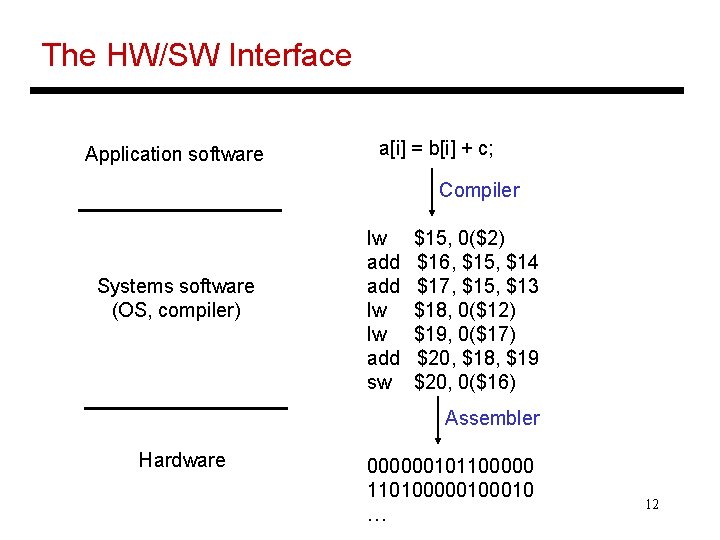
The HW/SW Interface Application software a[i] = b[i] + c; Compiler Systems software (OS, compiler) lw add lw lw add sw $15, 0($2) $16, $15, $14 $17, $15, $13 $18, 0($12) $19, 0($17) $20, $18, $19 $20, 0($16) Assembler Hardware 000000101100000 11010000010 … 12
Computer Components • Input/output devices • Secondary storage: non-volatile, slower, cheaper • Primary storage: volatile, faster, costlier • CPU/processor 13
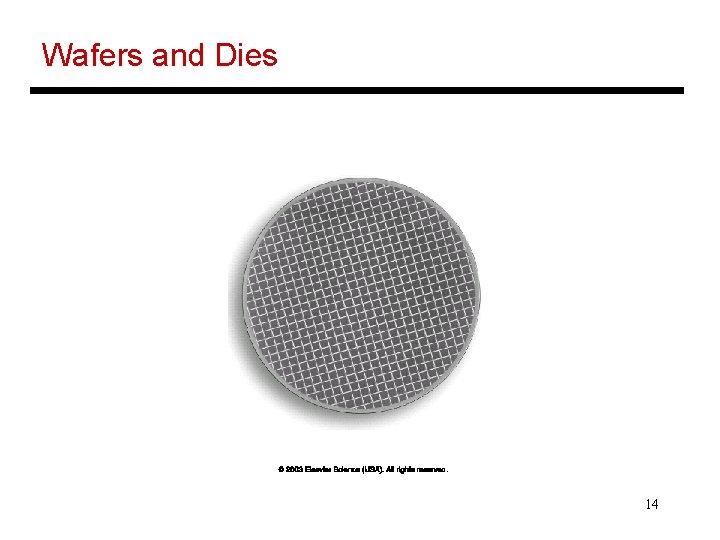
Wafers and Dies 14
Manufacturing Process • Silicon wafers undergo many processing steps so that different parts of the wafer behave as insulators, conductors, and transistors (switches) • Multiple metal layers on the silicon enable connections between transistors • The wafer is chopped into many dies – the size of the die determines yield and cost 15
Processor Technology Trends • Shrinking of transistor sizes: 250 nm (1997) 130 nm (2002) 70 nm (2008) 35 nm (2014) • Transistor density increases by 35% per year and die size increases by 10 -20% per year… functionality improvements! • Transistor speed improves linearly with size (complex equation involving voltages, resistances, capacitances) • Wire delays do not scale down at the same rate as transistor delays 16
Memory and I/O Technology Trends • DRAM density increases by 40 -60% per year, latency has reduced by 33% in 10 years (the memory wall!), bandwidth improves twice as fast as latency decreases • Disk density improves by 100% every year, latency improvement similar to DRAM • Networks: primary focus on bandwidth; 10 Mb 100 Mb in 10 years; 100 Mb 1 Gb in 5 years 17
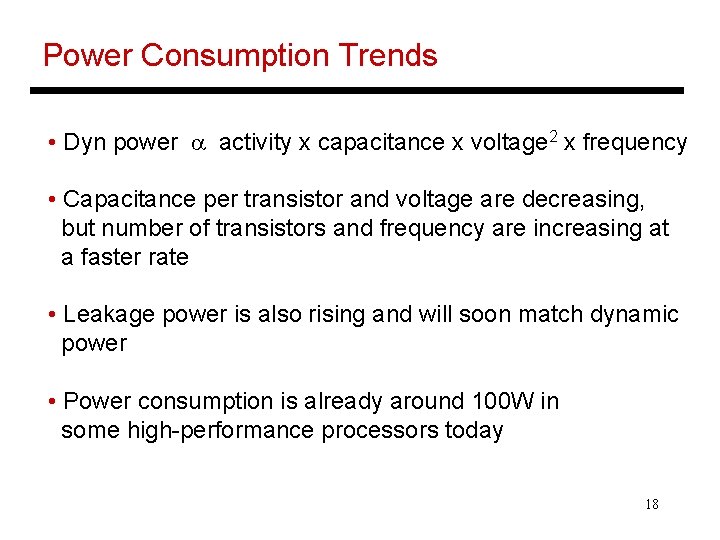
Power Consumption Trends • Dyn power a activity x capacitance x voltage 2 x frequency • Capacitance per transistor and voltage are decreasing, but number of transistors and frequency are increasing at a faster rate • Leakage power is also rising and will soon match dynamic power • Power consumption is already around 100 W in some high-performance processors today 18
Next Class • Topics: MIPS instruction set architecture (Chapter 2) • Visit the class web-page http: //www. cs. utah. edu/classes/cs 3810 • Sign up for the mailing list • Pick up CADE Lab passwords 19
Title • Bullet 20