
Lecture 1 Circuits Layout Outline q q q




- Slides: 45
Lecture 1: Circuits & Layout
Outline q q q A Brief History CMOS Gate Design Pass Transistors CMOS Latches & Flip-Flops Standard Cell Layouts Stick Diagrams 1: Circuits & Layout CMOS VLSI Design 4 th Ed. 2
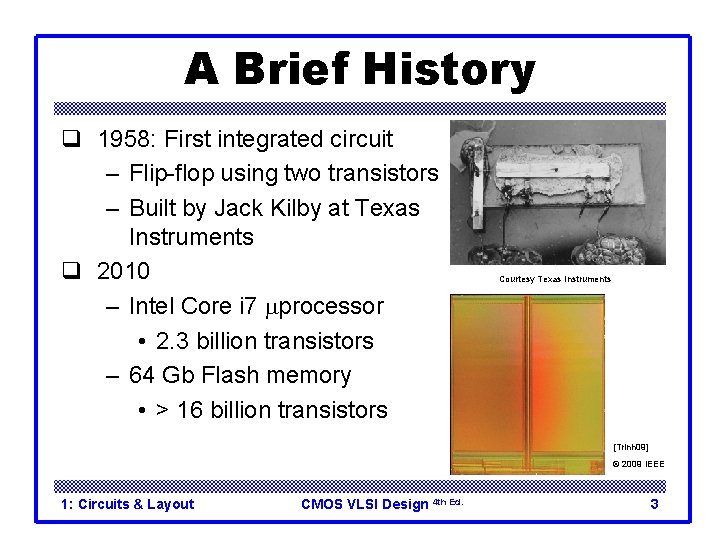
A Brief History q 1958: First integrated circuit – Flip-flop using two transistors – Built by Jack Kilby at Texas Instruments q 2010 – Intel Core i 7 mprocessor • 2. 3 billion transistors – 64 Gb Flash memory • > 16 billion transistors Courtesy Texas Instruments [Trinh 09] © 2009 IEEE 1: Circuits & Layout CMOS VLSI Design 4 th Ed. 3
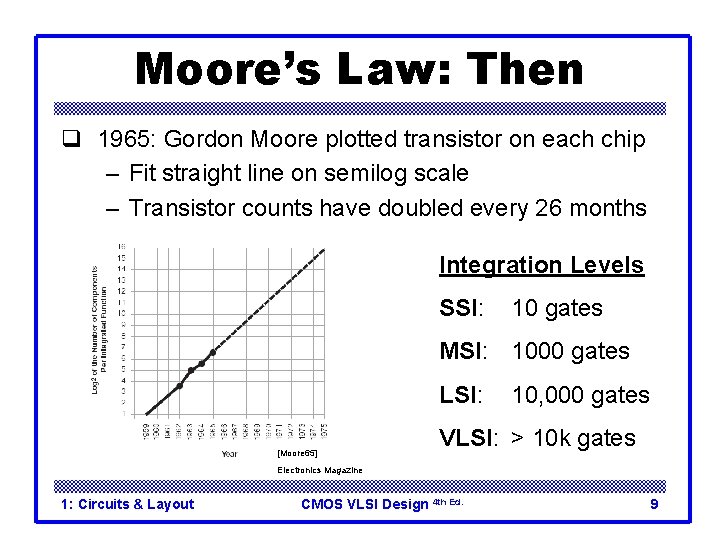
Growth Rate q 53% compound annual growth rate over 50 years – No other technology has grown so fast so long q Driven by miniaturization of transistors – Smaller is cheaper, faster, lower in power! – Revolutionary effects on society [Moore 65] Electronics Magazine 1: Circuits & Layout CMOS VLSI Design 4 th Ed. 4
Annual Sales q >1019 transistors manufactured in 2008 – 1 billion for every human on the planet 1: Circuits & Layout CMOS VLSI Design 4 th Ed. 5
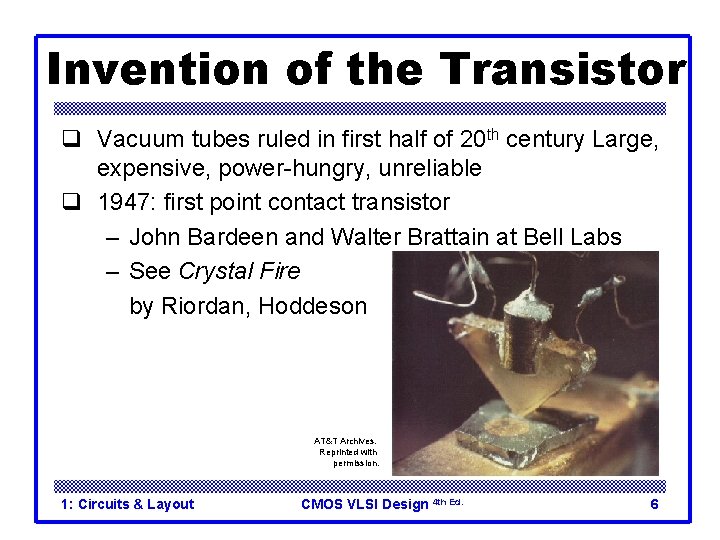
Invention of the Transistor q Vacuum tubes ruled in first half of 20 th century Large, expensive, power-hungry, unreliable q 1947: first point contact transistor – John Bardeen and Walter Brattain at Bell Labs – See Crystal Fire by Riordan, Hoddeson AT&T Archives. Reprinted with permission. 1: Circuits & Layout CMOS VLSI Design 4 th Ed. 6
Transistor Types q Bipolar transistors – npn or pnp silicon structure – Small current into very thin base layer controls large currents between emitter and collector – Base currents limit integration density q Metal Oxide Semiconductor Field Effect Transistors – n. MOS and p. MOSFETS – Voltage applied to insulated gate controls current between source and drain – Low power allows very high integration 1: Circuits & Layout CMOS VLSI Design 4 th Ed. 7
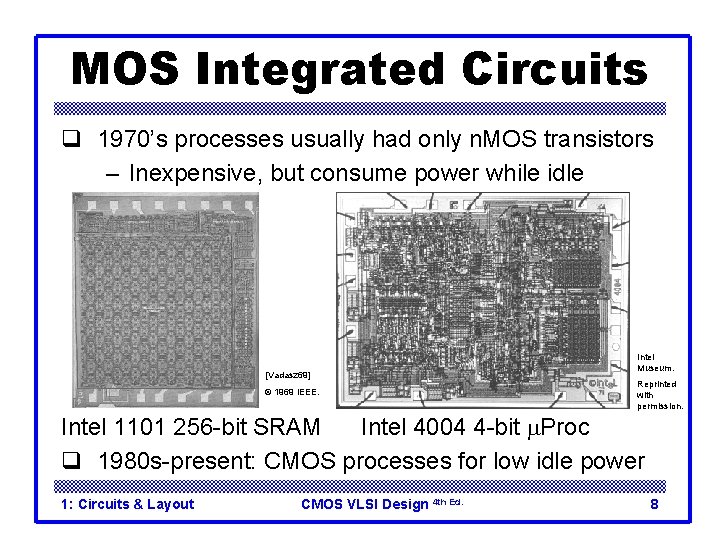
MOS Integrated Circuits q 1970’s processes usually had only n. MOS transistors – Inexpensive, but consume power while idle [Vadasz 69] © 1969 IEEE. Intel Museum. Reprinted with permission. Intel 1101 256 -bit SRAM Intel 4004 4 -bit m. Proc q 1980 s-present: CMOS processes for low idle power 1: Circuits & Layout CMOS VLSI Design 4 th Ed. 8
Moore’s Law: Then q 1965: Gordon Moore plotted transistor on each chip – Fit straight line on semilog scale – Transistor counts have doubled every 26 months Integration Levels SSI: 10 gates MSI: 1000 gates LSI: [Moore 65] 10, 000 gates VLSI: > 10 k gates Electronics Magazine 1: Circuits & Layout CMOS VLSI Design 4 th Ed. 9
And Now… 1: Circuits & Layout CMOS VLSI Design 4 th Ed. 10
Feature Size q Minimum feature size shrinking 30% every 2 -3 years 1: Circuits & Layout CMOS VLSI Design 4 th Ed. 11
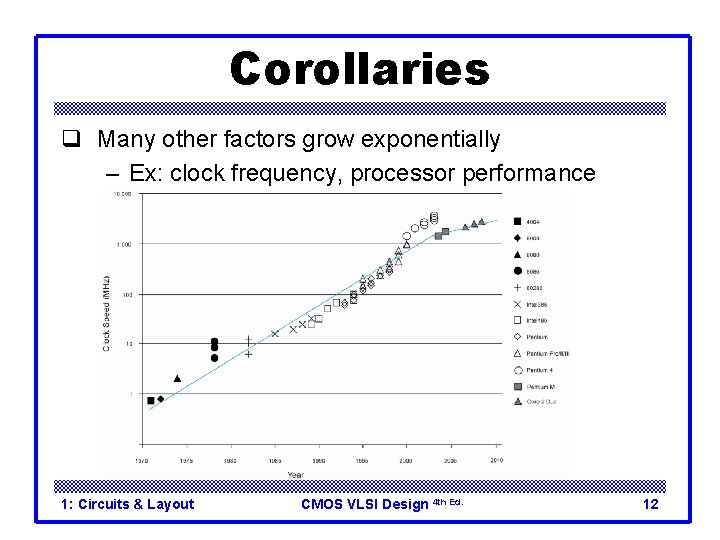
Corollaries q Many other factors grow exponentially – Ex: clock frequency, processor performance 1: Circuits & Layout CMOS VLSI Design 4 th Ed. 12
CMOS Gate Design q Activity: – Sketch a 4 -input CMOS NOR gate 1: Circuits & Layout CMOS VLSI Design 4 th Ed. 13
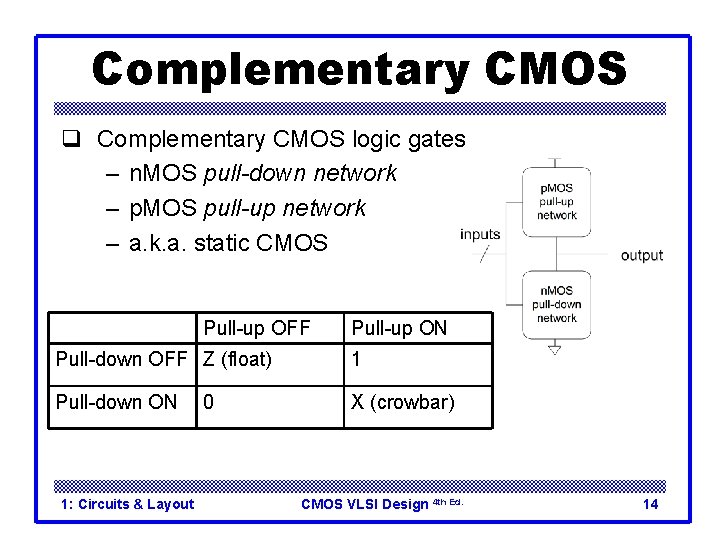
Complementary CMOS q Complementary CMOS logic gates – n. MOS pull-down network – p. MOS pull-up network – a. k. a. static CMOS Pull-up OFF Pull-up ON Pull-down OFF Z (float) 1 Pull-down ON X (crowbar) 1: Circuits & Layout 0 CMOS VLSI Design 4 th Ed. 14
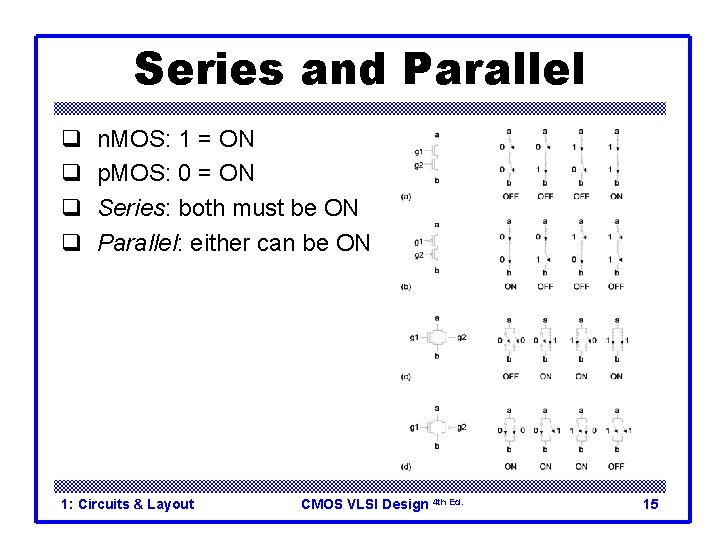
Series and Parallel q q n. MOS: 1 = ON p. MOS: 0 = ON Series: both must be ON Parallel: either can be ON 1: Circuits & Layout CMOS VLSI Design 4 th Ed. 15
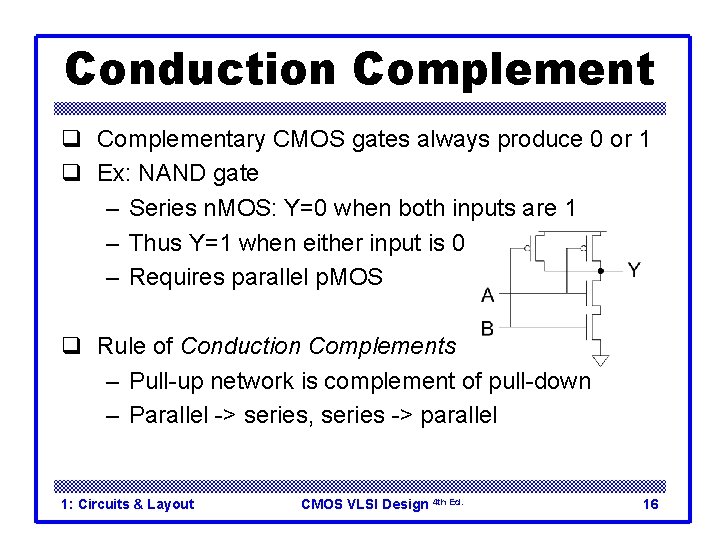
Conduction Complement q Complementary CMOS gates always produce 0 or 1 q Ex: NAND gate – Series n. MOS: Y=0 when both inputs are 1 – Thus Y=1 when either input is 0 – Requires parallel p. MOS q Rule of Conduction Complements – Pull-up network is complement of pull-down – Parallel -> series, series -> parallel 1: Circuits & Layout CMOS VLSI Design 4 th Ed. 16
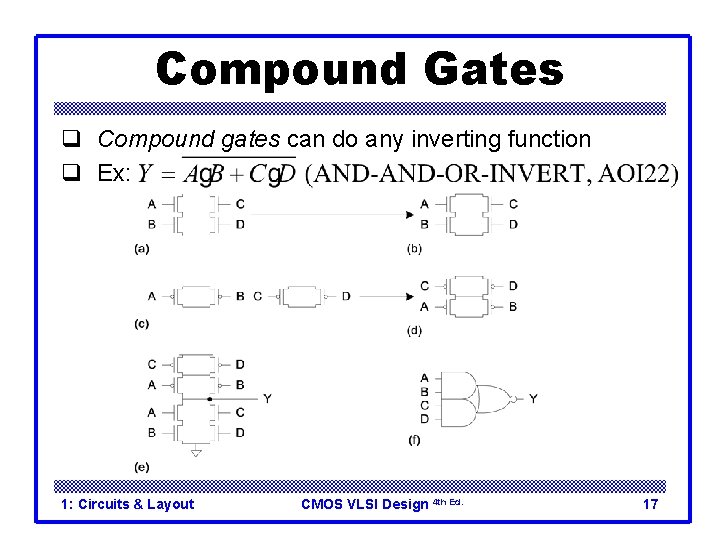
Compound Gates q Compound gates can do any inverting function q Ex: 1: Circuits & Layout CMOS VLSI Design 4 th Ed. 17
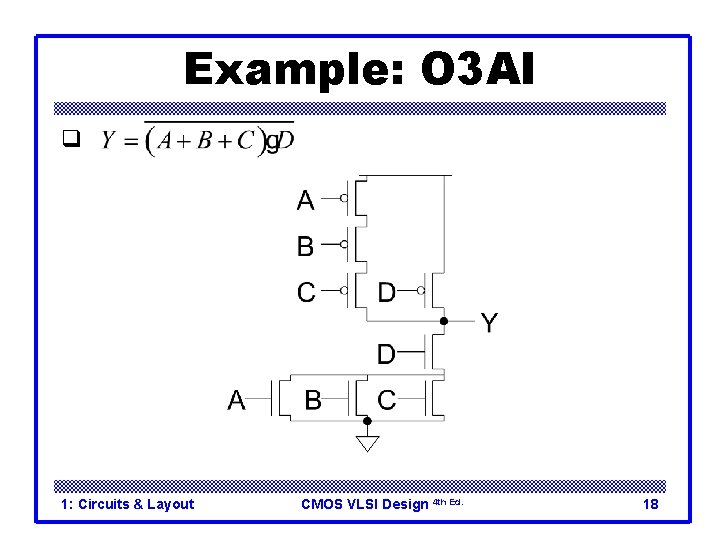
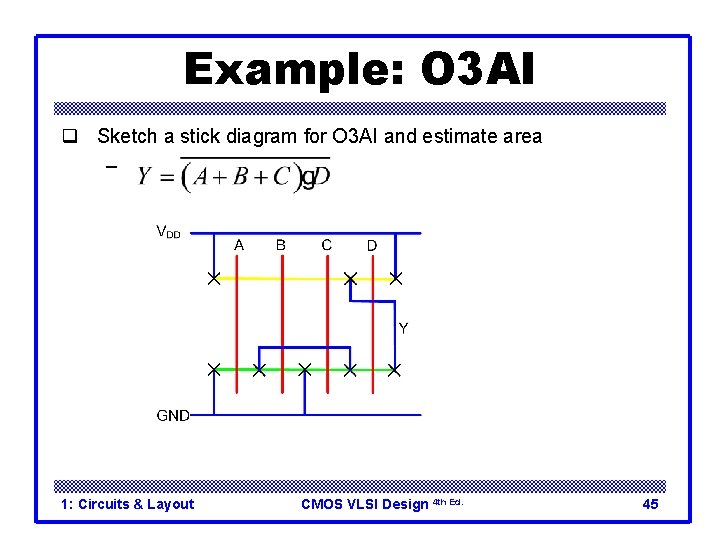
Example: O 3 AI q 1: Circuits & Layout CMOS VLSI Design 4 th Ed. 18
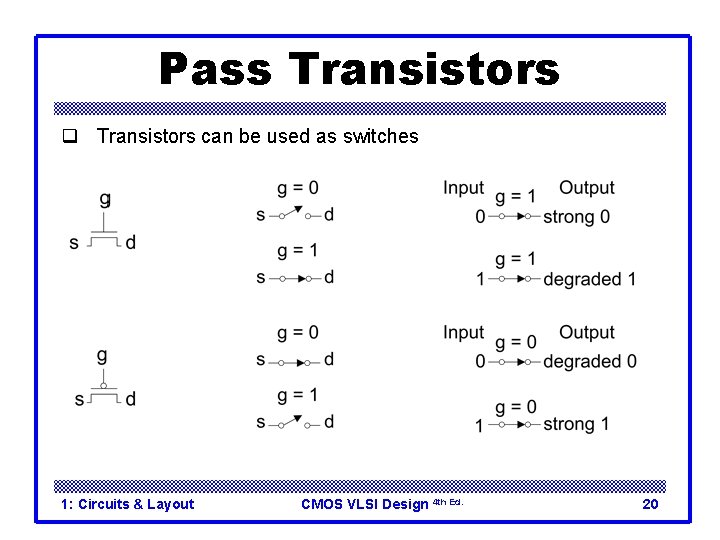
Signal Strength q Strength of signal – How close it approximates ideal voltage source q VDD and GND rails are strongest 1 and 0 q n. MOS pass strong 0 – But degraded or weak 1 q p. MOS pass strong 1 – But degraded or weak 0 q Thus n. MOS are best for pull-down network 1: Circuits & Layout CMOS VLSI Design 4 th Ed. 19
Pass Transistors q Transistors can be used as switches 1: Circuits & Layout CMOS VLSI Design 4 th Ed. 20
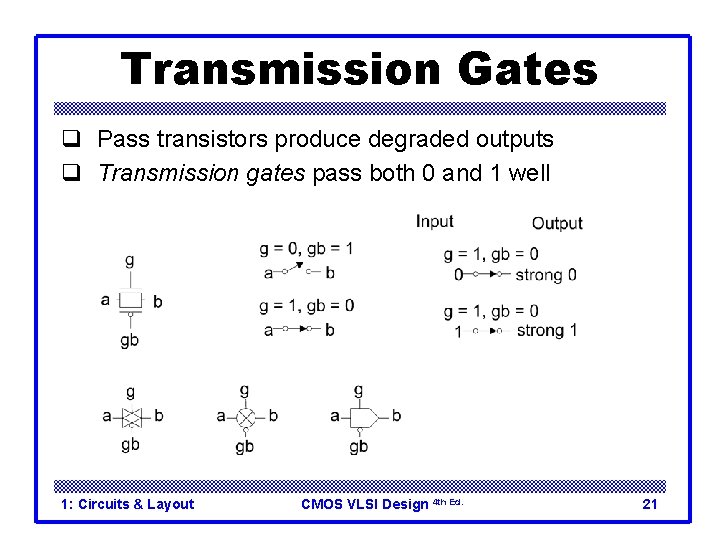
Transmission Gates q Pass transistors produce degraded outputs q Transmission gates pass both 0 and 1 well 1: Circuits & Layout CMOS VLSI Design 4 th Ed. 21
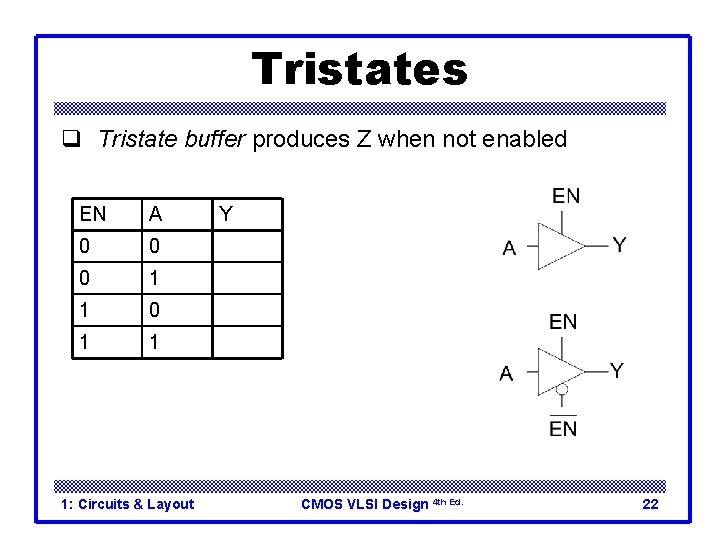
Tristates q Tristate buffer produces Z when not enabled EN A Y 0 0 Z 0 1 Z 1 0 0 1 1: Circuits & Layout CMOS VLSI Design 4 th Ed. 22
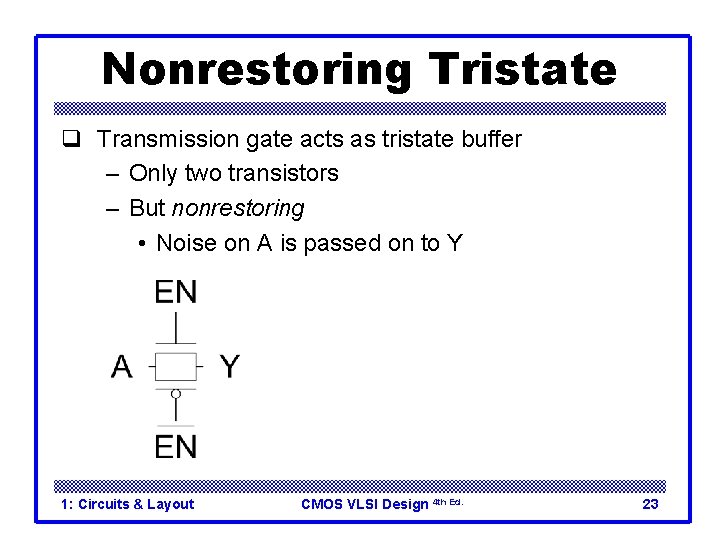
Nonrestoring Tristate q Transmission gate acts as tristate buffer – Only two transistors – But nonrestoring • Noise on A is passed on to Y 1: Circuits & Layout CMOS VLSI Design 4 th Ed. 23
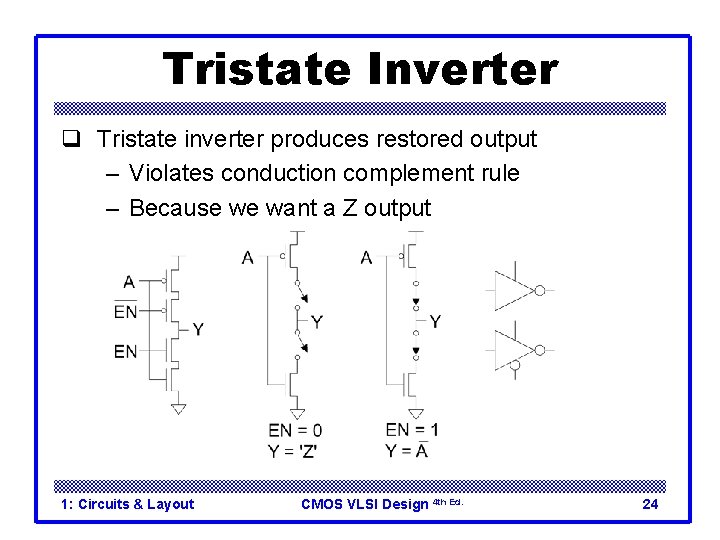
Tristate Inverter q Tristate inverter produces restored output – Violates conduction complement rule – Because we want a Z output 1: Circuits & Layout CMOS VLSI Design 4 th Ed. 24
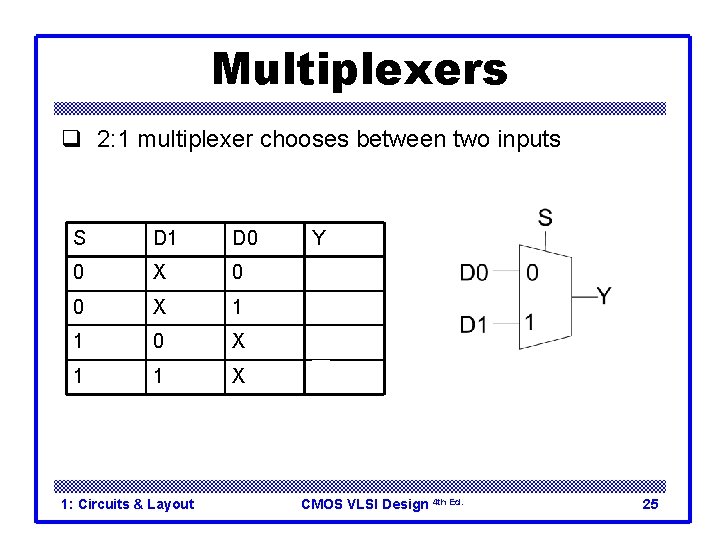
Multiplexers q 2: 1 multiplexer chooses between two inputs S D 1 D 0 Y 0 X 0 0 0 X 1 1 1 0 X 0 1 1 X 1 1: Circuits & Layout CMOS VLSI Design 4 th Ed. 25
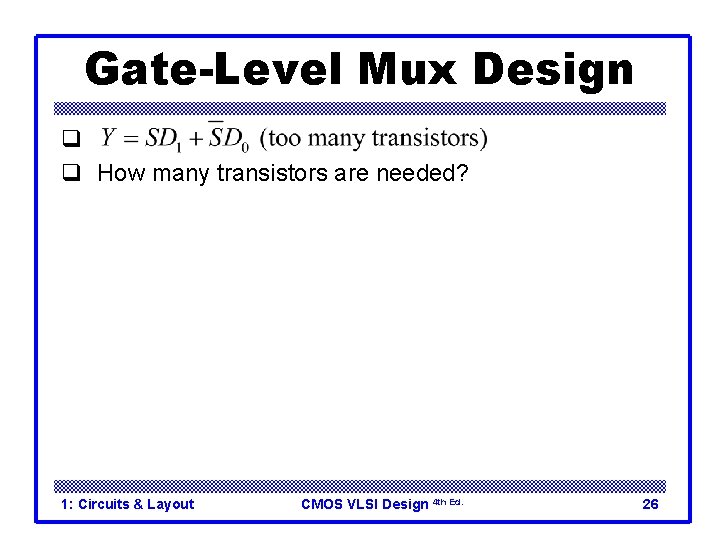
Gate-Level Mux Design q q How many transistors are needed? 20 1: Circuits & Layout CMOS VLSI Design 4 th Ed. 26
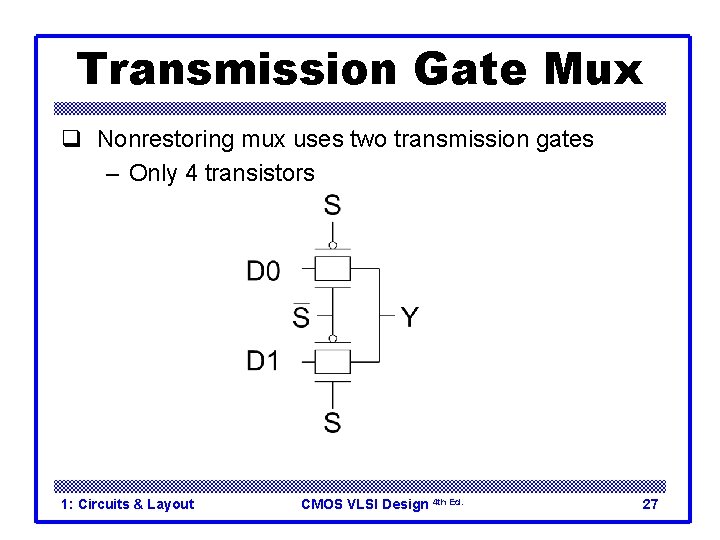
Transmission Gate Mux q Nonrestoring mux uses two transmission gates – Only 4 transistors 1: Circuits & Layout CMOS VLSI Design 4 th Ed. 27
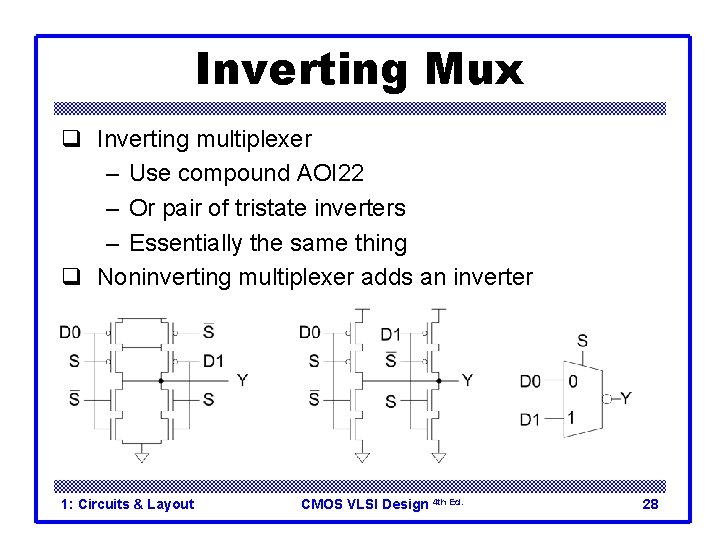
Inverting Mux q Inverting multiplexer – Use compound AOI 22 – Or pair of tristate inverters – Essentially the same thing q Noninverting multiplexer adds an inverter 1: Circuits & Layout CMOS VLSI Design 4 th Ed. 28
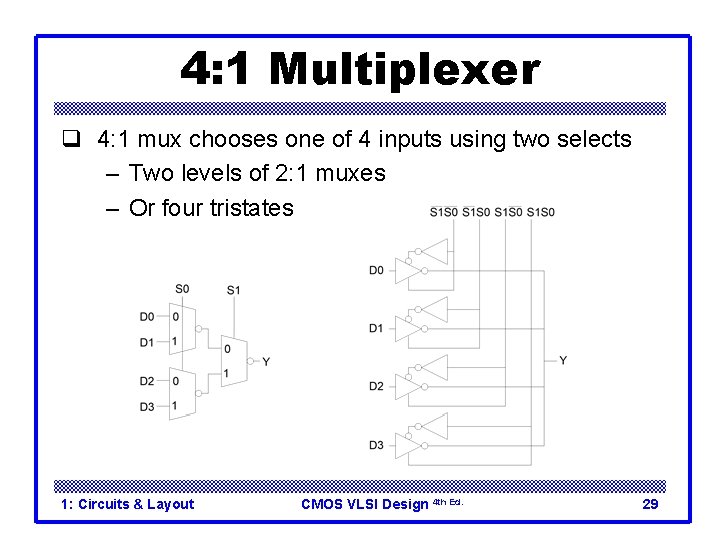
4: 1 Multiplexer q 4: 1 mux chooses one of 4 inputs using two selects – Two levels of 2: 1 muxes – Or four tristates 1: Circuits & Layout CMOS VLSI Design 4 th Ed. 29
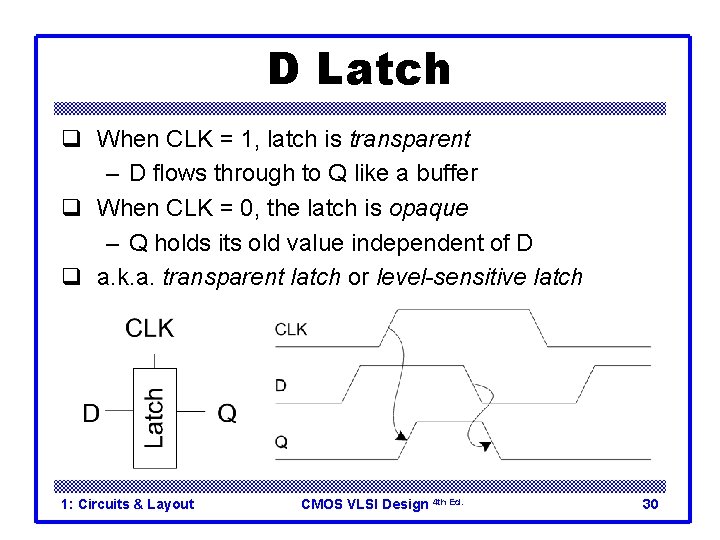
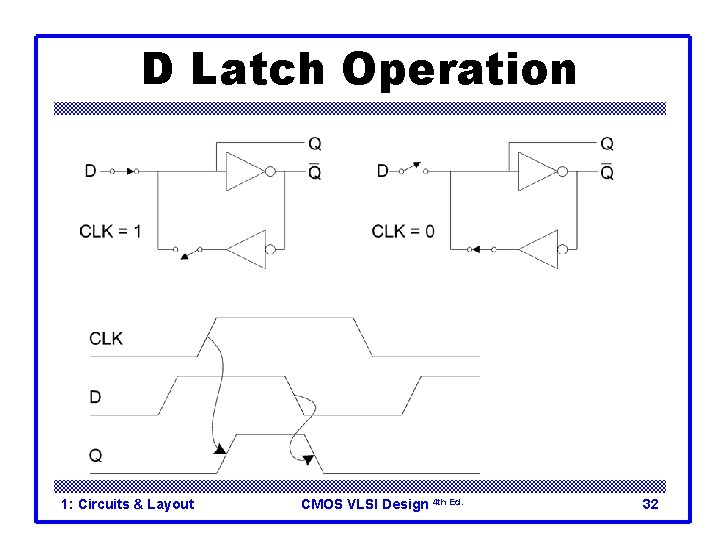
D Latch q When CLK = 1, latch is transparent – D flows through to Q like a buffer q When CLK = 0, the latch is opaque – Q holds its old value independent of D q a. k. a. transparent latch or level-sensitive latch 1: Circuits & Layout CMOS VLSI Design 4 th Ed. 30
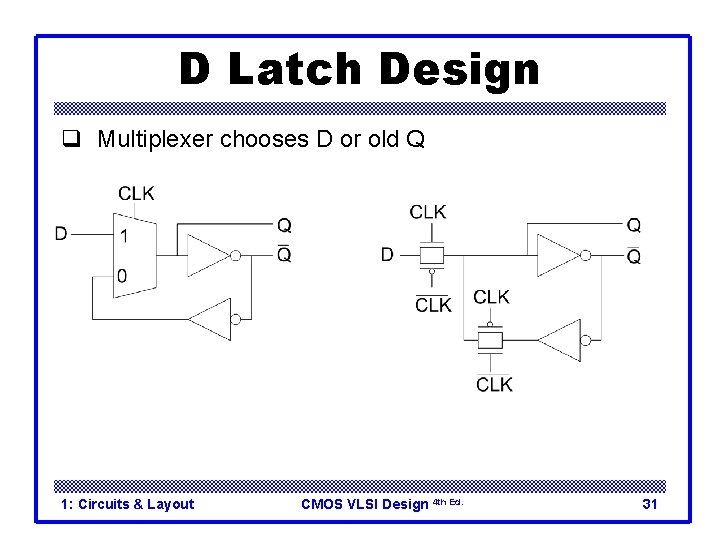
D Latch Design q Multiplexer chooses D or old Q 1: Circuits & Layout CMOS VLSI Design 4 th Ed. 31
D Latch Operation 1: Circuits & Layout CMOS VLSI Design 4 th Ed. 32
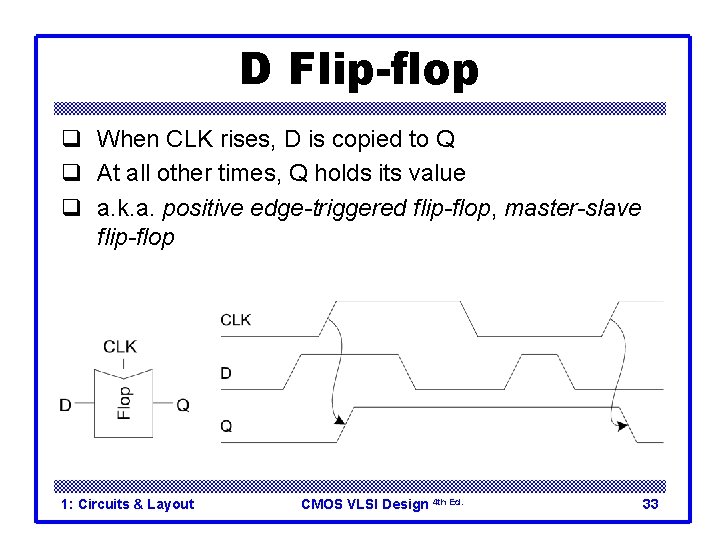
D Flip-flop q When CLK rises, D is copied to Q q At all other times, Q holds its value q a. k. a. positive edge-triggered flip-flop, master-slave flip-flop 1: Circuits & Layout CMOS VLSI Design 4 th Ed. 33
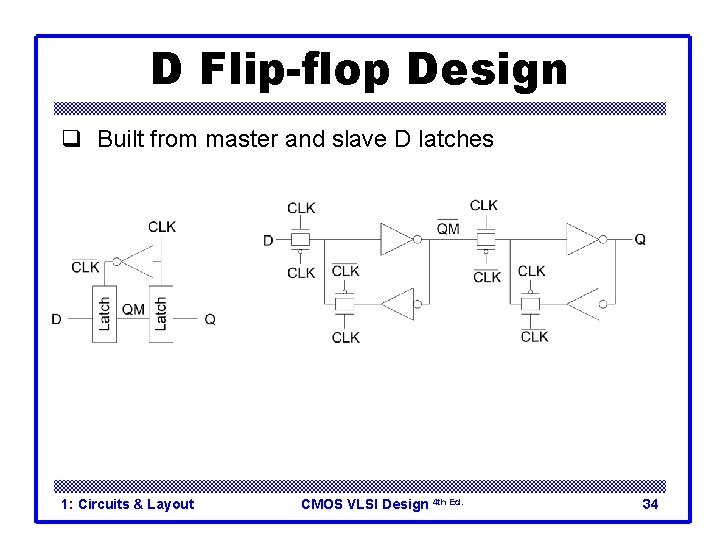
D Flip-flop Design q Built from master and slave D latches 1: Circuits & Layout CMOS VLSI Design 4 th Ed. 34
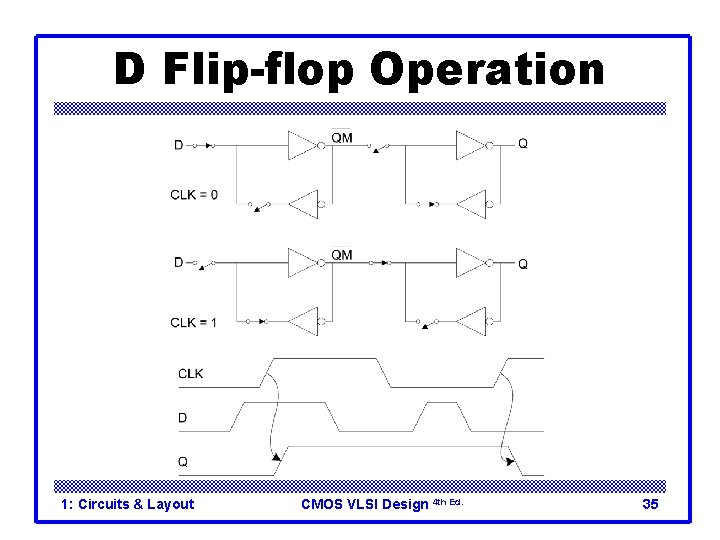
D Flip-flop Operation 1: Circuits & Layout CMOS VLSI Design 4 th Ed. 35
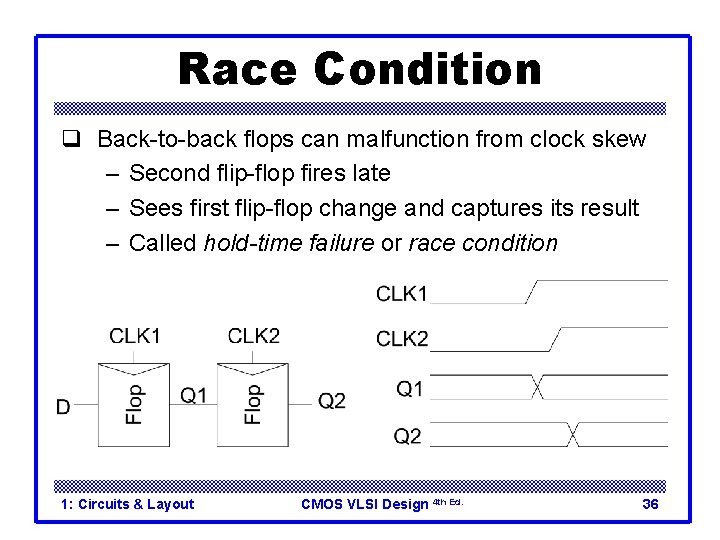
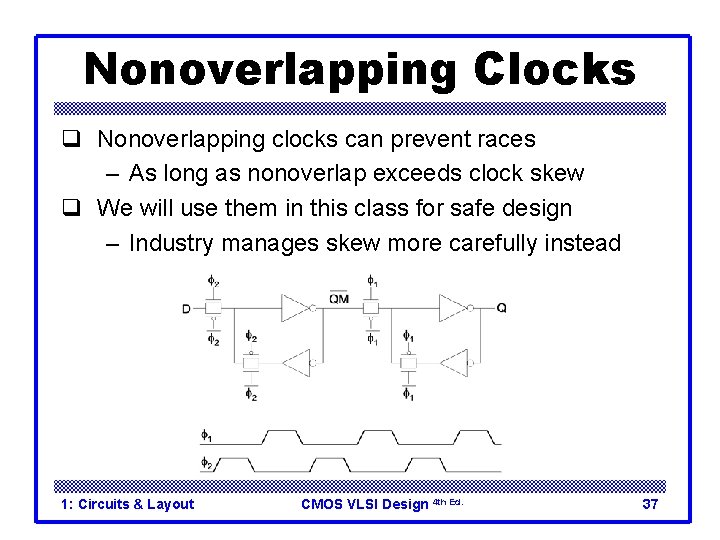
Race Condition q Back-to-back flops can malfunction from clock skew – Second flip-flop fires late – Sees first flip-flop change and captures its result – Called hold-time failure or race condition 1: Circuits & Layout CMOS VLSI Design 4 th Ed. 36
Nonoverlapping Clocks q Nonoverlapping clocks can prevent races – As long as nonoverlap exceeds clock skew q We will use them in this class for safe design – Industry manages skew more carefully instead 1: Circuits & Layout CMOS VLSI Design 4 th Ed. 37
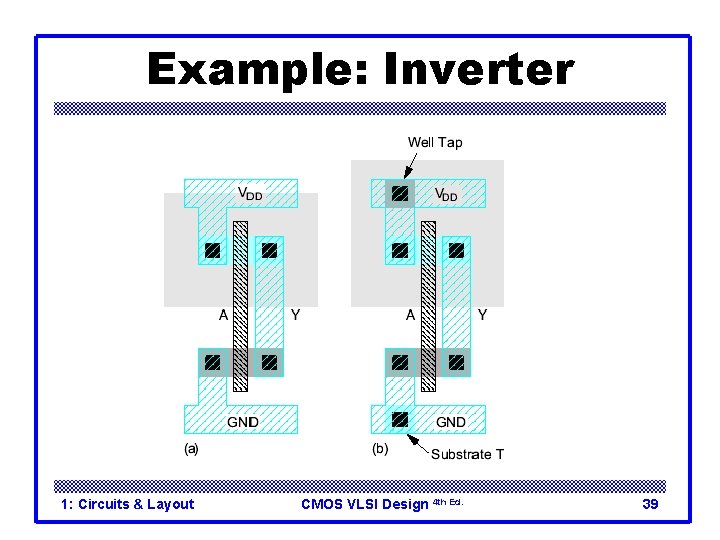
Gate Layout q Layout can be very time consuming – Design gates to fit together nicely – Build a library of standard cells q Standard cell design methodology – VDD and GND should abut (standard height) – Adjacent gates should satisfy design rules – n. MOS at bottom and p. MOS at top – All gates include well and substrate contacts 1: Circuits & Layout CMOS VLSI Design 4 th Ed. 38
Example: Inverter 1: Circuits & Layout CMOS VLSI Design 4 th Ed. 39
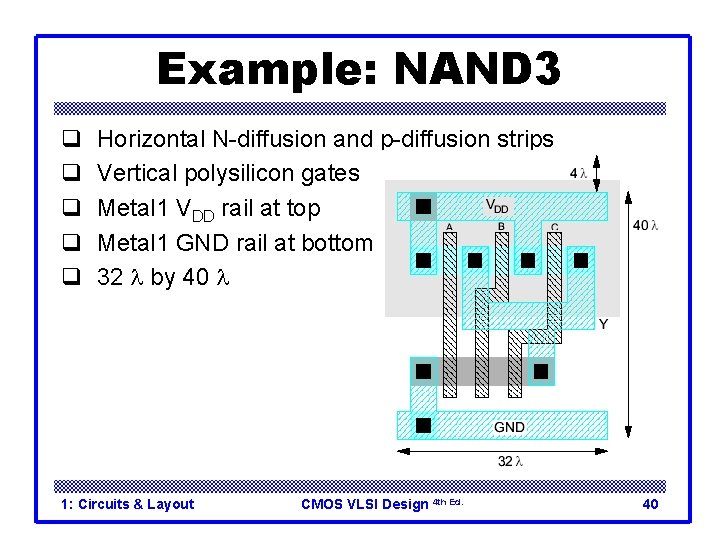
Example: NAND 3 q q q Horizontal N-diffusion and p-diffusion strips Vertical polysilicon gates Metal 1 VDD rail at top Metal 1 GND rail at bottom 32 l by 40 l 1: Circuits & Layout CMOS VLSI Design 4 th Ed. 40
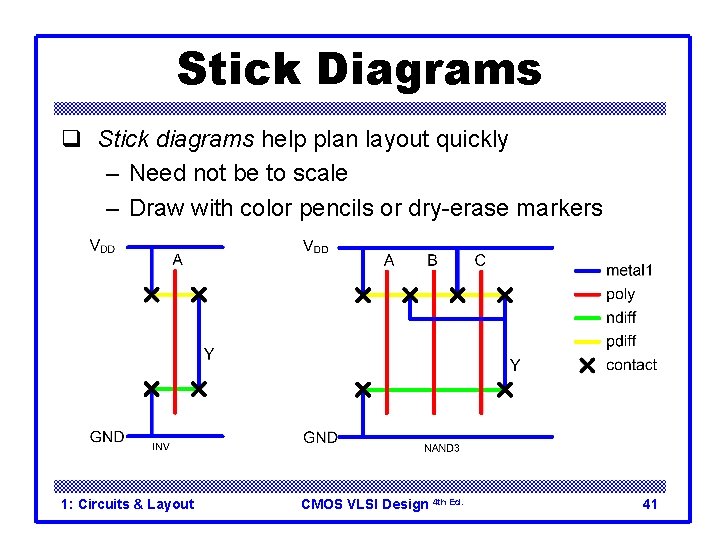
Stick Diagrams q Stick diagrams help plan layout quickly – Need not be to scale – Draw with color pencils or dry-erase markers 1: Circuits & Layout CMOS VLSI Design 4 th Ed. 41
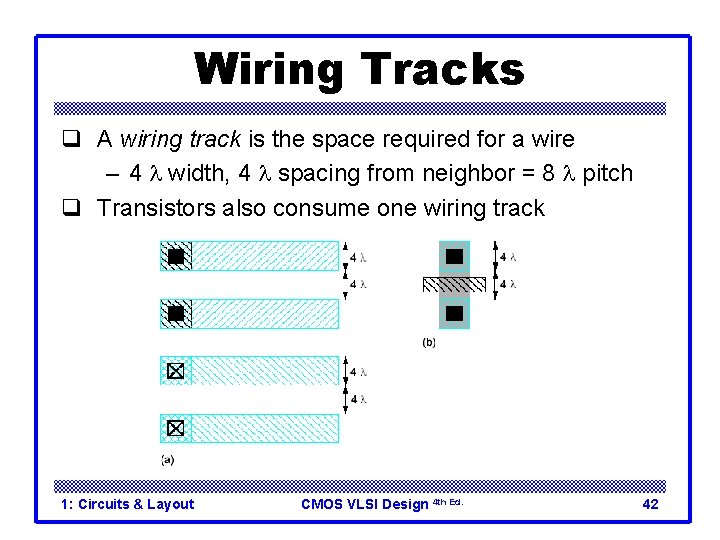
Wiring Tracks q A wiring track is the space required for a wire – 4 l width, 4 l spacing from neighbor = 8 l pitch q Transistors also consume one wiring track 1: Circuits & Layout CMOS VLSI Design 4 th Ed. 42
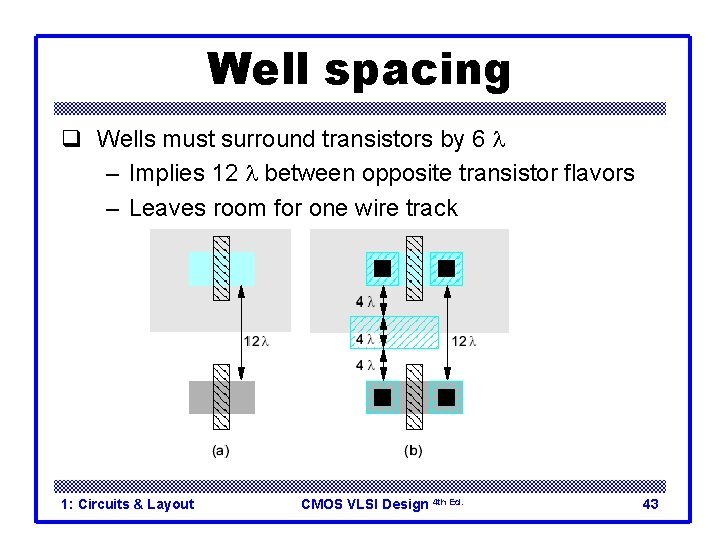
Well spacing q Wells must surround transistors by 6 l – Implies 12 l between opposite transistor flavors – Leaves room for one wire track 1: Circuits & Layout CMOS VLSI Design 4 th Ed. 43
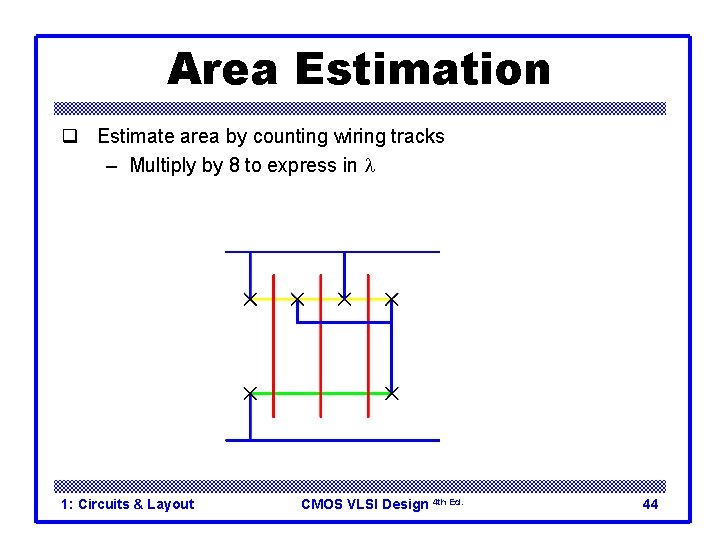
Area Estimation q Estimate area by counting wiring tracks – Multiply by 8 to express in l 1: Circuits & Layout CMOS VLSI Design 4 th Ed. 44
Example: O 3 AI q Sketch a stick diagram for O 3 AI and estimate area – 1: Circuits & Layout CMOS VLSI Design 4 th Ed. 45