
Lecture 1 Chapters 1 Variable Types and Roles
Lecture 1: Chapters 1 Variable Types and Roles Summarizing Variables 4 Processes of Statistics © 2011 Brooks/Cole, Cengage Learning Elementary Statistics: Looking at the Big Picture 1
Example: What Statistics Is All About • Background: Statistics teacher has a large collection of articles and reports of a statistical nature. • Question: How to classify them? • Background: Statistics students are faced with a collection of exam problems at the end of the semester. • Question: How to choose the right procedures to solve them? © 2011 Brooks/Cole, Cengage Learning Elementary Statistics: Looking at the Big Picture L 1. 2
Example: What Statistics Is All About • Response (to both questions): Statistics is all about variables--– Categorical or quantitative – Single variables or relationships variables between Looking Ahead: Identifying what kind of variables are involved is the key to classifying statistics problems and choosing the right solution tool. © 2011 Brooks/Cole, Cengage Learning Elementary Statistics: Looking at the Big Picture L 1. 3
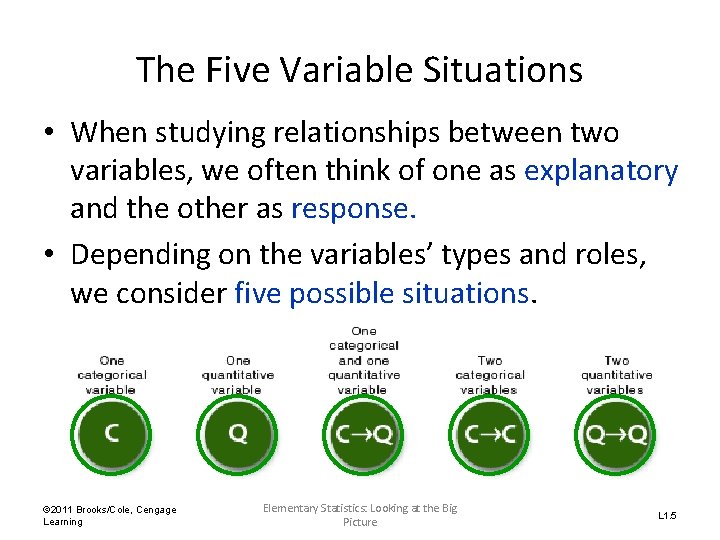
The Five Variable Situations • When studying relationships between two variables, we often think of one as explanatory and the other as response. • Depending on the variables’ types and roles, we consider five possible situations. © 2011 Brooks/Cole, Cengage Learning Elementary Statistics: Looking at the Big Picture L 1. 5
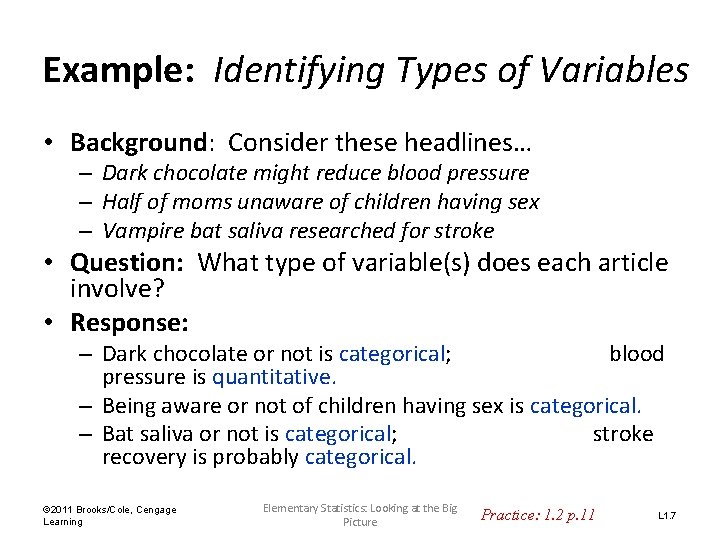
Example: Identifying Types of Variables • Background: Consider these headlines… – Dark chocolate might reduce blood pressure – Half of moms unaware of children having sex – Vampire bat saliva researched for stroke • Question: What type of variable(s) does each article involve? • Response: – Dark chocolate or not is categorical; blood pressure is quantitative. – Being aware or not of children having sex is categorical. – Bat saliva or not is categorical; stroke recovery is probably categorical. © 2011 Brooks/Cole, Cengage Learning Elementary Statistics: Looking at the Big Picture Practice: 1. 2 p. 11 L 1. 7

Example: Categorical Variable Giving Rise to Quantitative Variable • Background: Individual teenagers were surveyed about drug use. • Question: What type of variable(s) does this involve? • Response: – marijuana or not is categorical – harder drugs or not is categorical © 2011 Brooks/Cole, Cengage Learning Elementary Statistics: Looking at the Big Picture Practice: 1. 6 a p. 12 L 1. 9
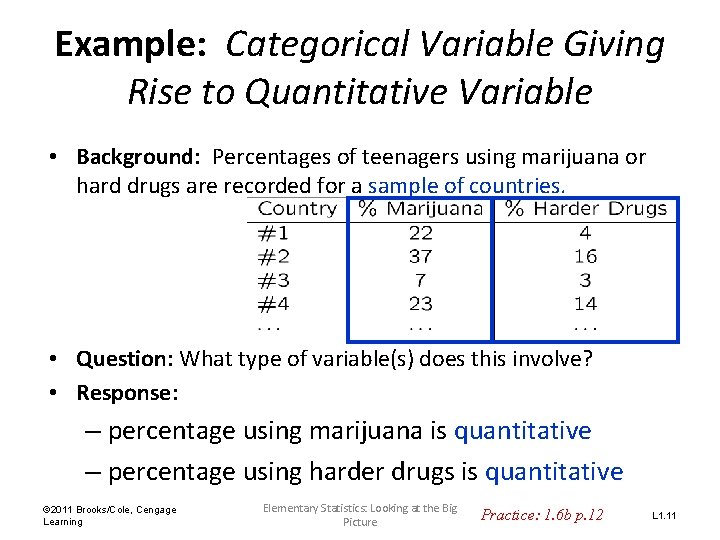
Example: Categorical Variable Giving Rise to Quantitative Variable • Background: Percentages of teenagers using marijuana or hard drugs are recorded for a sample of countries. • Question: What type of variable(s) does this involve? • Response: – percentage using marijuana is quantitative – percentage using harder drugs is quantitative © 2011 Brooks/Cole, Cengage Learning Elementary Statistics: Looking at the Big Picture Practice: 1. 6 b p. 12 L 1. 11
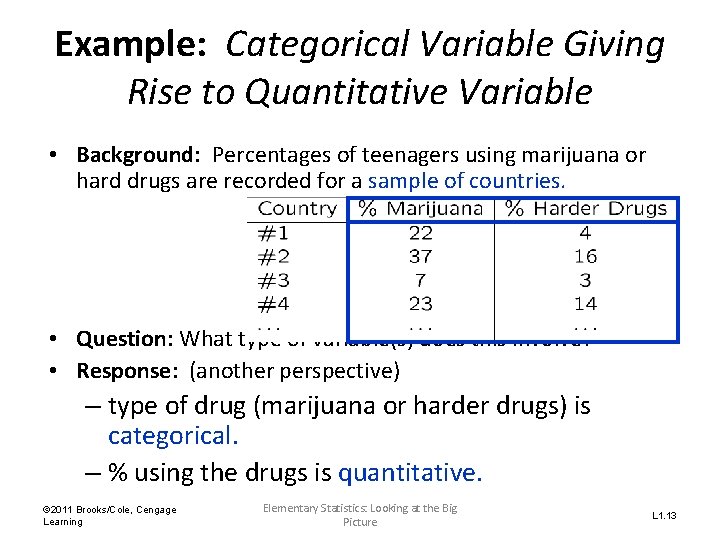
Example: Categorical Variable Giving Rise to Quantitative Variable • Background: Percentages of teenagers using marijuana or hard drugs are recorded for a sample of countries. • Question: What type of variable(s) does this involve? • Response: (another perspective) – type of drug (marijuana or harder drugs) is categorical. – % using the drugs is quantitative. © 2011 Brooks/Cole, Cengage Learning Elementary Statistics: Looking at the Big Picture L 1. 13

Example: Quantitative Variable Giving Rise to Categorical Variable • Background: Researchers studied effects of dental X-rays during pregnancy. – First approach: X-rays or not; baby’s weight – Second approach: X-rays or not; classify baby’s wt. as at least 6 lbs. (considered normal) or below 6 lbs. • Question: What type of variable(s) does each approach involve? • Response: – X-rays or not is categorical; baby’s weight is quantitative – X-rays or not is categorical; baby’s wt. at least 6 lbs. or below 6 lbs. is categorical © 2011 Brooks/Cole, Cengage Learning Elementary Statistics: Looking at the Big Picture Practice: 1. 8 p. 12 L 1. 15
Definitions • Data: recorded values of categorical or quantitative variables • Statistics: science concerned with – gathering data about a group of individuals – displaying and summarizing the data – using info from data to draw conclusions about larger group (All these skills are essential in both academic and professional settings. ) © 2011 Brooks/Cole, Cengage Learning Elementary Statistics: Looking at the Big Picture L 1. 17
Summarizing Data • Categorical data: – Count: number of individuals in a category – Proportion: count in category divided by total number of individuals considered – Percentage: proportion as decimal 100% • Quantitative data: mean is sum of values divided by total number of values © 2011 Brooks/Cole, Cengage Learning Elementary Statistics: Looking at the Big Picture L 1. 18
Example: Summarizing Variables • Background: “… 1. 9% of students nationwide got special accommodations for SAT…At 20 prominent NE private schools, nearly 1 in 10 received special treatment…” • Question: What type of variable is involved, and how is it summarized? • Response: special accommodations for SAT is categorical, summarized with percentage (1. 9%) or proportion (1 in 10). Hint: think about who or what are the individuals. What information is recorded for each of them? © 2011 Brooks/Cole, Cengage Learning Elementary Statistics: Looking at the Big Picture Practice: 1. 10 p. 12 L 1. 19

Example: Summarizing Variables • Background: “…On average, a white man with a college diploma earned $65, 000 in 2001. Similarly educated white women made 40% less; black and Hispanic men earned 30% less…” • Question: What type of variable is considered for each demographic group, and how is it summarized? • Response: Earnings is quantitative; summarize with mean. A Closer Look: When comparing quantitative values for two or more categorical groups, we sometimes quantify the difference by reporting what percentage higher or lower one mean is compared to the other. © 2011 Brooks/Cole, Cengage Learning Elementary Statistics: Looking at the Big Picture Practice: 1. 11 p. 12 L 1. 21

Roles of Variables When studying relationships between two variables, we often think of one as explanatory and the other as response. © 2011 Brooks/Cole, Cengage Learning Elementary Statistics: Looking at the Big Picture L 1. 23

Example: Identifying Types and Roles • Background: Consider these headlines--– Men twice as likely as women to be hit by lightning – Do Oscar winners live longer than less successful peers? • Questions: What types of variables are involved? For relationships, what roles do the variables play? • Responses: – Gender is categorical and explanatory; Hit by lightning or not is categorical and response. – Winning an Oscar or not is categorical and explanatory; Life span is quantitative and response. © 2011 Brooks/Cole, Cengage Learning Elementary Statistics: Looking at the Big Picture L 1. 24 Practice: 1. 17 p. 13

Example: More Identifying Types and Roles • Background: Consider these headlines--– 35% of returning troops seek mental health aid – Smaller, hungrier mice – County’s average weekly wages at $811, better than U. S. average • Questions: What types of variables are involved? For relationships, what roles do the variables play? • Responses: – Seeking mental health aid or not is categorical. – Size is quantitative and explanatory. Appetite is quantitative and response. – Wages are quantitative. © 2011 Brooks/Cole, Cengage Learning Elementary Statistics: Looking at the Big Picture L 1. 26
Definitions • A random occurrence is one that happens by chance alone, and not according to a preference or an attempted influence. • Probability: formal study of the chance of occurring in a random situation. • Statistical Inference: drawing conclusions about population based on sample. Looking Ahead: Probability and Inference are linked through their roles in the 4 -stage process of Statistics. © 2011 Brooks/Cole, Cengage Learning Elementary Statistics: Looking at the Big Picture L 1. 28

Statistics as Four-Stage Process • • Data Production Displaying and Summarizing Probability Statistical Inference Looking Ahead: Besides the word “probability”, a Probability statement may use the word “chance” or “likelihood” (the only synonyms available). © 2011 Brooks/Cole, Cengage Learning Elementary Statistics: Looking at the Big Picture L 1. 29

First Process of Statistics 1. Data Production: Take sample data from the population, with sampling and study designs that avoid bias. POPULATION SAMPLE PROBABILITY INFERENCE 2. Displaying and Summarizing: Use C appropriate displays and summaries of the sample data, according to variable C Q C C types and roles. 3. Probability: Assume we know what’s true for the population; how should random samples behave? 4. Statistical Inference: Assume we only know what’s true about sampled values of a single variable or relationship; what can we infer about the larger population? © 2011 Brooks/Cole, Cengage Learning Elementary Statistics: Looking at the Big Picture L 1. 31

Second Process of Statistics 1. Data Production: Take sample data from the population, with sampling and study designs that avoid bias. POPULATION SAMPLE © 2011 Brooks/Cole, Cengage Learning 2. Displaying and Summarizing: Use appropriate displays and summaries of the sample data, according to variable types and roles. Elementary Statistics: Looking at the Big Picture C Q C C Q Q L 1. 32
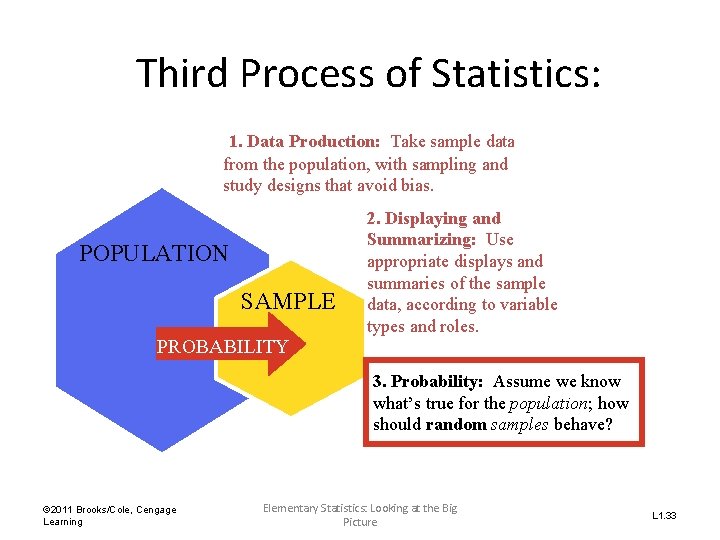
Third Process of Statistics: 1. Data Production: Take sample data from the population, with sampling and study designs that avoid bias. POPULATION SAMPLE PROBABILITY 2. Displaying and Summarizing: Use C appropriate displays and summaries of the sample data, according to variable CQ types and roles. Q Q 3. Probability: Assume we know what’s true for the population; how should random samples behave? © 2011 Brooks/Cole, Cengage Learning Elementary Statistics: Looking at the Big Picture L 1. 33

Fourth Process of Statistics 1. Data Production: Take sample data from the population, with sampling and study designs that avoid bias. POPULATION SAMPLE PROBABILITY INFERENCE 2. Displaying and Summarizing: Use appropriate displays and summaries of the sample data, according to variable types and roles. 3. Probability: Assume we know what’s true for the population; how should random samples behave? 4. Statistical Inference: Assume we only know what’s true about sampled values of a single variable or relationship; what can we infer about the larger population? © 2011 Brooks/Cole, Cengage Learning Elementary Statistics: Looking at the Big Picture C Q C C Q Q L 1. 34
- Slides: 22