
Lecture 1 c Synthesis of Anhydrous Metal Halides

- Slides: 19
Lecture 1 c Synthesis of Anhydrous Metal Halides
Introduction • Anhydrous metal halides are commonly used starting materials for many organometallic compounds (i. e. , in reactions with Grignard reagents, the formation of metallocene, chromium(III) dithiocarbamates) or as catalysts in organic reactions (i. e. , polymerizations, Friedel-Crafts acylations, etc. ) • Many anhydrous metal chlorides, bromides and iodides are commercially available from Sigma-Aldrich or Strem • Many of them are very expensive compared to their hydrated counterparts • The quality often times not as high as advertised due to prolonged storage
Purification by Distillation • Most metal halides are solids due to the fact that they form three-dimensional network structures. However, some of them are liquids because they are monomeric at room temperature: • Trichloride: boron, nitrogen, phosphorous and arsenic • Tetrachloride: carbon, silicon, germanium, tin, lead, titanium and vanadium • Pentachloride: antimony (T> -55 o. C), arsenic (T> -50 o. C (dec. )) • Most metal chlorides are contaminated by hydrates (due to their Lewis acidity), oxychlorides or oxides as a result of hydrolysis • PCl 3 (b. p. : 74. 5 o. C) and POCl 3 (b. p. : 105. 3 o. C) can be separated by fractionated distillation
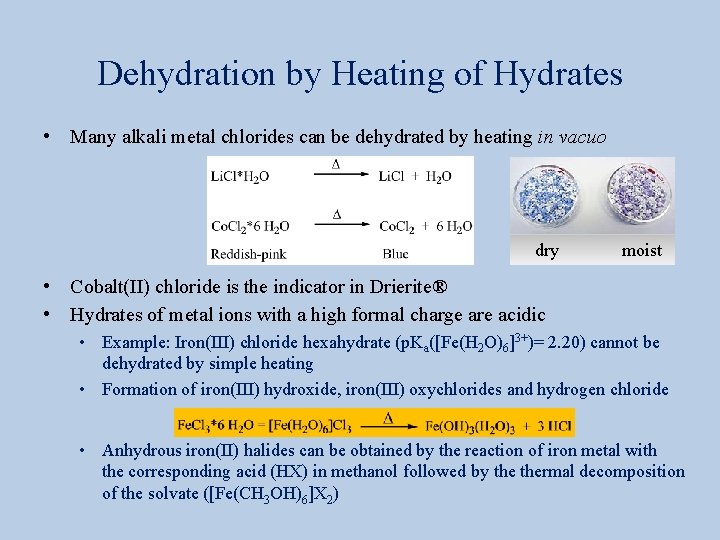
Dehydration by Heating of Hydrates • Many alkali metal chlorides can be dehydrated by heating in vacuo dry moist • Cobalt(II) chloride is the indicator in Drierite® • Hydrates of metal ions with a high formal charge are acidic • Example: Iron(III) chloride hexahydrate (p. Ka([Fe(H 2 O)6]3+)= 2. 20) cannot be dehydrated by simple heating • Formation of iron(III) hydroxide, iron(III) oxychlorides and hydrogen chloride • Anhydrous iron(II) halides can be obtained by the reaction of iron metal with the corresponding acid (HX) in methanol followed by thermal decomposition of the solvate ([Fe(CH 3 OH)6]X 2)
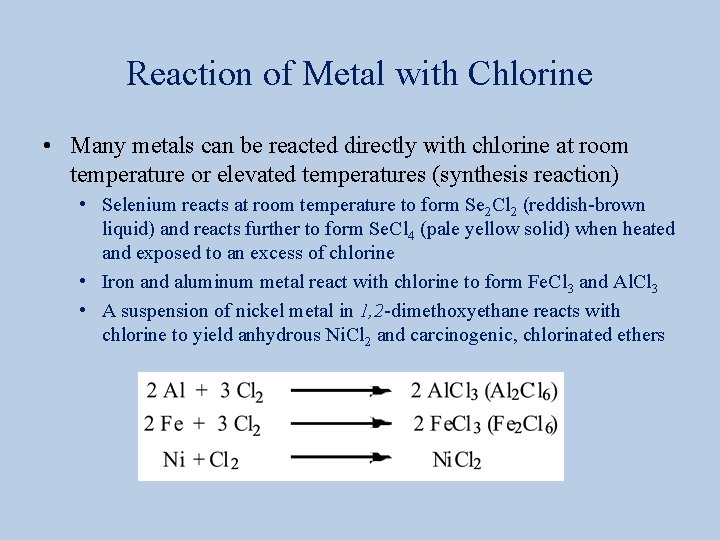
Reaction of Metal with Chlorine • Many metals can be reacted directly with chlorine at room temperature or elevated temperatures (synthesis reaction) • Selenium reacts at room temperature to form Se 2 Cl 2 (reddish-brown liquid) and reacts further to form Se. Cl 4 (pale yellow solid) when heated and exposed to an excess of chlorine • Iron and aluminum metal react with chlorine to form Fe. Cl 3 and Al. Cl 3 • A suspension of nickel metal in 1, 2 -dimethoxyethane reacts with chlorine to yield anhydrous Ni. Cl 2 and carcinogenic, chlorinated ethers
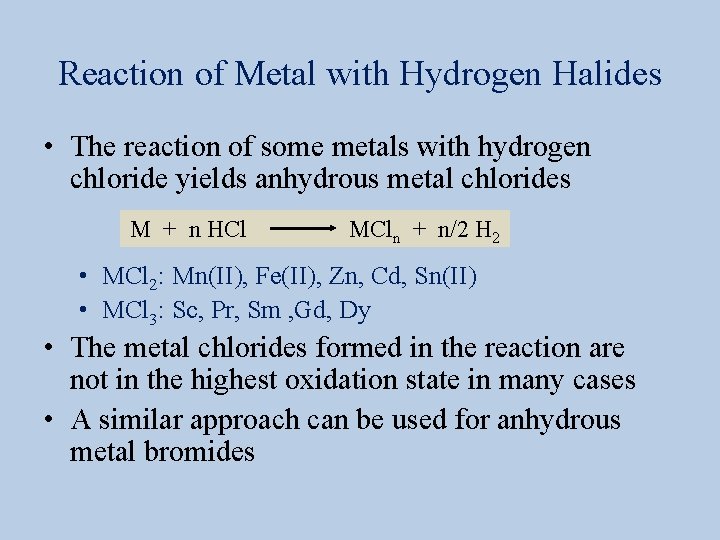
Reaction of Metal with Hydrogen Halides • The reaction of some metals with hydrogen chloride yields anhydrous metal chlorides M + n HCl MCln + n/2 H 2 • MCl 2: Mn(II), Fe(II), Zn, Cd, Sn(II) • MCl 3: Sc, Pr, Sm , Gd, Dy • The metal chlorides formed in the reaction are not in the highest oxidation state in many cases • A similar approach can be used for anhydrous metal bromides
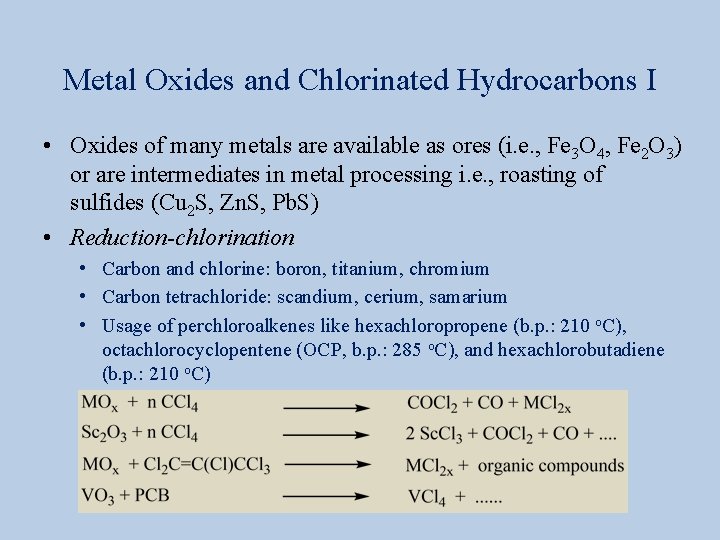
Metal Oxides and Chlorinated Hydrocarbons I • Oxides of many metals are available as ores (i. e. , Fe 3 O 4, Fe 2 O 3) or are intermediates in metal processing i. e. , roasting of sulfides (Cu 2 S, Zn. S, Pb. S) • Reduction-chlorination • Carbon and chlorine: boron, titanium, chromium • Carbon tetrachloride: scandium, cerium, samarium • Usage of perchloroalkenes like hexachloropropene (b. p. : 210 o. C), octachlorocyclopentene (OCP, b. p. : 285 o. C), and hexachlorobutadiene (b. p. : 210 o. C)
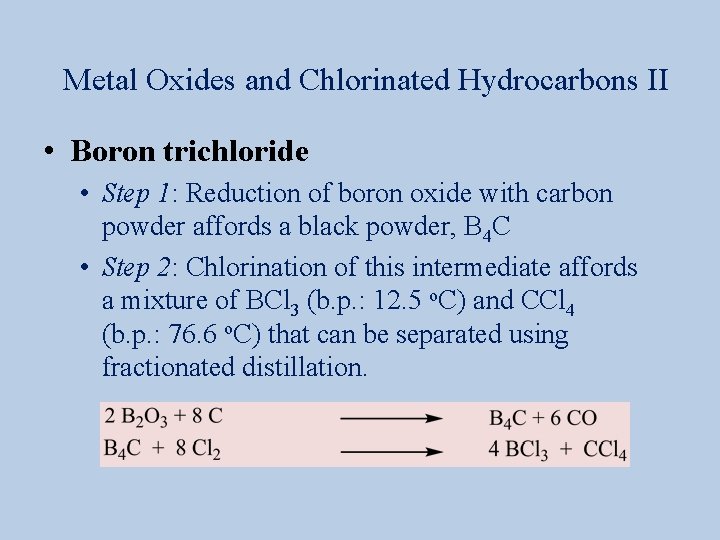
Metal Oxides and Chlorinated Hydrocarbons II • Boron trichloride • Step 1: Reduction of boron oxide with carbon powder affords a black powder, B 4 C • Step 2: Chlorination of this intermediate affords a mixture of BCl 3 (b. p. : 12. 5 o. C) and CCl 4 (b. p. : 76. 6 o. C) that can be separated using fractionated distillation.
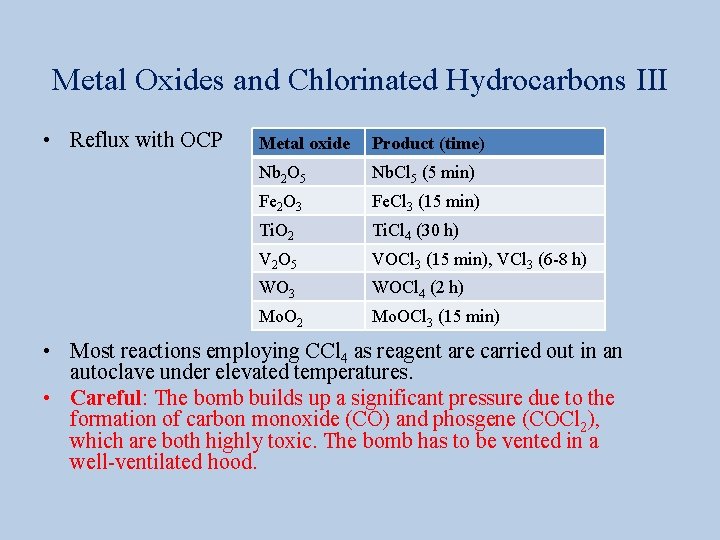
Metal Oxides and Chlorinated Hydrocarbons III • Reflux with OCP Metal oxide Product (time) Nb 2 O 5 Nb. Cl 5 (5 min) Fe 2 O 3 Fe. Cl 3 (15 min) Ti. O 2 Ti. Cl 4 (30 h) V 2 O 5 VOCl 3 (15 min), VCl 3 (6 -8 h) WO 3 WOCl 4 (2 h) Mo. O 2 Mo. OCl 3 (15 min) • Most reactions employing CCl 4 as reagent are carried out in an autoclave under elevated temperatures. • Careful: The bomb builds up a significant pressure due to the formation of carbon monoxide (CO) and phosgene (COCl 2), which are both highly toxic. The bomb has to be vented in a well-ventilated hood.
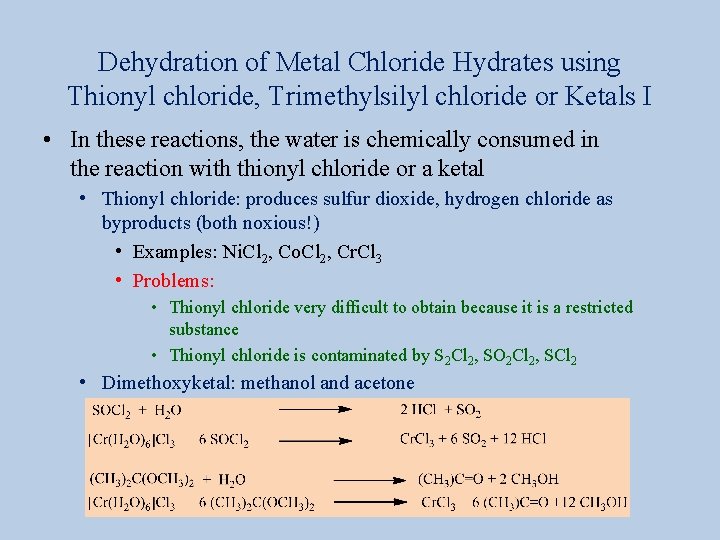
Dehydration of Metal Chloride Hydrates using Thionyl chloride, Trimethylsilyl chloride or Ketals I • In these reactions, the water is chemically consumed in the reaction with thionyl chloride or a ketal • Thionyl chloride: produces sulfur dioxide, hydrogen chloride as byproducts (both noxious!) • Examples: Ni. Cl 2, Co. Cl 2, Cr. Cl 3 • Problems: • Thionyl chloride very difficult to obtain because it is a restricted substance • Thionyl chloride is contaminated by S 2 Cl 2, SO 2 Cl 2, SCl 2 • Dimethoxyketal: methanol and acetone
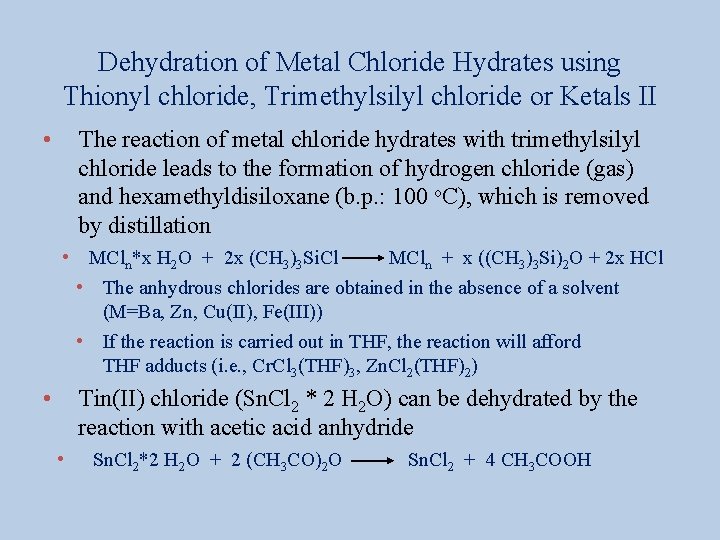
Dehydration of Metal Chloride Hydrates using Thionyl chloride, Trimethylsilyl chloride or Ketals II • The reaction of metal chloride hydrates with trimethylsilyl chloride leads to the formation of hydrogen chloride (gas) and hexamethyldisiloxane (b. p. : 100 o. C), which is removed by distillation • MCln*x H 2 O + 2 x (CH 3)3 Si. Cl MCln + x ((CH 3)3 Si)2 O + 2 x HCl • The anhydrous chlorides are obtained in the absence of a solvent (M=Ba, Zn, Cu(II), Fe(III)) • If the reaction is carried out in THF, the reaction will afford THF adducts (i. e. , Cr. Cl 3(THF)3, Zn. Cl 2(THF)2) • Tin(II) chloride (Sn. Cl 2 * 2 H 2 O) can be dehydrated by the reaction with acetic acid anhydride • Sn. Cl 2*2 H 2 O + 2 (CH 3 CO)2 O Sn. Cl 2 + 4 CH 3 COOH
Special Methods • Reaction of Metal Oxides with ammonium halides • M 2 O 3 + 6 NH 4 X • M=Ln; X=Cl, Br, I 2 MX 3 + 6 NH 3 + 3 H 2 O • Reaction of Metal acetates with acyl halides • M(OAc)n*m. H 2 O + (n+m) Ac. X MXn + n Ac 2 O + m Ac. OH + m HX • M=Mn-Cu (n=2), Cr, Nd, Sm (n=3), X=Cl, Br, I • Reaction of anhydrous Metal acetates with hydrogen halides • M(OAc)n + n HX MXn + n Ac. OH • M=Cr, X=Cl, Br; M=Mo, X=Cl
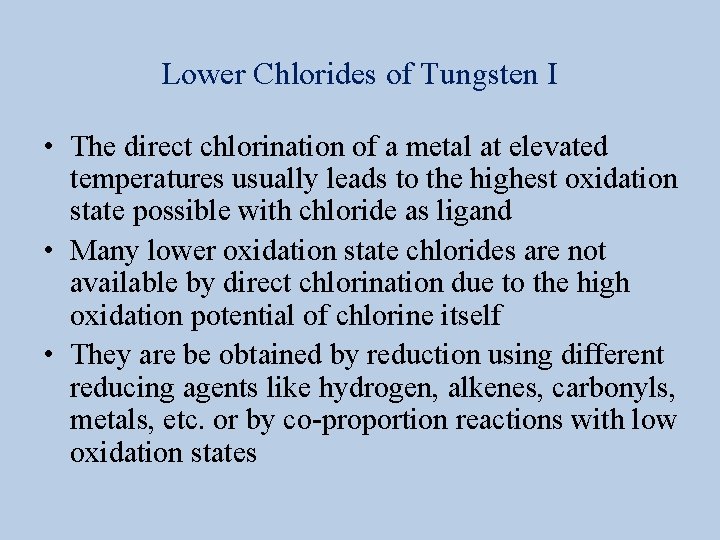
Lower Chlorides of Tungsten I • The direct chlorination of a metal at elevated temperatures usually leads to the highest oxidation state possible with chloride as ligand • Many lower oxidation state chlorides are not available by direct chlorination due to the high oxidation potential of chlorine itself • They are be obtained by reduction using different reducing agents like hydrogen, alkenes, carbonyls, metals, etc. or by co-proportion reactions with low oxidation states
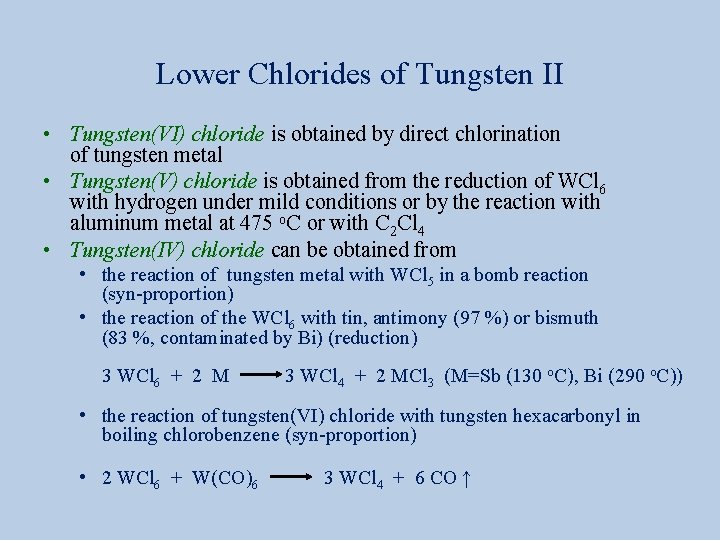
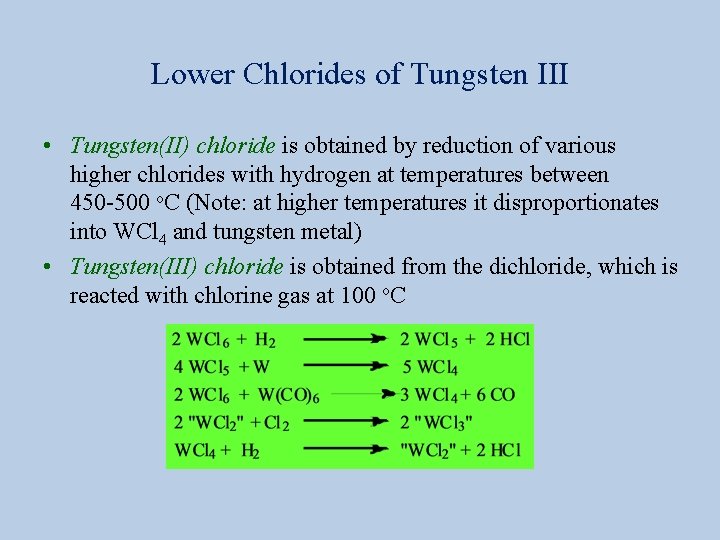
Lower Chlorides of Tungsten II • Tungsten(VI) chloride is obtained by direct chlorination of tungsten metal • Tungsten(V) chloride is obtained from the reduction of WCl 6 with hydrogen under mild conditions or by the reaction with aluminum metal at 475 o. C or with C 2 Cl 4 • Tungsten(IV) chloride can be obtained from • the reaction of tungsten metal with WCl 5 in a bomb reaction (syn-proportion) • the reaction of the WCl 6 with tin, antimony (97 %) or bismuth (83 %, contaminated by Bi) (reduction) 3 WCl 6 + 2 M 3 WCl 4 + 2 MCl 3 (M=Sb (130 o. C), Bi (290 o. C)) • the reaction of tungsten(VI) chloride with tungsten hexacarbonyl in boiling chlorobenzene (syn-proportion) • 2 WCl 6 + W(CO)6 3 WCl 4 + 6 CO ↑
Lower Chlorides of Tungsten III • Tungsten(II) chloride is obtained by reduction of various higher chlorides with hydrogen at temperatures between 450 -500 o. C (Note: at higher temperatures it disproportionates into WCl 4 and tungsten metal) • Tungsten(III) chloride is obtained from the dichloride, which is reacted with chlorine gas at 100 o. C
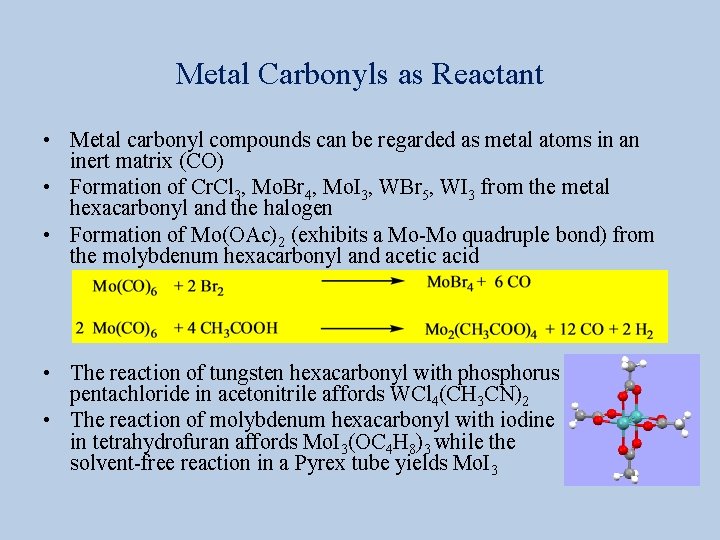
Metal Carbonyls as Reactant • Metal carbonyl compounds can be regarded as metal atoms in an inert matrix (CO) • Formation of Cr. Cl 3, Mo. Br 4, Mo. I 3, WBr 5, WI 3 from the metal hexacarbonyl and the halogen • Formation of Mo(OAc)2 (exhibits a Mo-Mo quadruple bond) from the molybdenum hexacarbonyl and acetic acid • The reaction of tungsten hexacarbonyl with phosphorus pentachloride in acetonitrile affords WCl 4(CH 3 CN)2 • The reaction of molybdenum hexacarbonyl with iodine in tetrahydrofuran affords Mo. I 3(OC 4 H 8)3 while the solvent-free reaction in a Pyrex tube yields Mo. I 3
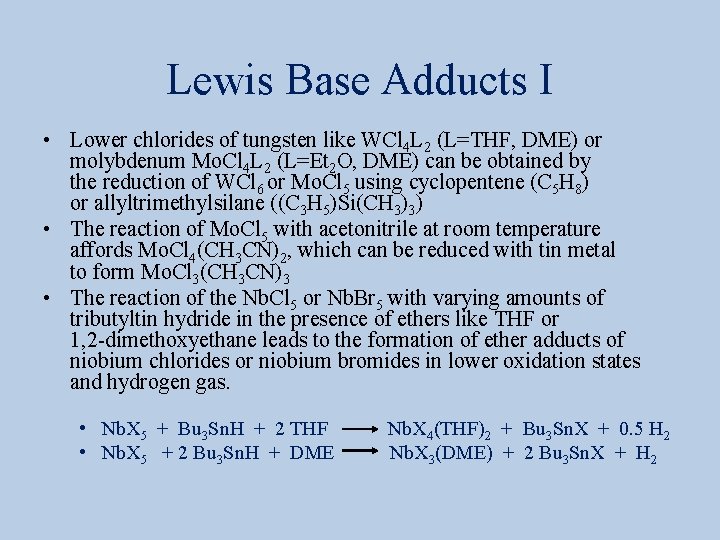
Lewis Base Adducts I • Lower chlorides of tungsten like WCl 4 L 2 (L=THF, DME) or molybdenum Mo. Cl 4 L 2 (L=Et 2 O, DME) can be obtained by the reduction of WCl 6 or Mo. Cl 5 using cyclopentene (C 5 H 8) or allyltrimethylsilane ((C 3 H 5)Si(CH 3)3) • The reaction of Mo. Cl 5 with acetonitrile at room temperature affords Mo. Cl 4(CH 3 CN)2, which can be reduced with tin metal to form Mo. Cl 3(CH 3 CN)3 • The reaction of the Nb. Cl 5 or Nb. Br 5 with varying amounts of tributyltin hydride in the presence of ethers like THF or 1, 2 -dimethoxyethane leads to the formation of ether adducts of niobium chlorides or niobium bromides in lower oxidation states and hydrogen gas. • Nb. X 5 + Bu 3 Sn. H + 2 THF • Nb. X 5 + 2 Bu 3 Sn. H + DME Nb. X 4(THF)2 + Bu 3 Sn. X + 0. 5 H 2 Nb. X 3(DME) + 2 Bu 3 Sn. X + H 2
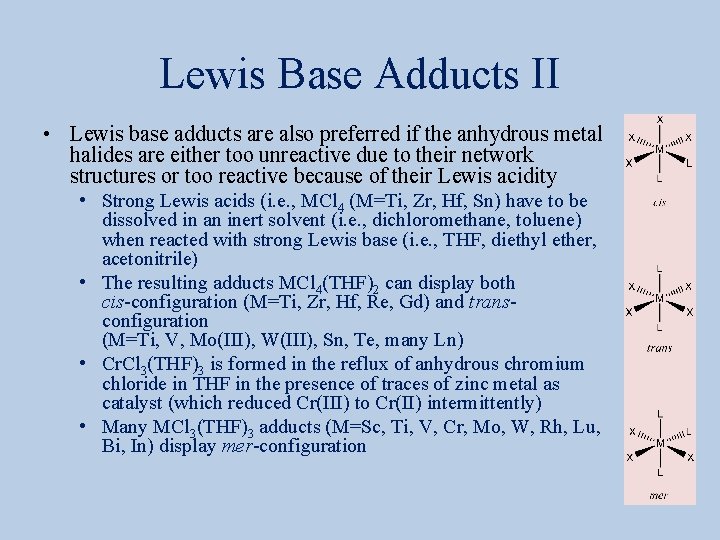
Lewis Base Adducts II • Lewis base adducts are also preferred if the anhydrous metal halides are either too unreactive due to their network structures or too reactive because of their Lewis acidity • Strong Lewis acids (i. e. , MCl 4 (M=Ti, Zr, Hf, Sn) have to be dissolved in an inert solvent (i. e. , dichloromethane, toluene) when reacted with strong Lewis base (i. e. , THF, diethyl ether, acetonitrile) • The resulting adducts MCl 4(THF)2 can display both cis-configuration (M=Ti, Zr, Hf, Re, Gd) and transconfiguration (M=Ti, V, Mo(III), W(III), Sn, Te, many Ln) • Cr. Cl 3(THF)3 is formed in the reflux of anhydrous chromium chloride in THF in the presence of traces of zinc metal as catalyst (which reduced Cr(III) to Cr(II) intermittently) • Many MCl 3(THF)3 adducts (M=Sc, Ti, V, Cr, Mo, W, Rh, Lu, Bi, In) display mer-configuration
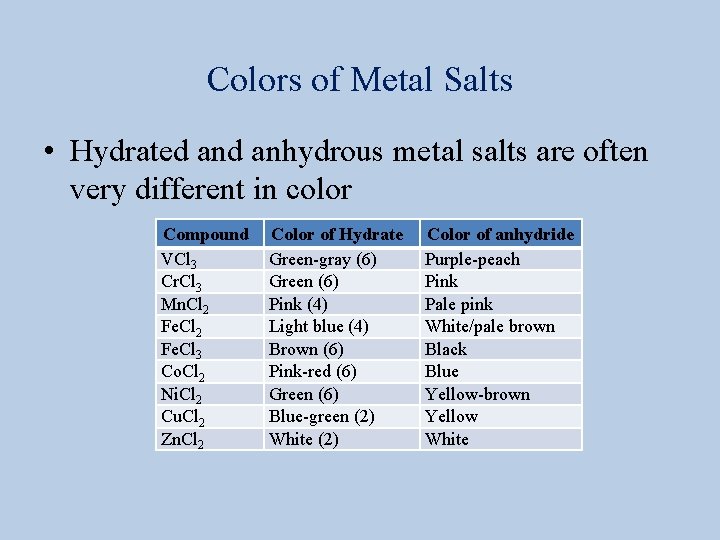
Colors of Metal Salts • Hydrated anhydrous metal salts are often very different in color Compound VCl 3 Cr. Cl 3 Mn. Cl 2 Fe. Cl 3 Co. Cl 2 Ni. Cl 2 Cu. Cl 2 Zn. Cl 2 Color of Hydrate Green-gray (6) Green (6) Pink (4) Light blue (4) Brown (6) Pink-red (6) Green (6) Blue-green (2) White (2) Color of anhydride Purple-peach Pink Pale pink White/pale brown Black Blue Yellow-brown Yellow White