
Lecture 1 1 Physics 241 Electricity and Optics
- Slides: 17
Lecture 1 -1 Physics 241: Electricity and Optics All Lectures take place in Rm. PHYS 112 Lecture 0101: 9: 30 – 10: 20 (T, Th) Prof. Wei Xie (wxie@purdue. edu) Office: PHYS Room 246 Lecture 0201: 0301: 10: 30 – 11: 20 (T, Th) 11: 30 – 12: 20 (T, Th) Prof. Rolf Scharenberg (schrnbrg@purdue. edu) Office: PHYS Room 245 Course Web Page: : http: //www. physics. purdue. edu/phys 241/ CHIP website: http: //chip. physics. purdue. edu/public/241/spring 2010/ Textbook: Physics for Scientists and Engineers (6 th edition ), volume 2 or newer by Paul A. Tipler and Gene Mosca Exams: 2 evening one-hour exams and a two-hour final exam Quizzes: during lectures using i. Clickers. Homework: CHIP (26 assignments)
Lecture 1 -2 An Old (and Fundamental!) Question: What is the Structure of Matter in the Universe?
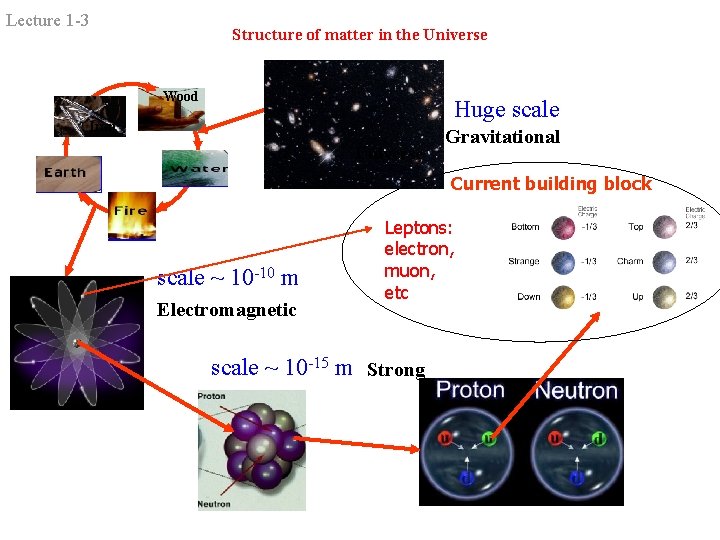
Lecture 1 -3 Structure of matter in the Universe Wood Huge scale Iron Universe Gravitational Current building block scale ~ 10 -10 m Electromagnetic Leptons: electron, muon, etc scale ~ 10 -15 m Strong
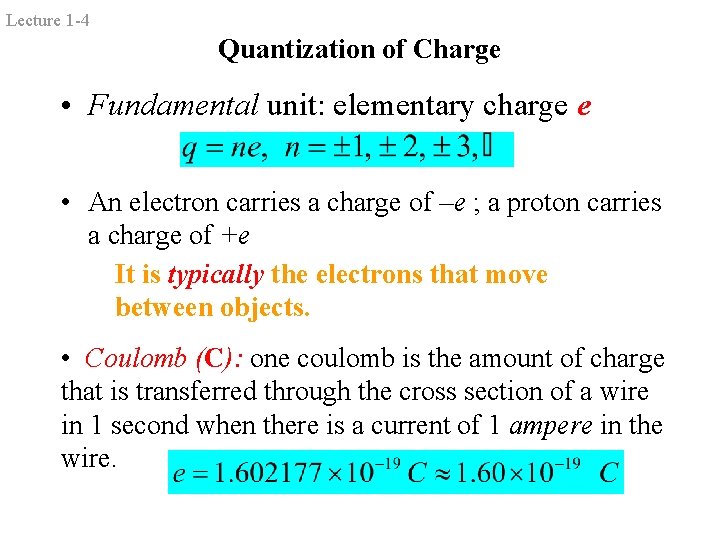
Lecture 1 -4 Quantization of Charge • Fundamental unit: elementary charge e • An electron carries a charge of –e ; a proton carries a charge of +e It is typically the electrons that move between objects. • Coulomb (C): one coulomb is the amount of charge that is transferred through the cross section of a wire in 1 second when there is a current of 1 ampere in the wire.
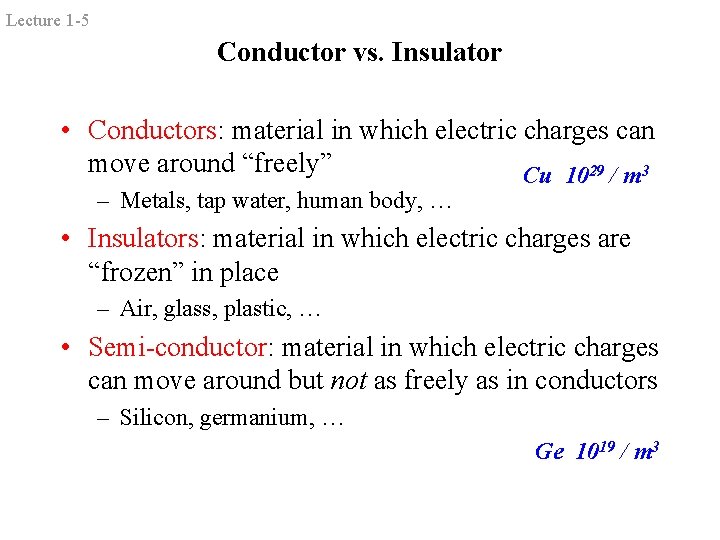
Lecture 1 -5 Conductor vs. Insulator • Conductors: material in which electric charges can move around “freely” Cu 1029 / m 3 – Metals, tap water, human body, … • Insulators: material in which electric charges are “frozen” in place – Air, glass, plastic, … • Semi-conductor: material in which electric charges can move around but not as freely as in conductors – Silicon, germanium, … Ge 1019 / m 3
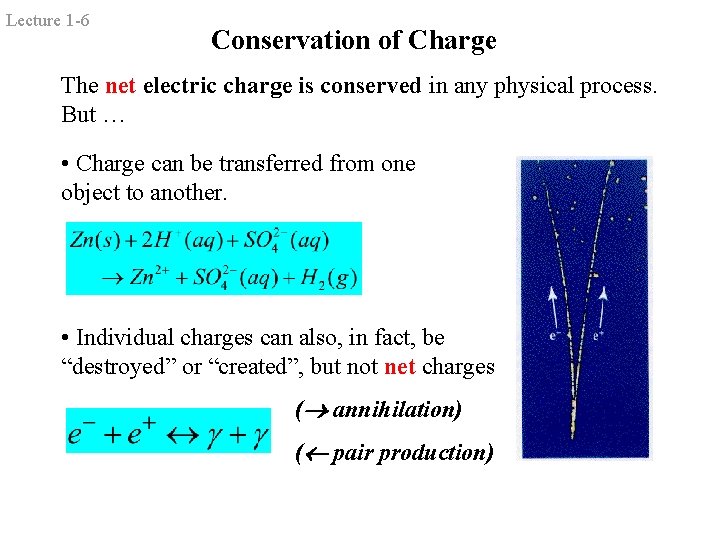
Lecture 1 -6 Conservation of Charge The net electric charge is conserved in any physical process. But … • Charge can be transferred from one object to another. • Individual charges can also, in fact, be “destroyed” or “created”, but not net charges ( annihilation) ( pair production)
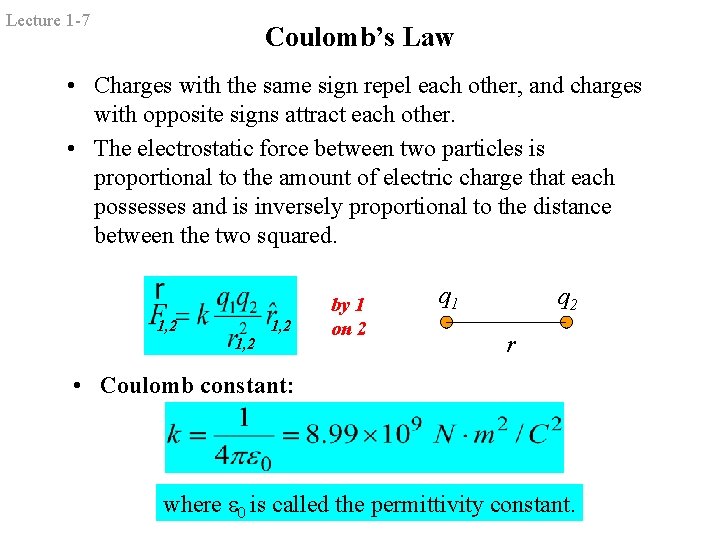
Lecture 1 -7 Coulomb’s Law • Charges with the same sign repel each other, and charges with opposite signs attract each other. • The electrostatic force between two particles is proportional to the amount of electric charge that each possesses and is inversely proportional to the distance between the two squared. 1, 2 by 1 on 2 q 1 q 2 r • Coulomb constant: where e 0 is called the permittivity constant.
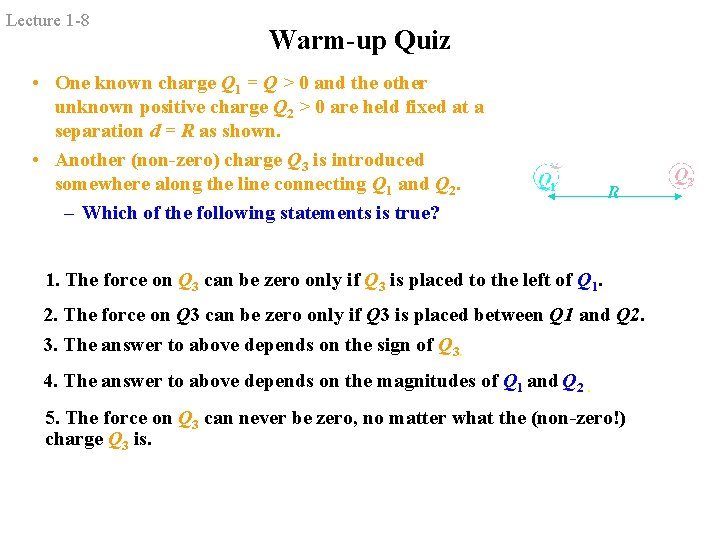
Lecture 1 -8 Warm-up Quiz • One known charge Q 1 = Q > 0 and the other unknown positive charge Q 2 > 0 are held fixed at a separation d = R as shown. • Another (non-zero) charge Q 3 is introduced somewhere along the line connecting Q 1 and Q 2. – Which of the following statements is true? 1. The force on Q 3 can be zero only if Q 3 is placed to the left of Q 1. 2. The force on Q 3 can be zero only if Q 3 is placed between Q 1 and Q 2. 3. The answer to above depends on the sign of Q 3. 4. The answer to above depends on the magnitudes of Q 1 and Q 2. 5. The force on Q 3 can never be zero, no matter what the (non-zero!) charge Q 3 is.
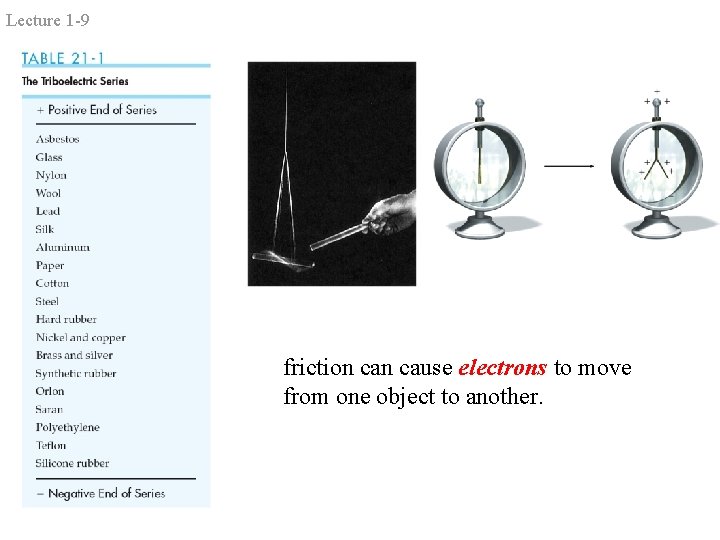
Lecture 1 -9 friction cause electrons to move from one object to another.
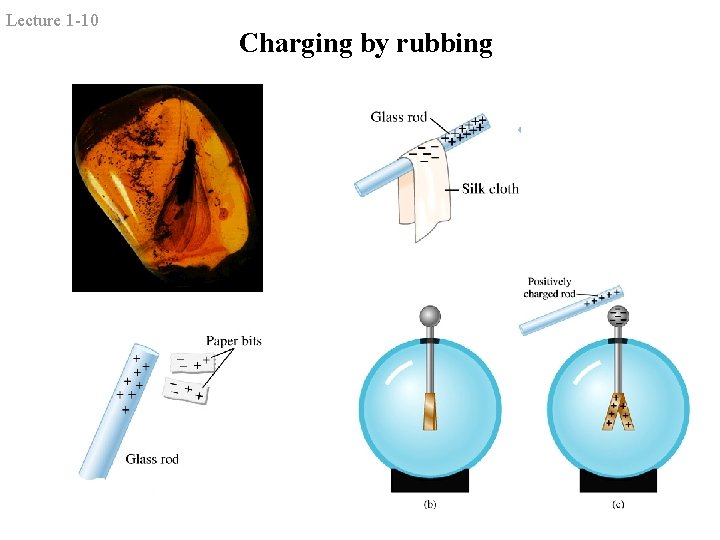
Lecture 1 -10 Charging by rubbing
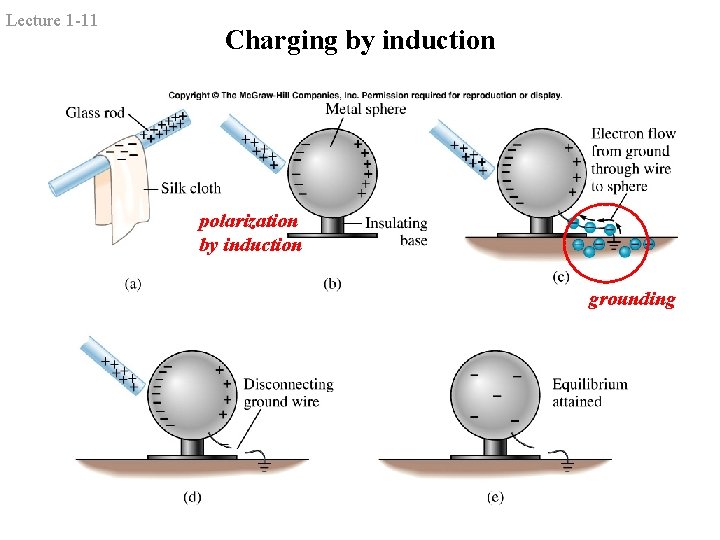
Lecture 1 -11 Charging by induction polarization by induction grounding
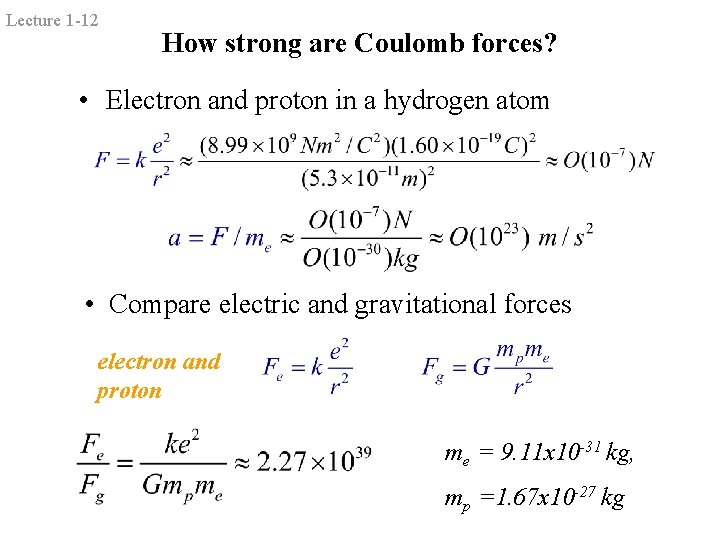
Lecture 1 -12 How strong are Coulomb forces? • Electron and proton in a hydrogen atom • Compare electric and gravitational forces electron and proton me = 9. 11 x 10 -31 kg, mp =1. 67 x 10 -27 kg
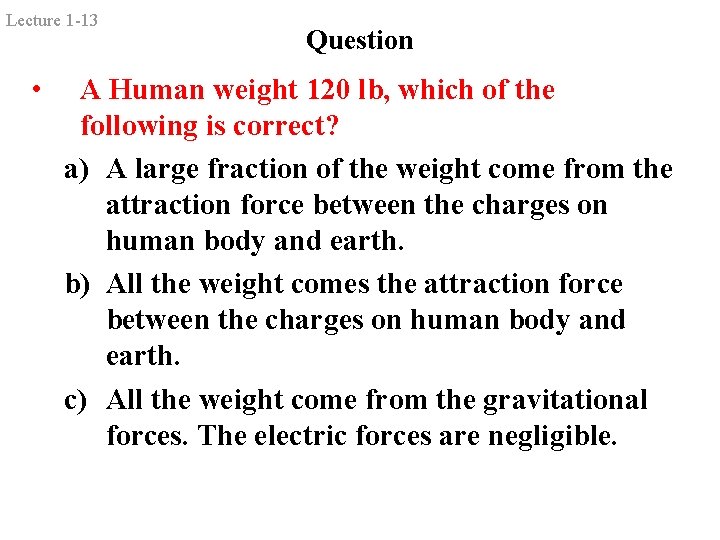
Lecture 1 -13 • Question A Human weight 120 lb, which of the following is correct? a) A large fraction of the weight come from the attraction force between the charges on human body and earth. b) All the weight comes the attraction force between the charges on human body and earth. c) All the weight come from the gravitational forces. The electric forces are negligible.
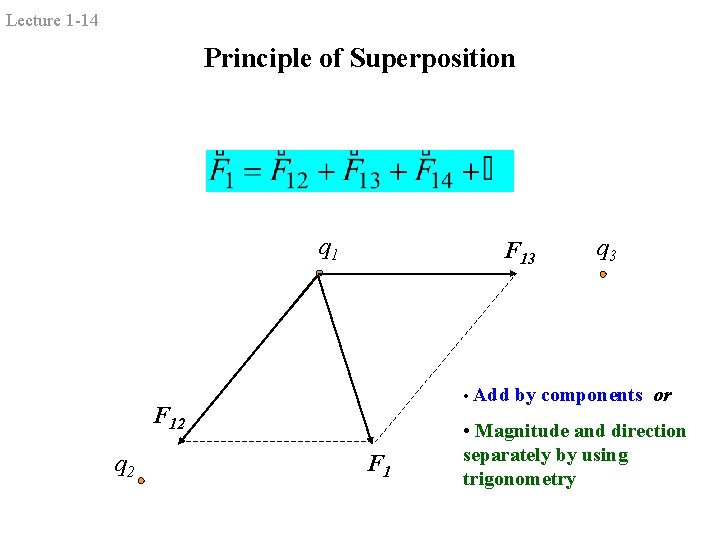
Lecture 1 -14 Principle of Superposition q 1 F 13 • Add F 12 q 2 F 1 q 3 by components or • Magnitude and direction separately by using trigonometry
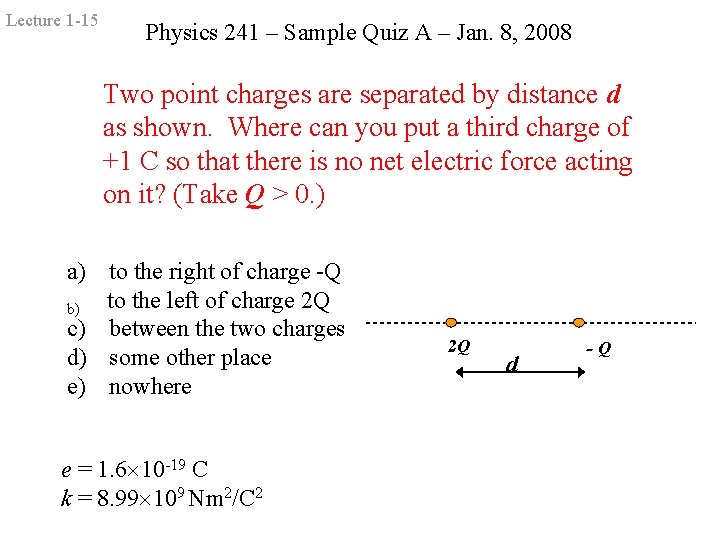
Lecture 1 -15 Physics 241 – Sample Quiz A – Jan. 8, 2008 Two point charges are separated by distance d as shown. Where can you put a third charge of +1 C so that there is no net electric force acting on it? (Take Q > 0. ) a) to the right of charge -Q to the left of charge 2 Q b) c) between the two charges d) some other place e) nowhere e = 1. 6 10 -19 C k = 8. 99 109 Nm 2/C 2 2 Q d -Q
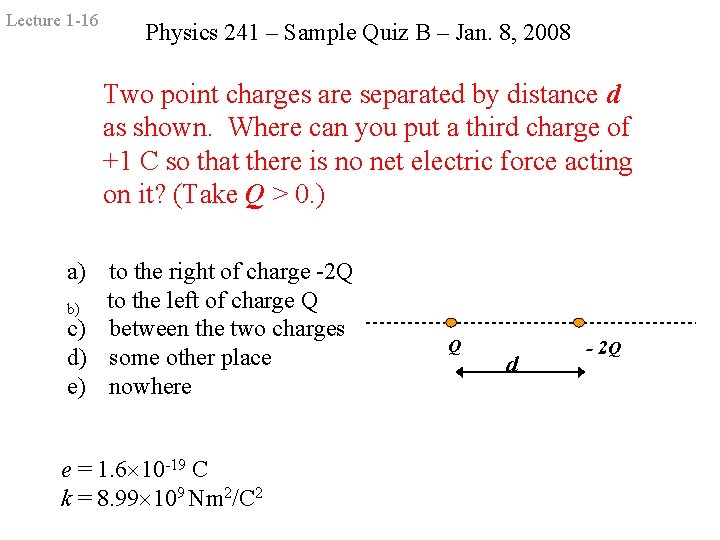
Lecture 1 -16 Physics 241 – Sample Quiz B – Jan. 8, 2008 Two point charges are separated by distance d as shown. Where can you put a third charge of +1 C so that there is no net electric force acting on it? (Take Q > 0. ) a) to the right of charge -2 Q to the left of charge Q b) c) between the two charges d) some other place e) nowhere e = 1. 6 10 -19 C k = 8. 99 109 Nm 2/C 2 Q d - 2 Q
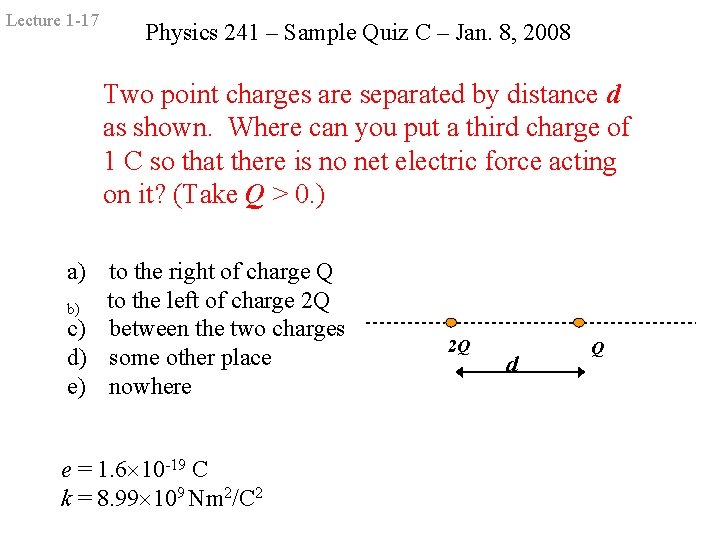
Lecture 1 -17 Physics 241 – Sample Quiz C – Jan. 8, 2008 Two point charges are separated by distance d as shown. Where can you put a third charge of 1 C so that there is no net electric force acting on it? (Take Q > 0. ) a) to the right of charge Q to the left of charge 2 Q b) c) between the two charges d) some other place e) nowhere e = 1. 6 10 -19 C k = 8. 99 109 Nm 2/C 2 2 Q d Q