
Lecture 1 1 Finding the right research approach



- Slides: 22
Lecture 1. 1 Finding the right research approach, methodology and research tools. -Defining the scope of your study. -Hypothesis or research questions? -Experimental studies? / Observational studies? / Surveys? /Theoretical study? -Sampling design -Field work -Data analysis
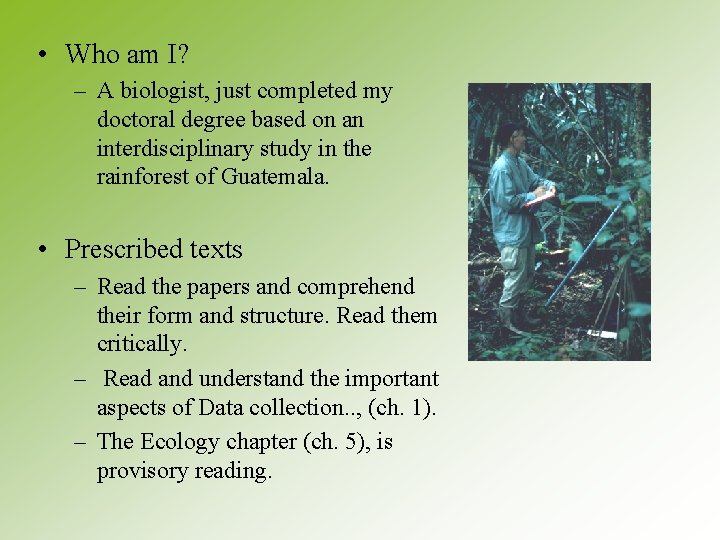
• Who am I? – A biologist, just completed my doctoral degree based on an interdisciplinary study in the rainforest of Guatemala. • Prescribed texts – Read the papers and comprehend their form and structure. Read them critically. – Read and understand the important aspects of Data collection. . , (ch. 1). – The Ecology chapter (ch. 5), is provisory reading.
Defining the scope of your study. 1. A small short-term study, or a large long-term study? - Do you want an in-depth study? -Easy to be overly enthusiastic with regard to what can be achieved. -The size of the project has important budget and resource implications.
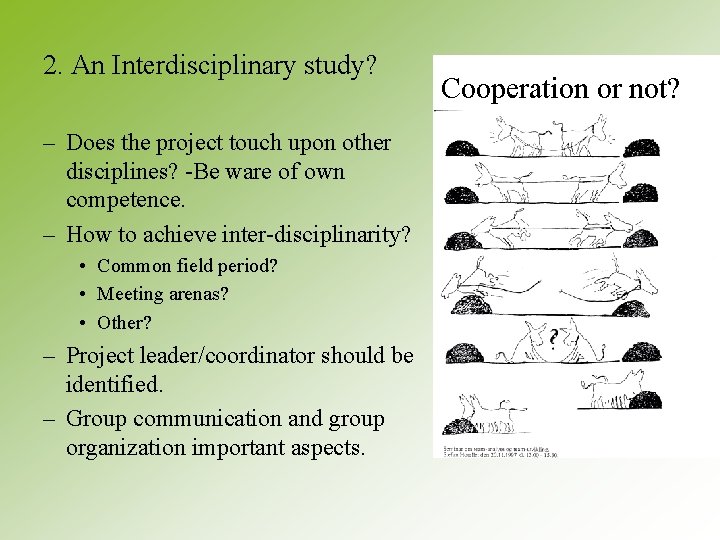
2. An Interdisciplinary study? – Does the project touch upon other disciplines? -Be ware of own competence. – How to achieve inter-disciplinarity? • Common field period? • Meeting arenas? • Other? – Project leader/coordinator should be identified. – Group communication and group organization important aspects. Cooperation or not?
3. Hypothesis or research questions? – To work by a hypothesis may sharpen and simplify, it is however, best used in lager phases of the investigation, or when substantial knowledge of the system is already obtained. – For a hypothesis to be tested, certain statistical assumptions needs to be met. • Ex. Peres et al. : Patterns of variation in population size structure are consistent with recruitment bottleneck resulting from long-term harvest. – Research questions enables a broader explorative focus of the investigation, best used in initial phases. • Ex. Stige et al. : 1. How do these effects differ geographically and 2. how do they differ among crop or animal types? 3. How much food to the effects correspond to in terms of the number of people who could be fed on above or below-average production?
4. Different types of studies – Experimental studies – Observational studies – Theoretical studies – Surveys
- Experimental studies • Experimental studies are those which include manipulation of predictor variable and randomization of treatments. • Experiments are the best tools for establishing causal relationships empirically. • Highly controlled studies, such as laboratory experiments, may not give rise to realistic results. • There is usually a trade-off between control and realism.
- Experimental studies • An example : Estimating pine seedling response to ozone and acidic rain. – Ozone level (treatment) was forced into the chambers surrounding the plants. Different levels assigned at random. Four replicates of each level. – Acidic rain levels were imposed by dispensing volumes of premixed solutions (natural rain was excluded). Different levels assigned at random. Four replicates of each level. – Each chamber can receive only one level of the ozone-acidic rain combination. – Thus the experiment involved both manipulation of predictor variable and randomization of treatments!!
- Observational studies • Observational studies are controlled studies designed with respect to a particular hypothesis, but which lack randomisation of treatments. • Such studies usually involve exploring relationships between a predestined set of response and predictor variables in a natural setting. • Such studies are weaker in control than experimental studies, but are usually stronger in realism and representation. • Observational studies (and surveys) often precede experimental studies.
- Observational studies • An example: Migration in endangered butterfly. – Measured local population size of the butterfly in 50 discrete habitat patches within an area of 15 km 2, and habitat quality, vegetation height, and an index of isolation of habitat (patch). – Aim at predicting the local population density of butterfly, and relate densities to the habitat characteristics (treatments). – Thus, there are treatments, but there are no randomization of treatments!
- Theoretical studies • Theoretical studies, seeking a variety of relevant data sources – documentary studies, – preparing instruments and tools for data collection and analysis, – theoretical re-interpretation – The Ortner and the Taylor article in the compendium, could serve as examples of theoretical studies.
- Surveys • Descriptive enumerative studies that are note based on any particular hypotheses are termed surveys. • The central design issue in surveys is sampling. • When designing a study, decisions have to be made regarding allocation of effort, the size of each sample, number of replicates and which values the predictor variable should take. • An example of a survey could by the study by Nesheim et al. in the compendium. The informants are the sample and the different species are the predictor variables.
Sampling design, - the what, the where, and the how. . • It is never possible to compile a complete data set, what shortcuts do we take to reduce our workload and still achieve accurate results! • The method used for deciding which member of a statistical population will be included in the sample is called the sampling design.
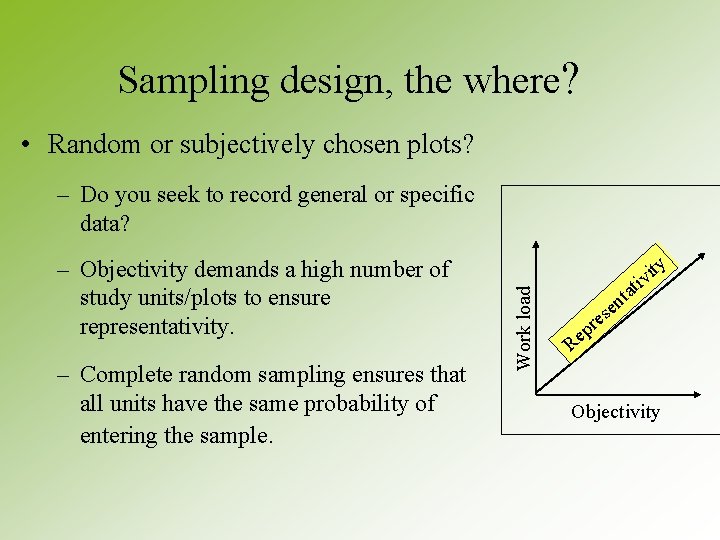
Sampling design, the where? • Random or subjectively chosen plots? – Objectivity demands a high number of study units/plots to ensure representativity. – Complete random sampling ensures that all units have the same probability of entering the sample. Work load – Do you seek to record general or specific data? e Re s re at t n ty i v i p Objectivity
Sampling design, the where? • Statistical qualities of plots /study units, are the plots independent? • Are rare types represented among the samples? • Redundancy – are common types too redundant (common)? • Lumping of plots? – How could lumping of plots have effected the results in the study by Peres et al. (the study of Brazil nut)?
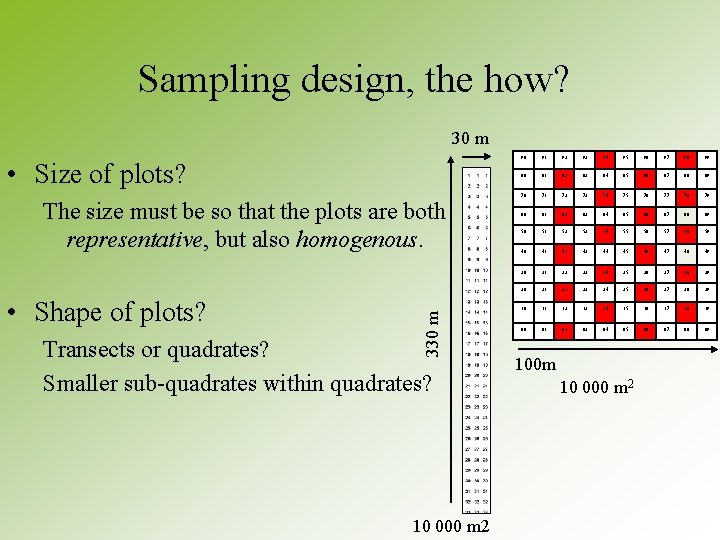
Sampling design, the how? 30 m • Size of plots? • Shape of plots? 330 m The size must be so that the plots are both representative, but also homogenous. Transects or quadrates? Smaller sub-quadrates within quadrates? 10 000 m 2 90 91 92 93 94 95 96 97 98 99 80 81 82 83 84 85 86 87 88 89 70 71 72 73 74 75 76 77 78 79 60 61 62 63 64 65 66 67 68 69 50 51 52 53 54 55 56 57 58 59 40 41 42 43 44 45 46 47 48 49 30 31 32 33 34 35 36 37 38 39 20 21 22 23 24 25 26 27 28 29 10 11 12 13 14 15 16 17 18 19 00 01 02 03 04 05 06 07 08 09 100 m 10 000 m 2
Sampling design, the how? • How many plots / study units? – High variation requires a higher number of plots/study units. – As many as you can… • Permanent plots? – Do you want to revisit? For other scientists to revisit? – Metal bars in the soil, metal tags on trees etc. , what more. . • Remember that several statistical analyses assume random sampling!
Sampling design, the what? qualitative and quantitative approaches. • Qualitative and quantitative approaches work together, both may be important in a study. – Qualitative approaches are useful and necessary for in depth knowledge of a situation, or when describing the study area or units of research, – Quantitative approaches is useful for more objective comparison of different systems, and may enable statistical analysis.
The data, quantitative approaches • Examples of explanatory variables, data to collect: soil variables (moisture, soil type, and more), aspect, shadow sun , income, parents occupation. . • Data collected /ecological variables must be tied directly to the sample plots /sample units. • All variables within a category must be quantified with the same unit in the study. • A questionnaire in social science may give quantitative variables.
The data, qualitative approaches. Observations, important in every discipline (ranging from non-participant to participant). – Interviews (ranging from semi-structured to open-ended). • Open ended, initial interviews – Documents • Private – public. – Audio visual (including materials such as photographs, compact disks and videotapes).
Interview protocol Project: Students SUM 4011 A/3011 Time of interview: Date: Place: Interviewer: Interviewee: Position of interviewee: (Briefly describe project) Questions: 1. What has been your role in the course? 2. What has been the impact of the course? 3. Did you learn anything about interdisciplinary methodology? 4. How did the seminars/ colloquium work? 5. Would you recommend the course to other students? (Thank individual for participating in this interview. Assure him or her of confidentiality of responses and potential future interviews. )
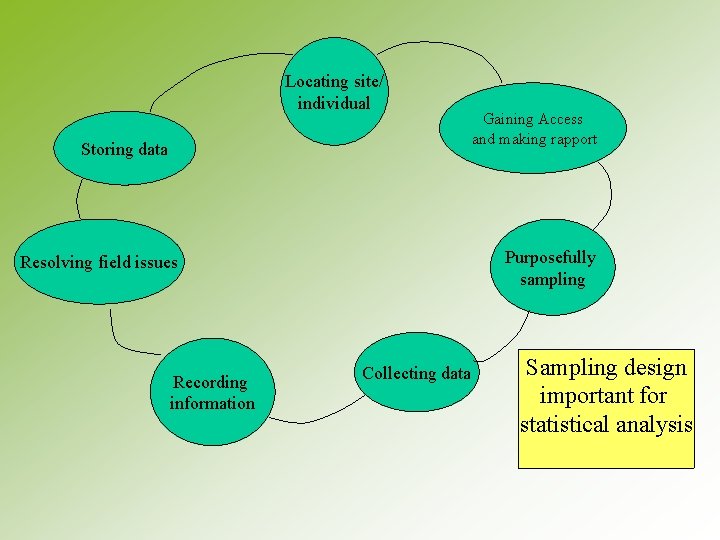
Locating site/ individual Storing data Purposefully sampling Resolving field issues Recording information Gaining Access and making rapport Collecting data Sampling design important for statistical analysis