
Lecture 08 Transaction management overview www cl cam
- Slides: 26
Lecture 08: Transaction management overview www. cl. cam. ac. uk/Teaching/current/Databases/ 1
Today’s lecture • Why do we want concurrent execution of user programs? • What properties might we wish for? • What’s a transaction? • What are the problems when interleaving transactions? • How might we overcome these? 2
Transactions • Concurrent execution of user programs is essential for good DBMS performance – Disk access is frequent and slow – Want to keep the CPU busy • A user’s program may carry out all sorts of operations on the data, but the DBMS is only concerned about what data is read from/written to the database 3
Transactions cont. • Thus a transaction is the DBMS’s abstract view of a user program: a series of reads/writes of database objects • Users submit transactions, and can think of each transaction as executing by itself – The concurrency is achieved by the DBMS, which interleaves actions of the various transactions • Issues: – Interleaving transactions, and – Crashes! 4
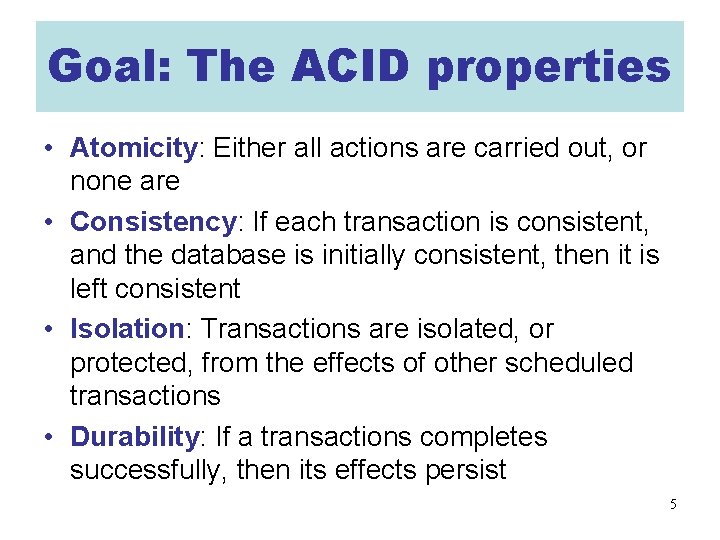
Goal: The ACID properties • Atomicity: Either all actions are carried out, or none are • Consistency: If each transaction is consistent, and the database is initially consistent, then it is left consistent • Isolation: Transactions are isolated, or protected, from the effects of other scheduled transactions • Durability: If a transactions completes successfully, then its effects persist 5
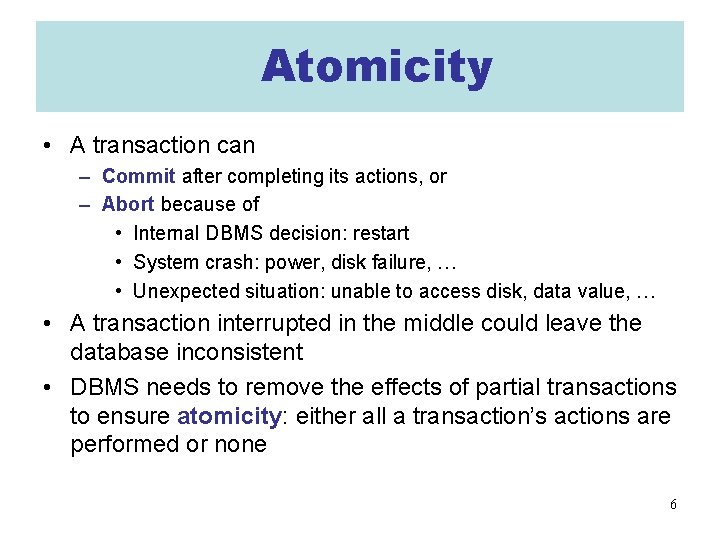
AAtomicity • A transaction can – Commit after completing its actions, or – Abort because of • Internal DBMS decision: restart • System crash: power, disk failure, … • Unexpected situation: unable to access disk, data value, … • A transaction interrupted in the middle could leave the database inconsistent • DBMS needs to remove the effects of partial transactions to ensure atomicity: either all a transaction’s actions are performed or none 6
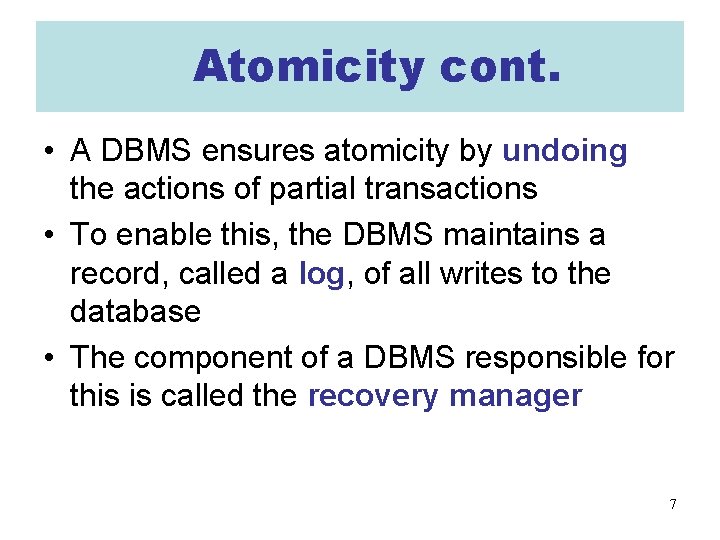
AAtomicity cont. • A DBMS ensures atomicity by undoing the actions of partial transactions • To enable this, the DBMS maintains a record, called a log, of all writes to the database • The component of a DBMS responsible for this is called the recovery manager 7
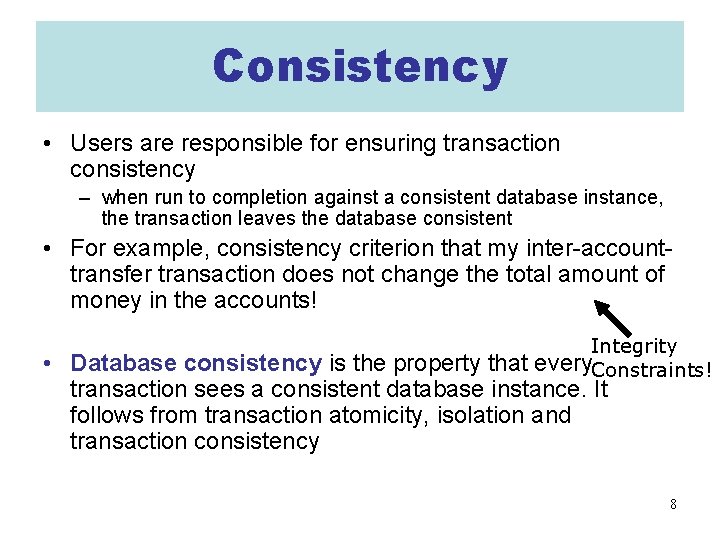
Consistency • Users are responsible for ensuring transaction consistency – when run to completion against a consistent database instance, the transaction leaves the database consistent • For example, consistency criterion that my inter-accounttransfer transaction does not change the total amount of money in the accounts! Integrity every. Constraints! • Database consistency is the property that transaction sees a consistent database instance. It follows from transaction atomicity, isolation and transaction consistency 8
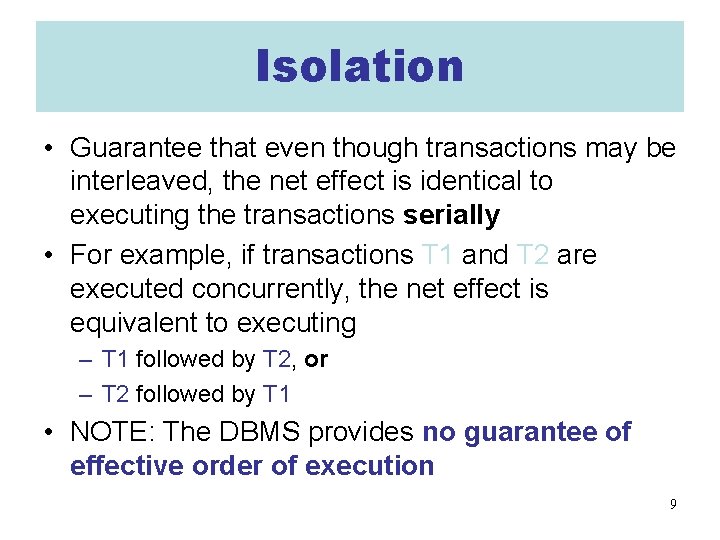
Isolation • Guarantee that even though transactions may be interleaved, the net effect is identical to executing the transactions serially • For example, if transactions T 1 and T 2 are executed concurrently, the net effect is equivalent to executing – T 1 followed by T 2, or – T 2 followed by T 1 • NOTE: The DBMS provides no guarantee of effective order of execution 9
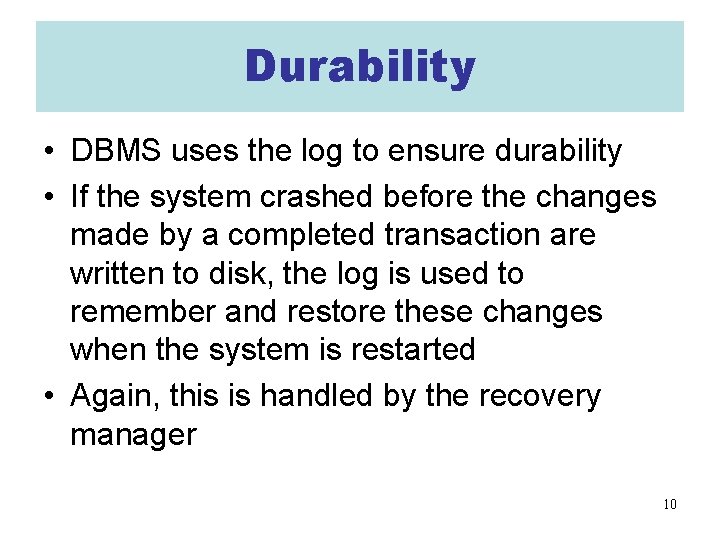
Durability • DBMS uses the log to ensure durability • If the system crashed before the changes made by a completed transaction are written to disk, the log is used to remember and restore these changes when the system is restarted • Again, this is handled by the recovery manager 10
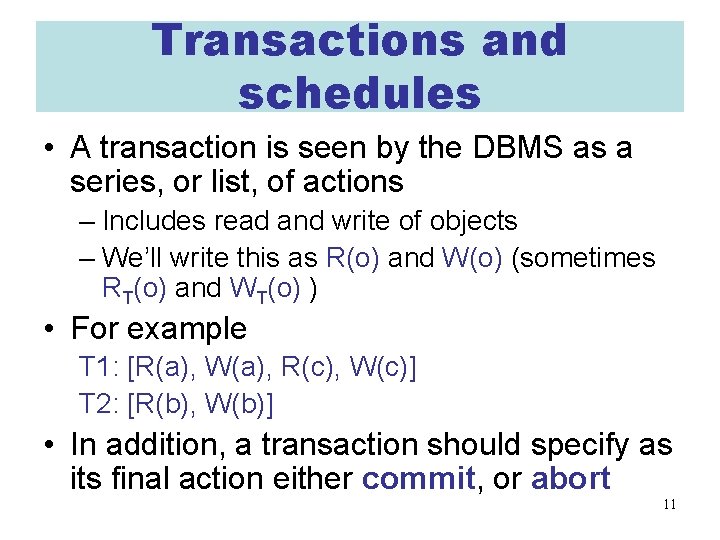
Transactions and schedules • A transaction is seen by the DBMS as a series, or list, of actions – Includes read and write of objects – We’ll write this as R(o) and W(o) (sometimes RT(o) and WT(o) ) • For example T 1: [R(a), W(a), R(c), W(c)] T 2: [R(b), W(b)] • In addition, a transaction should specify as its final action either commit, or abort 11
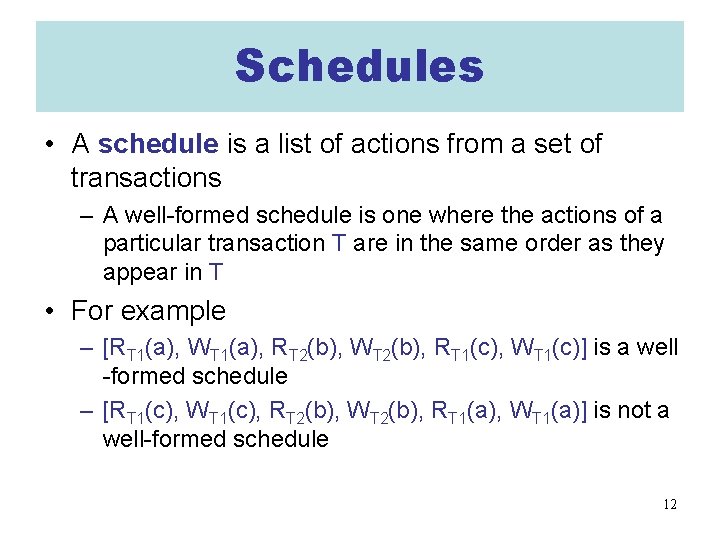
Schedules • A schedule is a list of actions from a set of transactions – A well-formed schedule is one where the actions of a particular transaction T are in the same order as they appear in T • For example – [RT 1(a), WT 1(a), RT 2(b), WT 2(b), RT 1(c), WT 1(c)] is a well -formed schedule – [RT 1(c), WT 1(c), RT 2(b), WT 2(b), RT 1(a), WT 1(a)] is not a well-formed schedule 12
Schedules cont. • A complete schedule is one that contains an abort or commit action for every transaction that occurs in the schedule • A serial schedule is one where the actions of different transactions are not interleaved 13
Serialisability • A serialisable schedule is a schedule whose effect on any consistent database instance is identical to that of some complete serial schedule • NOTE: – All different results assumed to be acceptable – It’s more complicated when we have transactions that abort – We’ll assume that all ‘side-effects’ of a transaction are written to the database 14
Anomalies with interleaved execution • Two actions on the same data object conflict if at least one of them is a write • We’ll now consider three ways in which a schedule involving two consistencypreserving transactions can leave a consistent database inconsistent 15
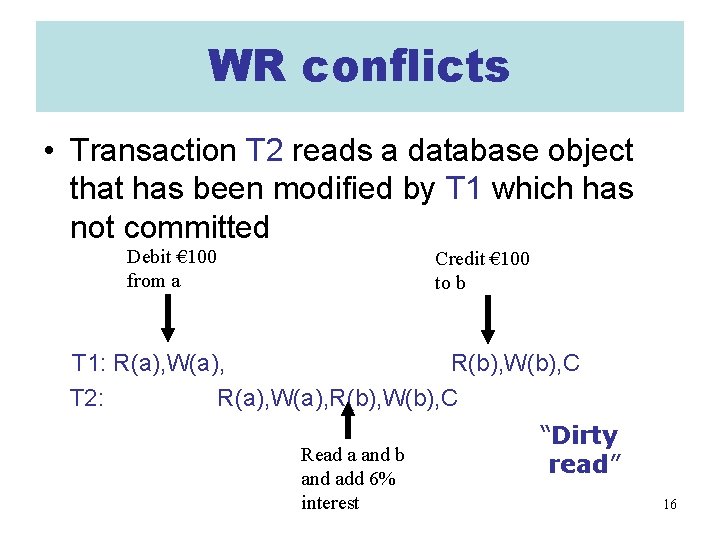
WR conflicts • Transaction T 2 reads a database object that has been modified by T 1 which has not committed Debit € 100 from a Credit € 100 to b T 1: R(a), W(a), R(b), W(b), C T 2: R(a), W(a), R(b), W(b), C Read a and b and add 6% interest “Dirty read” 16
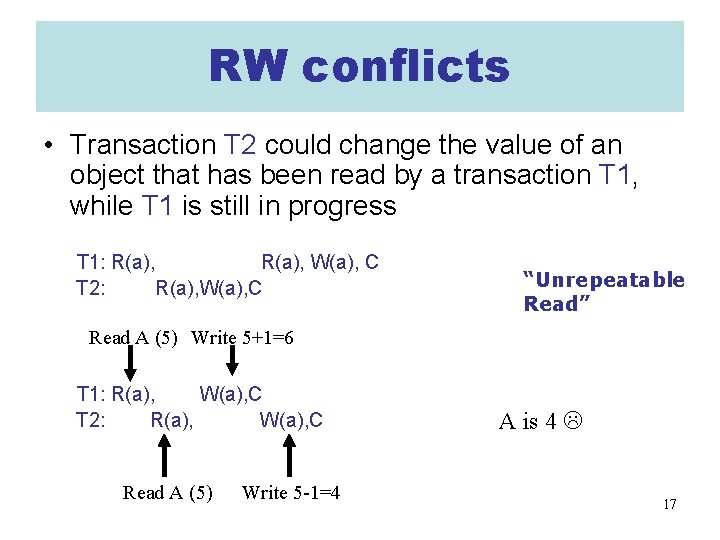
RW conflicts • Transaction T 2 could change the value of an object that has been read by a transaction T 1, while T 1 is still in progress T 1: R(a), W(a), C T 2: R(a), W(a), C “Unrepeatable Read” Read A (5) Write 5+1=6 T 1: R(a), W(a), C T 2: R(a), W(a), C Read A (5) Write 5 -1=4 A is 4 17
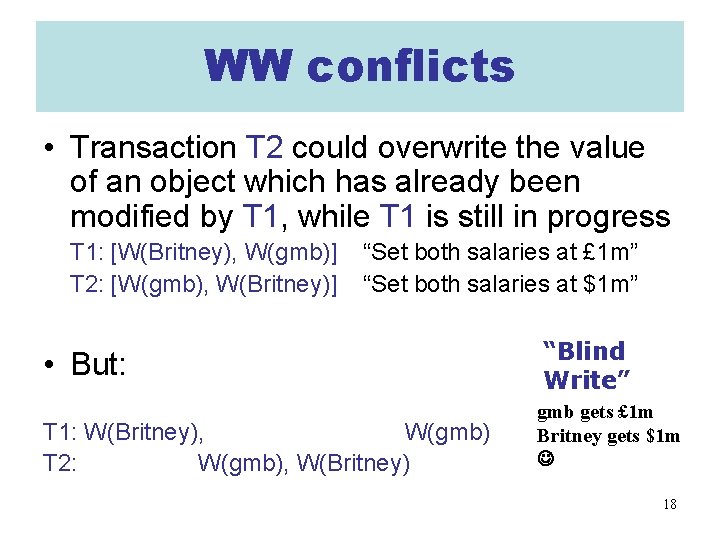
WW conflicts • Transaction T 2 could overwrite the value of an object which has already been modified by T 1, while T 1 is still in progress T 1: [W(Britney), W(gmb)] T 2: [W(gmb), W(Britney)] “Set both salaries at £ 1 m” “Set both salaries at $1 m” • But: T 1: W(Britney), W(gmb) T 2: W(gmb), W(Britney) “Blind Write” gmb gets £ 1 m Britney gets $1 m 18
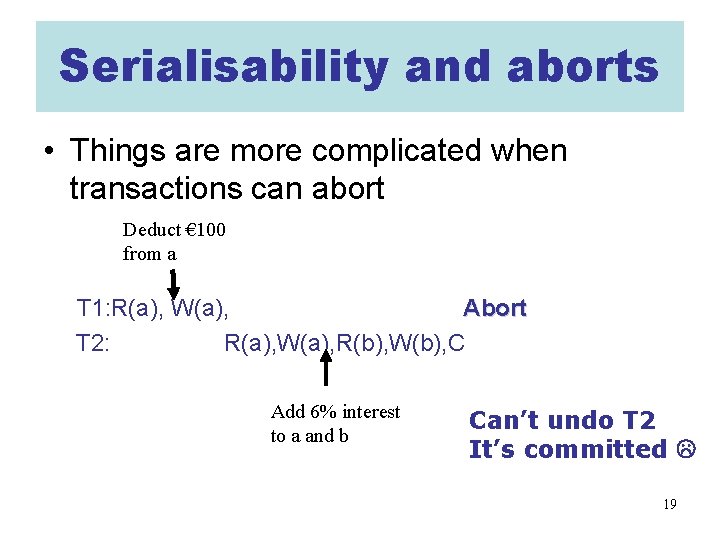
Serialisability and aborts • Things are more complicated when transactions can abort Deduct € 100 from a T 1: R(a), W(a), Abort T 2: R(a), W(a), R(b), W(b), C Add 6% interest to a and b Can’t undo T 2 It’s committed 19
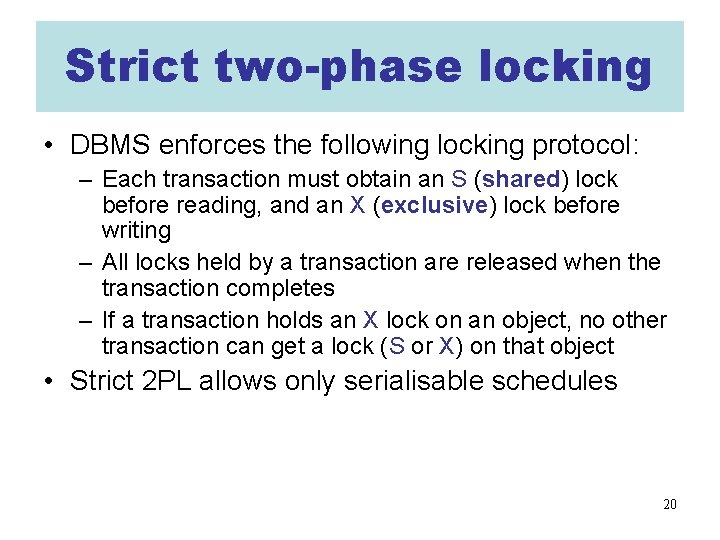
Strict two-phase locking • DBMS enforces the following locking protocol: – Each transaction must obtain an S (shared) lock before reading, and an X (exclusive) lock before writing – All locks held by a transaction are released when the transaction completes – If a transaction holds an X lock on an object, no other transaction can get a lock (S or X) on that object • Strict 2 PL allows only serialisable schedules 20
More refined locks • Some updates that seem at first sight to require a write (X) lock, can be given something weaker – Example: Consider a seat count object in a flights database – There are two transactions that wish to book a flight – get X lock on seat count – Does it matter in what order they decrement the count? • They are commutative actions! • Do they need a write lock? 21
Aborting • If a transaction Ti is aborted, then all actions must be undone – Also, if Tj reads object last written by Ti, then Tj must be aborted! • Most systems avoid cascading aborts by releasing locks only at commit time (strict protocols) – If Ti writes an object, then Tj can only read this after Ti finishes • In order to undo changes, the DBMS maintains a log which records every write 22
The log • The following facts are recorded in the log – “Ti writes an object”: store new and old values – “Ti commits/aborts”: store just a record • Log records are chained together by transaction id, so it’s easy to undo a specific transaction • Log is often duplexed and archived on stable storage (it’s important!) 23
Connection to Normalization • The more redundancy in a database, the more locking is required for (update) transactions. – Extreme case: so much redundancy that all update transactions are forced to execute serially. • In general, less redundancy allows for greater concurrency and greater transaction throughput. !!! This is what normalization is all about !!! 24
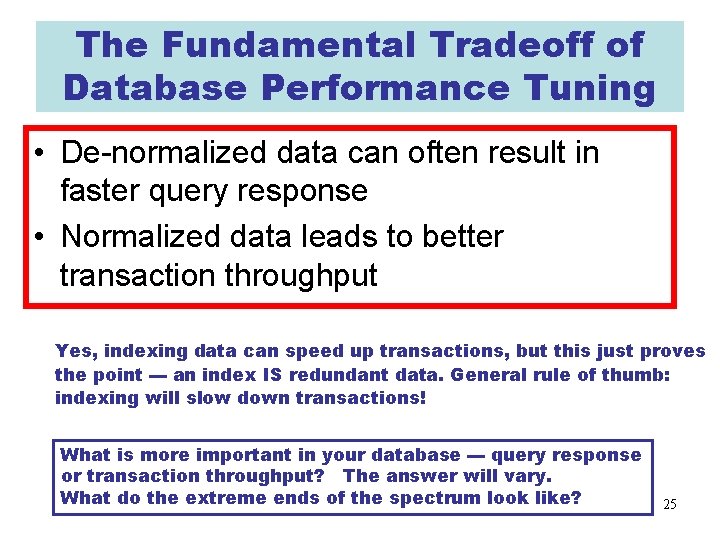
The Fundamental Tradeoff of Database Performance Tuning • De-normalized data can often result in faster query response • Normalized data leads to better transaction throughput Yes, indexing data can speed up transactions, but this just proves the point --- an index IS redundant data. General rule of thumb: indexing will slow down transactions! What is more important in your database --- query response or transaction throughput? The answer will vary. What do the extreme ends of the spectrum look like? 25
Summary You should now understand: • Transactions and the ACID properties • Schedules and serialisable schedules • Potential anomalies with interleaving • Strict 2 -phase locking • Problems with transactions that can abort • Logs Next lecture: OLAP. How to build “read only” databases by forgetting about 26 normal forms!