
Lecture 08 Psychoacoustics ESE 150 DIGITAL AUDIO BASICS
Lecture #08 – Psychoacoustics ESE 150 – DIGITAL AUDIO BASICS Based on slides © 2009— 2021 De. Hon, Koditschek Additional Material © 2014 Farmer 1
TEASER – DOG WHISTLE � What is special about a dog whistle? � https: //www. youtube. com/watch? v=dk 0 Hsv. Q 7 m_E 2
TEASER – RODENT DETERENT How do these work? � https: //www. amazon. com/Ultrasonic-Repelling. Electronic-Repellent. Squirrels/dp/B 081 F 5 WL 6 W/ref=sr_1_20? dchild= 1&keywords=ultrasonic+rodent+repeller&qid=1 613513635&sr=8 -20 � 3

HEARING RANGE https: //commons. wikimedia. org/wiki/File: Animal_hearing_frequency_range. svg 4
OBSERVE � There are sounds we cannot hear � Depends on frequency 5
LECTURE TOPICS � � � Where are we on course map? What we did in lab last week Psychoacoustics � � � Structure of Human Ear / encoding signals to brain Human Hearing Limits Critical Bands (Frequency bins) Next Lab References 6
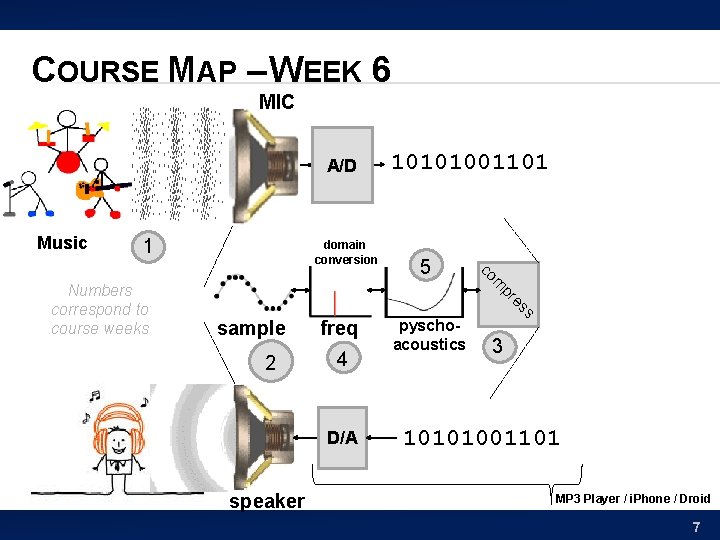
COURSE MAP – WEEK 6 MIC A/D Music 1 2 freq 4 D/A speaker pyschoacoustics s es pr sample 5 m co Numbers correspond to course weeks domain conversion 10101001101 3 10101001101 MP 3 Player / i. Phone / Droid 7
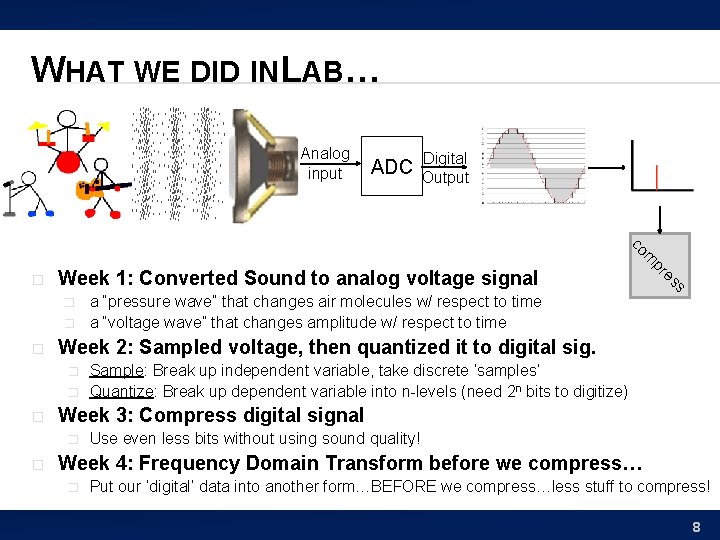
WHAT WE DID IN LAB… Analog input ADC Digital Output � � � Week 2: Sampled voltage, then quantized it to digital sig. � � � Sample: Break up independent variable, take discrete ‘samples’ Quantize: Break up dependent variable into n-levels (need 2 n bits to digitize) Week 3: Compress digital signal � � a “pressure wave” that changes air molecules w/ respect to time a “voltage wave” that changes amplitude w/ respect to time s es Week 1: Converted Sound to analog voltage signal pr m co � Use even less bits without using sound quality! Week 4: Frequency Domain Transform before we compress… � Put our ‘digital’ data into another form…BEFORE we compress…less stuff to compress! 8
PSYCHOACOUSTICS 9
WHAT IS PSYCHOACOUSTICS? � Scientific study of sound perception � � Branch of science studying the psychological and physiological responses associated with sound Also, considered a branch of: psychophysics Human physical (and neurological) mechanism for sound perception Why study sound & human’s perception? � Example: FREQUENCY vs. PITCH Frequency of sound: “how often” air particles vibrate (Hz) � Pitch of sound: the sensation of frequency � � � How our brains “interpret” the frequency of a sound Things may “sound” one way… � …but be interpreted by our brains very differently! 10
PSYCHOACOUSTICS &DIGITAL MUSIC How does psychoacoustics relate to MP 3? � The “consumer” of an MP 3 is the human ear… � Knowing more about brain’s interpretation of sound… � …helps us remove things human’s can’t hear anyway � � We’ve used some of this in our system already: � Limit of human perception of sound: 20 Hz to 20, 000 Hz � We � put an anti-aliasing filter limiting incoming audio Fixes our sampling rate, less data to store as a result! 11
OUR STUDY OF PSYCHOACOUSTICS � � � Structure of Human Ear / encoding signals to brain Human Hearing Limits Critical Bands Frequency Bins Masking (Spatial vs. Temporal) [next week] Applied Psychoacoustics [following week] � � Using all of the above to build. . . the “Psychoacoustical Model” Perceptual Coding in MP 3 (using the model to compress MP 3 s) 12
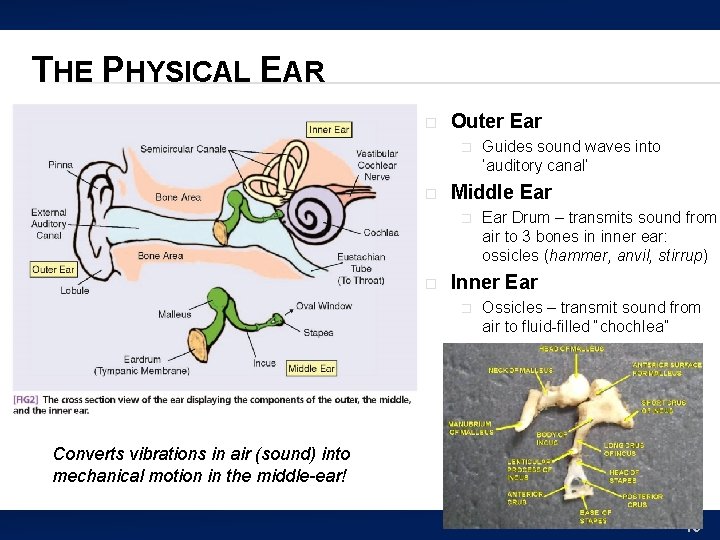
THE PHYSICAL EAR � Outer Ear � � Middle Ear � � Guides sound waves into ‘auditory canal’ Ear Drum – transmits sound from air to 3 bones in inner ear: ossicles (hammer, anvil, stirrup) Inner Ear � Ossicles – transmit sound from air to fluid-filled “chochlea” Converts vibrations in air (sound) into mechanical motion in the middle-ear! 13
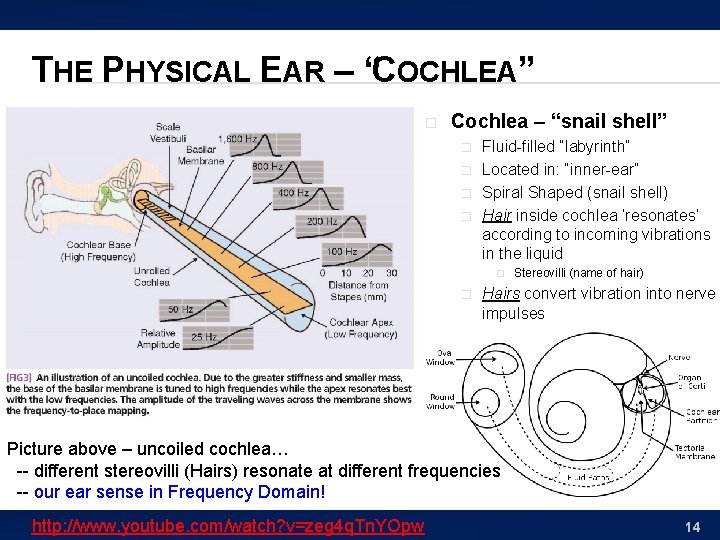
THE PHYSICAL EAR – “COCHLEA” � Cochlea – “snail shell” � � Fluid-filled “labyrinth” Located in: “inner-ear” Spiral Shaped (snail shell) Hair inside cochlea ‘resonates’ according to incoming vibrations in the liquid � � Stereovilli (name of hair) Hairs convert vibration into nerve impulses Picture above – uncoiled cochlea… -- different stereovilli (Hairs) resonate at different frequencies -- our ear sense in Frequency Domain! http: //www. youtube. com/watch? v=zeg 4 q. Tn. YOpw 14

COCHLEA ANIMATION � https: //www. youtube. com/watch? v=dyen. Mlu. Fa Uw 15
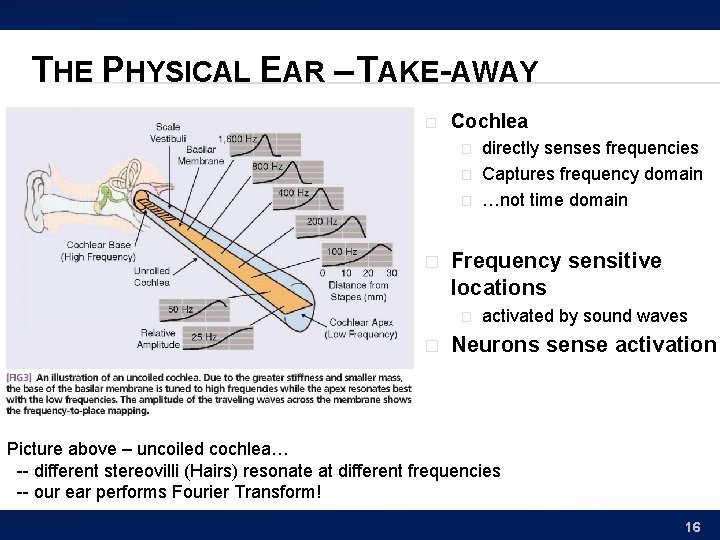
THE PHYSICAL EAR – TAKE-AWAY � Cochlea � � Frequency sensitive locations � � directly senses frequencies Captures frequency domain …not time domain activated by sound waves Neurons sense activation Picture above – uncoiled cochlea… -- different stereovilli (Hairs) resonate at different frequencies -- our ear performs Fourier Transform! 16
TAKE-AWAY � Our ear works in the frequency domain. � We could consider devices that � Directly recorded frequencies � Collection � of resonators? Directly produced frequencies � Collection of vibrators Tuning forks � Strings � Pipes � …sound familiar? � 17
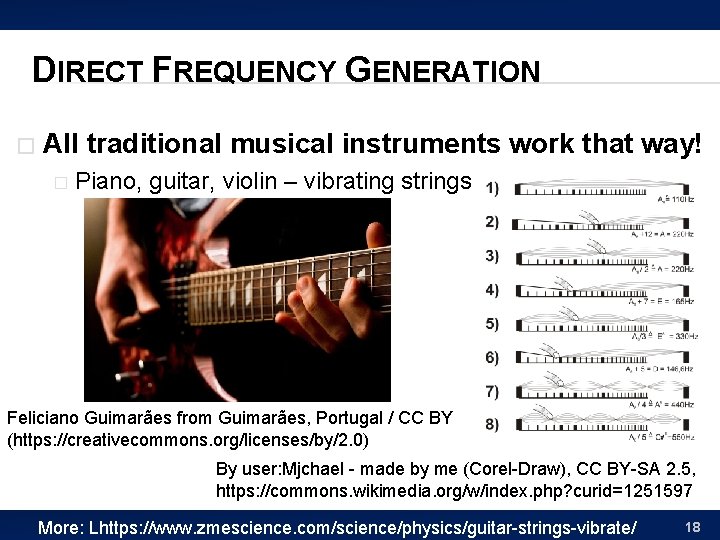
DIRECT FREQUENCY GENERATION � All traditional musical instruments work that way! � Piano, guitar, violin – vibrating strings Feliciano Guimarães from Guimarães, Portugal / CC BY (https: //creativecommons. org/licenses/by/2. 0) By user: Mjchael - made by me (Corel-Draw), CC BY-SA 2. 5, https: //commons. wikimedia. org/w/index. php? curid=1251597 More: Lhttps: //www. zmescience. com/science/physics/guitar-strings-vibrate/ 18
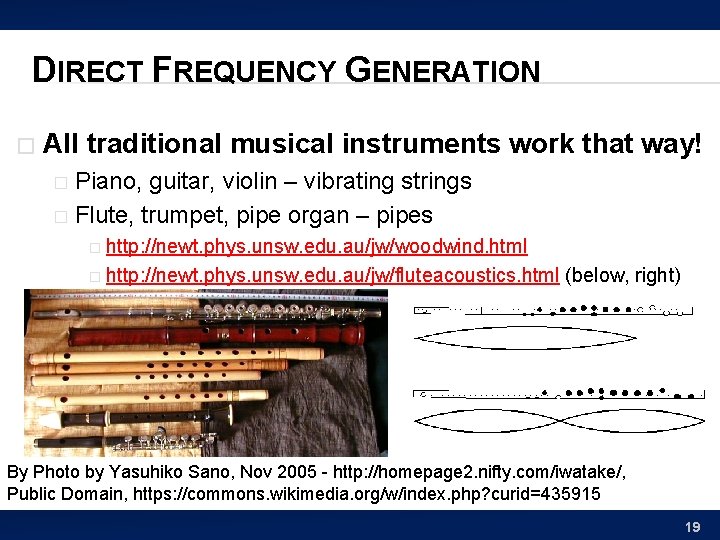
DIRECT FREQUENCY GENERATION � All traditional musical instruments work that way! Piano, guitar, violin – vibrating strings � Flute, trumpet, pipe organ – pipes � � http: //newt. phys. unsw. edu. au/jw/woodwind. html � http: //newt. phys. unsw. edu. au/jw/fluteacoustics. html (below, right) By Photo by Yasuhiko Sano, Nov 2005 - http: //homepage 2. nifty. com/iwatake/, Public Domain, https: //commons. wikimedia. org/w/index. php? curid=435915 19
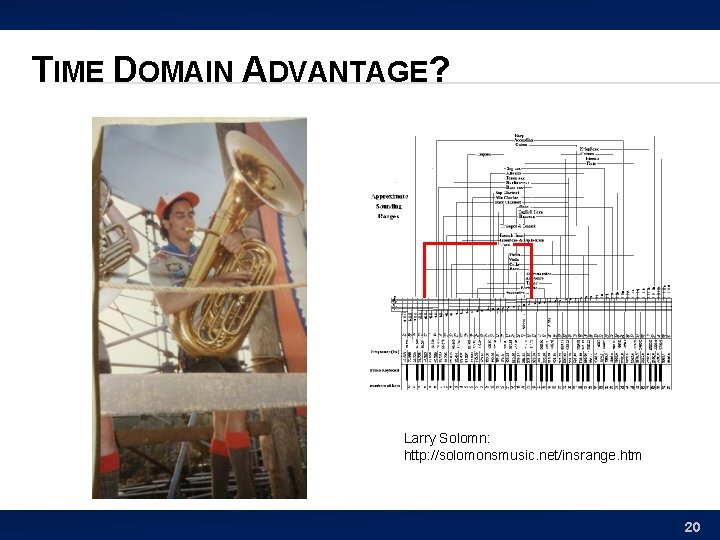
TIME DOMAIN ADVANTAGE? Larry Solomn: http: //solomonsmusic. net/insrange. htm 20
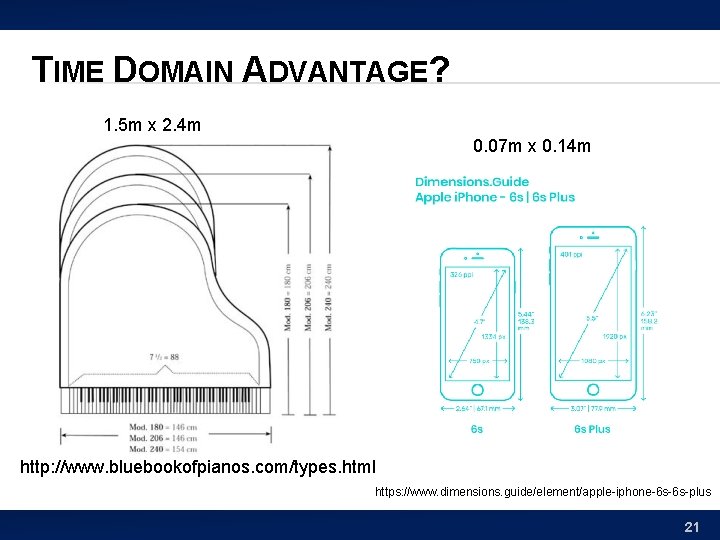
TIME DOMAIN ADVANTAGE? 1. 5 m x 2. 4 m 0. 07 m x 0. 14 m http: //www. bluebookofpianos. com/types. html https: //www. dimensions. guide/element/apple-iphone-6 s-6 s-plus 21
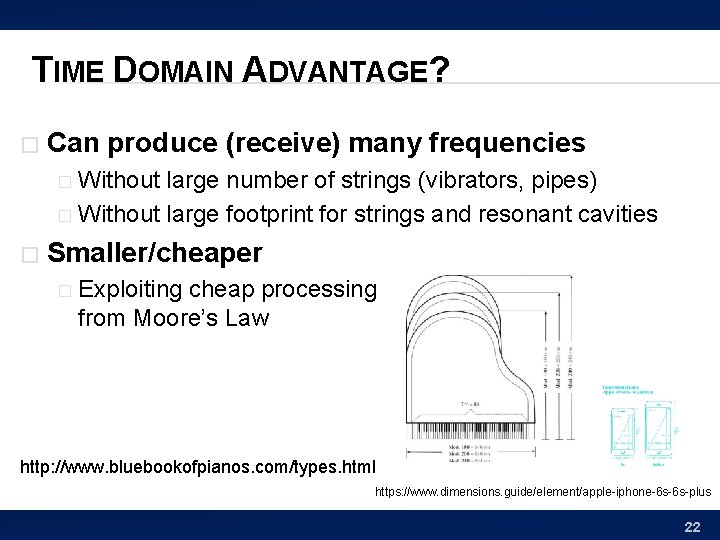
TIME DOMAIN ADVANTAGE? � Can produce (receive) many frequencies Without large number of strings (vibrators, pipes) � Without large footprint for strings and resonant cavities � � Smaller/cheaper � Exploiting cheap processing from Moore’s Law http: //www. bluebookofpianos. com/types. html https: //www. dimensions. guide/element/apple-iphone-6 s-6 s-plus 22
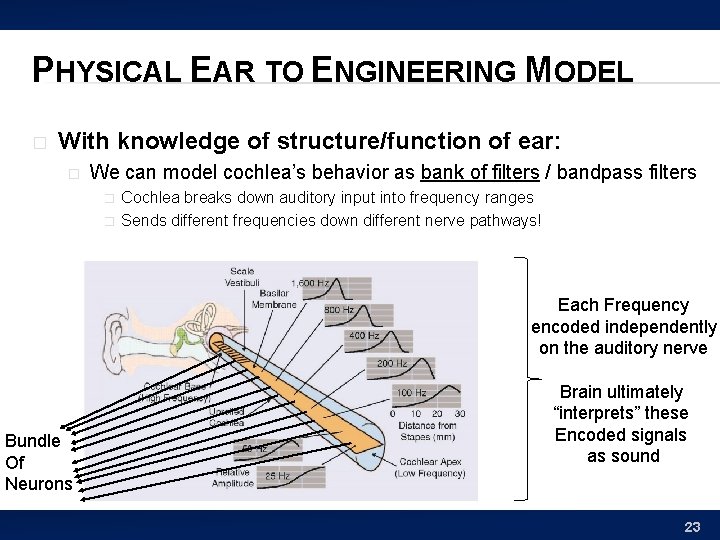
PHYSICAL EAR TO ENGINEERING MODEL � With knowledge of structure/function of ear: � We can model cochlea’s behavior as bank of filters / bandpass filters � � Cochlea breaks down auditory input into frequency ranges Sends different frequencies down different nerve pathways! Each Frequency encoded independently on the auditory nerve Bundle Of Neurons Brain ultimately “interprets” these Encoded signals as sound 23
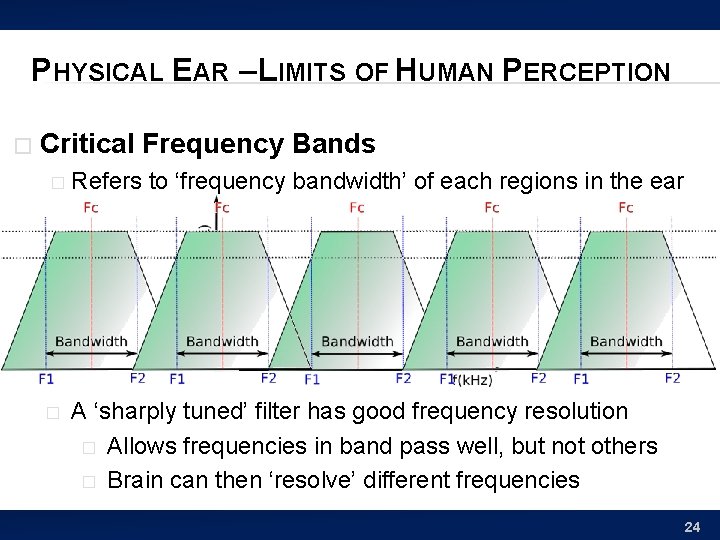
PHYSICAL EAR – LIMITS OF HUMAN PERCEPTION � Critical Frequency Bands � Refers to ‘frequency bandwidth’ of each regions in the ear � A ‘sharply tuned’ filter has good frequency resolution � Allows frequencies in band pass well, but not others � Brain can then ‘resolve’ different frequencies 24
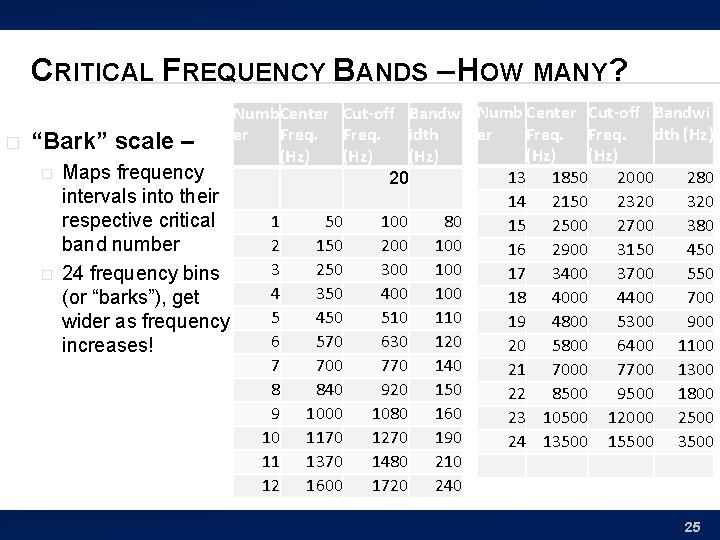
CRITICAL FREQUENCY BANDS – HOW MANY? Numb Center Cut-off Bandwi er Freq. dth (Hz) er Freq. idth � “Bark” scale – (Hz) (Hz) � Maps frequency 13 1850 2000 280 20 intervals into their 14 2150 2320 1 50 100 80 respective critical 15 2500 2700 380 2 150 200 100 band number 16 2900 3150 450 3 250 300 17 3400 3700 550 � 24 frequency bins 4 350 400 18 4000 4400 700 (or “barks”), get 5 450 510 19 4800 5300 900 wider as frequency 6 570 630 120 20 5800 6400 1100 increases! 7 700 770 140 21 7000 7700 1300 8 840 920 150 22 8500 9500 1800 9 1000 1080 160 23 10500 12000 2500 10 1170 1270 190 24 13500 15500 3500 11 1370 1480 210 12 1600 1720 240 25
OK, NOW…SOME TESTS… � How well can you hear? (range) � � � 20 Hz to 20 k. Hz – frequency increasing over 20 seconds Can you hear tone the entire time, or do is it appear to go silent at some point? Tells you how high (and maybe how low) of frequencies you can hear � Probably need to switch to audacity on laptop to see when still playing… 26
OK, NOW…SOME TESTS… � Can you hear two frequencies at once? (selectivity) � Let’s try: 400 Hz and 1000 Hz First independent references � Then together � 27
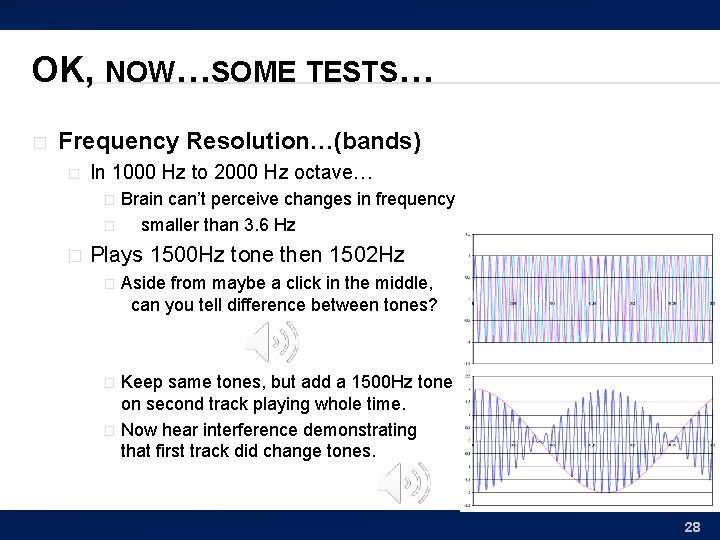
OK, NOW…SOME TESTS… � Frequency Resolution…(bands) � In 1000 Hz to 2000 Hz octave… Brain can’t perceive changes in frequency � smaller than 3. 6 Hz � � Plays 1500 Hz tone then 1502 Hz � Aside from maybe a click in the middle, can you tell difference between tones? Keep same tones, but add a 1500 Hz tone on second track playing whole time. � Now hear interference demonstrating that first track did change tones. � 28
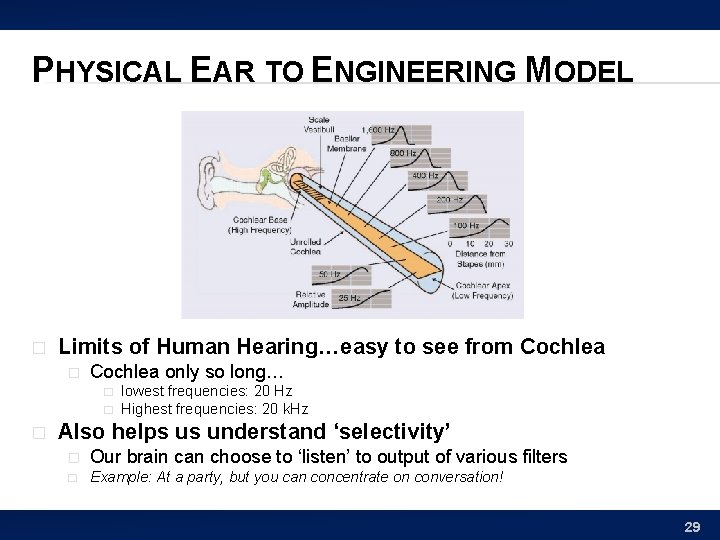
PHYSICAL EAR TO ENGINEERING MODEL � Limits of Human Hearing…easy to see from Cochlea � Cochlea only so long… � � � lowest frequencies: 20 Hz Highest frequencies: 20 k. Hz Also helps us understand ‘selectivity’ � Our brain can choose to ‘listen’ to output of various filters � Example: At a party, but you can concentrate on conversation! 29
SOUND INTENSITY & LOUDNESS 30
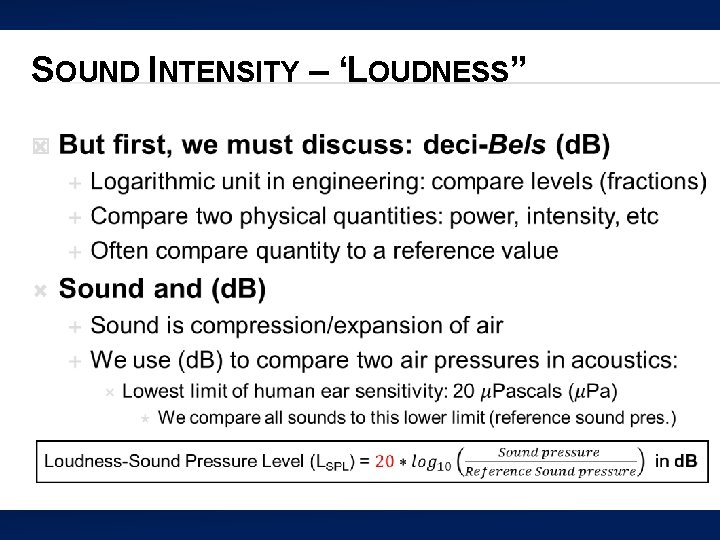
SOUND INTENSITY – “LOUDNESS” �
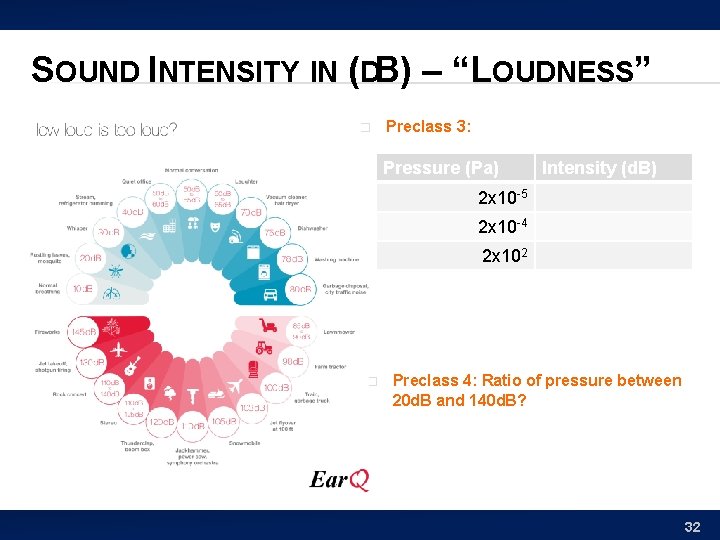
SOUND INTENSITY IN (DB) – “LOUDNESS” � Preclass 3: Pressure (Pa) Intensity (d. B) 2 x 10 -5 2 x 10 -4 2 x 10² � Preclass 4: Ratio of pressure between 20 d. B and 140 d. B? 32
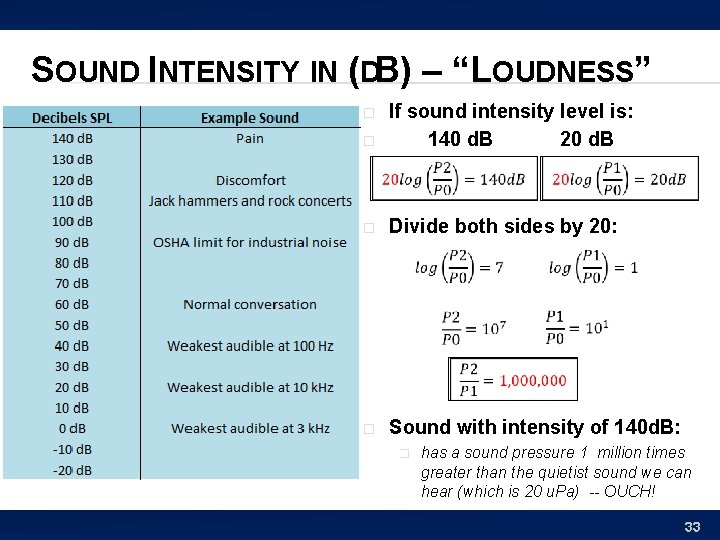
SOUND INTENSITY IN (DB) – “LOUDNESS” � If sound intensity level is: 140 d. B 20 d. B � Divide both sides by 20: � Sound with intensity of 140 d. B: � � has a sound pressure 1 million times greater than the quietist sound we can hear (which is 20 u. Pa) -- OUCH! 33
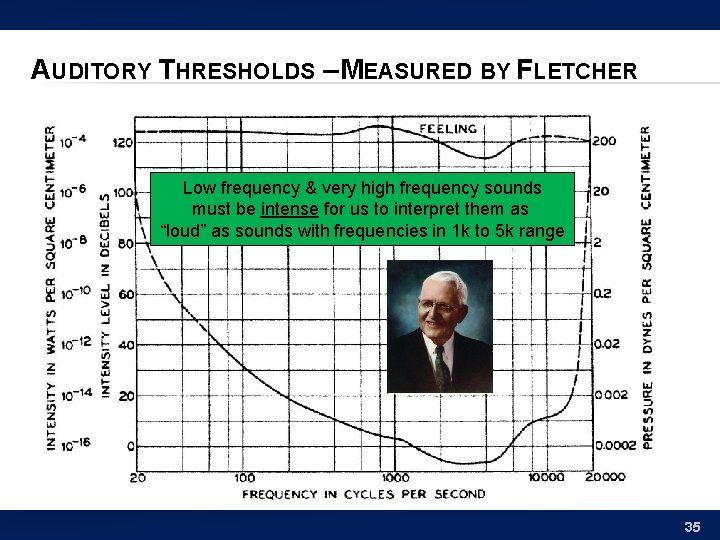
SOUND INTENSITY IN (DB) – “LOUDNESS” � Loudness – � � Intensity – � � subjective perception of intensity of sound Sound power per unit area Does loudness change with frequency? � Yes! Scientist: Harvey Fletcher (1940) � Measured loudness vs. frequency (Auditory Thresholds) � Same ‘amplitude’ sound can sound very quiet or really loud � � All depends on its frequency Turns out… � We � are very sensitive to frequencies from 1 k. Hz to 5 k. Hz They don’t have to be ‘intense’ for us to hear them…why? ? 34
AUDITORY THRESHOLDS – MEASURED BY FLETCHER Low frequency & very high frequency sounds must be intense for us to interpret them as “loud” as sounds with frequencies in 1 k to 5 k range 35
DEMONSTRATION � Same demo as before: 1 Hz to 20 k. Hz Instead of thinking about frequency cutoff (range) � Think instead about how “loud” the sounds at different frequencies are… � � Which ‘band’ sounds ‘loudest’ to you? � Note: they are all at same amplitude, so equally intense � But we perceive sounds in 1 k. Hz to 5 k. Hz to be louder! 36
BIG IDEAS � Human hearing mechanism directly encodes frequency By position on Cochlea � Frequency domain representation is the natural one � � Differential sensitivity by frequency � Hear some frequencies louder than others 37
LEARN MORE � BIBB 417 – Visual Processing � � Same kind of look at physiology, but for vision LING 520 – Phonetics 1 � Focus on speech, includes both hearing and production 38
COMING UP Feedback � Friday: Fourier Math � � � In Lab Monday � � Get things into the frequency domain Measure sensitivity and masking effects Next week: Masking 39
REFERENCES � Physical Ear: � � Filter Bank: � � http: //www. ugr. es/~atv/web_ci_SIM/en/seccion_4_en. htm Bark Scale: � � R. Munkong and B. -H. Juang. IEEE Sig. Proc. Mag. , 25(3): 98– 117, 2008 [E. Zwicker. J. Acoust. Soc. Am. , 33(2): 248, February 1961] DB Chart: � http: //www. dspguide. com/ch 22/1. htm 40
- Slides: 40