
Lecture 04 05 Good practices for requirements engineering



- Slides: 13
Lecture 04, 05 Good practices for requirements engineering
Requirements engineering process lists more than 50 practices, grouped into 7 categories, that can help all development. “Good practices for requirements engineering, ” not “Best practices. ” It’s doubtful whether all of these practices will ever be systematically evaluated for this purpose. Nonetheless, many other practitioners have found these techniques to be effective (Sommerville and Sawyer 1997; Hofmann and Lehner 2001; Gottesdiener 2005; IIBA 2009).
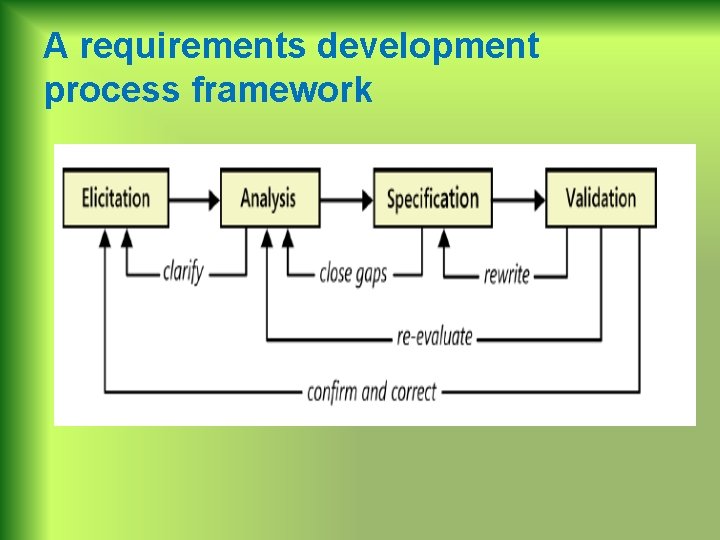
A requirements development process framework
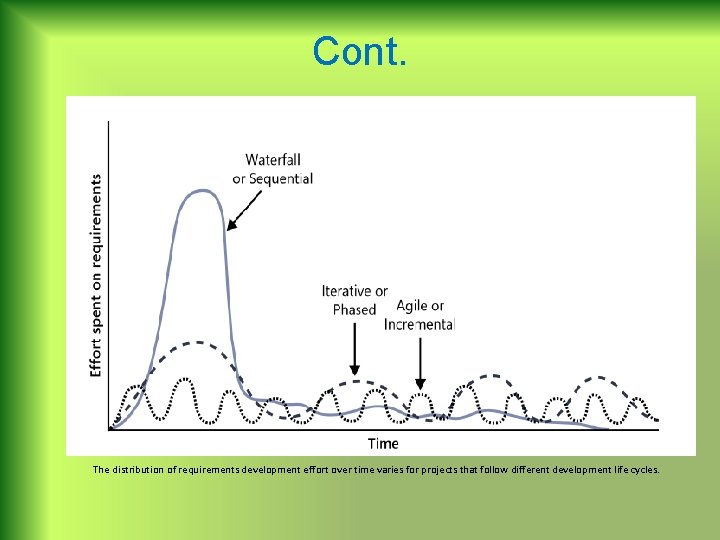
Cont. The distribution of requirements development effort over time varies for projects that follow different development life cycles.
Good practices: Requirements elicitation three levels of requirements: business, user, and functional. These come from different sources at different times during the project, have different audiences and purposes, and need to be documented in different ways.
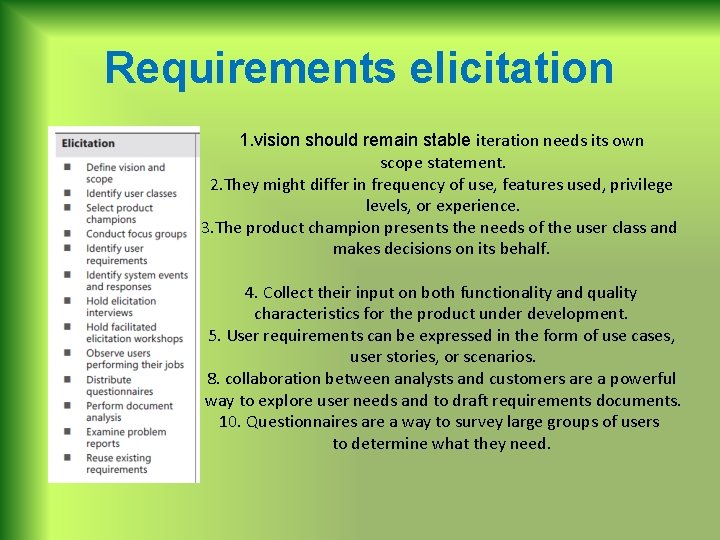
Requirements elicitation 1. vision should remain stable iteration needs its own scope statement. 2. They might differ in frequency of use, features used, privilege levels, or experience. 3. The product champion presents the needs of the user class and makes decisions on its behalf. 4. Collect their input on both functionality and quality characteristics for the product under development. 5. User requirements can be expressed in the form of use cases, user stories, or scenarios. 8. collaboration between analysts and customers are a powerful way to explore user needs and to draft requirements documents. 10. Questionnaires are a way to survey large groups of users to determine what they need.
Requirements analysis • Requirements analysis involves refining the requirements to ensure that all stakeholders understand them and scrutinizing them for errors, omissions, and other deficiencies. • The goal is to develop requirements of sufficient quality and precision that managers can construct realistic project estimates and technical staff can proceed with design, construction, and testing.
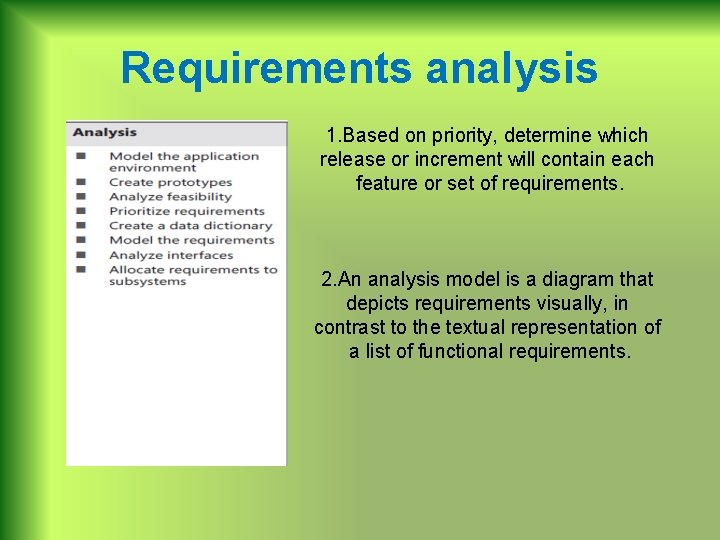
Requirements analysis 1. Based on priority, determine which release or increment will contain each feature or set of requirements. 2. An analysis model is a diagram that depicts requirements visually, in contrast to the textual representation of a list of functional requirements.
Good practices: Requirements specification • Document requirements of different types in a consistent, accessible, and reviewable way that is readily understandable by the intended audiences. • Record the business requirements in a vision and scope document. • User requirements typically are represented in the form of use cases or user stories. Detailed software FR and NFRs are recorded in a (SRS) or an alternative repository, such as a requirements management tool.
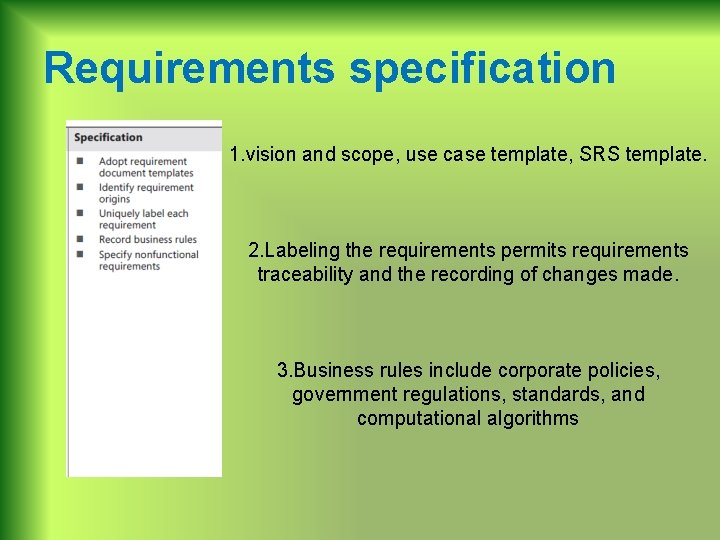
Requirements specification 1. vision and scope, use case template, SRS template. 2. Labeling the requirements permits requirements traceability and the recording of changes made. 3. Business rules include corporate policies, government regulations, standards, and computational algorithms
Good practices: Requirements validation • Validation ensures that the requirements are correct, demonstrate the desired quality characteristics, and will satisfy customer needs. Requirements that seem fine when you read them might turn out to have ambiguities and gaps when developers try to work with them.
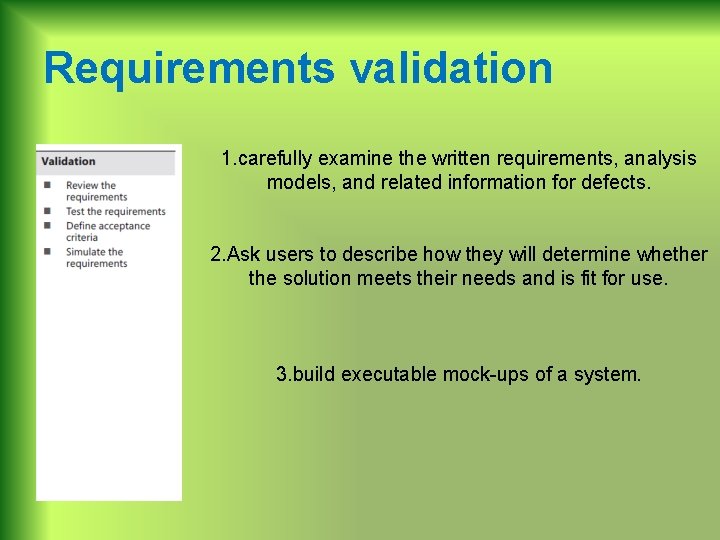
Requirements validation 1. carefully examine the written requirements, analysis models, and related information for defects. 2. Ask users to describe how they will determine whether the solution meets their needs and is fit for use. 3. build executable mock-ups of a system.