
Lecture 03 Lecture overview v Goals of MNC




- Slides: 56
Lecture 03
Lecture overview v Goals of MNC v What is MNC v Business Combinations v Classes of Business Combinations v Defensive tactics against Hostile takeover v Business combinations: Why and How? v Types of Business Combinations v Methods for Arranging business combinations v Parent company-subsidiary relationship v Financial Statements/Consolidated financial statements v Constraints interfering with the MNC’s Goal v Managing within the constraints
Theories of International Business v Theory of Comparative Advantage v Imperfect Markets v Product Cycle Theory
Theory of Comparative Advantage v When a country Specializes in some products, it my not produce other products, so trade between countries is essential. – American, European Technology – Chinese cheap labor market
Imperfect Markets v Real world suffer from imperfect market conditions where factors of production are somewhat immobile. There are costs and often restrictions related to the transfer of labor and other resources used for production. There may also be restrictions on transferring funds and other resources among countries. v “ imperfect markets provide an incentive for firms to seek out foreign opportunities”.
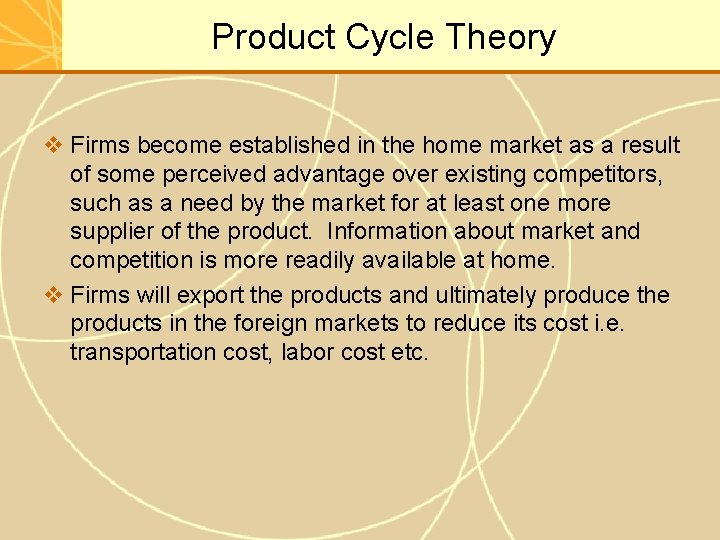
Product Cycle Theory v Firms become established in the home market as a result of some perceived advantage over existing competitors, such as a need by the market for at least one more supplier of the product. Information about market and competition is more readily available at home. v Firms will export the products and ultimately produce the products in the foreign markets to reduce its cost i. e. transportation cost, labor cost etc.
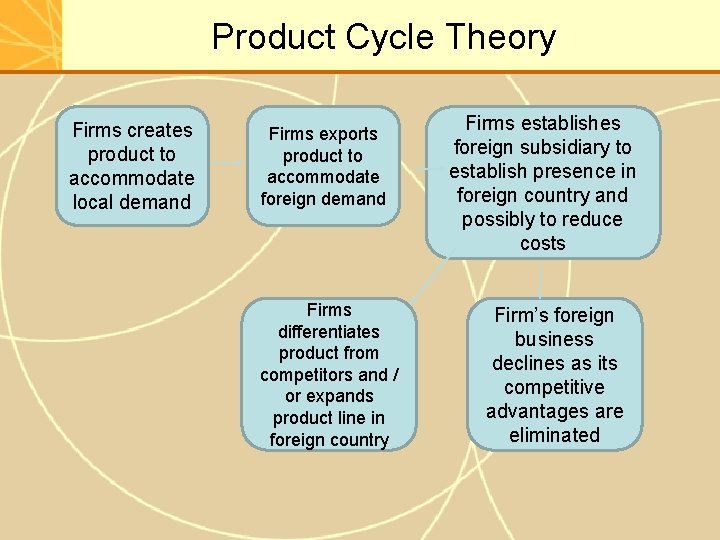
Product Cycle Theory Firms creates product to accommodate local demand Firms exports product to accommodate foreign demand Firms differentiates product from competitors and / or expands product line in foreign country Firms establishes foreign subsidiary to establish presence in foreign country and possibly to reduce costs Firm’s foreign business declines as its competitive advantages are eliminated
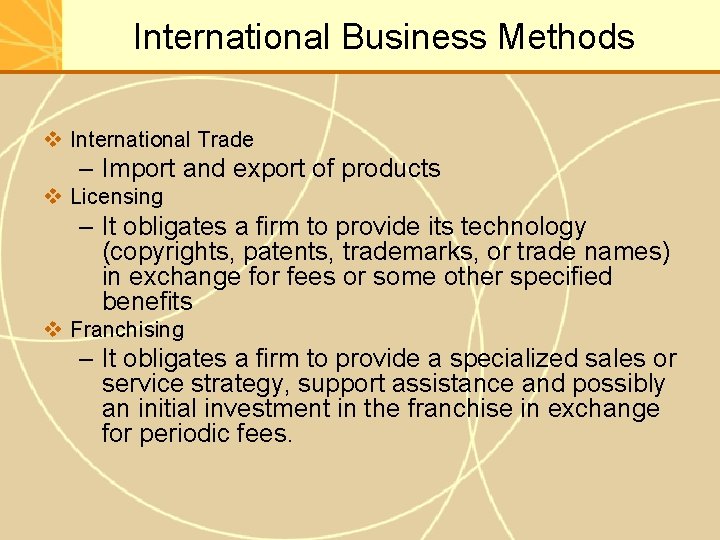
International Business Methods v International Trade – Import and export of products v Licensing – It obligates a firm to provide its technology (copyrights, patents, trademarks, or trade names) in exchange for fees or some other specified benefits v Franchising – It obligates a firm to provide a specialized sales or service strategy, support assistance and possibly an initial investment in the franchise in exchange for periodic fees.
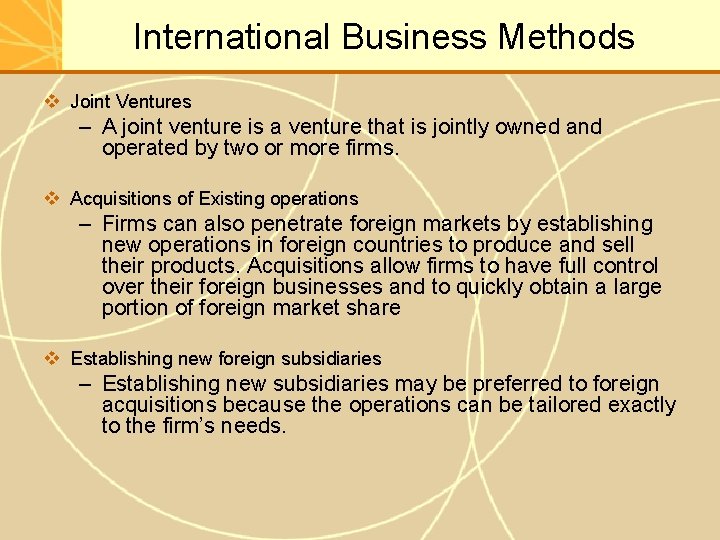
International Business Methods v Joint Ventures – A joint venture is a venture that is jointly owned and operated by two or more firms. v Acquisitions of Existing operations – Firms can also penetrate foreign markets by establishing new operations in foreign countries to produce and sell their products. Acquisitions allow firms to have full control over their foreign businesses and to quickly obtain a large portion of foreign market share v Establishing new foreign subsidiaries – Establishing new subsidiaries may be preferred to foreign acquisitions because the operations can be tailored exactly to the firm’s needs.
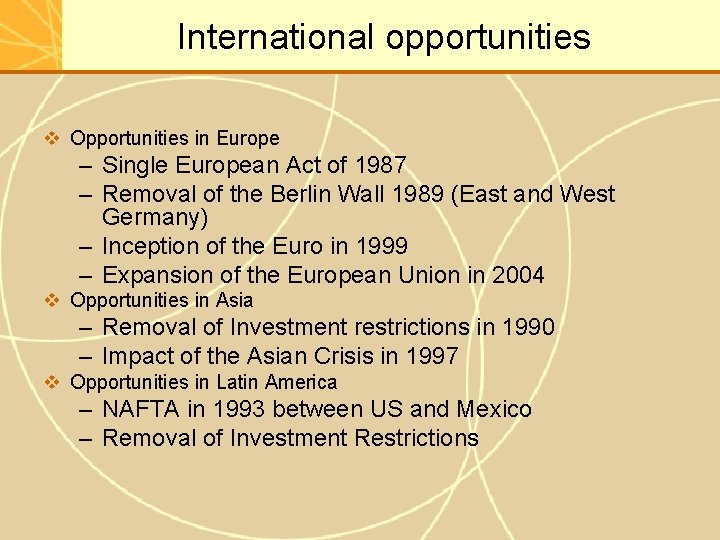
International opportunities v Opportunities in Europe – Single European Act of 1987 – Removal of the Berlin Wall 1989 (East and West Germany) – Inception of the Euro in 1999 – Expansion of the European Union in 2004 v Opportunities in Asia – Removal of Investment restrictions in 1990 – Impact of the Asian Crisis in 1997 v Opportunities in Latin America – NAFTA in 1993 between US and Mexico – Removal of Investment Restrictions
Exposure to International Risk v Exposure to Exchange Rate Movements v Exposure to Foreign Economies v Exposure to Political Risk
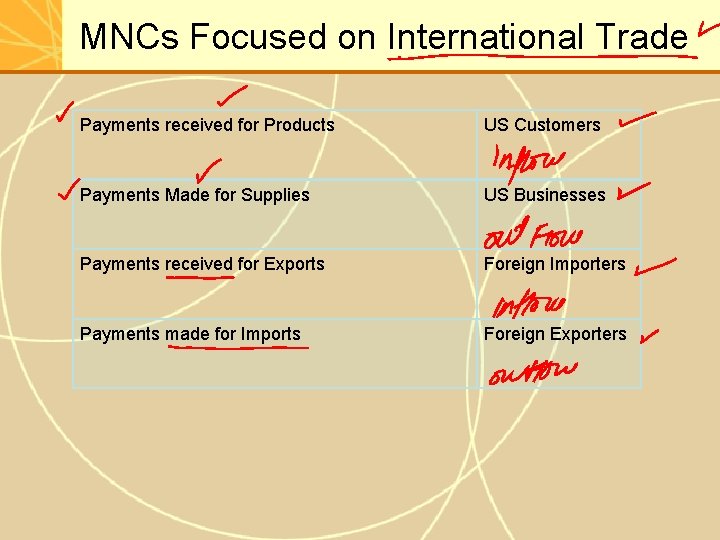
MNCs Focused on International Trade Payments received for Products US Customers Payments Made for Supplies US Businesses Payments received for Exports Foreign Importers Payments made for Imports Foreign Exporters
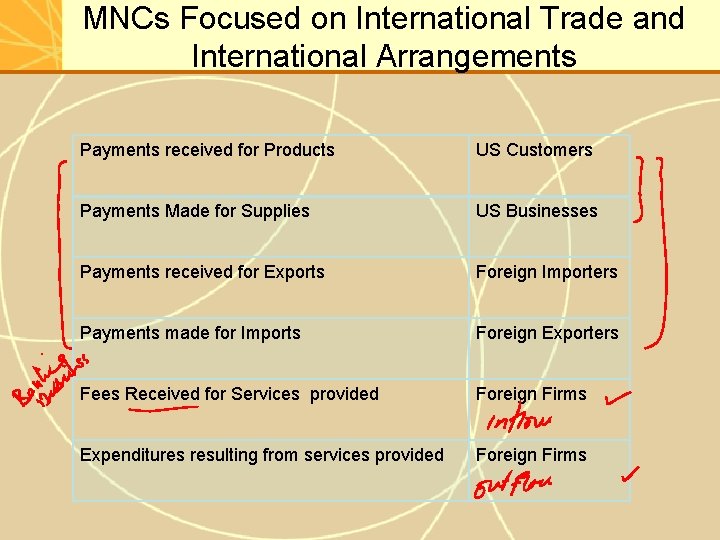
MNCs Focused on International Trade and International Arrangements Payments received for Products US Customers Payments Made for Supplies US Businesses Payments received for Exports Foreign Importers Payments made for Imports Foreign Exporters Fees Received for Services provided Foreign Firms Expenditures resulting from services provided Foreign Firms
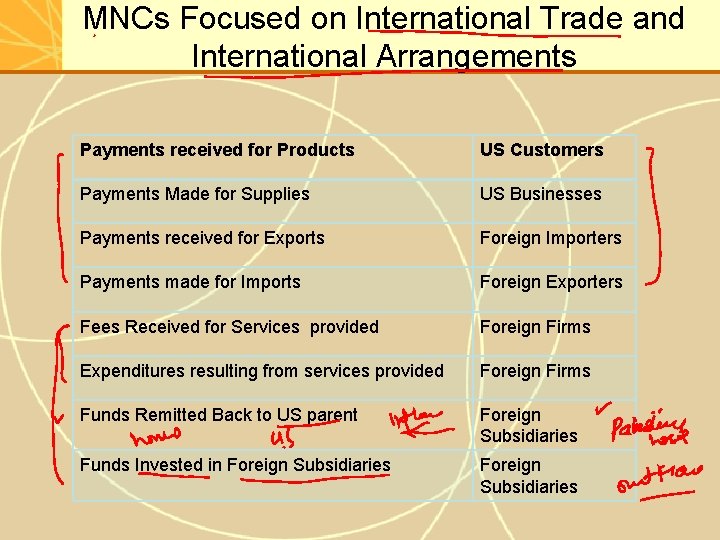
MNCs Focused on International Trade and International Arrangements Payments received for Products US Customers Payments Made for Supplies US Businesses Payments received for Exports Foreign Importers Payments made for Imports Foreign Exporters Fees Received for Services provided Foreign Firms Expenditures resulting from services provided Foreign Firms Funds Remitted Back to US parent Foreign Subsidiaries Funds Invested in Foreign Subsidiaries
Globalization
What Is Globalization? v. The world is moving away from self-contained national economies toward an interdependent, integrated global economic system v. Globalization refers to the shift toward a more integrated and interdependent world economy Globalization has two facets: 1) the globalization of markets 2) the globalization of production
The Globalization Of Markets v. The globalization of markets refers to the merging of historically distinct and separate national markets into one huge global marketplace v. In many industries, it is no longer meaningful to talk about the “German market” or the “American market” v. Instead, there is only the global market
The Globalization Of Markets v. Falling trade barriers make it easier to sell internationally v. The tastes and preferences of consumers are converging on some global norm v. Firms help create the global market by offering the same basic products worldwide
The Globalization Of Production v. The globalization of production refers to the sourcing of goods and services from locations around the globe to take advantage of national differences in the cost and quality of factors of production like land, labor, and capital v. Companies compete more effectively by lowering their overall cost structure or improving the quality or functionality of their product offering. v. Boeing jet 777 airliner ( Japan, Singapore, Italy) v. IBM (Design in US) ( Case, Keyboard, Hard drive in Thailand) (Display Screen, memory in S. Korea) ( Wirelesscard in Malaysia) (Micro Processor in US)
The Emergence Of Global Institutions are needed to: v. Help manage, regulate, and police the global marketplace v. Promote the establishment of multinational treaties to govern the global business system
The Emergence Of Global Institutions created over the past half century include: v. The General Agreement on Tariffs and Trade (GATT) v. The World Trade Organization (WTO)- (153 members by July 2008) v. The International Monetary Fund (IMF)- lender of the last resort - HO in Geneva v. The World Bank-HO Washington DC, USA v. The United Nations (UN)-(1945)
Agencies that facilitate International Flows • International Monetary Fund (IMF) • • • Established in 1944 by the UN Monetary and Financial Conference in Bretton Wood, New Hampshire. Developed for structured international monetary system Compensatory financial facility which attempts to reduce the impact of export instability on country economies. Special Drawing rights Charter Includes – Promote Cooperation among countries on International Monetary Issues – Promote stability in exchange rates – Provide temporary funds to member countries attempting to correct imbalance of international payments – Promote free mobility of capital funds across countries – Promote free trade. “ IMF Goals is to encourage increased internationalization of business”
World Bank • International Bank for Reconstruction and development (IBRD) • Established in 1944. • It provides loans to countries to enhance economic development. • It provides small portion of the financing needed by developing countries. • It attempts to spread its funds by entering into cofinancing agreements. • It established the Multilateral investment Guarantee Agency (MIGA) which offers various forms of political risk insurance.
World Trade Organization (WTO) v. The World Trade Organization (like its predecessor GATT) is primarily responsible for policing the world trading system and making sure that nation-states adhere to the rules laid down in trade treaties signed by WTO members v. In 2007, the 150 nations that accounted for 97% of world trade were WTO members v. The WTO promotes lower barriers to trade and investment
International Financial Corporation (IFC) • Established in 1956 to promote private enterprise rather government within countries. • It typically provides 10 -15 percent of the necessary funds in private enterprise projects. • Its works as catalyst rather sole supporter for private enterprises projects. • It obtains funds from World Bank and some other international financial markets.
International Development Association (IDA) v Established in 1960 for country development objectives. Its loan policy is more appropriate for less prosperous nations. v It extends loans at less interest rats to poor nations
Bank for International Settlements (BIS) • It facilitate cooperation among countries with regards to international transactions. • Provides assistance to countries experiencing a financial crisis. • Also called central bank or lender of last resort. • It normally provides assistance to central banks of Latin America and Eastern European countries.
Regional Development Agencies v Intern-American Development bank v Asian Development Bank v African Development Bank v European Bank for reconstruction and Development
How International Trade Affects an MNC’s Value v Export higher than inflation rate or national income v Cash flow may increase with trade agreements and reduction in tariff or barriers
The Emergence Of Global Institutions The United Nations was established in 1945 to: vmaintain international peace and security vdevelop friendly relations among nations vcooperate in solving international problems vand in promoting respect for human rights
Drivers Of Globalization Two macro factors underlie the trend toward greater globalization: v the decline in barriers to the free flow of goods, services, and capital that has occurred since the end of World War II v technological change
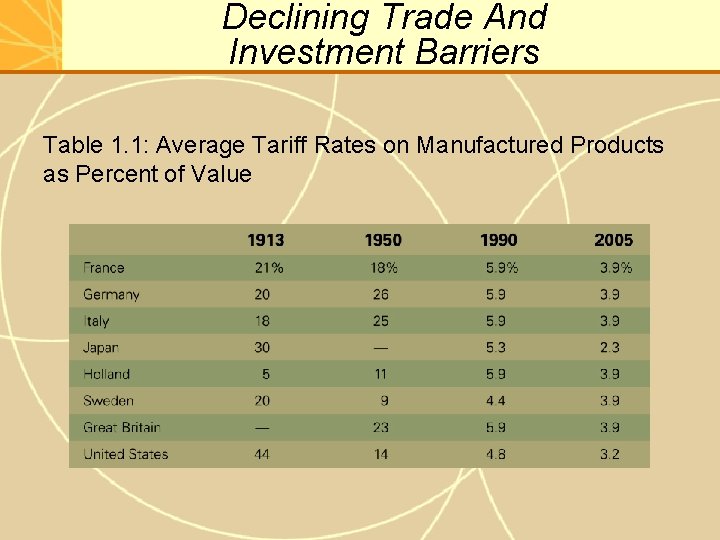
Declining Trade And Investment Barriers v. International trade occurs when a firm exports goods or services to consumers in another country v. Foreign direct investment (FDI) occurs when a firm invests resources in business activities outside its home country v. After World War II, advanced countries made a commitment to lower barriers to trade and investment v. Since 1950, average tariffs have fallen significantly and are now at about 4% v. Countries have also been opening markets to FDI
Declining Trade And Investment Barriers Table 1. 1: Average Tariff Rates on Manufactured Products as Percent of Value
Declining Trade And Investment Barriers Lower barriers to trade and investment mean: vthat firms can view the world, rather than a single country, as their market vthat firms can base production in the optimal location for that activity
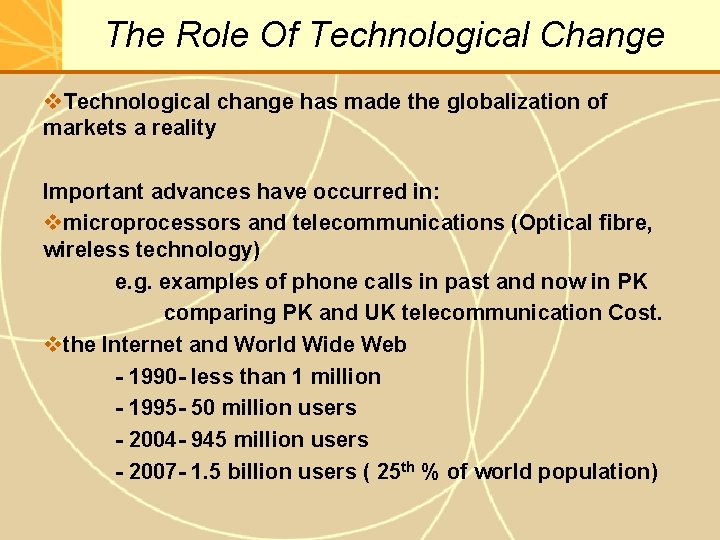
The Role Of Technological Change v. Technological change has made the globalization of markets a reality Important advances have occurred in: vmicroprocessors and telecommunications (Optical fibre, wireless technology) e. g. examples of phone calls in past and now in PK comparing PK and UK telecommunication Cost. vthe Internet and World Wide Web - 1990 - less than 1 million - 1995 - 50 million users - 2004 - 945 million users - 2007 - 1. 5 billion users ( 25 th % of world population)
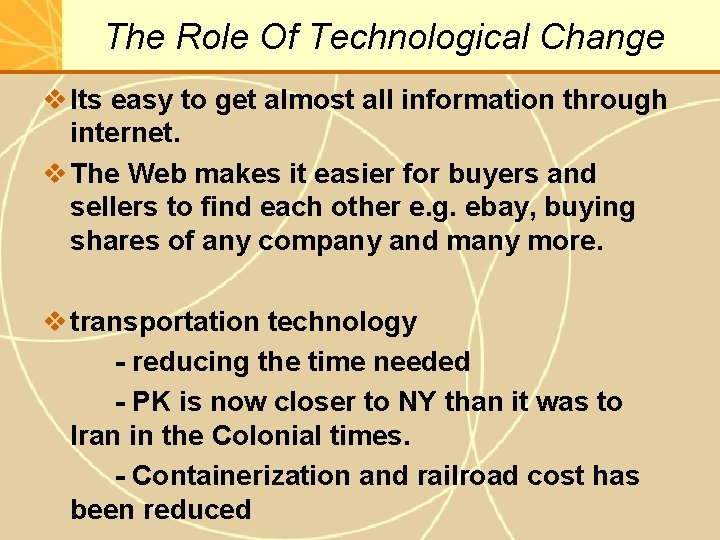
The Role Of Technological Change v Its easy to get almost all information through internet. v The Web makes it easier for buyers and sellers to find each other e. g. ebay, buying shares of any company and many more. v transportation technology - reducing the time needed - PK is now closer to NY than it was to Iran in the Colonial times. - Containerization and railroad cost has been reduced
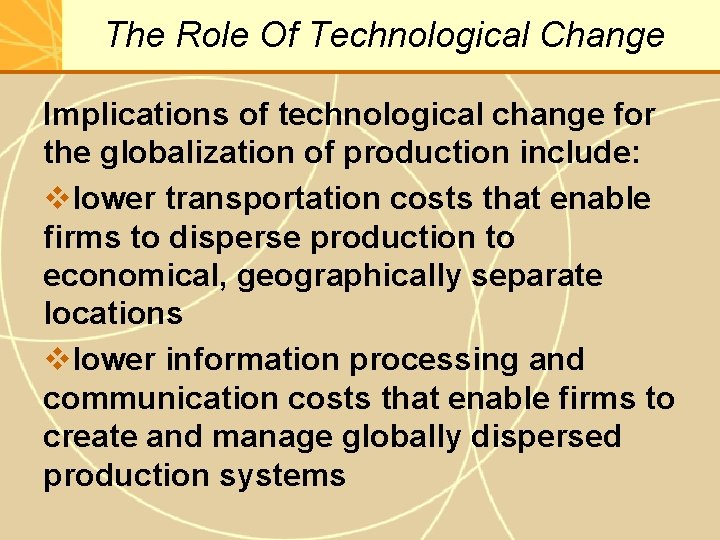
The Role Of Technological Change Implications of technological change for the globalization of production include: vlower transportation costs that enable firms to disperse production to economical, geographically separate locations vlower information processing and communication costs that enable firms to create and manage globally dispersed production systems
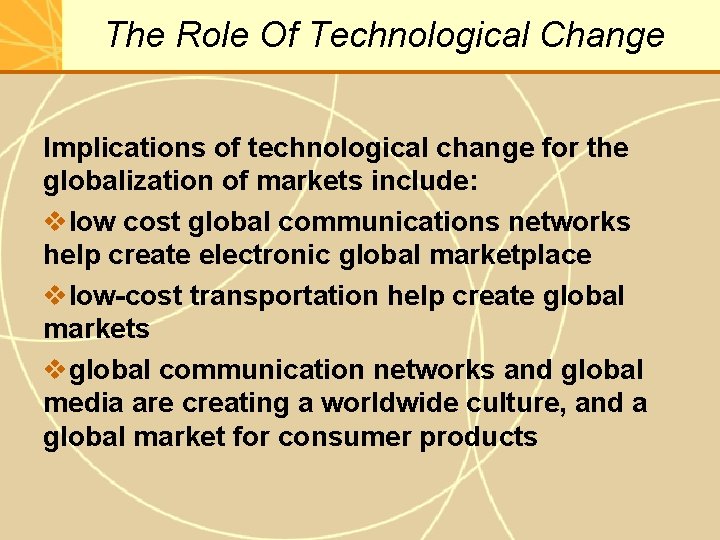
The Role Of Technological Change Implications of technological change for the globalization of markets include: vlow cost global communications networks help create electronic global marketplace vlow-cost transportation help create global markets vglobal communication networks and global media are creating a worldwide culture, and a global market for consumer products
The Changing Demographics Of The Global Economy v. There has been a drastic change in the demographics of the world economy in the last 30 years Four trends are important: vthe Changing World Output and World Trade Picture vthe Changing Foreign Direct Investment Picture vthe Changing Nature of the Multinational Enterprise vthe Changing World Order
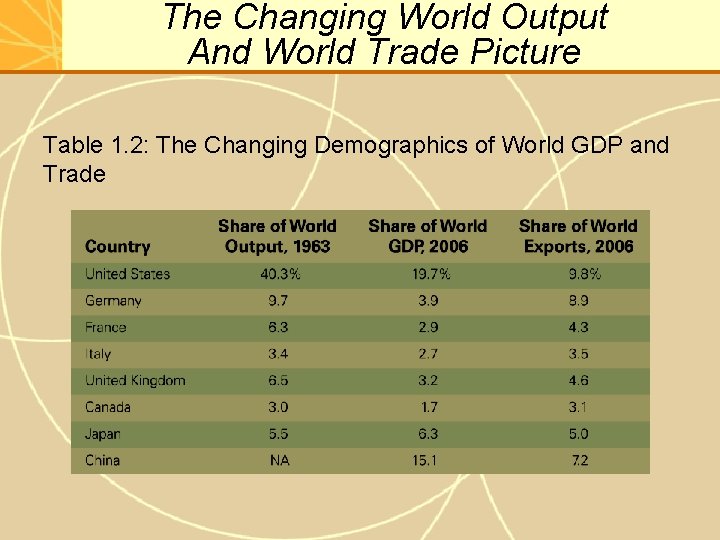
The Changing World Output And World Trade Picture v. In 1960, the United States accounted for over 40% of world economic activity v. By 2006, the United States accounted for less than 20% of world economic activity v. A similar trend occurred in other developed countries v. The share of world output accounted for by developing nations is rising and is expected to account for more than 60% of world economic activity by 2020 v The World Bank has estimated that with the current prevailing situation, the Chinese economy could be larger than the US by 2020 while the economy of India will approach to that of Germany.
The Changing World Output And World Trade Picture Table 1. 2: The Changing Demographics of World GDP and Trade
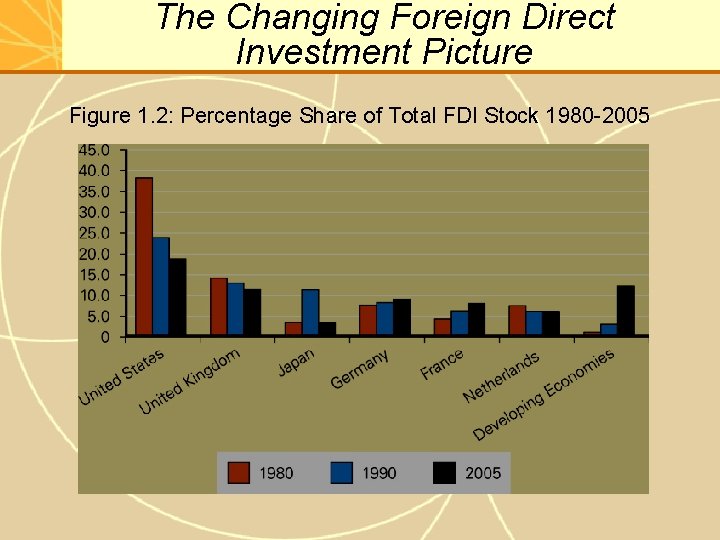
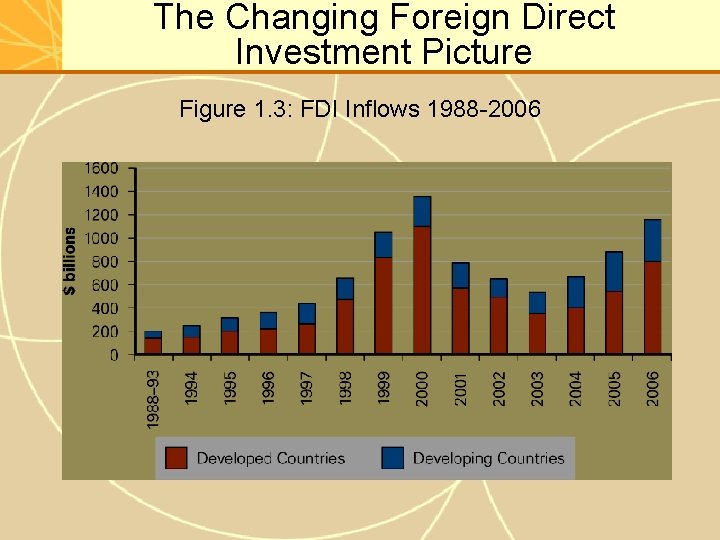
The Changing Foreign Direct Investment Picture v. In the 1960 s, U. S. firms accounted for about two-thirds of worldwide FDI flows v. Today, the United States accounts for less than one-fifth of worldwide FDI flows v. Other developed countries have followed a similar pattern v. In contrast, the share of FDI accounted for by developing countries has risen from less than 2% in 1980 to almost 12% in 2005 v. Developing countries, especially China, have also become popular destinations for FDI
The Changing Foreign Direct Investment Picture Figure 1. 2: Percentage Share of Total FDI Stock 1980 -2005
The Changing Foreign Direct Investment Picture Figure 1. 3: FDI Inflows 1988 -2006
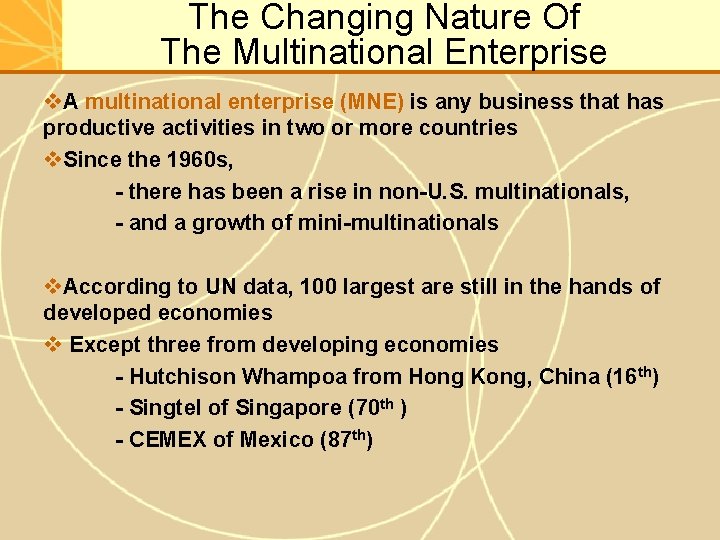
The Changing Nature Of The Multinational Enterprise v. A multinational enterprise (MNE) is any business that has productive activities in two or more countries v. Since the 1960 s, - there has been a rise in non-U. S. multinationals, - and a growth of mini-multinationals v. According to UN data, 100 largest are still in the hands of developed economies v Except three from developing economies - Hutchison Whampoa from Hong Kong, China (16 th) - Singtel of Singapore (70 th ) - CEMEX of Mexico (87 th)
The Changing World Order v. Many former Communist nations in Europe and Asia are now committed to democratic politics and free market economies and so, create new opportunities for international businesses v. China and Latin America are also moving toward greater free market reforms
The Global Economy Of The Twenty-first Century v. The world is moving toward a more global economic system, but globalization is not inevitable v. Globalization also brings risks like the financial crisis that swept through South East Asia in the late 1990 s. 2007 till running.
The Globalization Debate Is the shift toward a more integrated and interdependent global economy a good thing? v. Supporters believe that increased trade and cross-border investment mean lower prices for goods and services, greater economic growth, higher consumer income, and more jobs v. Critics worry that globalization will cause job losses, environmental degradation, and the cultural imperialism of global media and MNEs
Anti-Globalization Protests v. More than 40, 000 anti-globalization protesters took to the street at the WTO meeting in Seattle in 1999 v. Protesters now regularly show up at most major meetings of global institutions
Globalization, Jobs, And Income v. Globalization critics argue that falling barriers to trade are destroying manufacturing jobs in advanced countries v. Supporters of globalization contend that the benefits of this trend outweigh the costs—that countries will specialize in what they do most efficiently and trade for other goods—and all countries will benefit
Globalization, Labor Policies, And The Environment v. Globalization critics argue that firms avoid costly efforts to adhere to labor and environmental regulations by moving production to countries where such regulations do not exist, or are not enforced v. Globalization supporters claim that tougher environmental and labor standards are associated with economic progress, so as countries get richer from free trade, they get tougher environmental and labor regulations
Globalization And National Sovereignty v. Critics of globalization worry that today’s interdependent global economy is shifting economic power away from national governments toward supranational organizations like the WTO, the EU, and the UN v. Supporters of globalization contend that the power of these organizations is limited to what nation-states agree to grant, and that the power of the organizations lies in their ability to get countries to agree to follow certain actions
Globalization And The World’s Poor v. Critics of globalization argue that the gap between rich nations and poor nations is getting wider v. Supporters of globalization claim that the best way for the poor nations to improve their situation is to reduce barriers to trade and investment and implement economic policies based on free market economies, and to receive debt forgiveness for debts incurred under totalitarian regimes
Managing In The Global Marketplace v. An international business is any firm that engages in international trade or investment
Managing In The Global Marketplace Managing an international business differs from managing a domestic business because: vcountries are different vthe range of problems confronted in an international business is wider and the problems more complex than those in a domestic business vfirms have to find ways to work within the limits imposed by government intervention in the international trade and investment system vinternational transactions involve converting money into different currencies