
Lecture 03 Introduction to RUP RUP Rational Unified
- Slides: 26
Lecture 03 (Introduction to RUP) • RUP (Rational Unified Process) (Iterative, Evolutionary, and Agile)
Grady Booch speaks • “People are more important than any process. • Good people with a good process will outperform good people with no process any time. ”
The Unified Process • The Unified Process has emerged as a popular and effective software development process. • In particular, the Rational Unified Process, as modified at Rational Software, is widely practiced and adopted by industry.
The Most Important Concept • The critical idea in the Rational Unified Process is Iterative Development. • Iterative Development is successively enlarging and refining a system through multiple iterations, using feedback and adaptation. • Each iteration will include requirements, analysis, design, and implementation. • Iterations are timeboxed.
What is Rational Unified Process (RUP)? § RUP is a complete software-development process framework , developed by Rational Corporation. § It’s an iterative development methodology based upon six industry-proven best practices. § Processes derived from RUP vary from lightweight— addressing the needs of small projects —to more comprehensive processes addressing the needs of large, possibly distributed project teams.
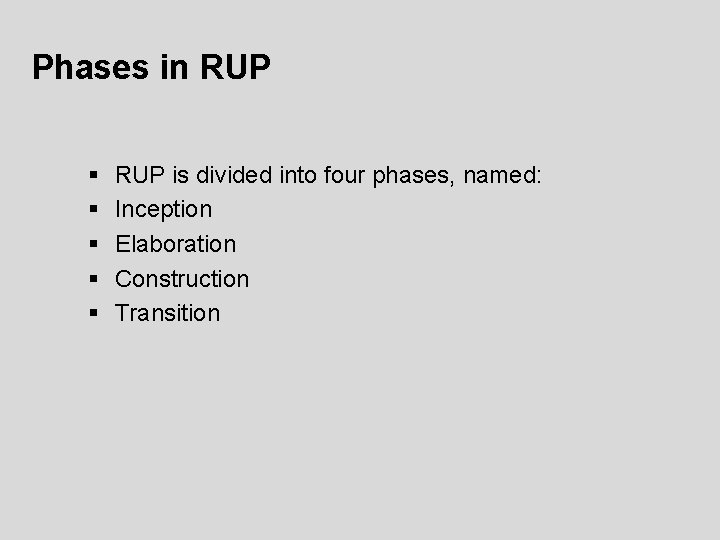
Phases in RUP § § § RUP is divided into four phases, named: Inception Elaboration Construction Transition
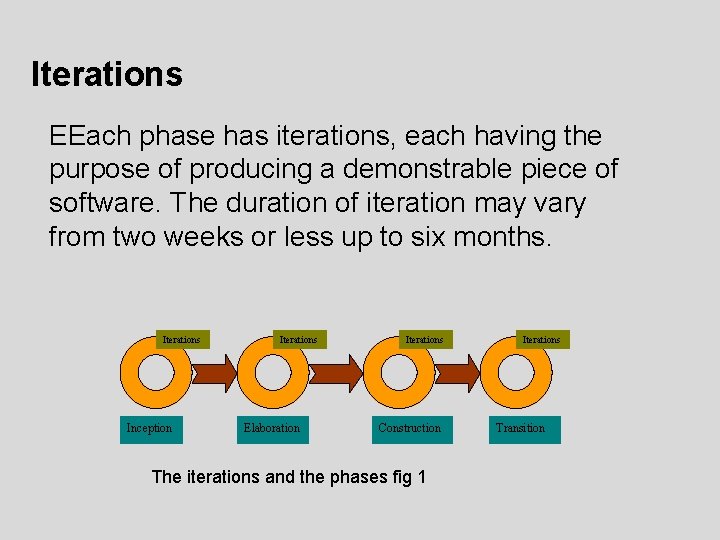
Iterations EEach phase has iterations, each having the purpose of producing a demonstrable piece of software. The duration of iteration may vary from two weeks or less up to six months. Iterations Inception Iterations Elaboration Iterations Construction The iterations and the phases fig 1 Iterations Transition
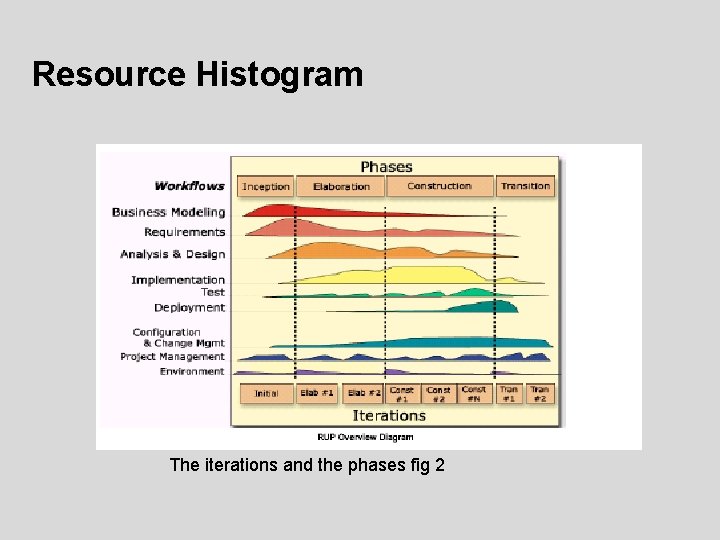
Resource Histogram The iterations and the phases fig 2
The Agile Manifesto • Individuals and interactions – Over processes and tools • Working software – Over comprehensive documentation • Customer collaboration – Over contract negotiation • Responding to change – Over following a plan
Unified Process best practices • • Get high risk and high value first Constant user feedback and engagement Early cohesive core architecture Test early, often, and realistically Apply use cases where needed Do some visual modeling with UML Manage requirements and scope creep Manage change requests and configuration
Inception • The life-cycle objectives of the project are stated, so that the needs of every stakeholder are considered. Scope and boundary conditions, acceptance criteria and some requirements are established.
Inception - Entry criteria • The expression of a need, which can take any of the following forms: § an original vision § a legacy system § an RFP (request for proposal) § the previous generation and a list of enhancements § some assets (software, know-how, financial assets) § a conceptual prototype, or a mock-up
Inception - Activities § Formulate the scope of the project. § Needs of every stakeholder, scope, boundary conditions and acceptance criteria established. § Plan and prepare the business case. § Define risk mitigation strategy, develop an initial project plan and identify known cost, schedule, and profitability trade-offs. § Synthesize candidate architecture. § Candidate architecture is picked from various potential architectures § Prepare the project environment.
Inception - Exit criteria § An initial business case containing at least a clear formulation of the product vision - the core requirements - in terms of functionality, scope, performance, capacity, technology base. § Success criteria (example: revenue projection). § An initial risk assessment. § An estimate of the resources required to complete the elaboration phase.
Elaboration • An analysis is done to determine the risks, stability of vision of what the product is to become, stability of architecture and expenditure of resources.
Elaboration - Entry criteria § The products and artifacts described in the exit criteria of the previous phase. § The plan approved by the project management, and funding authority, and the resources required for the elaboration phase have been allocated.
Elaboration - Activities § Define the architecture. § Project plan is defined. The process, infrastructure and development environment are described. § Validate the architecture. § Baseline the architecture. § To provide a stable basis for the bulk of the design and implementation effort in the construction phase.
Elaboration - Exit criteria § § § A detailed software development plan, with an updated risk assessment, a management plan, a staffing plan, a phase plan showing the number and contents of the iteration , an iteration plan, and a test plan The development environment and other tools A baseline vision, in the form of a set of evaluation criteria for the final product A domain analysis model, sufficient to be able to call the corresponding architecture ‘complete’. An executable architecture baseline.
Construction • The Construction phase is a manufacturing process. It emphasizes managing resources and controlling operations to optimize costs, schedules and quality. This phase is broken into several iterations.
Construction - Entry criteria § The product and artifacts of the previous iteration. The iteration plan must state the iteration specific goals § Risks being mitigated during this iteration. § Defects being fixed during the iteration.
Construction - Activities § Develop and test components. § Components required satisfying the use cases, scenarios, and other functionality for the iteration are built. Unit and integration tests are done on Components. § Manage resources and control process. § Assess the iteration § Satisfaction of the goal of iteration is determined.
Construction - Exit Criteria § The same products and artifacts, updated, plus: § A release description document, which captures the results of an iteration § Test cases and results of the tests conducted on the products, § An iteration plan, detailing the next iteration § Objective measurable evaluation criteria for assessing the results of the next iteration(s).
Transition • The transition phase is the phase where the product is put in the hands of its end users. It involves issues of marketing, packaging, installing, configuring, supporting the usercommunity, making corrections, etc.
Transition - Entry criteria Ø The product and artifacts of the previous iteration, and in particular a software product sufficiently mature to be put into the hands of its users.
Transition - Activities § Test the product deliverable in a customer environment. § Fine tune the product based upon customer feedback § Deliver the final product to the end user § Finalize end-user support material
Transition - Exit criteria § An update of some of the previous documents, as necessary, the plan being replaced by a “post-mortem” analysis of the performance of the project relative to its original and revised success criteria; § A brief inventory of the organization’s new assets as a result this cycle.