
Lecture 02 The Web Application Development Process Models
Lecture 02 The Web Application Development Process Models Mr. Mubashir Ali Lecturer (Dept. of Computer Science) dr. mubashirali 1@gmail. com 1
Summary of the last lecture • Web engineering extends Software Engineering to Web applications • Why web engineering? • Web applications • Categories of web applications • Characteristics of web applications Mubashir Ali - Lecturer (Department of Computer Science) 2
Outline • Development Process model – software development process activities • Requirement for a web development process model • Rational unified process model (RUP) – suitability for web application development Mubashir Ali - Lecturer (Department of Computer Science) 3
1. Process model • A set of related activities that leads to the production of a software product – development of software from scratch – extending and modifying existing systems • Common activities – Software specification – Designing and implementation – System validation – System evolution Mubashir Ali - Lecturer (Department of Computer Science) 4
1. 1 Process activities • Software specification: • The functionality of the software and constraints on its operation must be defined – critical stage (can lead to problems in design and implementation) • Activities: – Feasibility study – Requirement elicitation and analysis – Requirement specification – Requirement validation Mubashir Ali - Lecturer (Department of Computer Science) 5
1. 1 Process activities… • Software design and implementation: • Design is the description of – System structure – Data models – Interface between components • Implementation: Converting a system specification into an executable system Mubashir Ali - Lecturer (Department of Computer Science) 6
1. 1 Process activities… • System validation: • Intended to show that the system – confirms its specification – meets customer’s expectations • Development testing – tested by the people developed the components • System testing – finding component integration errors • Acceptance testing – System is tested by the customer’s provided data Mubashir Ali - Lecturer (Department of Computer Science) 7
1. 1 Process activities… • Software evolution: • Software is flexible as compared to hardware – Changes can be made to the system during development or after the development Mubashir Ali - Lecturer (Department of Computer Science) 8
1. 2 Common approaches • The waterfall approach • Iterative approach • Reuse oriented approach Mubashir Ali - Lecturer (Department of Computer Science) 9
2. Requirements for a web application development process • Evolving from informational medium to application medium • Existing approaches are over-pragmatic – lead to short development time • Web engineering does not have its own mature development process model • SE development process models are adopted Mubashir Ali - Lecturer (Department of Computer Science) 10
2. Requirements for a web application development process… • Handling Short development cycles – Development time is short • Normally does not exceed six month – Immediate delivery mechanism • Capture share in the market – Leaves less freedom for systematic development process Mubashir Ali - Lecturer (Department of Computer Science) 11
2. Requirements for a web application development process… • Handling changing requirement – Requirements often emerge during development • as developer understand the unknown business – Integrate changes rapidly to remain in competition – User involvement is more critical • due to emerging and unstable requirements Mubashir Ali - Lecturer (Department of Computer Science) 12
2. Requirements for a web application development process… • Reuse and integration – to meet time constraints developer try to reuse components • Leads to integration issues – Development can not be isolated from the development of other applications within the organization Mubashir Ali - Lecturer (Department of Computer Science) 13
2. Requirements for a web application development process… • Adapting to web application’s complexity level – process depends upon the level of complexity – process is adapted dynamically • for low complexity, it should be like lightweight process • for high complexity, it should be like heavyweight process Mubashir Ali - Lecturer (Department of Computer Science) 14
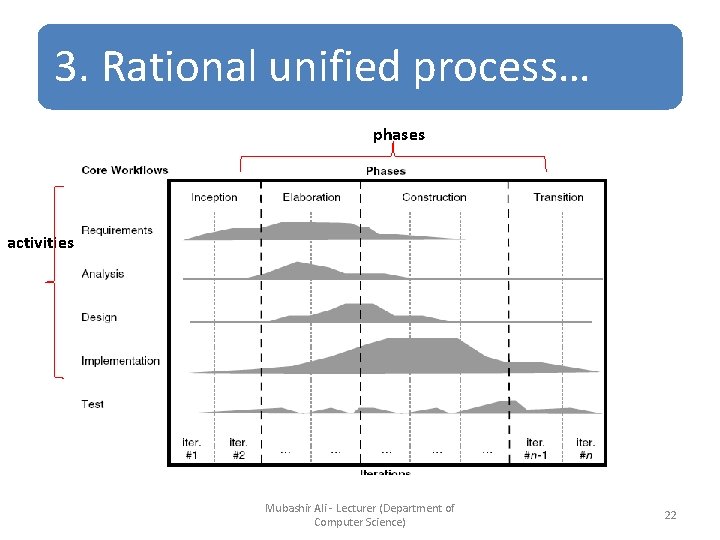
3. Rational unified process • RUP is a heavyweight, phase oriented, incremental and iterative process • Described in three perspectives – Dynamic perspective: phases – Static perspective: activities in phases – Practice perspective: good engineering practices Mubashir Ali - Lecturer (Department of Computer Science) 15
3. Rational unified process • RUP phases: • Inception: Define the business case for the project • Goals: – Business case • Identify and interact with external entities • Asses the business contribution • Artifacts: – business case Mubashir Ali - Lecturer (Department of Computer Science) 16
3. Rational unified process • RUP phases: • Elaboration: establish understanding with the problem • Goals: – Establish software scope – Discriminating critical use-cases – Estimating cost, schedules and risks • Artifacts: – development plan, use-case model, architectural description Mubashir Ali - Lecturer (Department of Computer Science) 17
3. Rational unified process • RUP phases: • Construction: involves system design, programming and testing • Goals: – Develop the design – Implement the design – Validate the system • Artifacts: – System, training material Mubashir Ali - Lecturer (Department of Computer Science) 18
3. Rational unified process • RUP phases: • Transition: Installing the system in real environment • Goals: – Testing in real environment – training – Bug fixing, performance enhancements • Artifacts: – A documented system working correctly Mubashir Ali - Lecturer (Department of Computer Science) 19
3. Rational unified process • RUP activities (workflows): – Requirements – analysis – design – implementation – test Mubashir Ali - Lecturer (Department of Computer Science) 20
3. Rational unified process • RUP good practices: – Develop software iteratively – Manage requirements – Use component-based architectures – Visually model software-using UML – Verify software quality – Control changes to software Mubashir Ali - Lecturer (Department of Computer Science) 21
3. Rational unified process… phases activities Mubashir Ali - Lecturer (Department of Computer Science) 22
3. 1 RUP for web application • Inception phase: • Definition is problematic for web application – no concrete view of the system at beginning – has target group but needs are unknown • Elaboration phase: – due to short development time, first version has priority over clearly defined end-product Mubashir Ali - Lecturer (Department of Computer Science) 23
3. 1 RUP for web application… • Construction phase: – exists in web development process • Transition phase: – is meaningful for web application development Mubashir Ali - Lecturer (Department of Computer Science) 24
3. 1 RUP for web application… • Handling short development cycles: – Conflicting • short cycle means concession in modeling and documentation while RUP is heavyweight • Handling changing requirements: – Conflicting with time constraints • require concrete vision at the end of inception phase which require more time in web application due to evolving requirements Mubashir Ali - Lecturer (Department of Computer Science) 25
3. 1 RUP for web application… • Parallel development of different releases: – can be met with RUP • RUP only allow parallel development in construction phase • Reuse and integration: – Conflicting • It requires coordination with development processes of other applications RUP does not describe this Mubashir Ali - Lecturer (Department of Computer Science) 26
3. 1 RUP for web application… • Adapting to a Web application’s complexity level: – RUP can be adopted for later stages when complexity of web application is understood Mubashir Ali - Lecturer (Department of Computer Science) 27
Summary • Development Process model – software development process activities – conventional software development approaches • Requirement for a web development process model • Rational unified process model (RUP) – suitability for web application development Mubashir Ali - Lecturer (Department of Computer Science) 28
References • Chapter 10, Kappel, G. , Proll, B. Reich, S. & Retschitzegger, W. (2006). Web Engineering, Hoboken, NJ: Wiley & Sons • Chapter 2, Sommerville, Software Engineering, ISBN-10: 0 -13 -703515 -2 , PEARSON Mubashir Ali - Lecturer (Department of Computer Science) 29
- Slides: 29