
Lecture 02 Artificial neural networks versus human brain
Lecture 02: Artificial neural networks versus human brain By: Nur Uddin, Ph. D 1
Neural Network as an Adaptive Machine • A neural network is a massively parallel distributed processor made up of simple processing units that has a natural propensity for storing experiential knowledge and making it available for use. • It resembles the brain in two respects: 1. Knowledge is acquired by the network from its environment through a learning process. 2. Interneuron connection strengths, known as synaptic weights, are used to store the acquired knowledge. Artificial Intelligent - Lecture 1 2

Artificial Neural Network • Commonly referred to as “neural networks”. • A neural network is a machine that is designed to model the way in which the brain performs a particular task or function of interest. • The neural network is usually implemented by using electronic components or is simulated in software on a digital computer. Artificial Intelligent - Lecture 1 3
Motivation of Neural Network • Motivation: human brain computes in an entirely different way from conventional digital computers. • The brain is highly complex, nonlinear, and parallel computer. Note: Compute : process information Computer : information-processing system Artificial Intelligent - Lecture 1 4
Example: Human Vision • A human vision is an information-processing system to provide a visual representation of the environment around us. • The brain routinely accomplishes perceptual recognition tasks (e. g. , recognizing a familiar face in an unfamiliar scene) in approximately 100– 200 ms, whereas tasks of much lesser complexity take a great deal longer on a powerful computer). Artificial Intelligent - Lecture 1 5
How Does the Brain Work ? • At birth, a brain already has considerable structure and the ability to build up its own rules of behavior through what we usually refer to as “experience. ” • Indeed, experience is built up over time, with much of the development (i. e. , hardwiring) of the human brain taking place during the first two years from birth, but the development continues well beyond that stage. Artificial Intelligent - Lecture 1 6
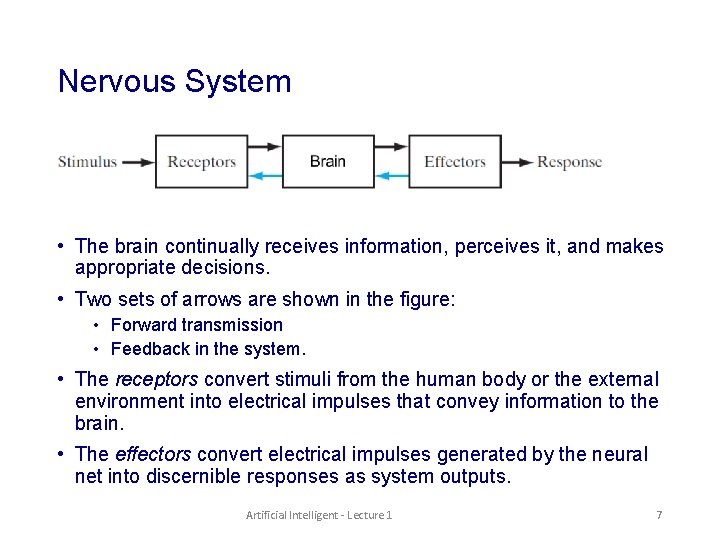
Nervous System • The brain continually receives information, perceives it, and makes appropriate decisions. • Two sets of arrows are shown in the figure: • Forward transmission • Feedback in the system. • The receptors convert stimuli from the human body or the external environment into electrical impulses that convey information to the brain. • The effectors convert electrical impulses generated by the neural net into discernible responses as system outputs. Artificial Intelligent - Lecture 1 7
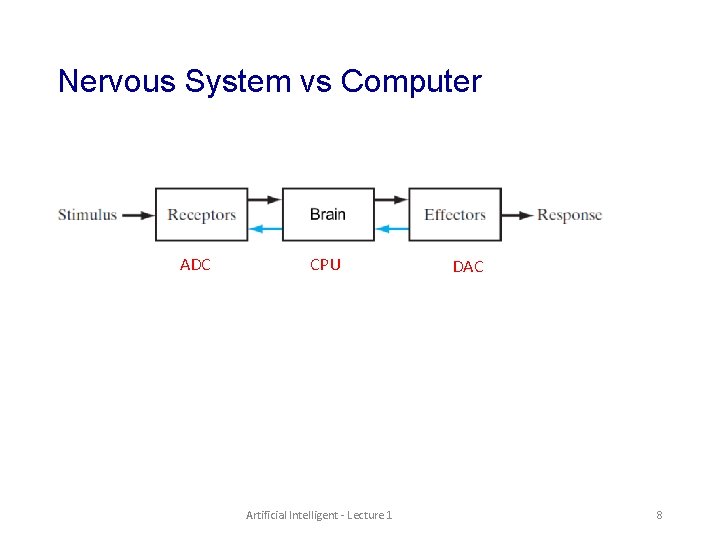
Nervous System vs Computer ADC CPU Artificial Intelligent - Lecture 1 DAC 8
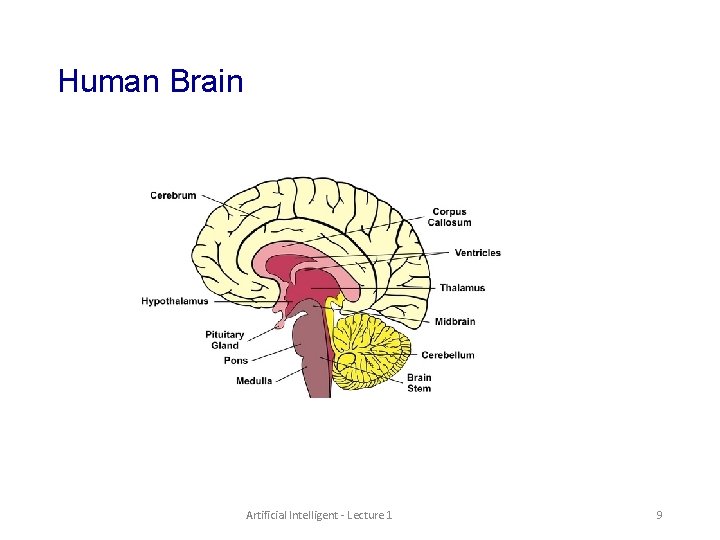
Human Brain Artificial Intelligent - Lecture 1 9
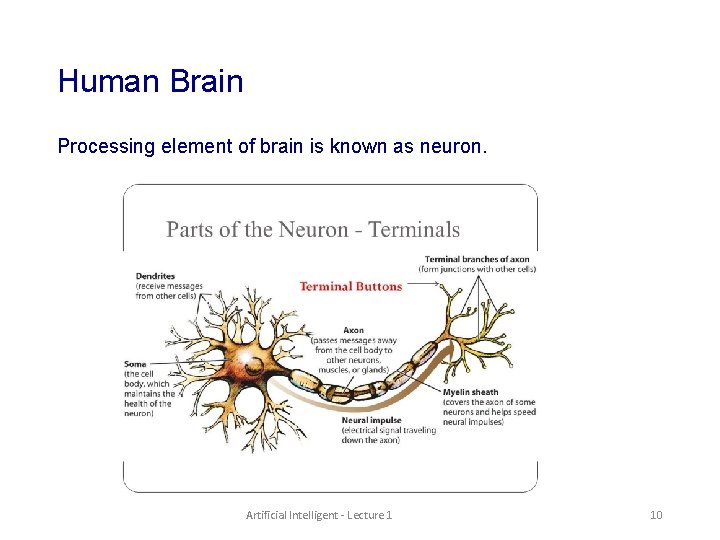
Human Brain Processing element of brain is known as neuron. Artificial Intelligent - Lecture 1 10
- Slides: 10