
LECTURE 01 INTRODUCTION TO RURAL PLANNING DEVELOPMENT DEFINITIONS
- Slides: 11
LECTURE # 01 INTRODUCTION TO RURAL PLANNING & DEVELOPMENT
DEFINITIONS • Rural/Rural Area ü The area having ccharacteristic of farming or country life • Planning ü “According to Haimann, Planning is the determines in advance what should be done. ” function that • Development ü The act of making some area of land or profitable or productive or useful. water more üA multi-dimensional process which involves transformation in structures, attitudes and institutions as well as the acceleration of economic growth, reduction of inequality and the eradication of absolute poverty.
RURAL DEVELOPMENT • ü It is a strategy designed to improve the economic and social life of rural poor. ü It is a process, which aims at improving the well being and self realization of people living outside the urbanized areas through collective process. ü It is all about bringing change among rural community from the traditional way of living to progressive way of living. ü It is also expressed as a movement for progress.
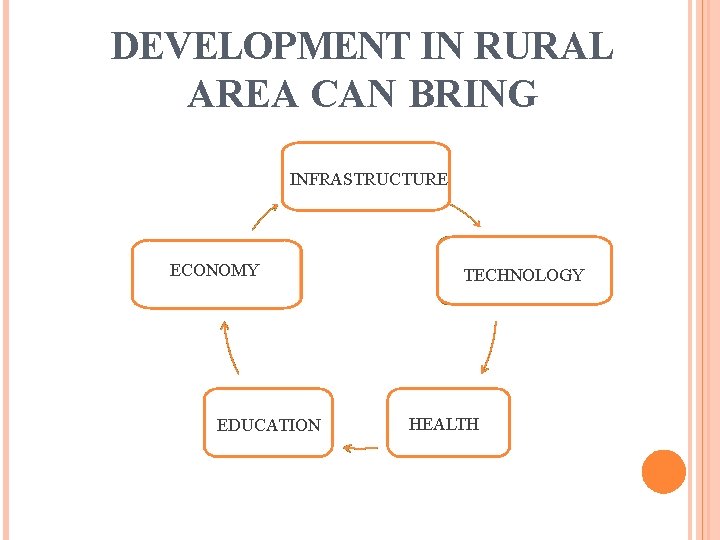
DEVELOPMENT IN RURAL AREA CAN BRING INFRASTRUCTURE ECONOMY EDUCATION TECHNOLOGY HEALTH
OBJECTIVES OF RURAL DEVELOPMENT • To develop farm, home, public service and village community. • To bring improvement in producing of crops and animals living condition. • To improve health and education condition • To improve villagers with their own efforts. • To improve village communication.
WORLD DEVELOPMENT REPORT WORLD BANK 1991 • “ A better quality of life in world’s poor countries calls for higher incomes but it involves much more. It encompasses better education, higher standards of health and nutrition, less poverty, a cleaner environment, more quality of opportunities, greater individual freedom, and richer cultural life. ”
THREE CORE VALUES OF DEVELOPMENT • To increase the availability and widen the distribution of basic life sustaining goods such as food, shelter, health and protection. • To raise levels of living, that is to say, higher incomes, the provision of more jobs, better education, and greater attention to cultural and humanistic values. • To extend the range of economic and social choices available to individuals and nations by freeing them from servitude and dependence not only in relation to other people and nation states but also to the forces of ignorance and human misery.
CONT. . • Development is primarily defined in the context of economy as it is equaled with economic development of the country. • Various scholars of diverse disciplines have view development ain the following context: ü Improvement-change (for the better) ü Economic growth, Modernization Industrialization.
IMPORTANCE OF RURAL DEVELOPMENT • Rural development is a dynamic process. • It is mainly concerned with rural areas. • These include ü Agricultural growth ü Putting up of economic and social infrastructure ü Fair wages ü Housing and house sites for the landless ü Village planning ü Education ü Functional literacy.
RURAL DEVELOPMENT IS NEEDED BECAUSE !!!! • To develop rural area as whole in terms of culture society, economy, technology and health. • To develop living standard of rural mass. • To develop rural youths, children and women. • To develop and empower human resource of rural area in terms of their psychology, skill, knowledge, attitude and other abilities. • To solve the problems faced by the rural mass for their development.
CONCLUSION • Rural development is a transversal function and cannot be executed successfully without the collaboration amongst a variety of social partners and the participation of communities; • Through social mobilisation and organising of rural people into functional groups communities can effectively take charge of their own development.