
LECTUR 2 The neurotransmitters receptors of Autonomic NS




- Slides: 28
LECTUR (2) The neurotransmitters & receptors of Autonomic NS
INTRODUCTION
INTRODUCTION • It is the balance between the sympathetic and parasympathetic nervous system that keeps our automated body functions working properly • The autonomic nervous system receptors act as on/off buttons that control the various sympathetic and parasympathetic effects in the body. When these buttons are turned on or off, things happen in your body. If you learn about these receptors and their actions described below, you will be able to understand what a beta-blocker does or what to expect from an alpha agonist medication.
OBJECTIVES
OBJECTIVES • describe neurotransmitters that can release at pre and post ganglionic of Autonomic NS. • Describe Autonomic NS receptors.
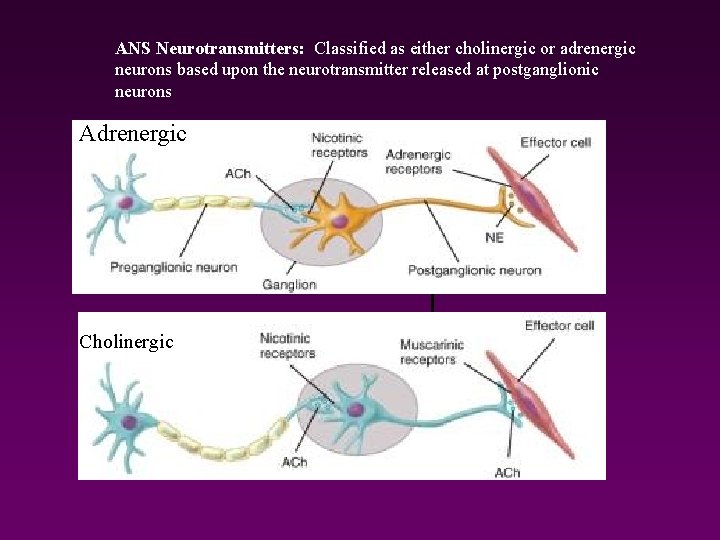
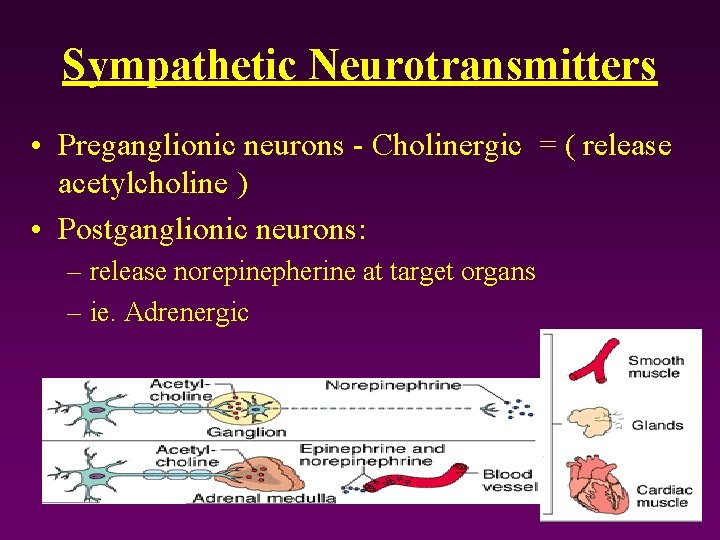
ANS Neurotransmitters: Classified as either cholinergic or adrenergic neurons based upon the neurotransmitter released at postganglionic neurons Adrenergic Cholinergic
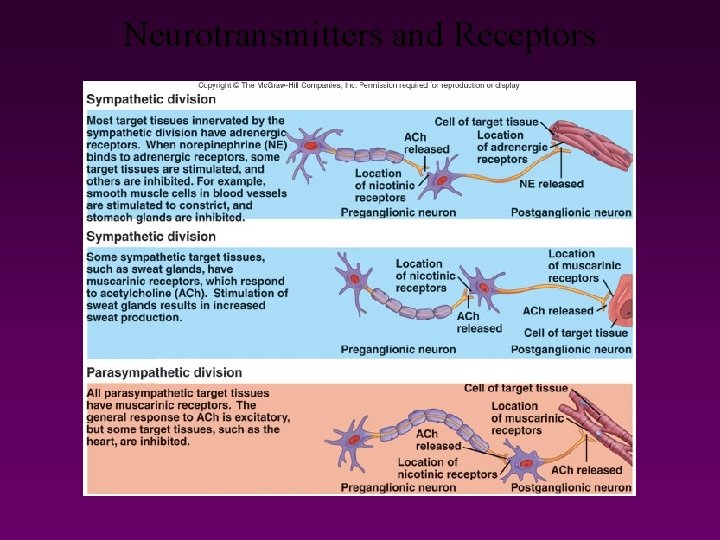
Sympathetic Neurotransmitters • Preganglionic neurons - Cholinergic = ( release acetylcholine ) • Postganglionic neurons: – release norepinepherine at target organs – ie. Adrenergic
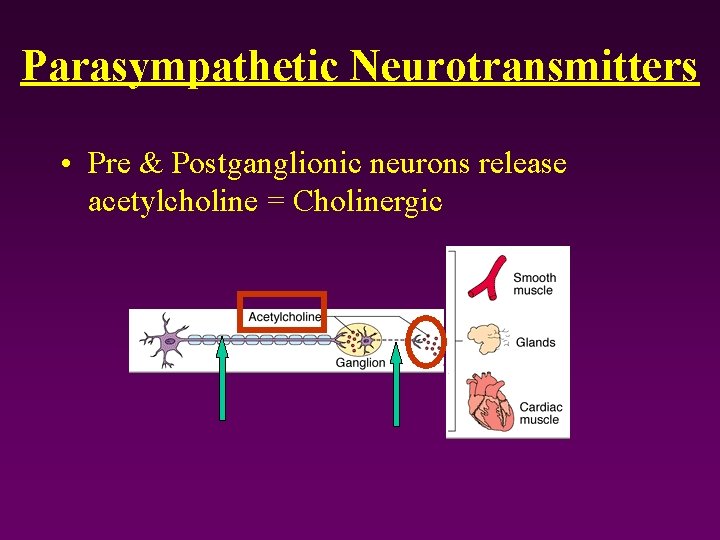
Parasympathetic Neurotransmitters • Pre & Postganglionic neurons release acetylcholine = Cholinergic
Chemical or neural transmitter • All preganglionic fibers release acetylcholin (Ach). • All parasympathetic postganglionic release Ach. • All sympathetic postganglionic release noradrenalin except sweat glands & blood vessels to skeletal muscles
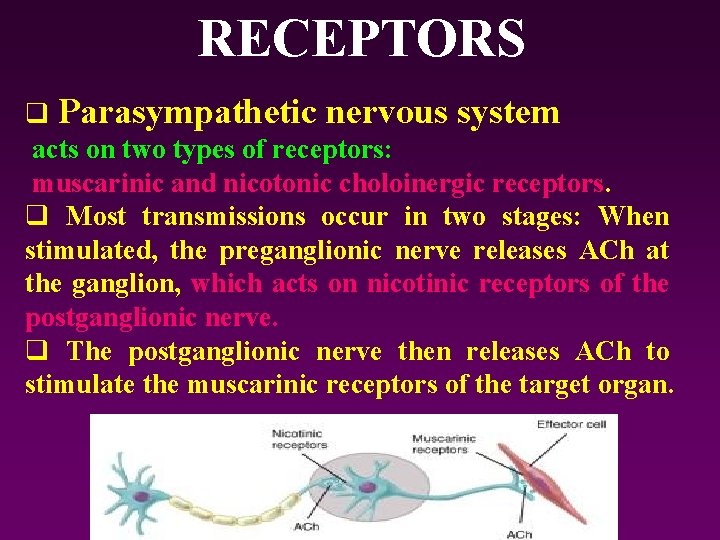
RECEPTORS q Parasympathetic nervous system acts on two types of receptors: muscarinic and nicotonic choloinergic receptors. q Most transmissions occur in two stages: When stimulated, the preganglionic nerve releases ACh at the ganglion, which acts on nicotinic receptors of the postganglionic nerve. q The postganglionic nerve then releases ACh to stimulate the muscarinic receptors of the target organ.
TYPES OF MUSCARINIC RECEPTORS Three main types of muscarinic receptors: M 1, M 2&M 3 • M 1 at neural system. • M 2 at heart. • act to bring the heart back to normal after the actions of the sympathetic nervous system: slowing down the heart rate, reducing contractile forces of the atrial cardiac muscle, and reducing conduction velocity of the SA and AV node. • Note, they have no effect on the contractile forces of the ventricular muscle.
TYPES OF MUSCARINIC RECEPTORS • M 3 at many places in the body, such as • smooth muscles vasoconstriction of the blood vessels> cause • lungs> cause bronchioconstriction • smooth muscles of the GIT > help in increasing intestinal motility and dilating sphincters. • many glands that help to stimulate secretion in salivary glands and other glands of the body.
q. The Sympathetic NS Acts on tow types of receptors : q α and β.
Types of -adrenergic receptor • Two types: • 1, found in smooth muscle, heart, and liver, with effects including vasoconstriction, intestinal relaxation, uterine contraction and pupillary dilation, • • • 2 platelets >platelet aggregation vascular smooth muscle > vasoconstriction nerve termini > inhibition of norepinephrine pancreatic islets > inhibition of insulin secretion. -adrenergic receptors >respond to norepinephrine and to blocking agents as phenoxybenzamine.
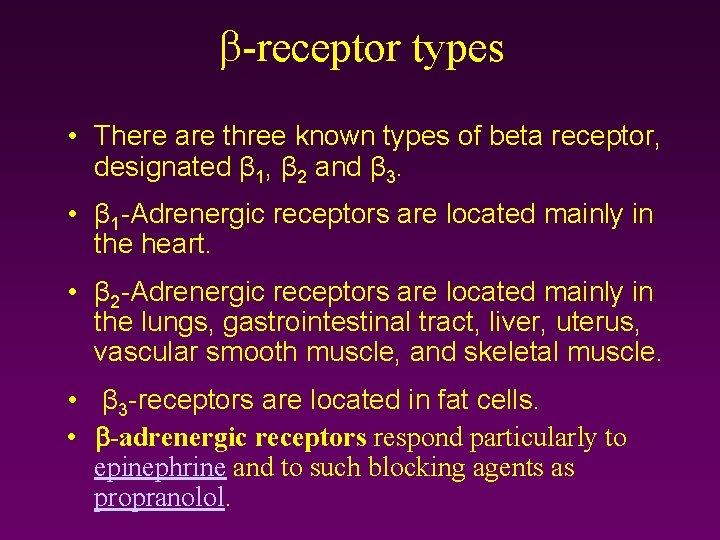
-receptor types • There are three known types of beta receptor, designated β 1, β 2 and β 3. • β 1 -Adrenergic receptors are located mainly in the heart. • β 2 -Adrenergic receptors are located mainly in the lungs, gastrointestinal tract, liver, uterus, vascular smooth muscle, and skeletal muscle. • β 3 -receptors are located in fat cells. • -adrenergic receptors respond particularly to epinephrine and to such blocking agents as propranolol.
Neurotransmitters and Receptors
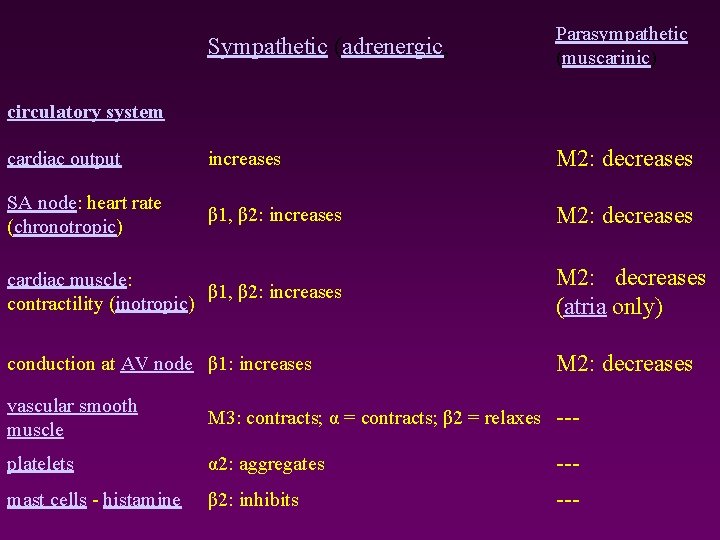
Sympathetic (adrenergic, Parasympathetic (muscarinic) cardiac output increases M 2: decreases SA node: heart rate (chronotropic) β 1, β 2: increases M 2: decreases circulatory system cardiac muscle: β 1, β 2: increases contractility (inotropic) M 2: decreases (atria only) conduction at AV node β 1: increases M 2: decreases vascular smooth muscle M 3: contracts; α = contracts; β 2 = relaxes --- platelets α 2: aggregates mast cells - histamine β 2: inhibits -----
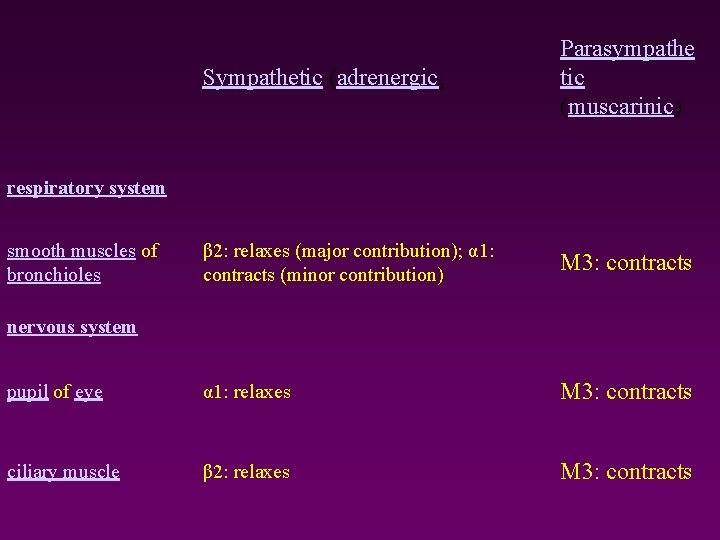
Sympathetic (adrenergic, Parasympathe tic (muscarinic) β 2: relaxes (major contribution); α 1: contracts (minor contribution) M 3: contracts pupil of eye α 1: relaxes M 3: contracts ciliary muscle β 2: relaxes M 3: contracts respiratory system smooth muscles of bronchioles nervous system
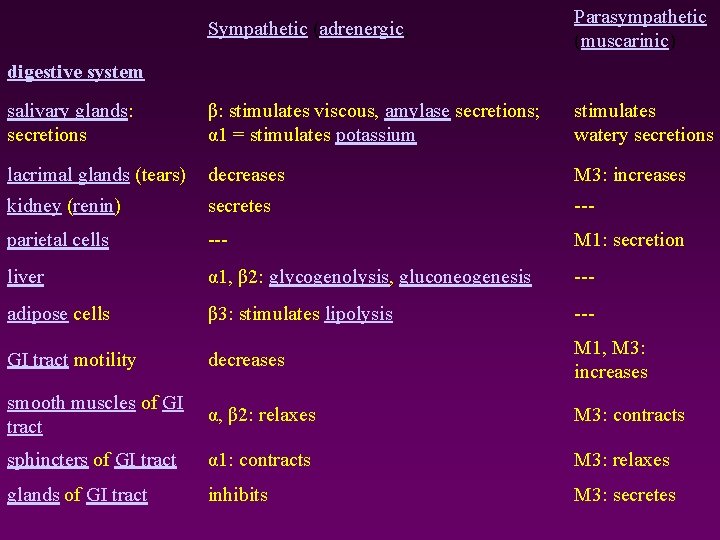
Sympathetic (adrenergic, Parasympathetic (muscarinic) salivary glands: secretions β: stimulates viscous, amylase secretions; α 1 = stimulates potassium stimulates watery secretions lacrimal glands (tears) decreases M 3: increases kidney (renin) secretes --- parietal cells --- M 1: secretion liver α 1, β 2: glycogenolysis, gluconeogenesis --- adipose cells β 3: stimulates lipolysis --- GI tract motility decreases M 1, M 3: increases smooth muscles of GI tract α, β 2: relaxes M 3: contracts sphincters of GI tract α 1: contracts M 3: relaxes glands of GI tract inhibits M 3: secretes digestive system
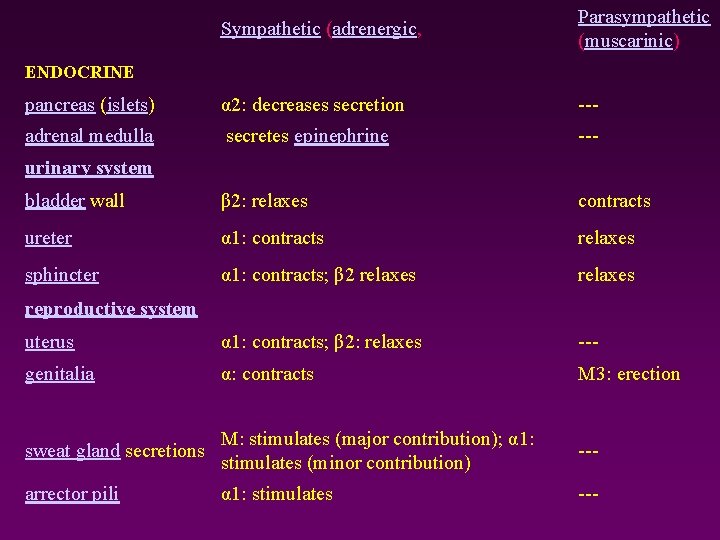
Sympathetic (adrenergic, Parasympathetic (muscarinic) pancreas (islets) α 2: decreases secretion --- adrenal medulla secretes epinephrine --- bladder wall β 2: relaxes contracts ureter α 1: contracts relaxes sphincter α 1: contracts; β 2 relaxes uterus α 1: contracts; β 2: relaxes --- genitalia α: contracts M 3: erection sweat gland secretions M: stimulates (major contribution); α 1: stimulates (minor contribution) --- arrector pili α 1: stimulates --- ENDOCRINE urinary system reproductive system
Summary
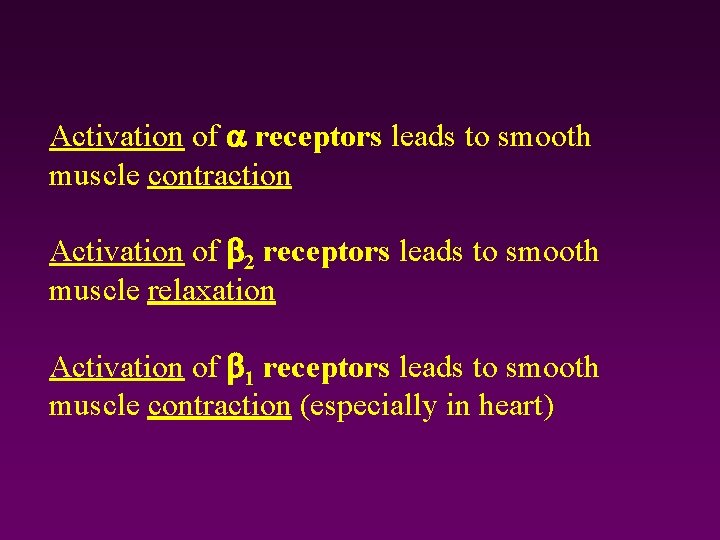
Activation of receptors leads to smooth muscle contraction Activation of 2 receptors leads to smooth muscle relaxation Activation of 1 receptors leads to smooth muscle contraction (especially in heart)
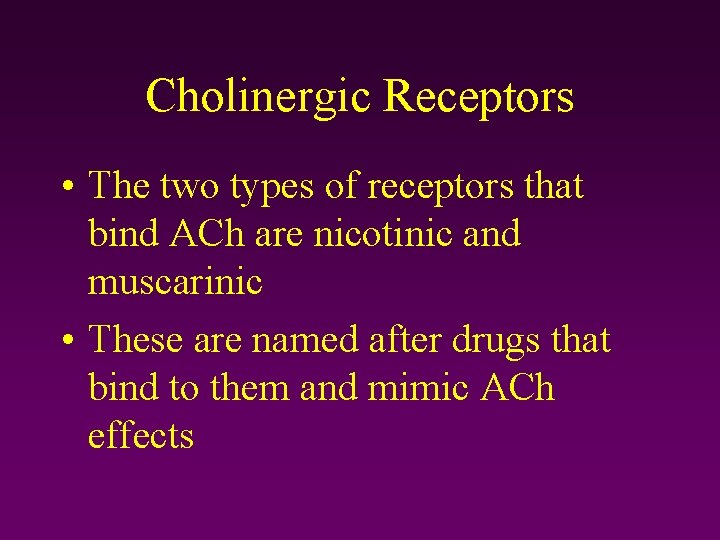
Cholinergic Receptors • The two types of receptors that bind ACh are nicotinic and muscarinic • These are named after drugs that bind to them and mimic ACh effects
Nicotinic Receptors • Nicotinic receptors are found on: – Motor end plates (somatic targets) – All ganglionic neurons of both sympathetic and parasympathetic divisions – The hormone-producing cells of the adrenal medulla • The effect of ACh binding to nicotinic receptors is always stimulatory
Muscarinic Receptors • Muscarinic receptors occur on all effector cells stimulated by postganglionic cholinergic fibers • The effect of ACh binding: – Can be either inhibitory or excitatory – Depends on the receptor type of the target organ
Adrenergic Receptors • The two types of adrenergic receptors are alpha and beta • Effects of NE binding to: – receptors is generally stimulatory – receptors is generally inhibitory • A notable exception – NE binding to receptors of the heart is stimulatory
Dual Innervation • Most of viscera receive nerve fibers from both parasympathetic and sympathetic divisions • Both divisions do not normally innervate an organ equally