
LECHATELIERS PRINCIPLE There are ways to control equilibrium
LECHATELIER’S PRINCIPLE
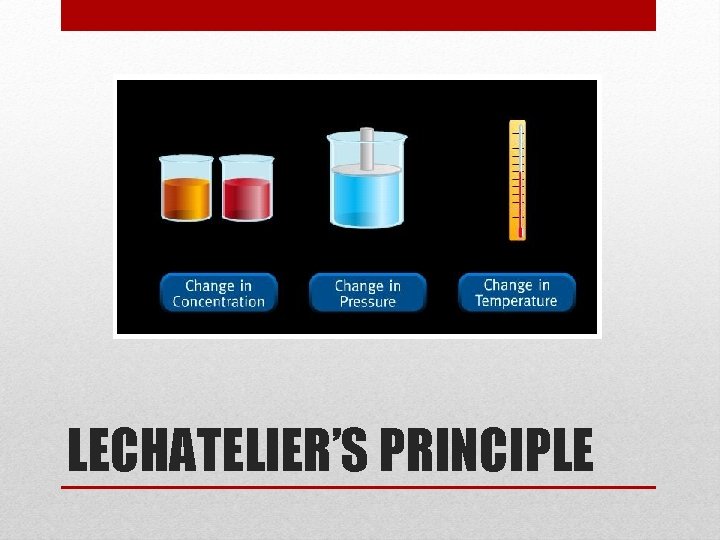
• There are ways to control equilibrium to make reactions more productive. • If a change in conditions is imposed on a system at equilibrium, the equilibrium position will shift in the direction that tends to reduce that change in conditions. • A STRESS is any kind of change in a system at equilibrium that upsets the equilibrium. • A reaction system will shift in the forward or reverse direction to “undo” the altering factor. LECHATELIER’S PRINCIPLE
STRESSES Concentration Pressure Temperature ANIMATION LECHATELIER’S PRINCIPLE
• If you add more of a reactant, the reaction will proceed to the right. • If you add more of a product, the reaction will proceed to the left. • If a substance is removed, its concentration decreases. The reaction will return to equilibrium by producing more of the substance that was removed. **The position of equilibrium shifts, the equilibrium constant, Keq, does not. CONCENTRATION
WHY? • Adding a substance to a system at equilibrium drives the system to consume that substance. • Removing a substance from a system at equilibrium drives the system to produce more of that substance. CONCENTRATION
• In gaseous systems, changing the pressure can shift the reaction backwards or forwards – it all depends on the number of moles on each side of the reaction. • If you increase the pressure of the system, the system will shift to reduce that pressure by proceeding in the direction that produces the fewer molecules. PRESSURE (AND VOLUME)
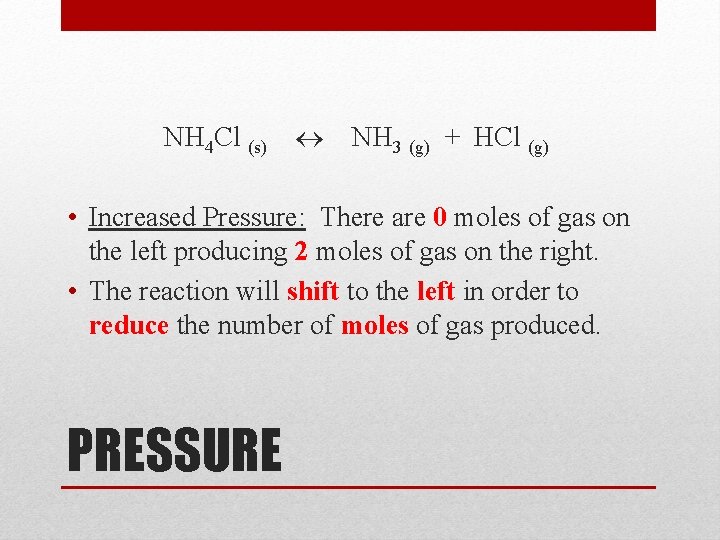
NH 4 Cl (s) NH 3 (g) + HCl (g) • Increased Pressure: There are 0 moles of gas on the left producing 2 moles of gas on the right. • The reaction will shift to the left in order to reduce the number of moles of gas produced. PRESSURE
• If there is the same number of moles on both sides of a reaction in equilibrium, there will be no shift in equilibrium if pressure is added. • Pressure only affects gases, not solids and liquids. • Remember, if you change volume, you change pressure. **The position of equilibrium shifts, the equilibrium constant does not. PRESSURE

• The position of the equilibrium shifts AND Keq changes in value. • When determining what the temperature will do, you have to know if the reaction is exothermic (gives off heat) or endothermic (takes in heat). • Keq is a measure of the extent to which the reaction proceeds. TEMPERATURE
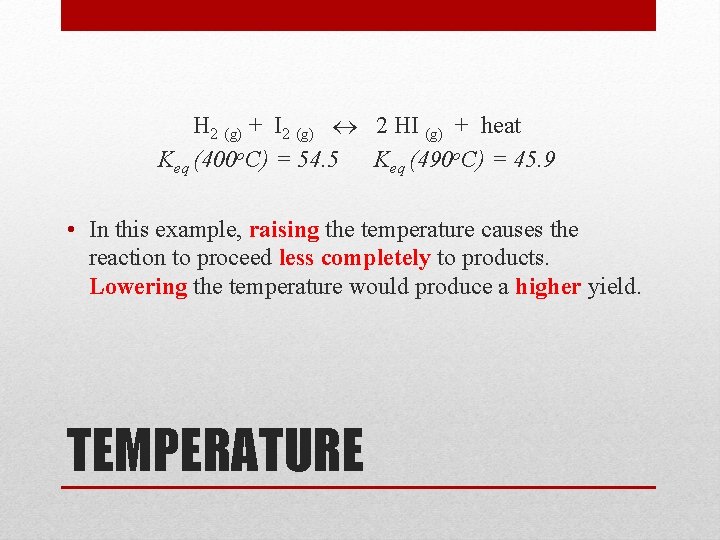
H 2 (g) + I 2 (g) 2 HI (g) + heat Keq (400 o. C) = 54. 5 Keq (490 o. C) = 45. 9 • In this example, raising the temperature causes the reaction to proceed less completely to products. Lowering the temperature would produce a higher yield. TEMPERATURE

• If heat is added to a system that is exothermic in the forward direction, the reaction tends to reestablish equilibrium by consuming the additional heat through the reverse (endothermic) reaction. Heat + NH 4 Cl (s) NH 3 (g) + HCl (g) • In this reaction, raising the temperature will shift the reaction in the forward direction and lowering the temperature will shift it in the reverse direction. TEMPERATURE

• Use the equation to solve the problems: 4 HCl + O 2 + heat 2 Cl 2 + 2 H 2 O A. Temperature increases. The reaction will shift _______ and favor the formation of _____ B. Cl 2 is removed as it is formed. The reaction will shift _______ and favor the formation of _____ C. The pressure is increased. The reaction will shift _______ and favor the formation of _____ D. H 2 O is added. The reaction will shift _______ and favor the formation of _____. PRACTICE

• Fritz Haber studied the reaction of gaseous nitrogen and gaseous hydrogen to form ammonia. 3 H 2 (g) + N 2 (g) NH 3 (g) + heat THE HABER PROCESS
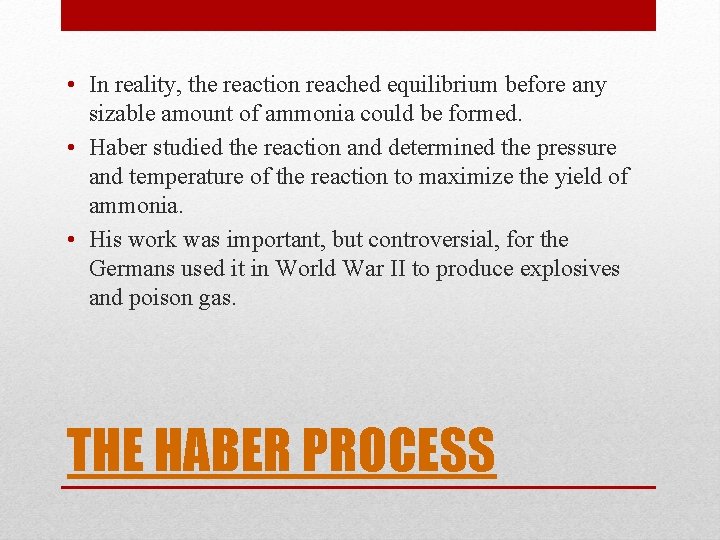
• In reality, the reaction reached equilibrium before any sizable amount of ammonia could be formed. • Haber studied the reaction and determined the pressure and temperature of the reaction to maximize the yield of ammonia. • His work was important, but controversial, for the Germans used it in World War II to produce explosives and poison gas. THE HABER PROCESS
- Slides: 14