
Lec 4 Friday 17 Feb potential and eqs
Lec 4, Friday 17 Feb • potential and eqs. of motion – in general geometry – Axisymmetric – spherical
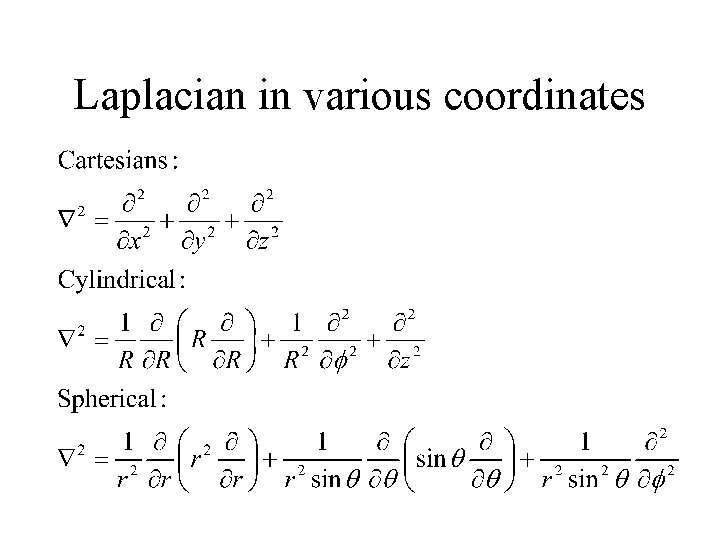
Laplacian in various coordinates
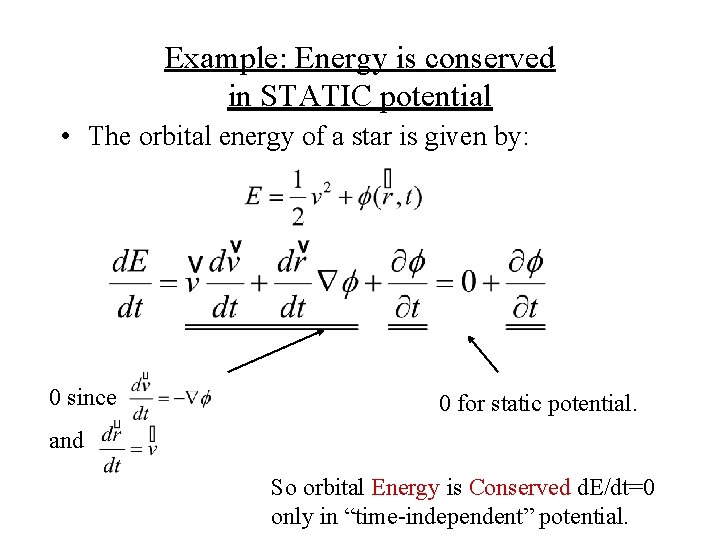
Example: Energy is conserved in STATIC potential • The orbital energy of a star is given by: 0 since 0 for static potential. and So orbital Energy is Conserved d. E/dt=0 only in “time-independent” potential.
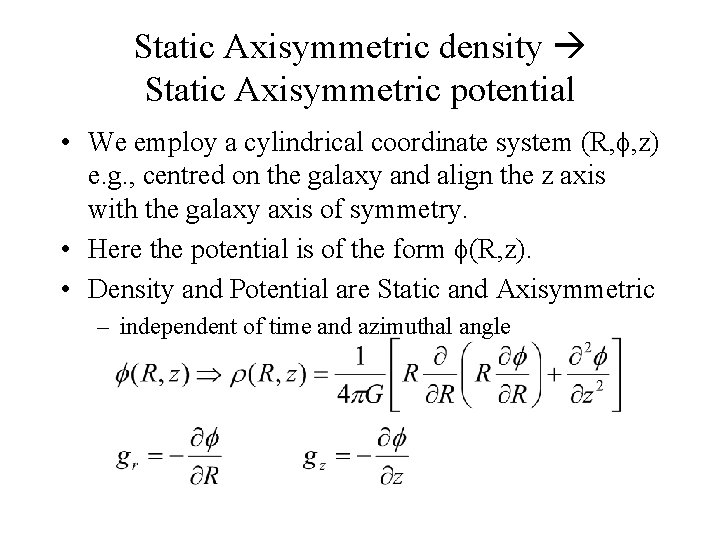
Static Axisymmetric density Static Axisymmetric potential • We employ a cylindrical coordinate system (R, , z) e. g. , centred on the galaxy and align the z axis with the galaxy axis of symmetry. • Here the potential is of the form (R, z). • Density and Potential are Static and Axisymmetric – independent of time and azimuthal angle
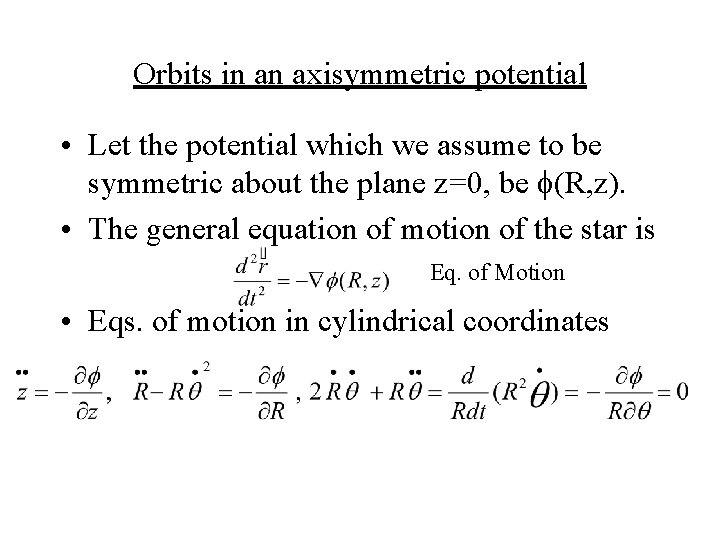
Orbits in an axisymmetric potential • Let the potential which we assume to be symmetric about the plane z=0, be (R, z). • The general equation of motion of the star is Eq. of Motion • Eqs. of motion in cylindrical coordinates
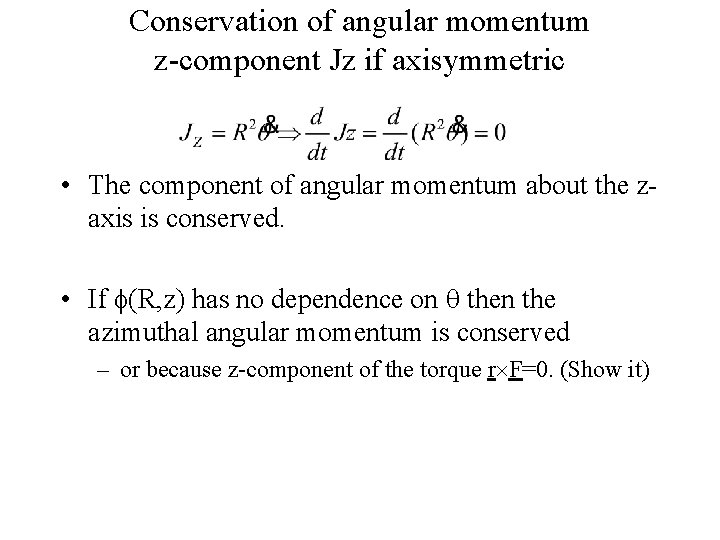
Conservation of angular momentum z-component Jz if axisymmetric • The component of angular momentum about the zaxis is conserved. • If (R, z) has no dependence on then the azimuthal angular momentum is conserved – or because z-component of the torque r F=0. (Show it)
Spherical Static System • Density, potential function of radius |r| only • Conservation of – energy E, – angular momentum J (all 3 -components) – Argue that a star moves orbit which confined to a plane perpendicular to J vector.
Spherical Cow Theorem • Most astronomical objects can be approximated as spherical. • Anyway non-spherical systems are too difficult to model, almost all models are spherical.
Globular: A nearly spherical static system
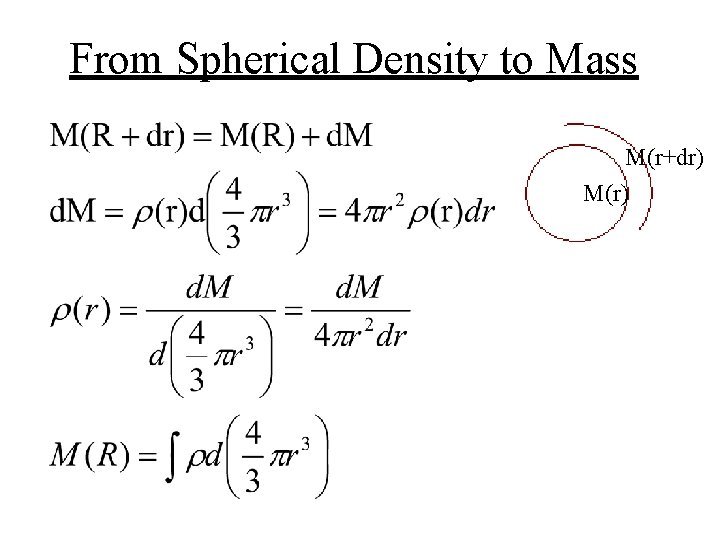
From Spherical Density to Mass M(r+dr) M(r)
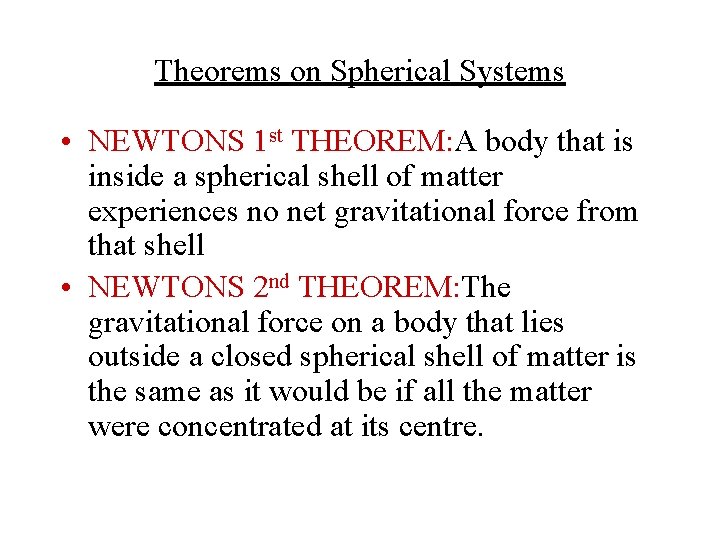
Theorems on Spherical Systems • NEWTONS 1 st THEOREM: A body that is inside a spherical shell of matter experiences no net gravitational force from that shell • NEWTONS 2 nd THEOREM: The gravitational force on a body that lies outside a closed spherical shell of matter is the same as it would be if all the matter were concentrated at its centre.

Poisson’s eq. in Spherical systems • Poisson’s eq. in a spherical potential with no θ or Φ dependence is:
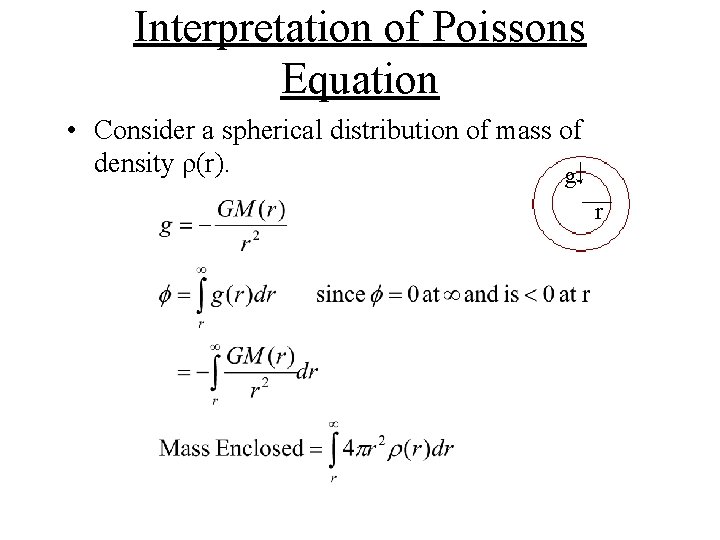
Interpretation of Poissons Equation • Consider a spherical distribution of mass of density ρ(r). g r
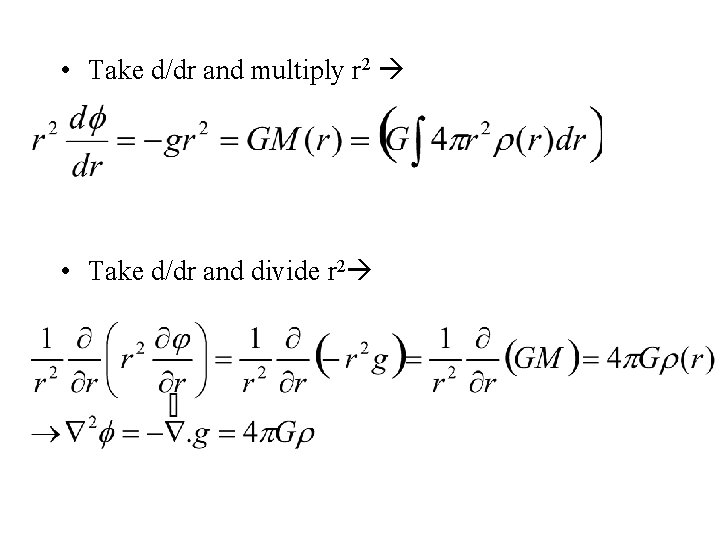
• Take d/dr and multiply r 2 • Take d/dr and divide r 2
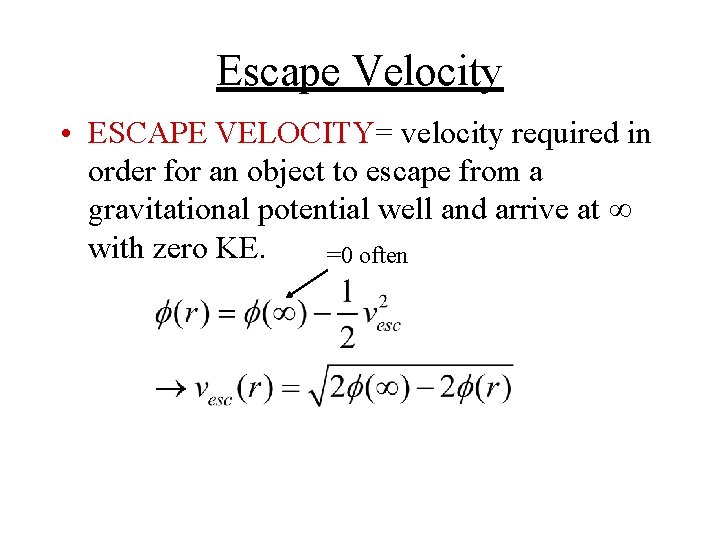
Escape Velocity • ESCAPE VELOCITY= velocity required in order for an object to escape from a gravitational potential well and arrive at with zero KE. =0 often
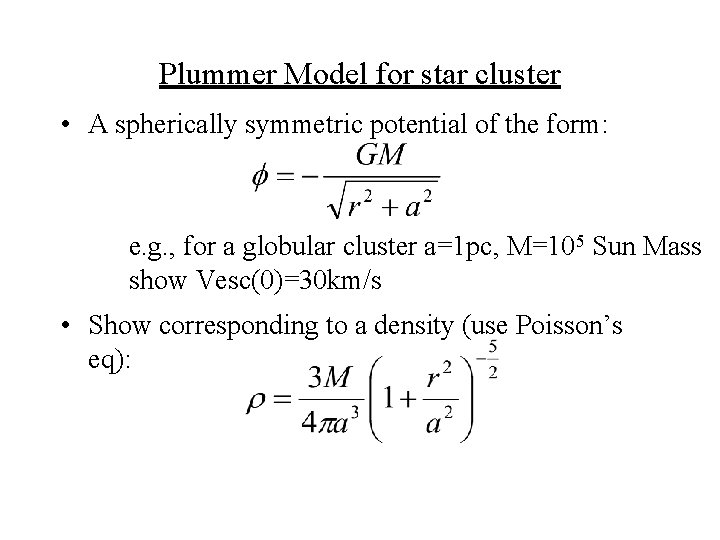
Plummer Model for star cluster • A spherically symmetric potential of the form: e. g. , for a globular cluster a=1 pc, M=105 Sun Mass show Vesc(0)=30 km/s • Show corresponding to a density (use Poisson’s eq):
What have we learned? • Conditions for conservation of orbital energy, angular momentum of a test particle • Meaning of escape velocity • How Poisson’s equation simplifies in cylindrical and spherical symmetries
Lec 5, Tue 21 Feb
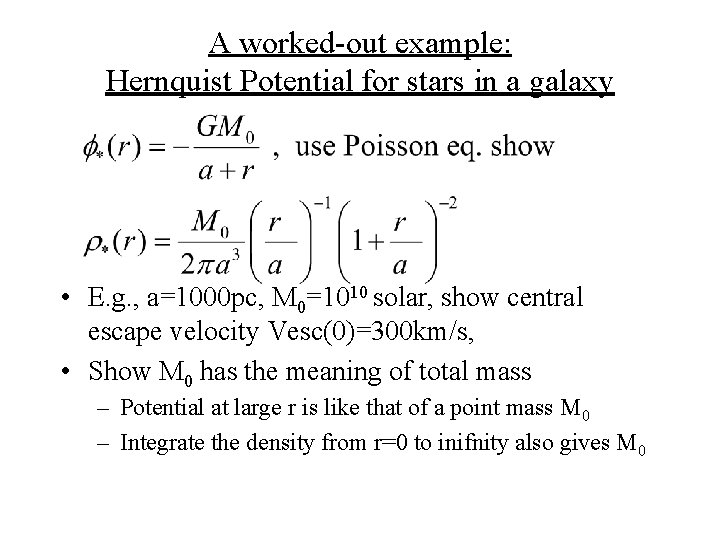
A worked-out example: Hernquist Potential for stars in a galaxy • E. g. , a=1000 pc, M 0=1010 solar, show central escape velocity Vesc(0)=300 km/s, • Show M 0 has the meaning of total mass – Potential at large r is like that of a point mass M 0 – Integrate the density from r=0 to inifnity also gives M 0
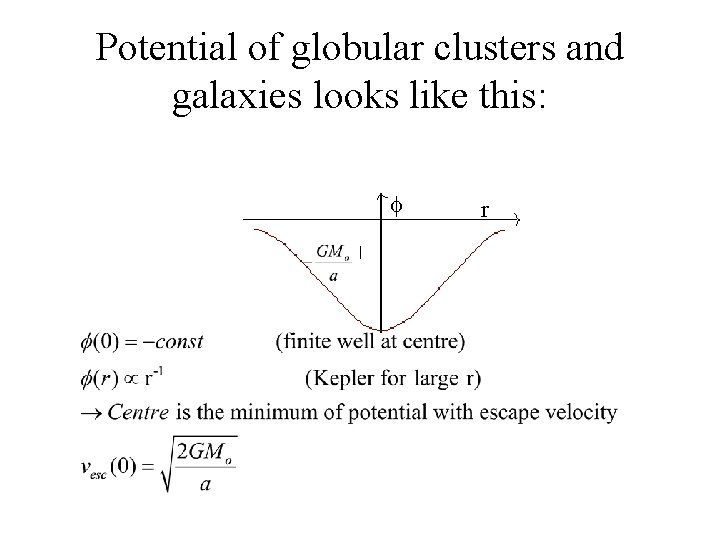
Potential of globular clusters and galaxies looks like this: r
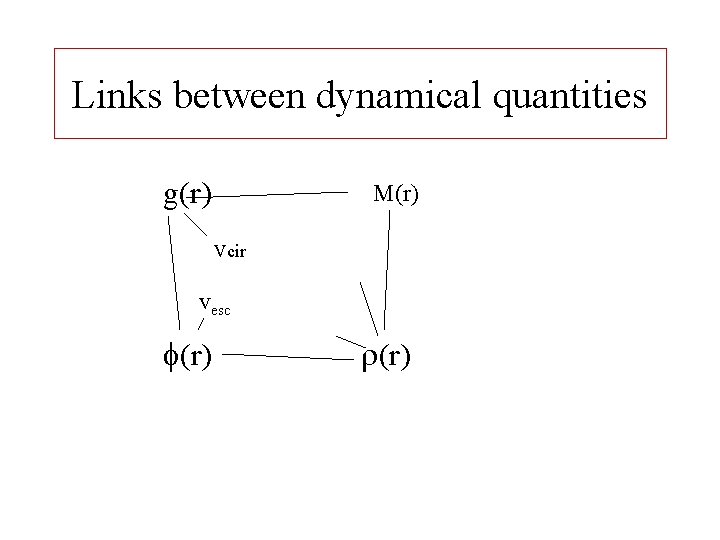
Links between dynamical quantities g(r) M(r) Vcir vesc (r)
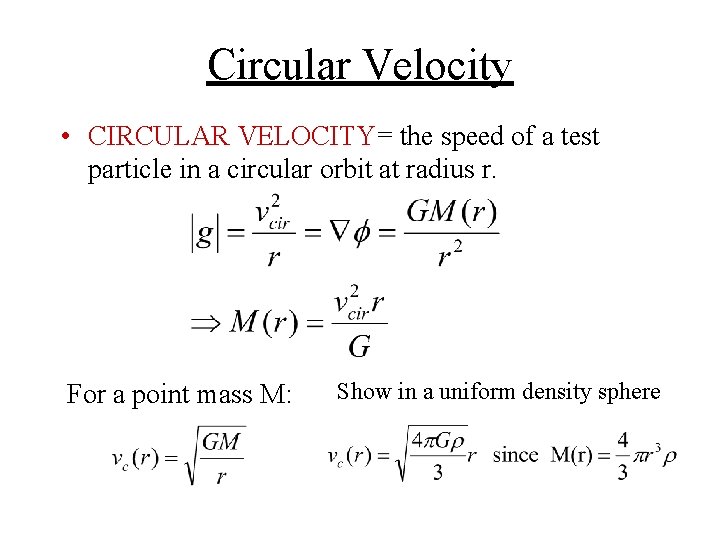
Circular Velocity • CIRCULAR VELOCITY= the speed of a test particle in a circular orbit at radius r. For a point mass M: Show in a uniform density sphere
What have we learned? • How to apply Poisson’s eq. • How to relate – Vesc with potential and – Vcir with gravity • The meanings of – the potential at very large radius, – The enclosed mass
Lec 6, Fri, 24 Feb
Motions in spherical potential
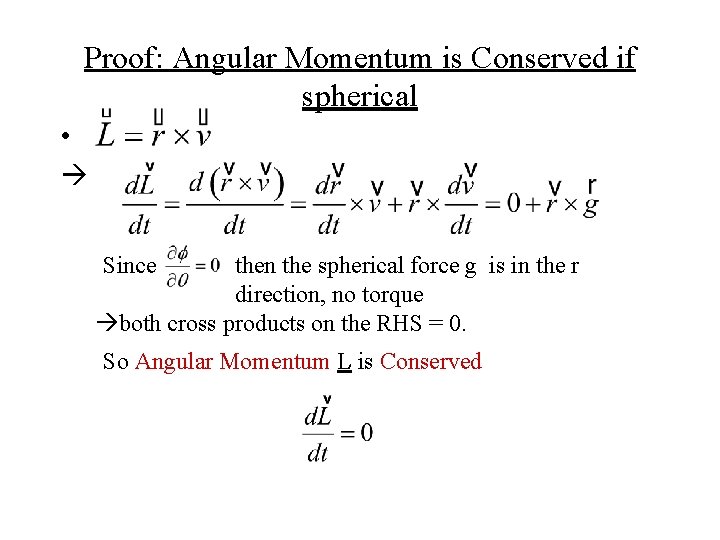
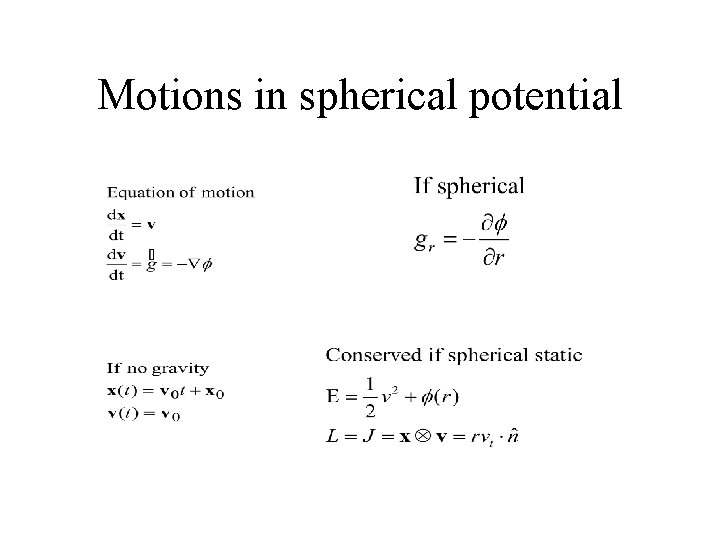
Proof: Angular Momentum is Conserved if spherical • Since then the spherical force g is in the r direction, no torque both cross products on the RHS = 0. So Angular Momentum L is Conserved
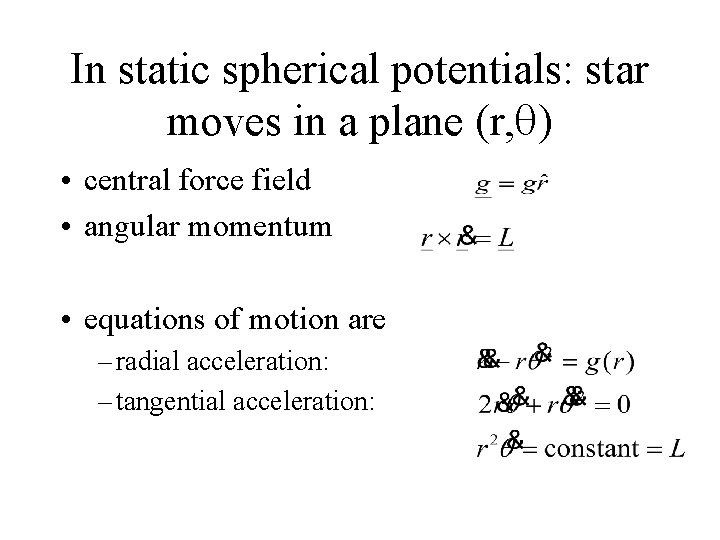
In static spherical potentials: star moves in a plane (r, ) • central force field • angular momentum • equations of motion are – radial acceleration: – tangential acceleration:
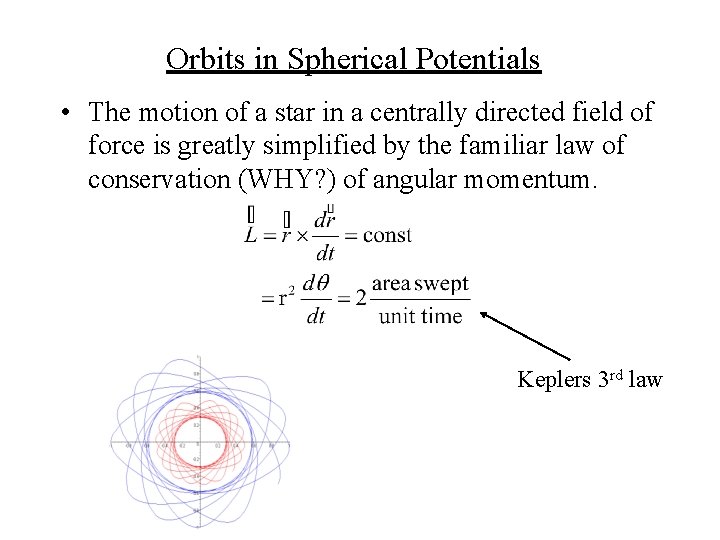
Orbits in Spherical Potentials • The motion of a star in a centrally directed field of force is greatly simplified by the familiar law of conservation (WHY? ) of angular momentum. Keplers 3 rd law
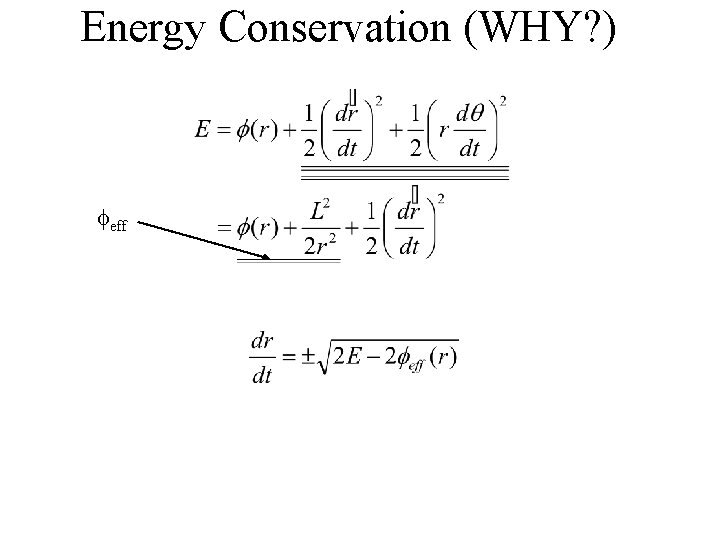
Energy Conservation (WHY? ) eff
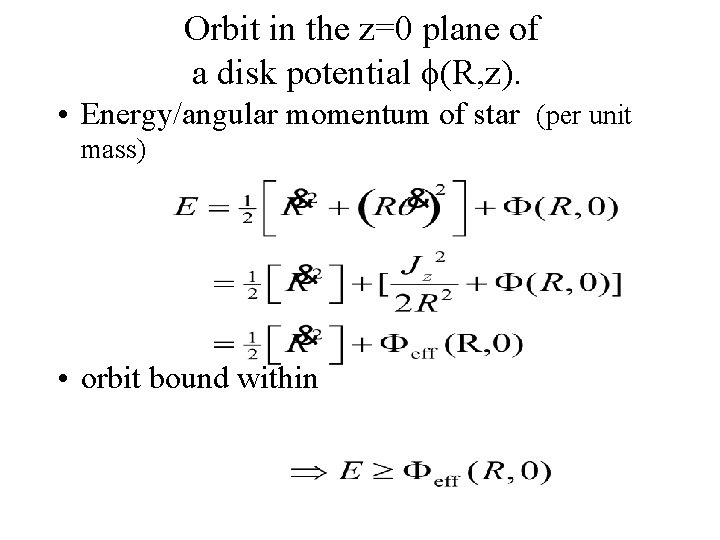
Orbit in the z=0 plane of a disk potential (R, z). • Energy/angular momentum of star (per unit mass) • orbit bound within
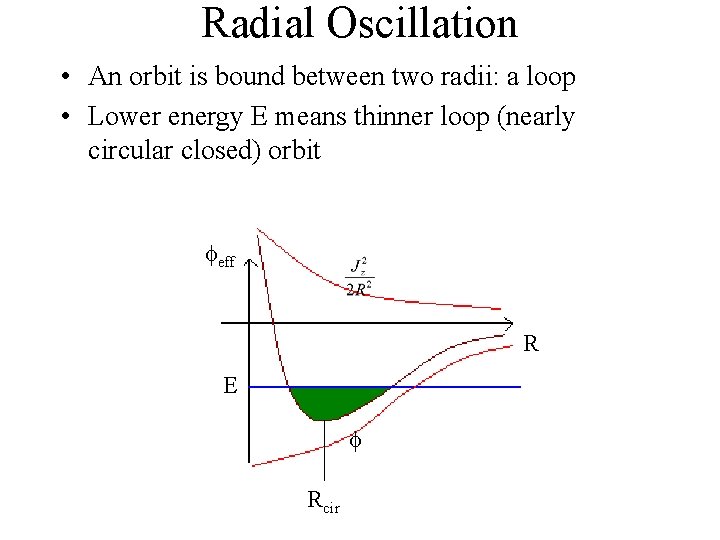
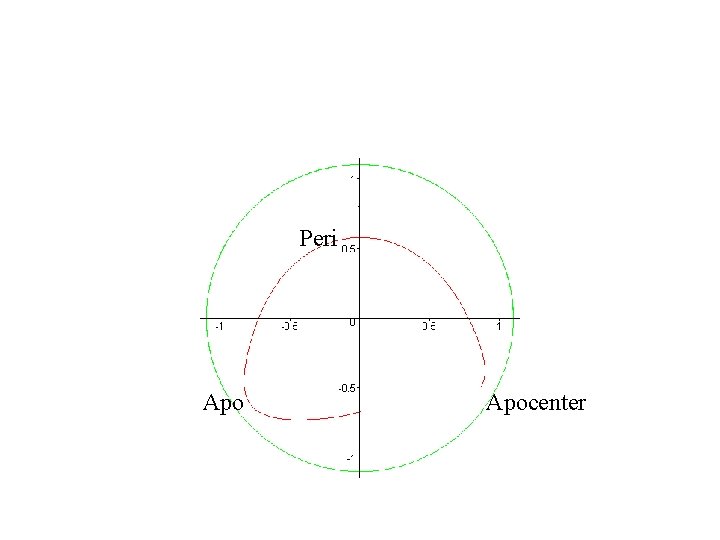
Radial Oscillation • An orbit is bound between two radii: a loop • Lower energy E means thinner loop (nearly circular closed) orbit eff R E Rcir
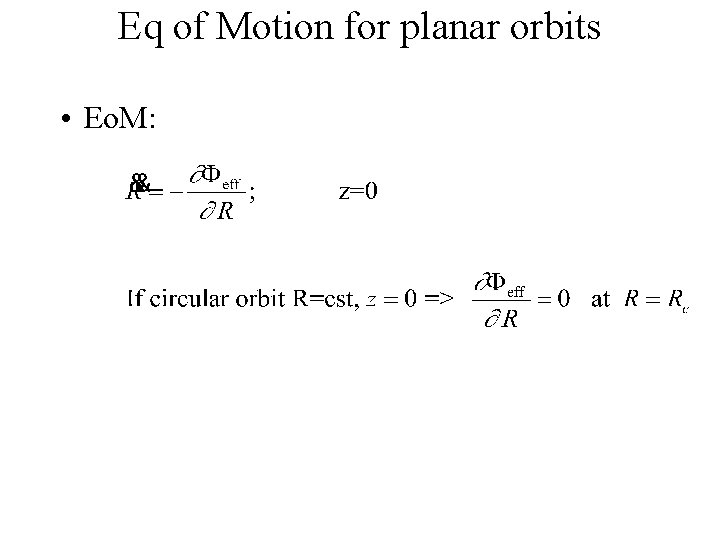
Eq of Motion for planar orbits • Eo. M:
Pericenter Apocenter
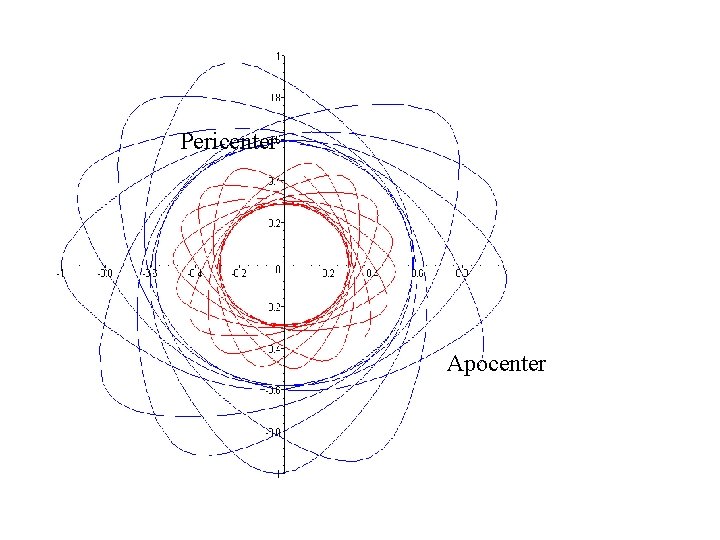
Peri Apocenter
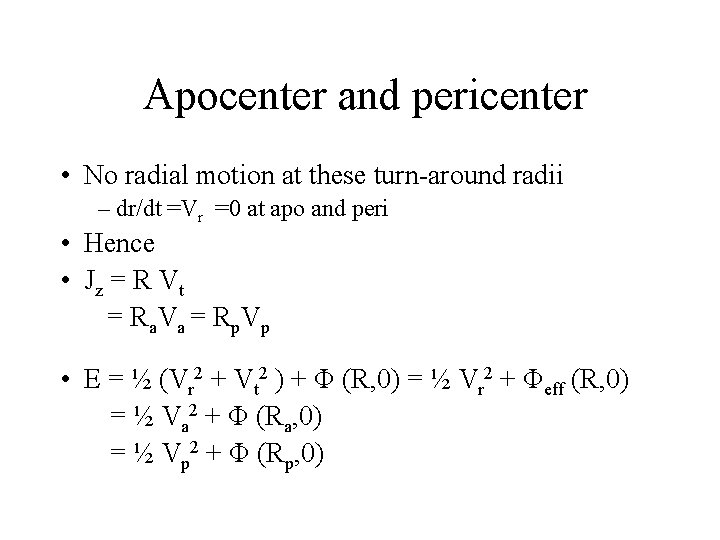
Apocenter and pericenter • No radial motion at these turn-around radii – dr/dt =Vr =0 at apo and peri • Hence • Jz = R Vt = R a V a = R p. V p • E = ½ (Vr 2 + Vt 2 ) + Φ (R, 0) = ½ Vr 2 + Φeff (R, 0) = ½ Va 2 + Φ (Ra, 0) = ½ Vp 2 + Φ (Rp, 0)
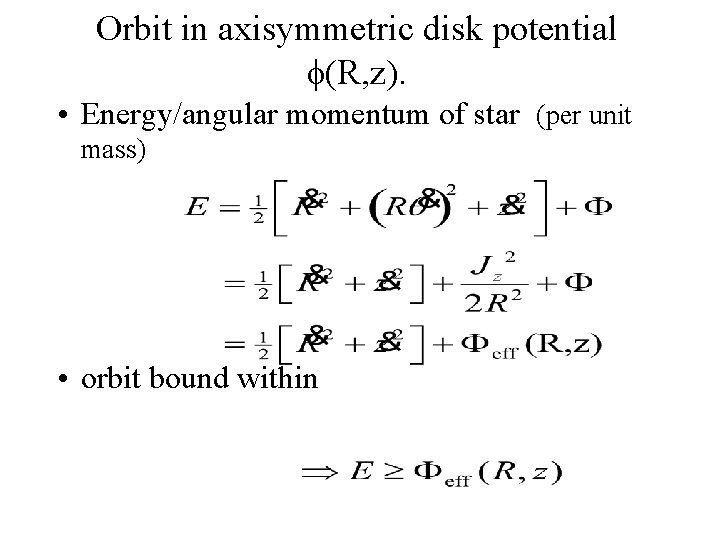
Orbit in axisymmetric disk potential (R, z). • Energy/angular momentum of star (per unit mass) • orbit bound within
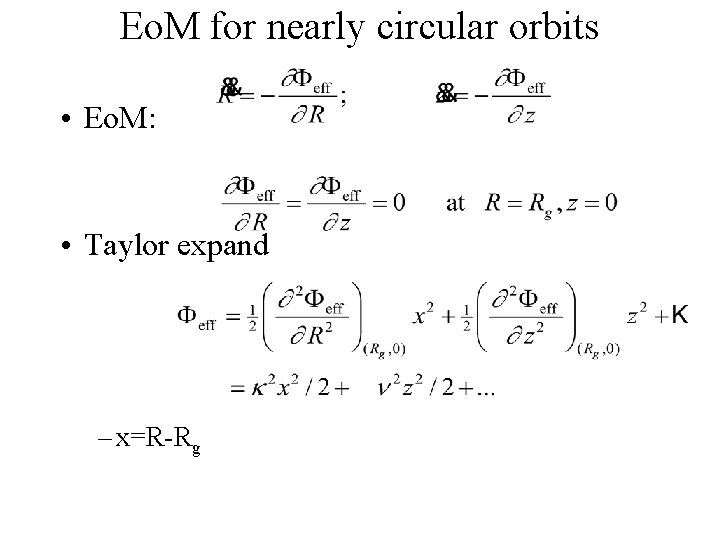
Eo. M for nearly circular orbits • Eo. M: • Taylor expand – x=R-Rg
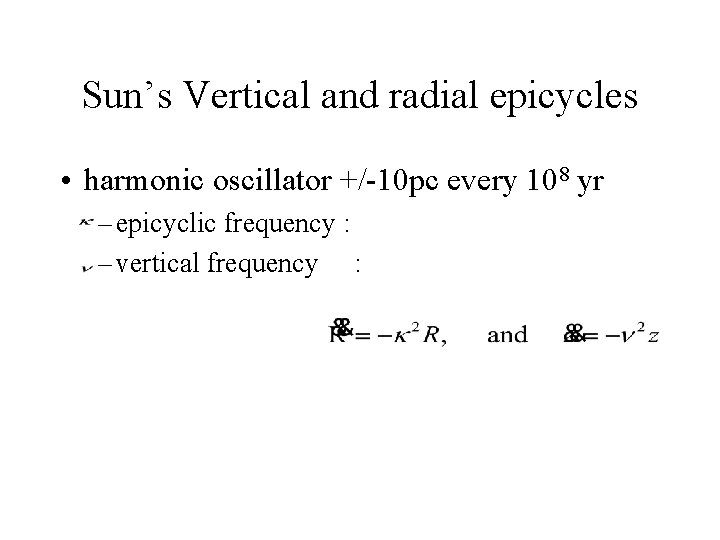
Sun’s Vertical and radial epicycles • harmonic oscillator +/-10 pc every 108 yr – epicyclic frequency : – vertical frequency :
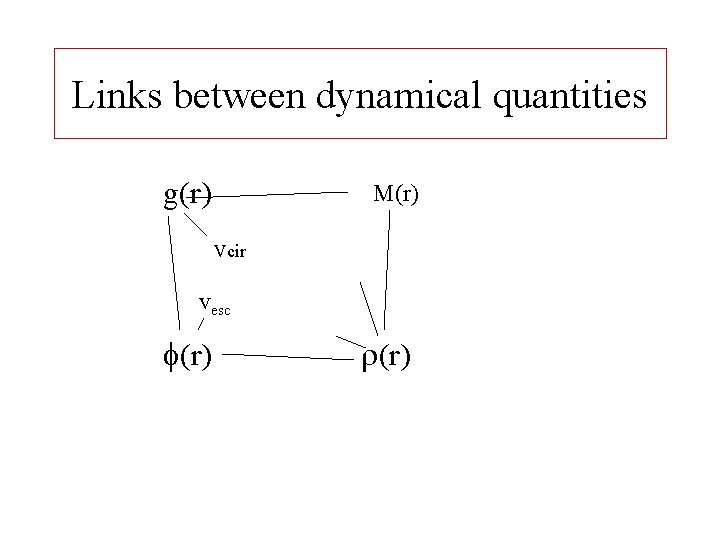
Links between dynamical quantities g(r) M(r) Vcir vesc (r)
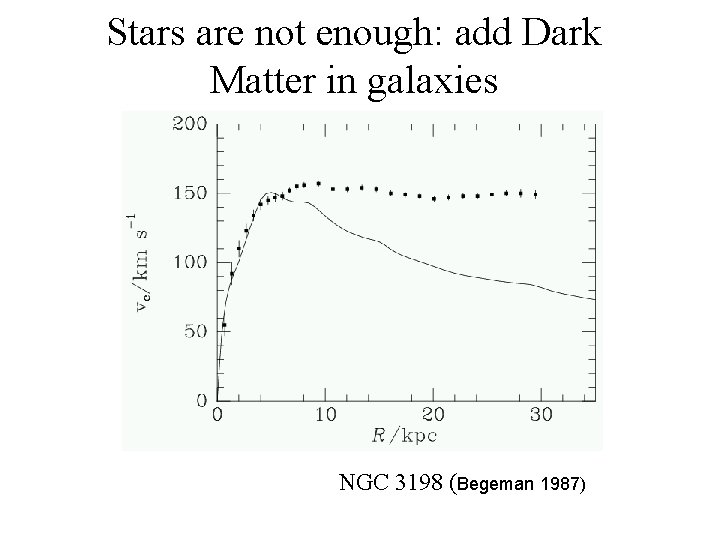
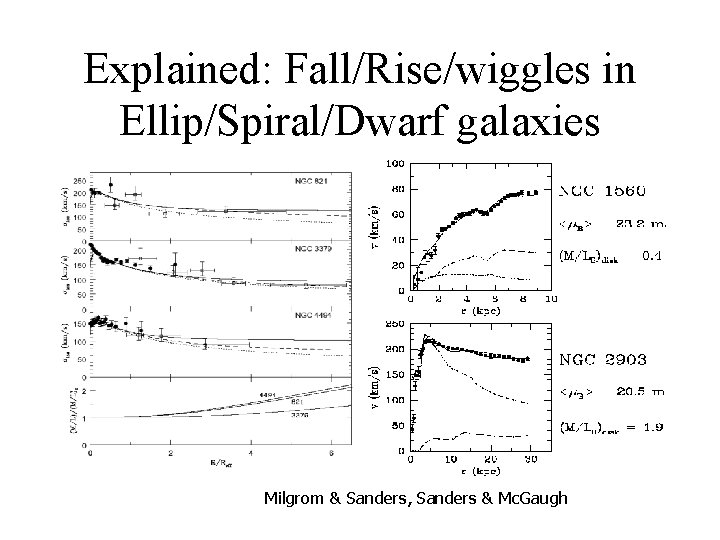
Stars are not enough: add Dark Matter in galaxies NGC 3198 (Begeman 1987)
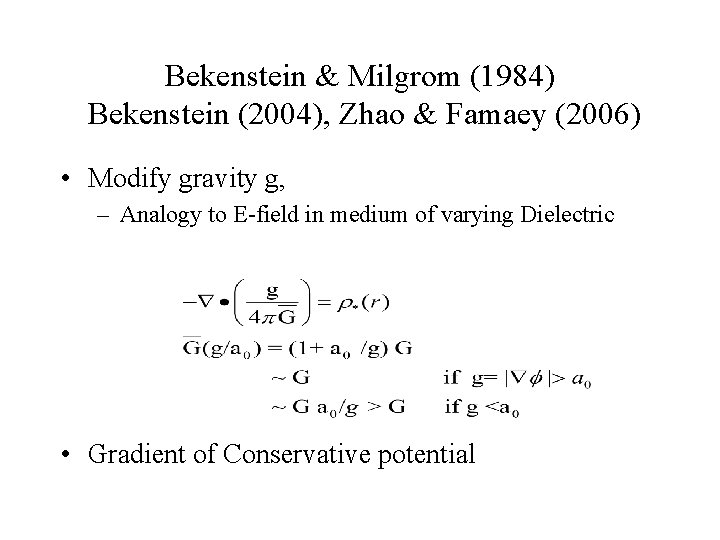
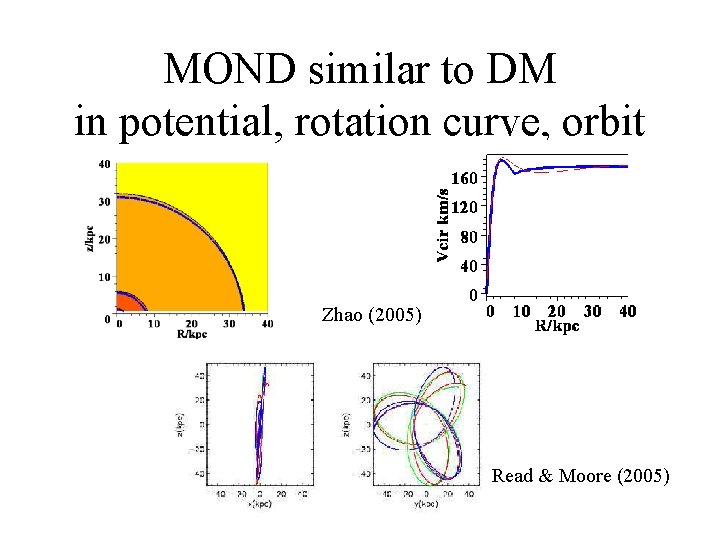
Bekenstein & Milgrom (1984) Bekenstein (2004), Zhao & Famaey (2006) • Modify gravity g, – Analogy to E-field in medium of varying Dielectric • Gradient of Conservative potential
MOND similar to DM in potential, rotation curve, orbit Zhao (2005) Read & Moore (2005)
Explained: Fall/Rise/wiggles in Ellip/Spiral/Dwarf galaxies Milgrom & Sanders, Sanders & Mc. Gaugh
What have we learned? • Orbits in a spherical potential or in the midplane of a disk potential • How to relate Pericentre, Apocentre through energy and angular momentum conservation. • Rotation curves of galaxies – Need for Dark Matter or a boosted gravity
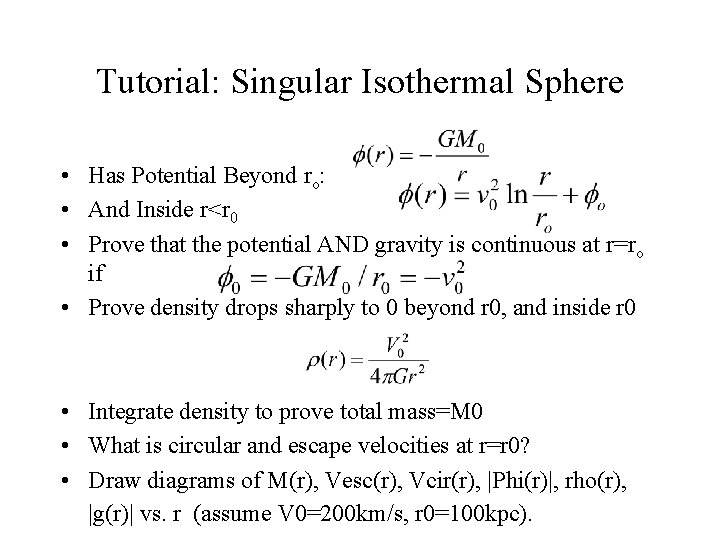
Tutorial: Singular Isothermal Sphere • Has Potential Beyond ro: • And Inside r<r 0 • Prove that the potential AND gravity is continuous at r=ro if • Prove density drops sharply to 0 beyond r 0, and inside r 0 • Integrate density to prove total mass=M 0 • What is circular and escape velocities at r=r 0? • Draw diagrams of M(r), Vesc(r), Vcir(r), |Phi(r)|, rho(r), |g(r)| vs. r (assume V 0=200 km/s, r 0=100 kpc).
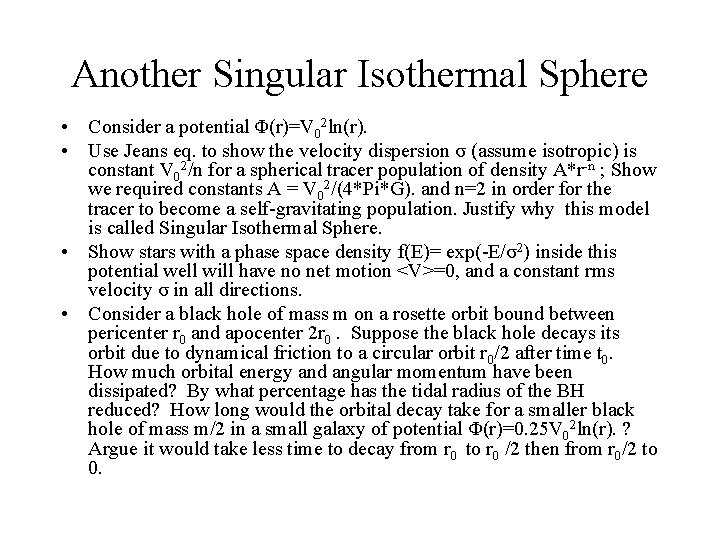
Another Singular Isothermal Sphere • Consider a potential Φ(r)=V 02 ln(r). • Use Jeans eq. to show the velocity dispersion σ (assume isotropic) is constant V 02/n for a spherical tracer population of density A*r-n ; Show we required constants A = V 02/(4*Pi*G). and n=2 in order for the tracer to become a self-gravitating population. Justify why this model is called Singular Isothermal Sphere. • Show stars with a phase space density f(E)= exp(-E/σ2) inside this potential well will have no net motion <V>=0, and a constant rms velocity σ in all directions. • Consider a black hole of mass m on a rosette orbit bound between pericenter r 0 and apocenter 2 r 0. Suppose the black hole decays its orbit due to dynamical friction to a circular orbit r 0/2 after time t 0. How much orbital energy and angular momentum have been dissipated? By what percentage has the tidal radius of the BH reduced? How long would the orbital decay take for a smaller black hole of mass m/2 in a small galaxy of potential Φ(r)=0. 25 V 02 ln(r). ? Argue it would take less time to decay from r 0 to r 0 /2 then from r 0/2 to 0.
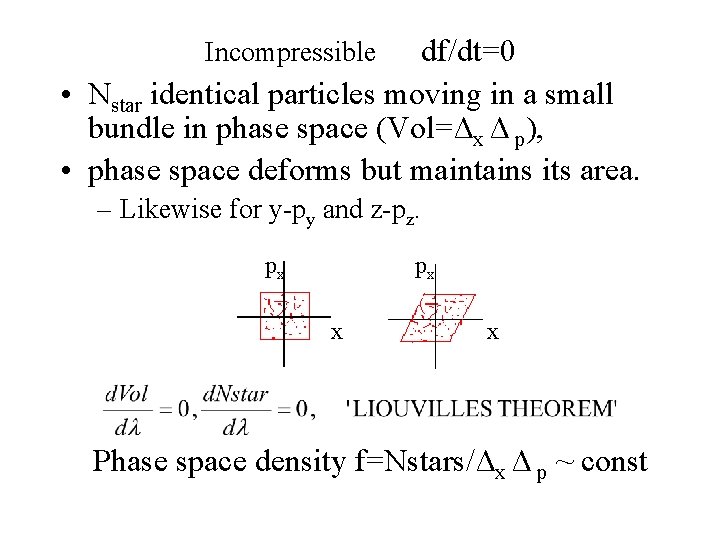
df/dt=0 • Nstar identical particles moving in a small bundle in phase space (Vol=Δx Δ p), • phase space deforms but maintains its area. Incompressible – Likewise for y-py and z-pz. px px x x Phase space density f=Nstars/Δx Δ p ~ const
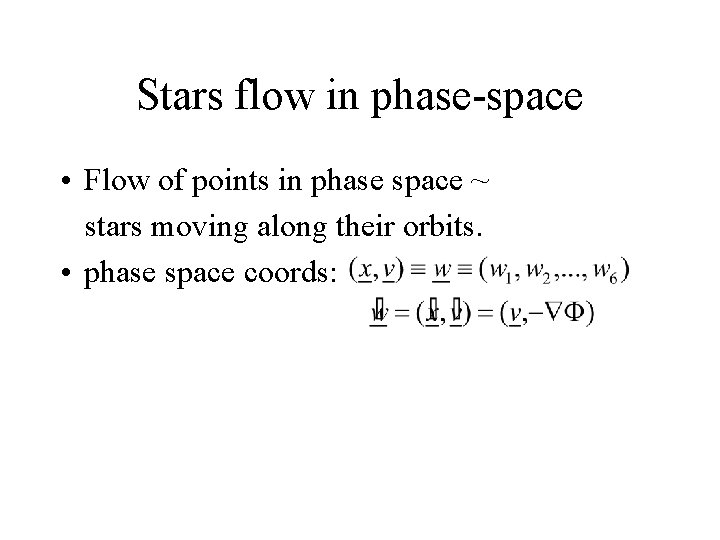
Stars flow in phase-space • Flow of points in phase space ~ stars moving along their orbits. • phase space coords:
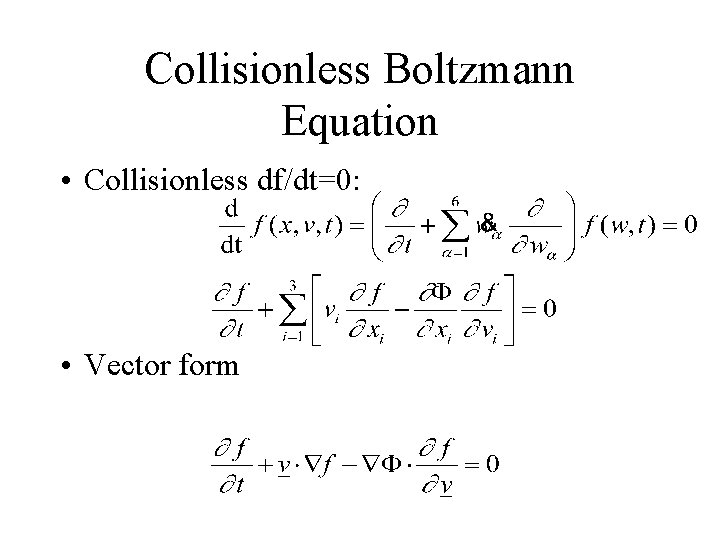
Collisionless Boltzmann Equation • Collisionless df/dt=0: • Vector form
- Slides: 49