
Lec 24 Rankine cycle reheat deviations efficiency increases

- Slides: 25
Lec 24: Rankine cycle reheat, deviations, efficiency increases, viscosity, introduction to fluid flow 1
An alternative: reheat • Reheat improves turbine efficiency • With reheat, we’ll run the steam through an initial stage of the turbine, then send it back to the boiler to be “reheated” • Reheat also increases the quality at the turbine exit and the average temperature of heat addition 2
Simple schematic of Rankine reheat cycle 3
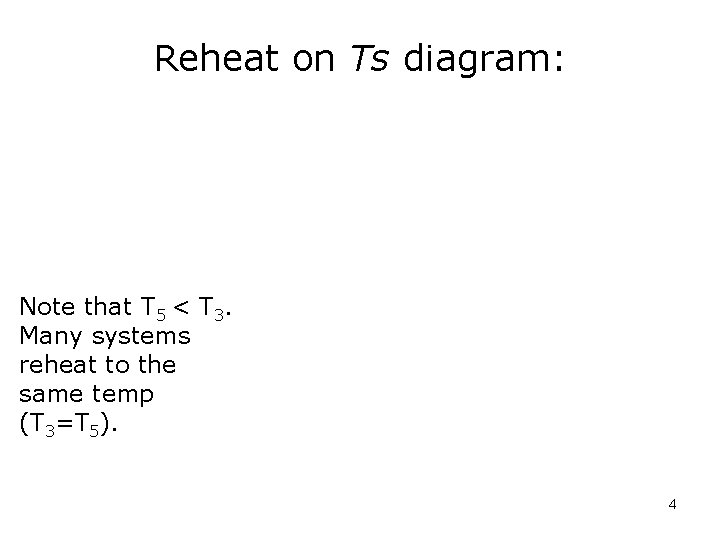
Reheat on Ts diagram: Note that T 5 < T 3. Many systems reheat to the same temp (T 3=T 5). 4
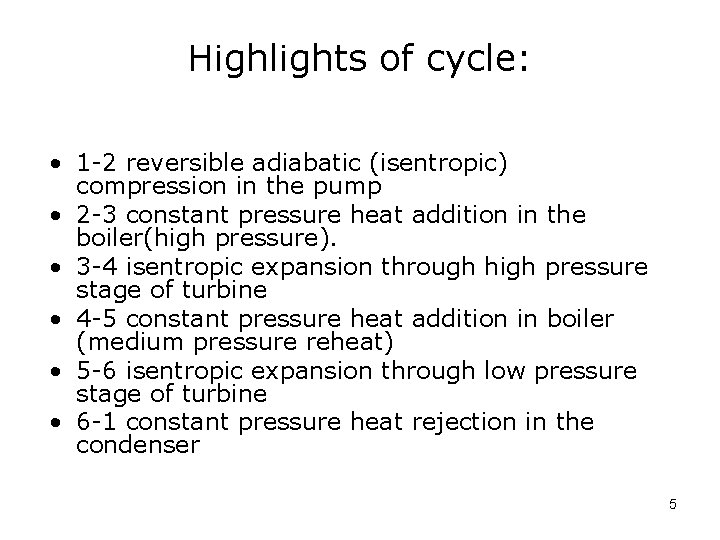
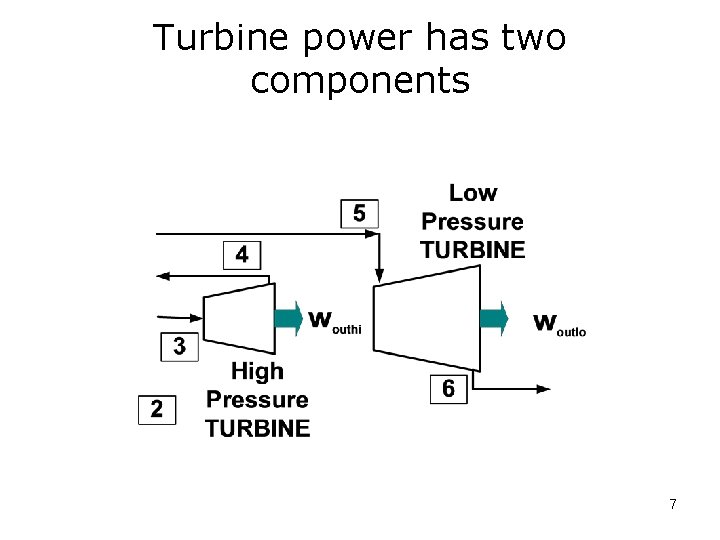
Highlights of cycle: • 1 -2 reversible adiabatic (isentropic) compression in the pump • 2 -3 constant pressure heat addition in the boiler(high pressure). • 3 -4 isentropic expansion through high pressure stage of turbine • 4 -5 constant pressure heat addition in boiler (medium pressure reheat) • 5 -6 isentropic expansion through low pressure stage of turbine • 6 -1 constant pressure heat rejection in the condenser 5
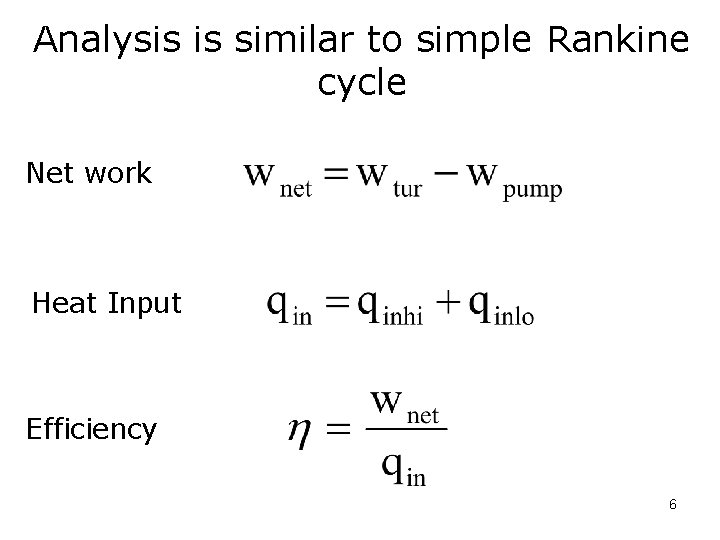
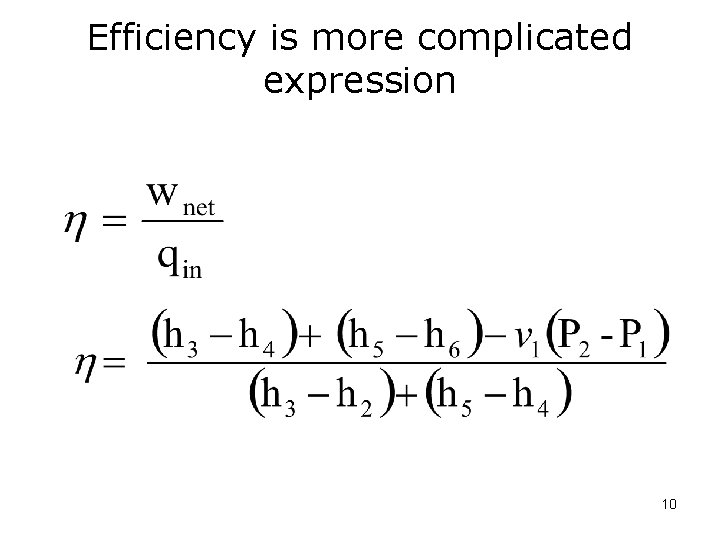
Analysis is similar to simple Rankine cycle Net work Heat Input Efficiency 6
Turbine power has two components 7
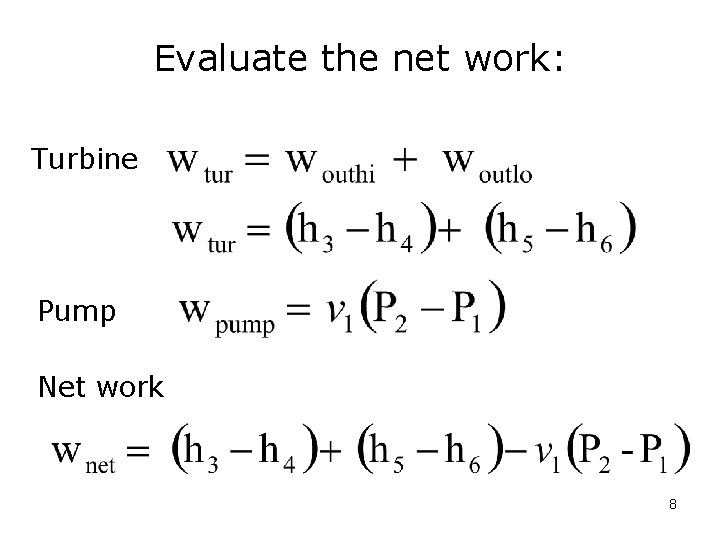
Evaluate the net work: Turbine Pump Net work 8
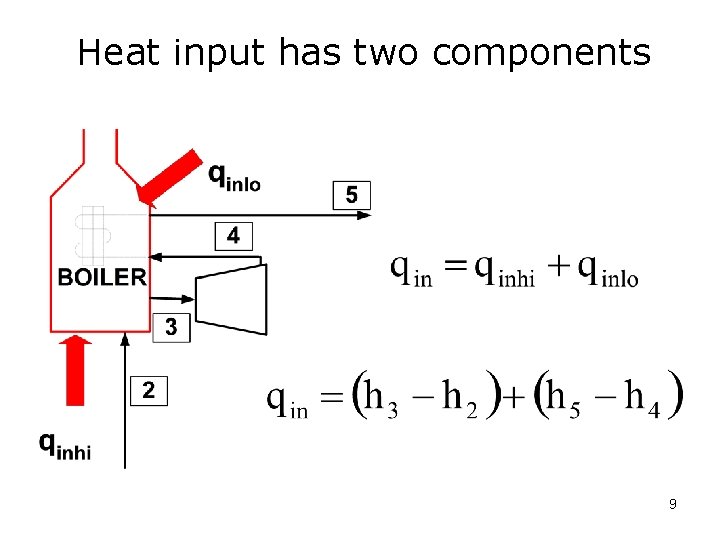
Heat input has two components 9
Efficiency is more complicated expression 10
TEAMPLAY Work problem 8 -114 11
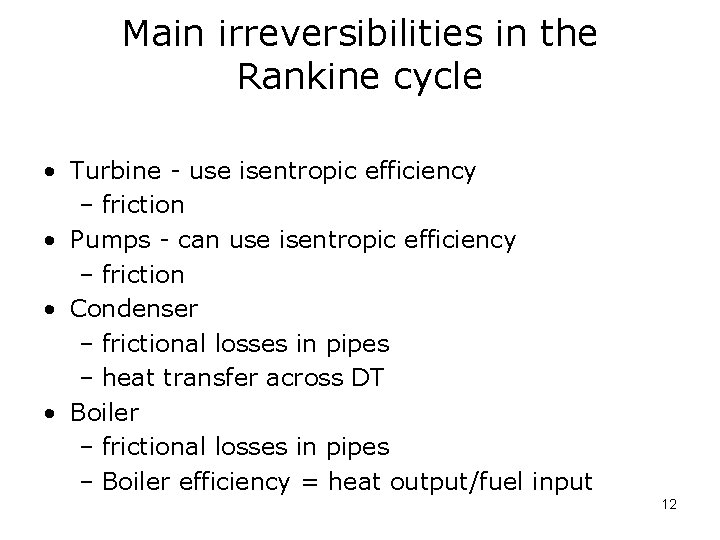
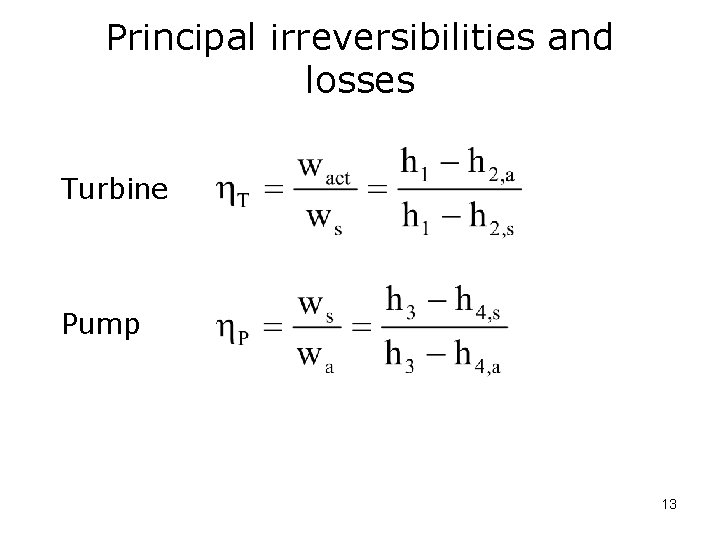
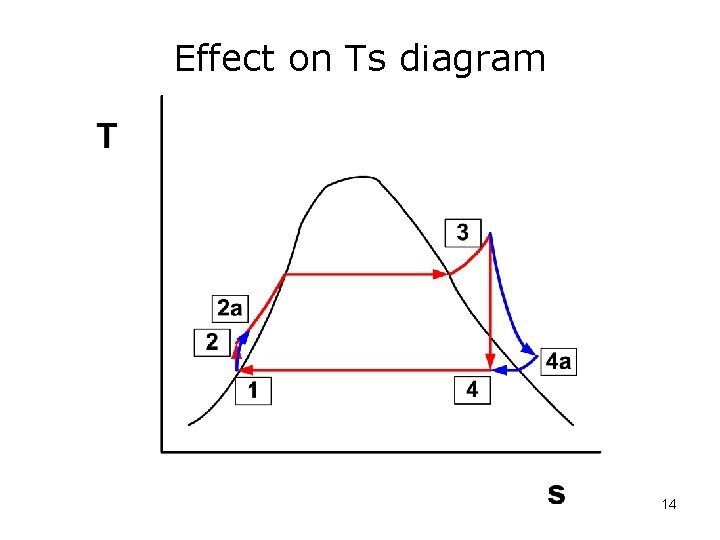
Main irreversibilities in the Rankine cycle • Turbine - use isentropic efficiency – friction • Pumps - can use isentropic efficiency – friction • Condenser – frictional losses in pipes – heat transfer across DT • Boiler – frictional losses in pipes – Boiler efficiency = heat output/fuel input 12
Principal irreversibilities and losses Turbine Pump 13
Effect on Ts diagram 14
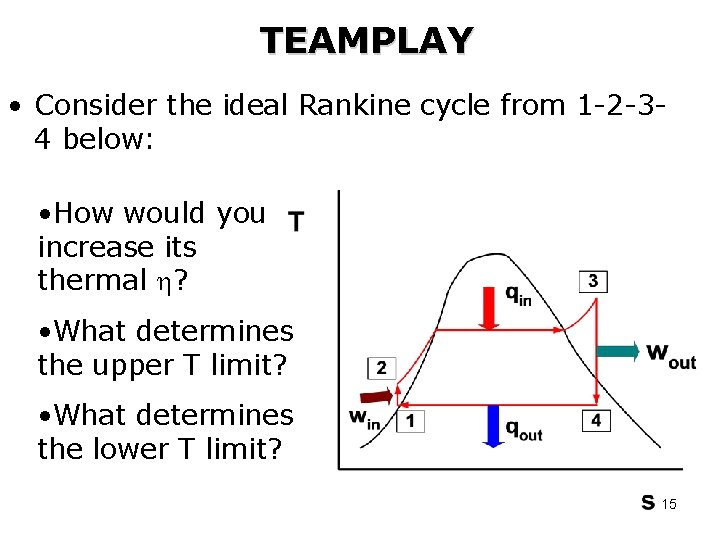
TEAMPLAY • Consider the ideal Rankine cycle from 1 -2 -34 below: • How would you increase its thermal ? • What determines the upper T limit? • What determines the lower T limit? 15
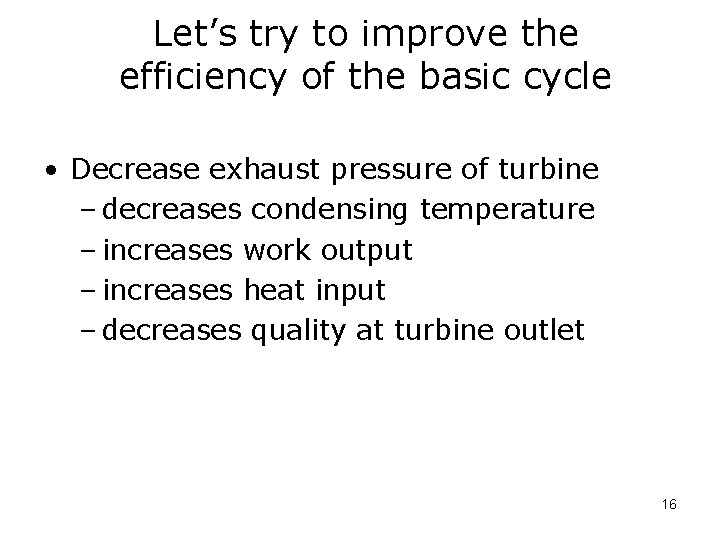
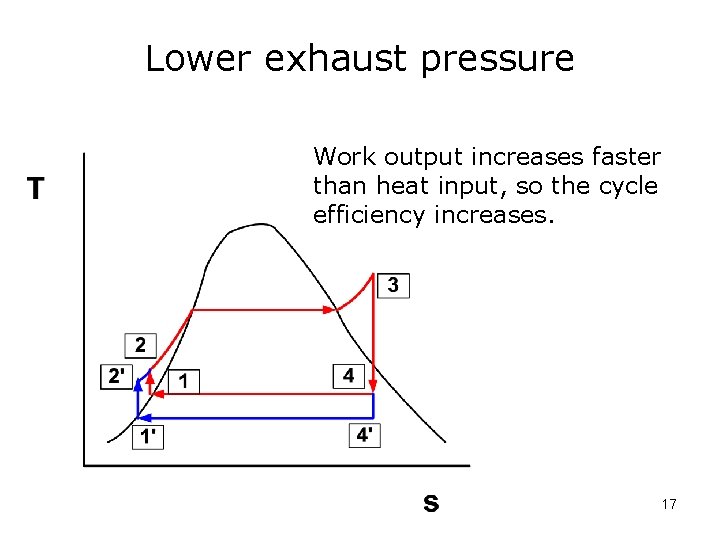
Let’s try to improve the efficiency of the basic cycle • Decrease exhaust pressure of turbine – decreases condensing temperature – increases work output – increases heat input – decreases quality at turbine outlet 16
Lower exhaust pressure Work output increases faster than heat input, so the cycle efficiency increases. 17
Increase steam superheat at boiler outlet • Increasing superheat – increases heat input – increases work output – increases quality at turbine outlet – may produce material problems if temperature gets too high 18
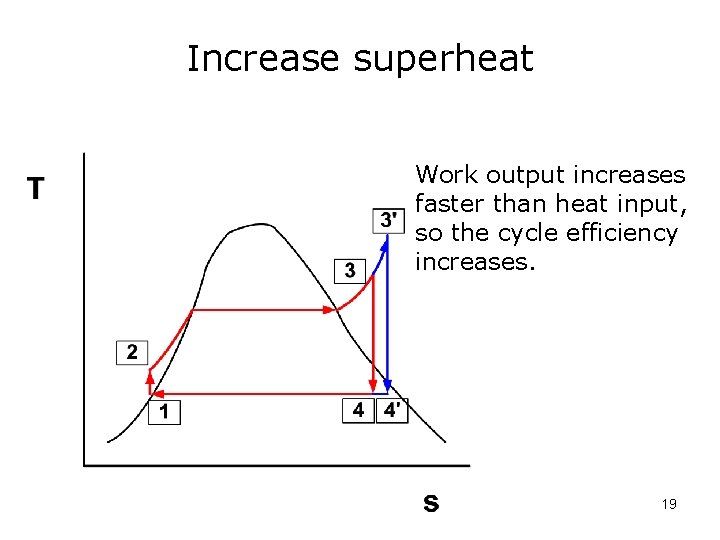
Increase superheat Work output increases faster than heat input, so the cycle efficiency increases. 19
Fluid mechanics definitions • Internal flow--the liquid is completely enclosed and wets all boundary surfaces. For example, flow in a garden hose or air conditioner duct. • External flow--the liquid is unbounded and flows over a wall or pipe or wing, for example. • Open-channel flow--The bounding surfaces are substantial but incomplete. This includes channel flow such as irrigation ditches and partially full pipes. 20
More definitions • Density variations of gases have been of concern. Liquids, on the other hand, have been treated as incompressible (v=constant). • It turns out that, at speeds up to Mach ~0. 3 for gases, density variations can be ignored. 21
TEAMPLAY • Why would the density of a gas change during a flow process? 22
More definitions • Flows where density variations are unimportant are called incompressible. • In this course all our flows for fluid mechanics purposes will be incompressible. 23
More definitions • A fluid moves by force or naturally. • In forced flow (aka forced convection) energy is added to the flow by a fan or pump or compressor that forces it to flow. • In natural flow (natural convection) natural forces such as gravity or buoyancy cause the fluid to flow. 24
Review definitions • Steady--not changing with time. • Uniform--not changing at a given location in a control volume. • Our flows will be steady and uniform. 25