
LEAVES daun The primary functions of leaves Photosyntesis
- Slides: 47
LEAVES (daun)
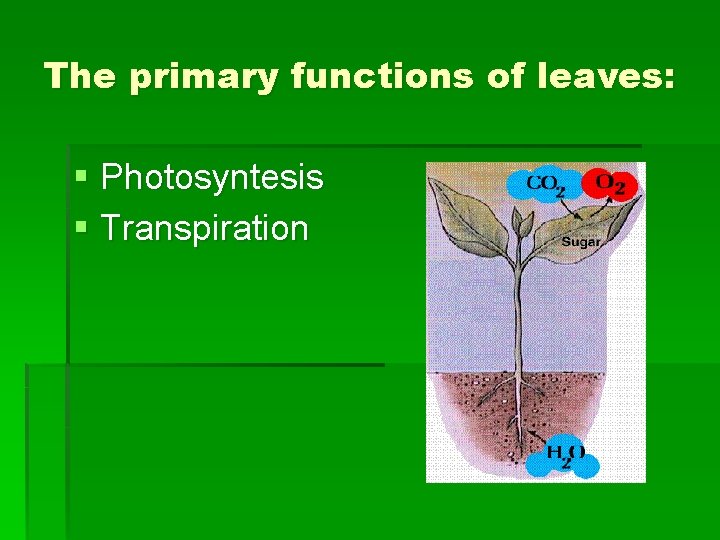
The primary functions of leaves: § Photosyntesis § Transpiration
§ Leaf Function: Leaves are the powerhouse of plants. In most plants, leaves are the major site of food production for the plant. Structures within a leaf convert the energy in sunlight into chemical energy that the plant can use as food. Chlorophyll is the molecule in leaves that uses the energy in sunlight to turn water (H 2 O) and carbon dioxide gas (CO 2) into sugar and oxygen gas (O 2). This process is called photosynthesis.
Leaf Structure: § A leaf is made of many layers that are sandwiched between two layers of tough skin cells (called the epidermis). The epidermis also secretes a waxy substance called the cuticle. These layers protect the leaf from insects, bacteria, and other pests. Among the epidermal cells are pairs of sausage-shaped guard cells. Each pair of guard cells forms a pore (called stoma; the plural is stomata). Gases enter and exit the leaf through the stomata.
Dicotyledonous leaves Is composed of two principal parts: § § § Blade or lamina Petiole or stalk Netted venation
Monocotyledonous leaves: Is divided into two parts: § Sheath § Blade § Paralled venation
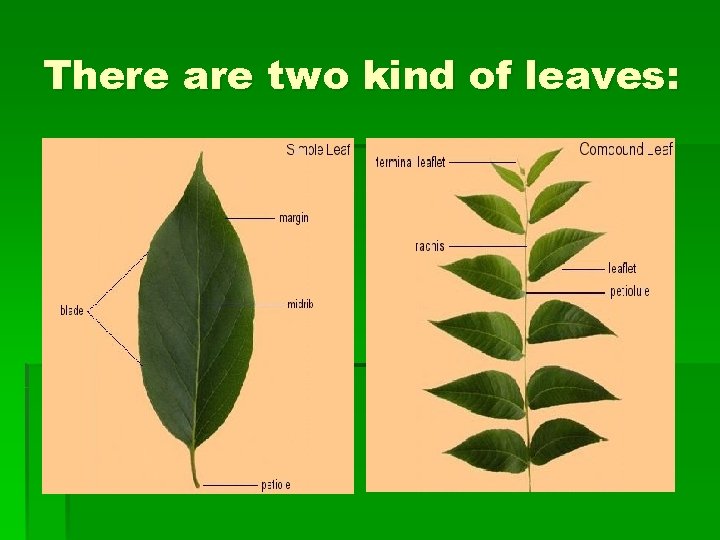
There are two kind of leaves:
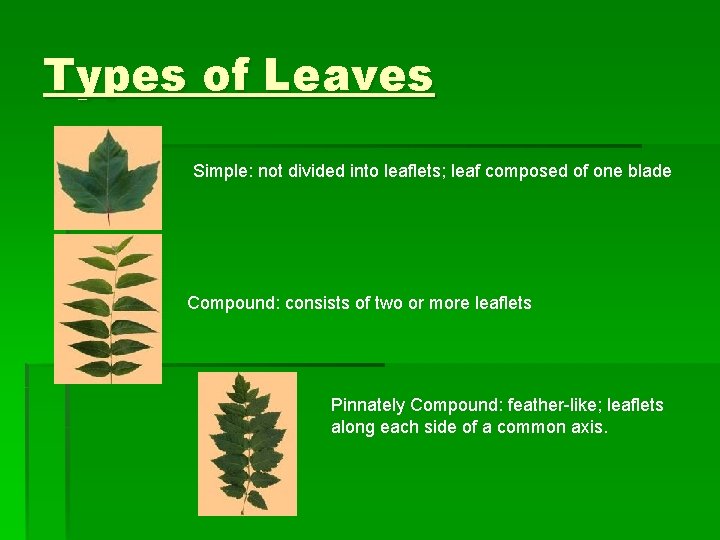
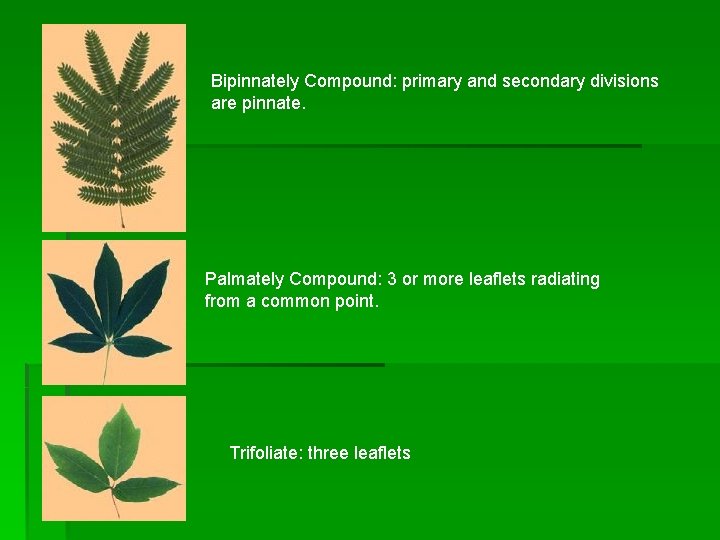
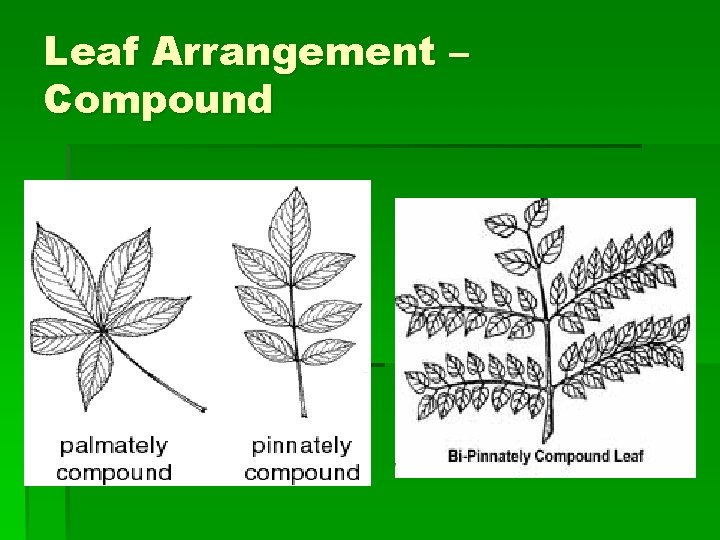
Types of Leaves Simple: not divided into leaflets; leaf composed of one blade Compound: consists of two or more leaflets Pinnately Compound: feather-like; leaflets along each side of a common axis.
Bipinnately Compound: primary and secondary divisions are pinnate. Palmately Compound: 3 or more leaflets radiating from a common point. Trifoliate: three leaflets
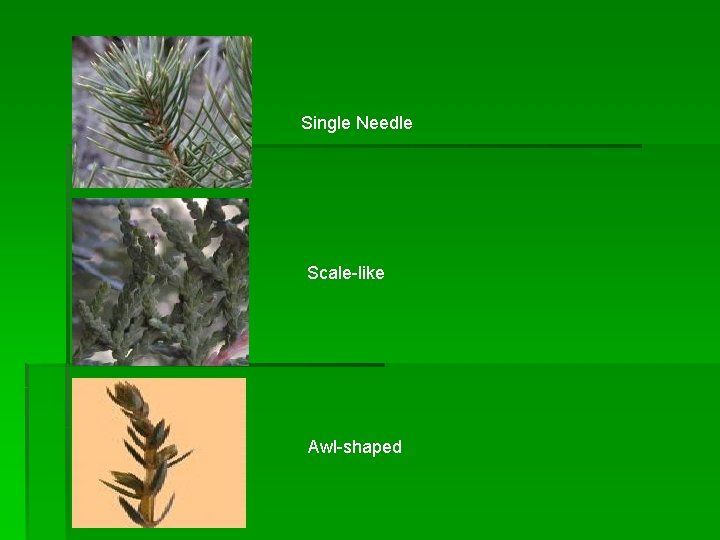
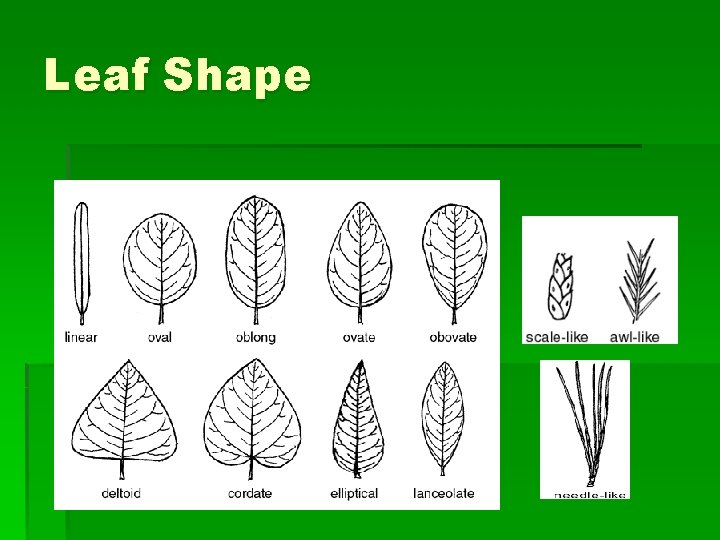
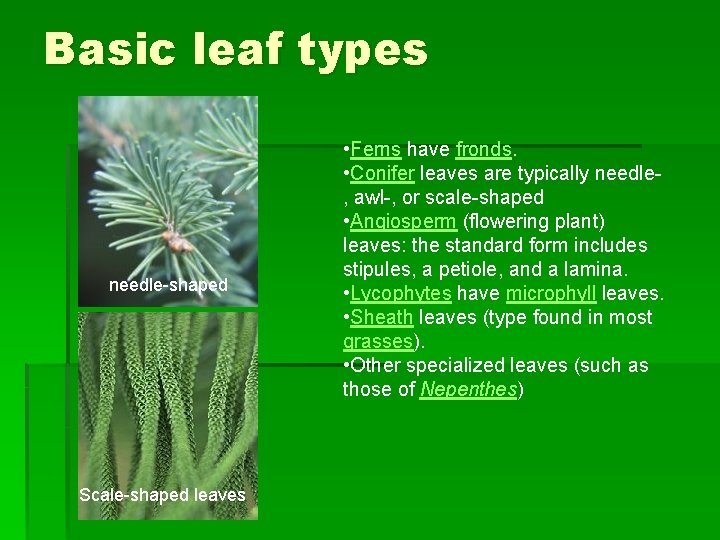
Single Needle Scale-like Awl-shaped
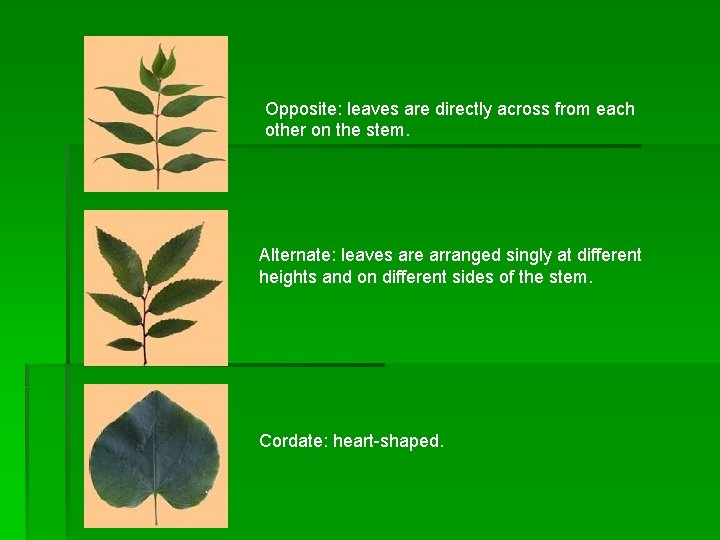
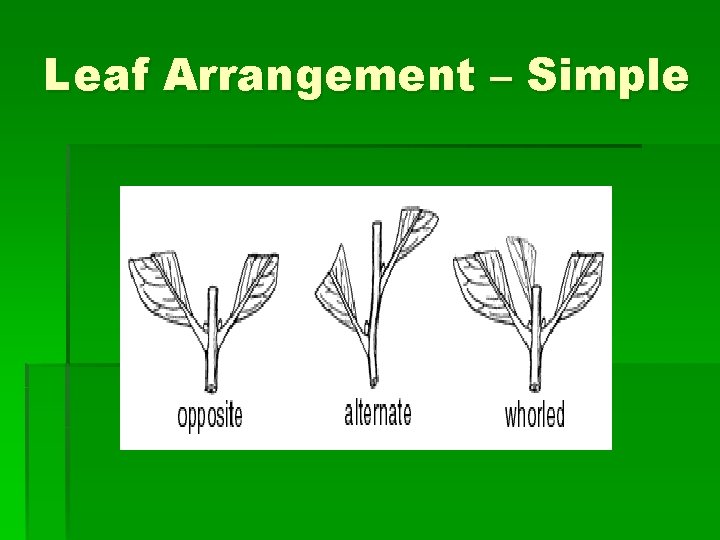
Opposite: leaves are directly across from each other on the stem. Alternate: leaves are arranged singly at different heights and on different sides of the stem. Cordate: heart-shaped.
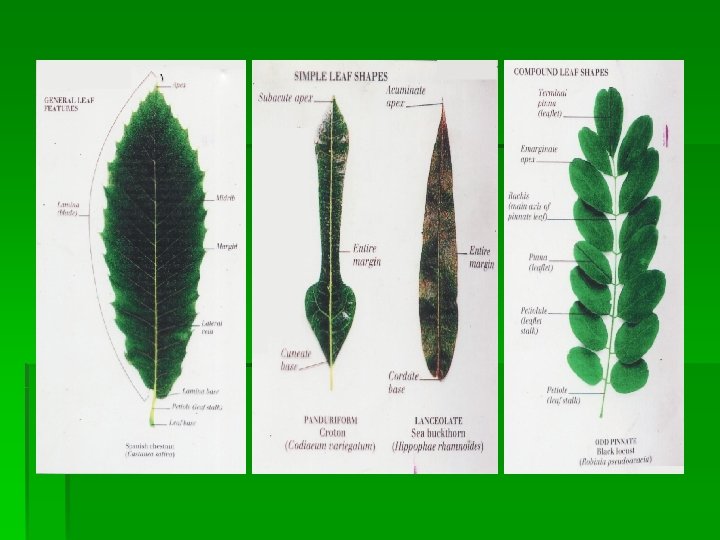
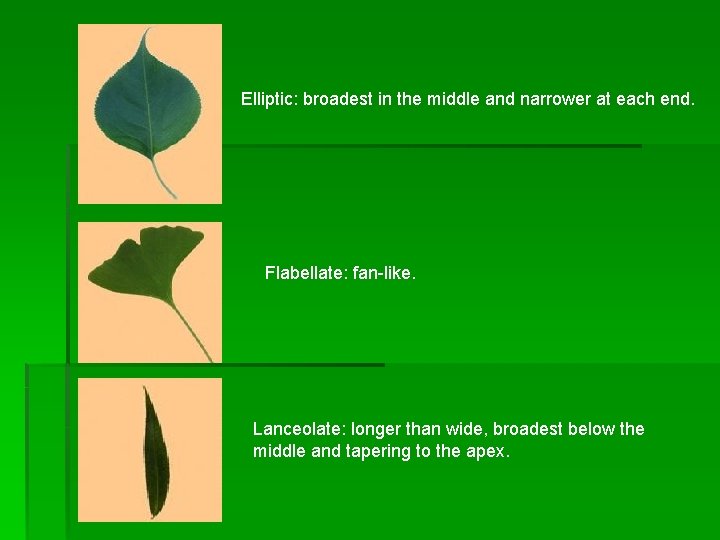
Elliptic: broadest in the middle and narrower at each end. Flabellate: fan-like. Lanceolate: longer than wide, broadest below the middle and tapering to the apex.
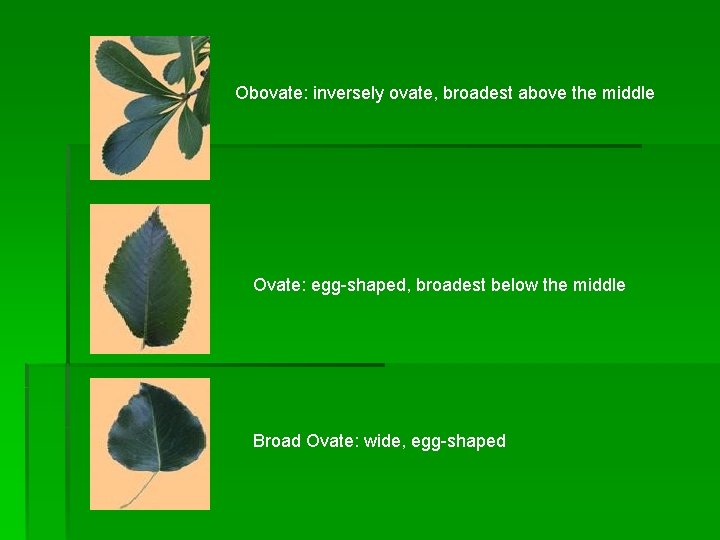
Obovate: inversely ovate, broadest above the middle Ovate: egg-shaped, broadest below the middle Broad Ovate: wide, egg-shaped
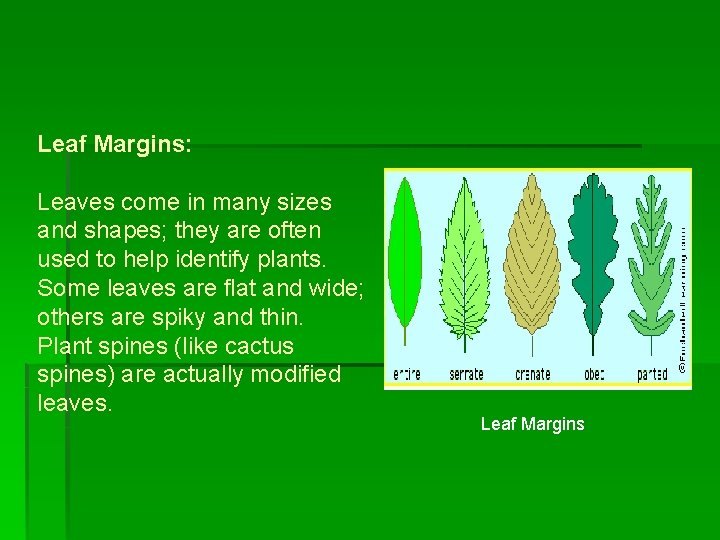
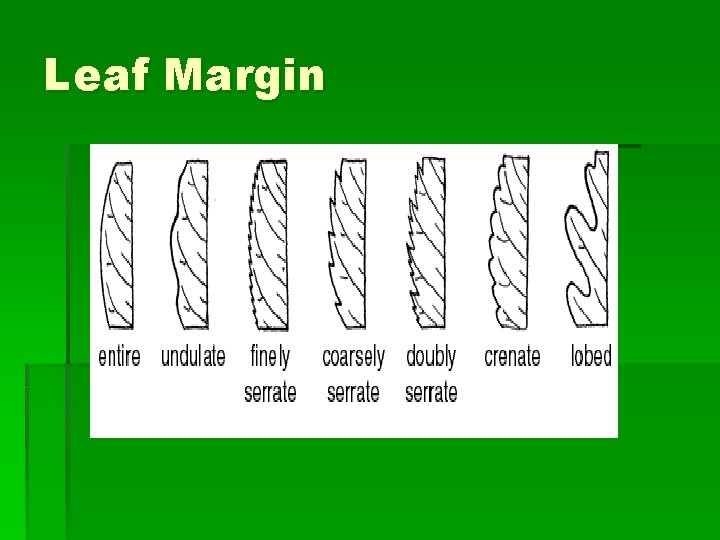
Leaf Margins: Leaves come in many sizes and shapes; they are often used to help identify plants. Some leaves are flat and wide; others are spiky and thin. Plant spines (like cactus spines) are actually modified leaves. Leaf Margins
Plant Parts – Leaf § § § § Arrangement Shapes Color Vein Pattern Form – Simple or Compound Margin Surface
Leaf Arrangement – Simple
Leaf Arrangement – Compound
Leaf Shape
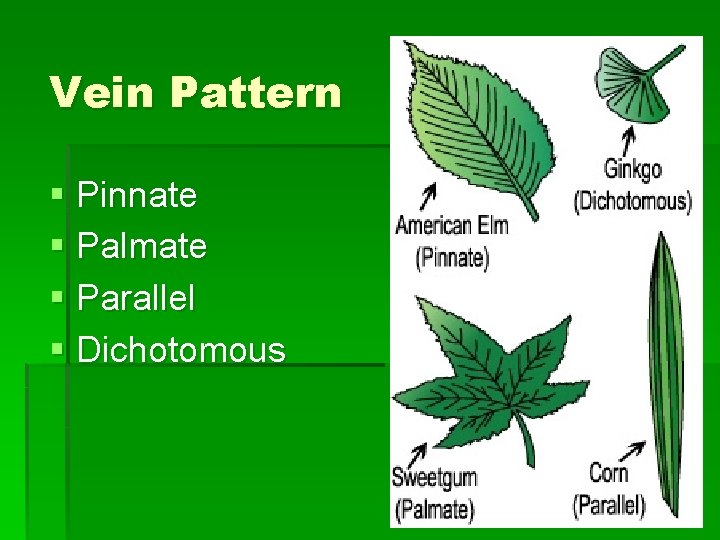
Vein Pattern § Pinnate § Palmate § Parallel § Dichotomous
Leaf Margin
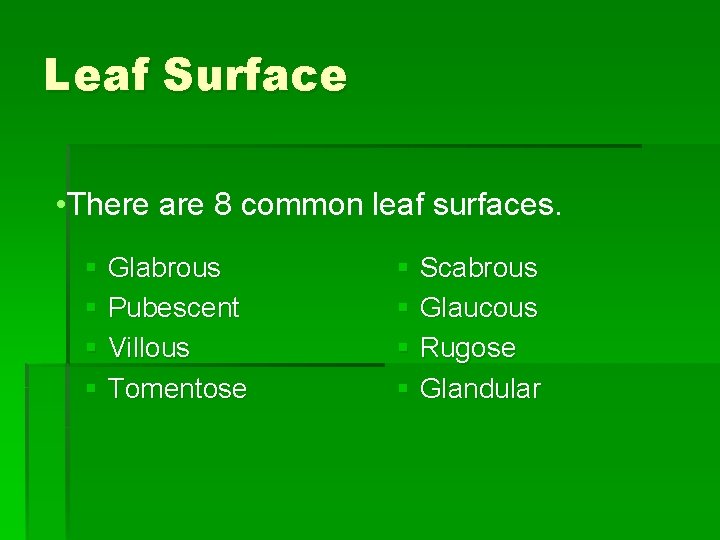
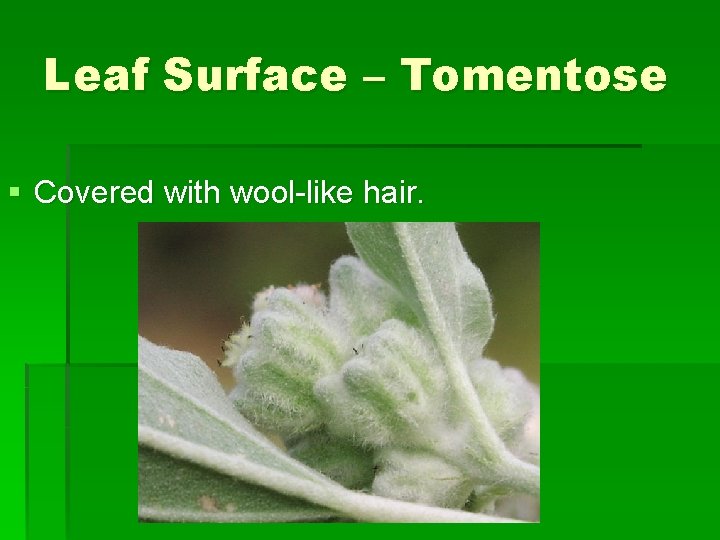
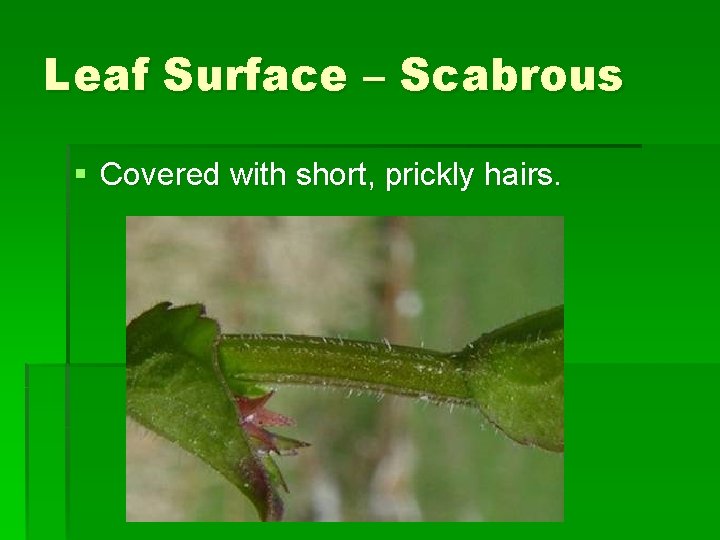
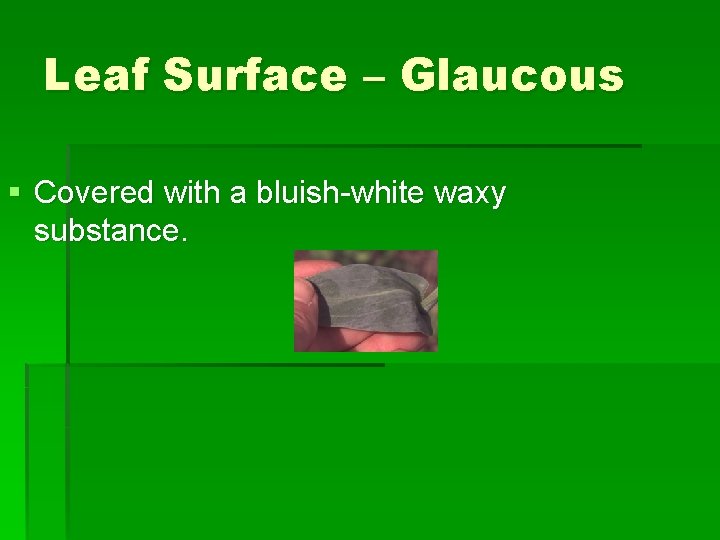
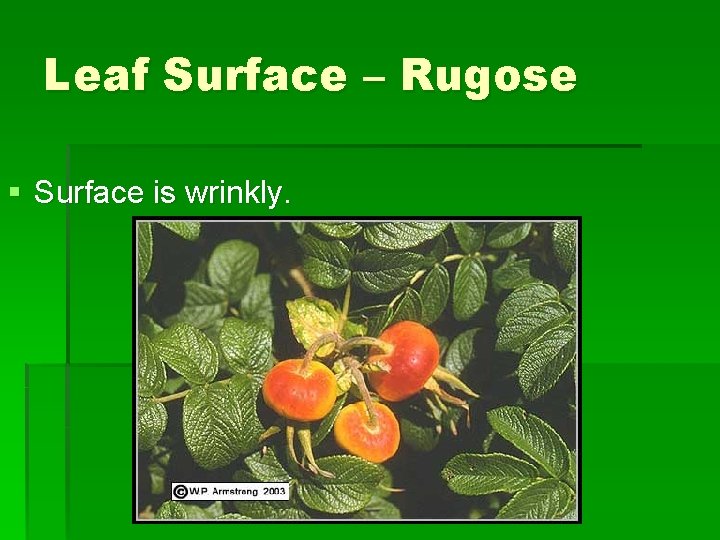
Leaf Surface • There are 8 common leaf surfaces. § Glabrous § Pubescent § Villous § Tomentose § Scabrous § Glaucous § Rugose § Glandular
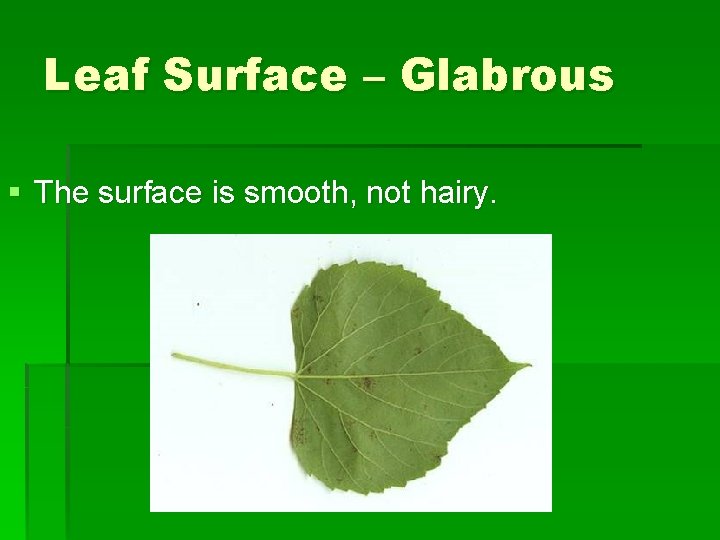
Leaf Surface – Glabrous § The surface is smooth, not hairy.
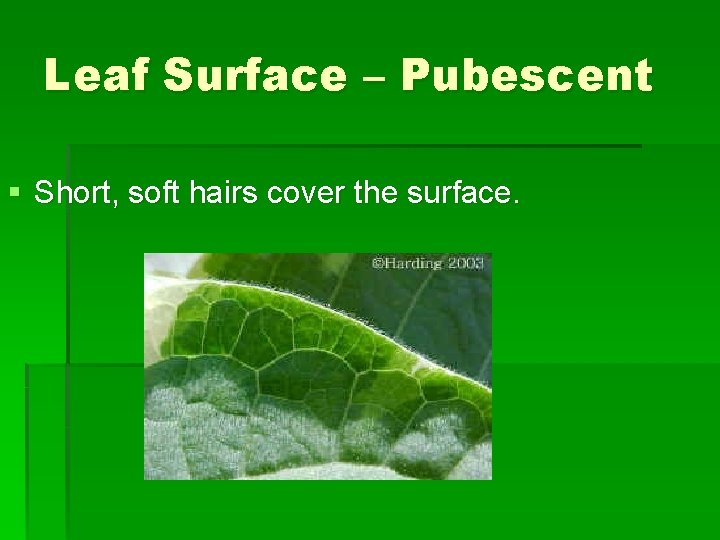
Leaf Surface – Pubescent § Short, soft hairs cover the surface.
Leaf Surface – Tomentose § Covered with wool-like hair.
Leaf Surface – Scabrous § Covered with short, prickly hairs.
Leaf Surface – Glaucous § Covered with a bluish-white waxy substance.
Leaf Surface – Rugose § Surface is wrinkly.
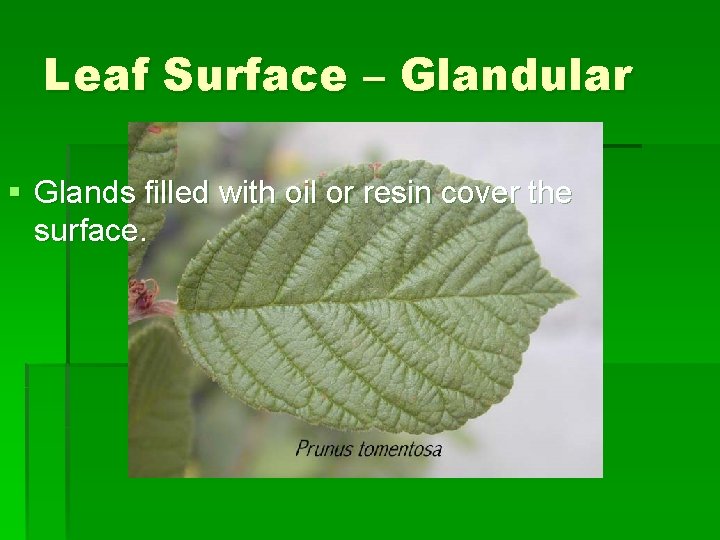
Leaf Surface – Glandular § Glands filled with oil or resin cover the surface.
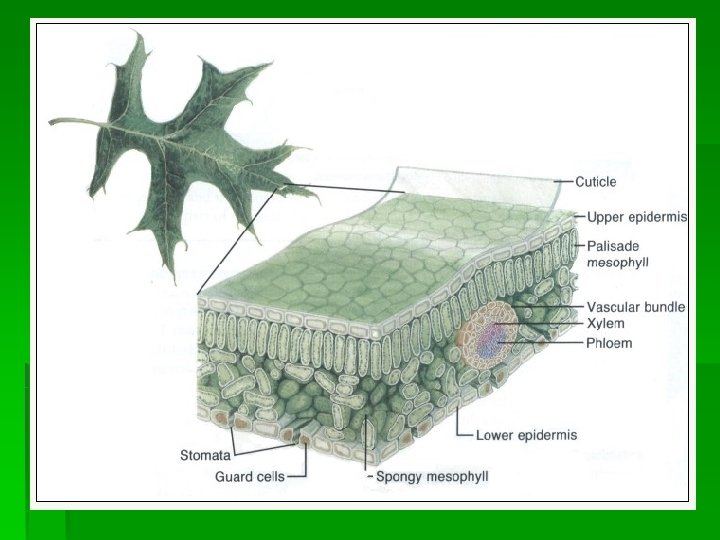
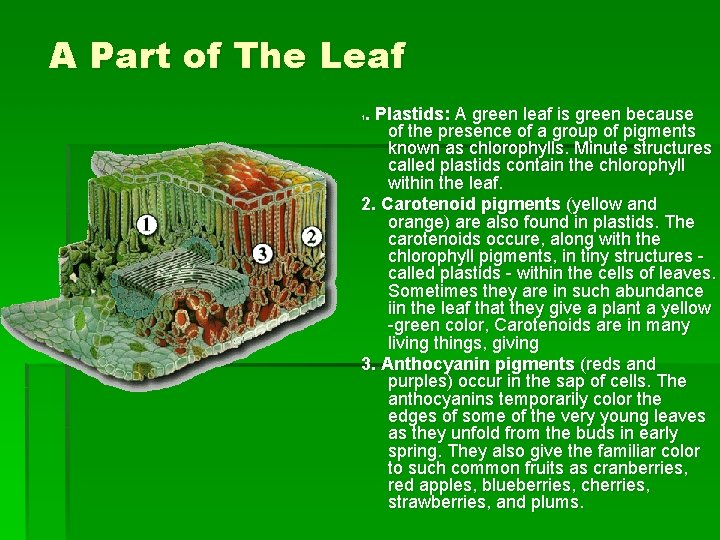
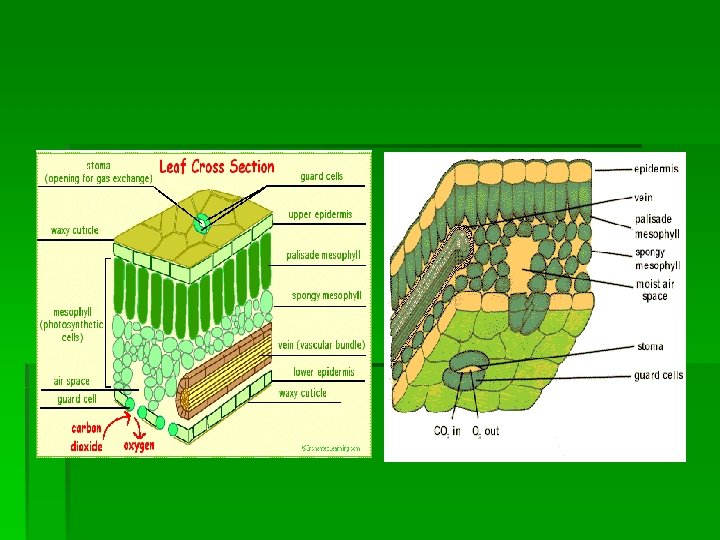
Anatomy of the foliage leaf: In the leaves of most trees, three distinct tissue layers can be discerned in their leaves. These are: § § 1. The epidermis with its cuticle and stomata 2. The mesophyll where most of the chloroplasts are found and photosynthesis takes place 3. The leaf veins which transport water and inorganic compounds into the leaf, and organic compounds produced by photosynthesis away from the leaf, to other parts of the plant.
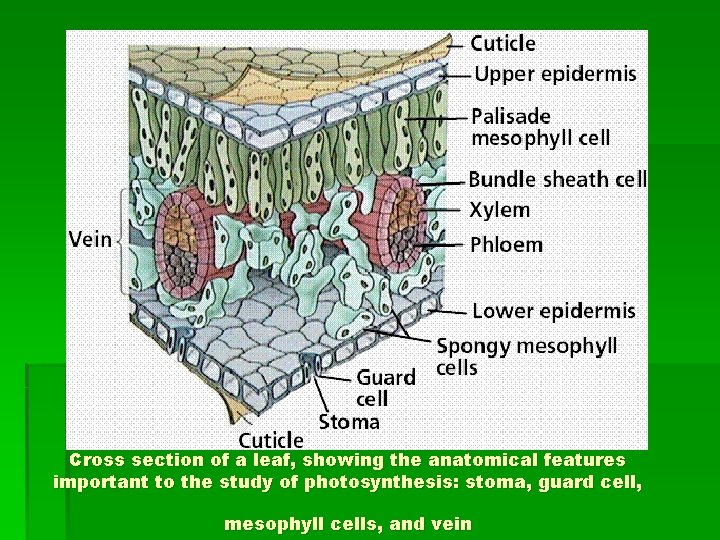
Cross section of a leaf, showing the anatomical features important to the study of photosynthesis: stoma, guard cell, mesophyll cells, and vein
§ Epidermis § The epidermal tissue functions in prevention of water loss and acts as a barrier to fungi and other invaders. Thus, epidermal cells are closely packed, with little intercellular space. To further cut down on water loss, many plants have a waxy cuticle layer deposited on top of the epidermal cells. § Guard Cells § To facilitate gas exchange between the inner parts of leaves, stems, and fruits, plants have a series of openings known as stomata (singular stoma). They regulate exchange of water vapor, oxygen and carbon dioxide through the stoma.
§ Collenchyma cells support the plant. These cells are charcterized by thickenings of the wall, they are alive at maturity. They tend to occur as part of vascular bundles or on the corners of angular stems. § Sclerenchyma cells support the plant. They often occur as bundle cap fibers. Sclerenchyma cells are characterized by thickenings in their secondary walls. They are dead at maturity. A common type of schlerenchyma cell is the fiber.
§ Xylem is a term applied to woody (ligninimpregnated)walls of certain cells of plants. Xylem cells tend to conduct water and minerals from roots to leaves. While parenchyma cells do occur within what is commonly termed the "xylem" the more identifiable cells, tracheids and vessel elements, tend to stain red with Safranin-O. Tracheids are the more primitive of the two cell types, occurring in the earliest vascular plants. Tracheids are long and tapered, with angled end-plates that connect cell to cell. Vessel elements are shorter, much wider, and lack end plates. They occur only in angiosperms, the most recently evolved large group of plants
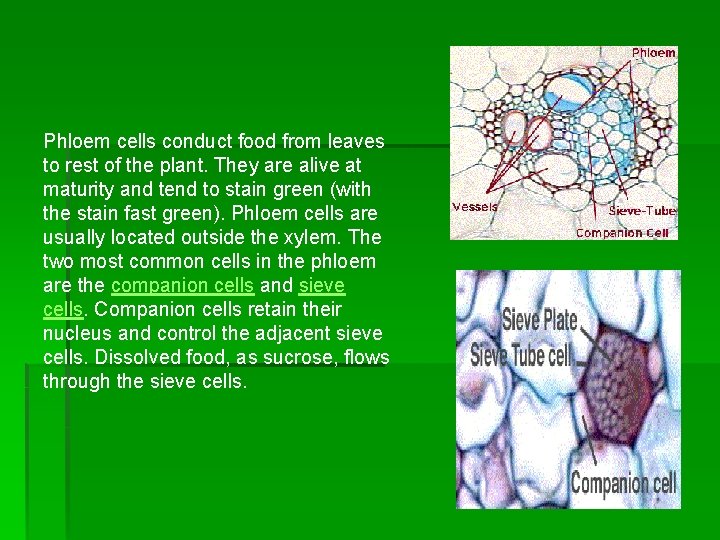
Phloem cells conduct food from leaves to rest of the plant. They are alive at maturity and tend to stain green (with the stain fast green). Phloem cells are usually located outside the xylem. The two most common cells in the phloem are the companion cells and sieve cells. Companion cells retain their nucleus and control the adjacent sieve cells. Dissolved food, as sucrose, flows through the sieve cells.
A Part of The Leaf. Plastids: A green leaf is green because of the presence of a group of pigments known as chlorophylls. Minute structures called plastids contain the chlorophyll within the leaf. 2. Carotenoid pigments (yellow and orange) are also found in plastids. The carotenoids occure, along with the chlorophyll pigments, in tiny structures called plastids - within the cells of leaves. Sometimes they are in such abundance iin the leaf that they give a plant a yellow -green color, Carotenoids are in many living things, giving 3. Anthocyanin pigments (reds and purples) occur in the sap of cells. The anthocyanins temporarily color the edges of some of the very young leaves as they unfold from the buds in early spring. They also give the familiar color to such common fruits as cranberries, red apples, blueberries, cherries, strawberries, and plums. 1
Basic leaf types needle-shaped Scale-shaped leaves • Ferns have fronds. • Conifer leaves are typically needle, awl-, or scale-shaped • Angiosperm (flowering plant) leaves: the standard form includes stipules, a petiole, and a lamina. • Lycophytes have microphyll leaves. • Sheath leaves (type found in most grasses). • Other specialized leaves (such as those of Nepenthes)
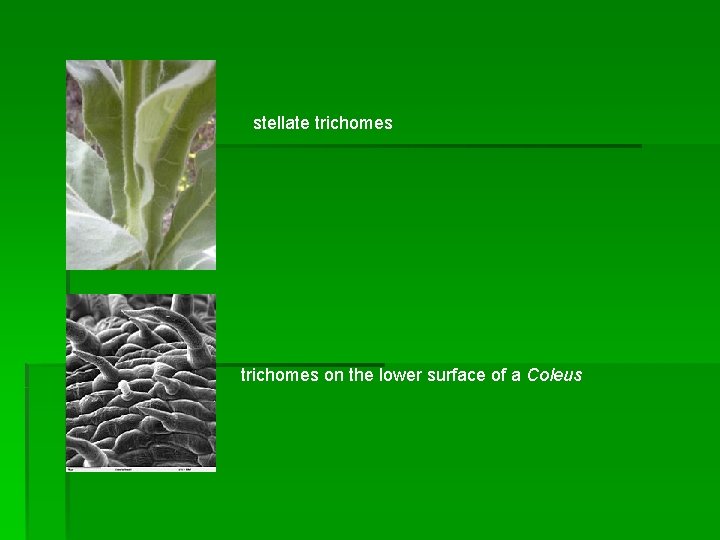
stellate trichomes on the lower surface of a Coleus
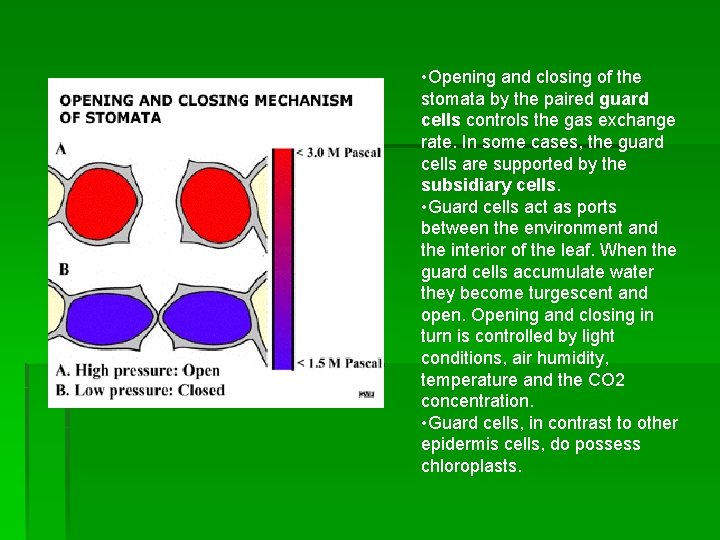
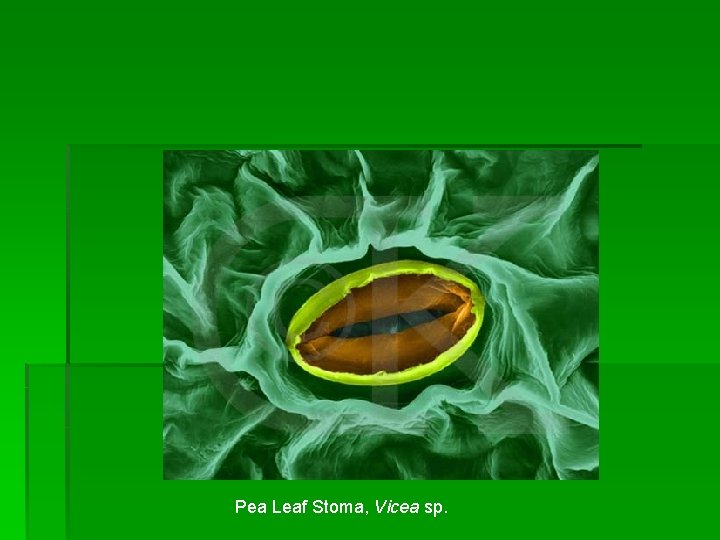
• Opening and closing of the stomata by the paired guard cells controls the gas exchange rate. In some cases, the guard cells are supported by the subsidiary cells. • Guard cells act as ports between the environment and the interior of the leaf. When the guard cells accumulate water they become turgescent and open. Opening and closing in turn is controlled by light conditions, air humidity, temperature and the CO 2 concentration. • Guard cells, in contrast to other epidermis cells, do possess chloroplasts.
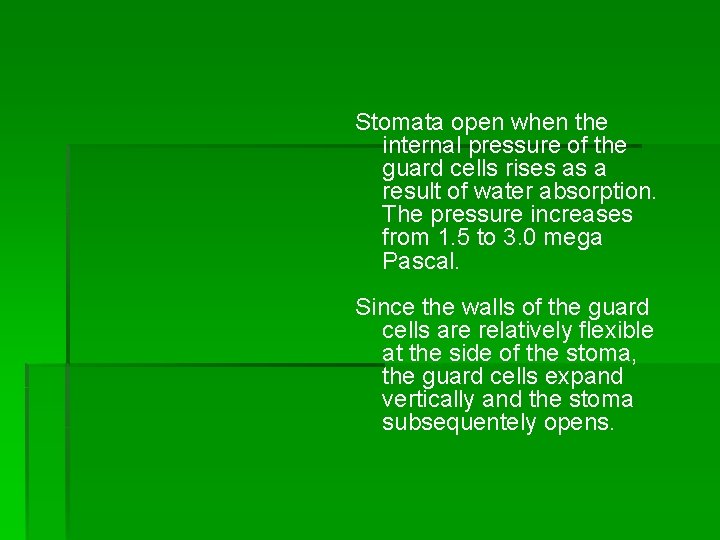
Stomata open when the internal pressure of the guard cells rises as a result of water absorption. The pressure increases from 1. 5 to 3. 0 mega Pascal. Since the walls of the guard cells are relatively flexible at the side of the stoma, the guard cells expand vertically and the stoma subsequentely opens.
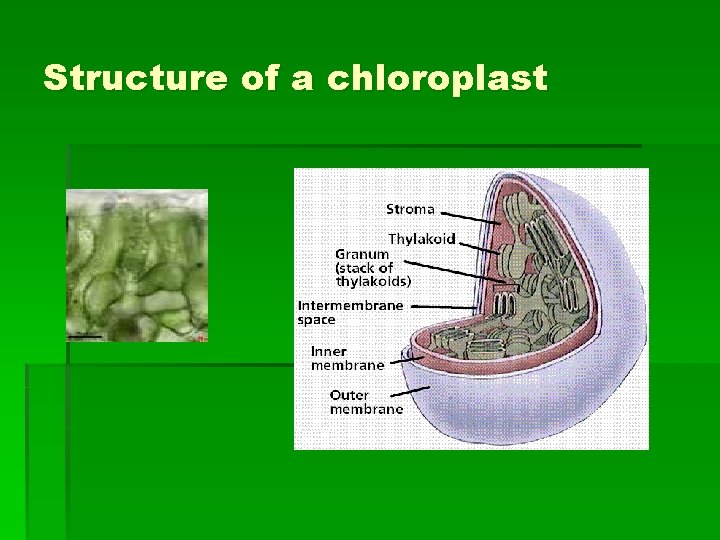
Structure of a chloroplast
Pea Leaf Stoma, Vicea sp.
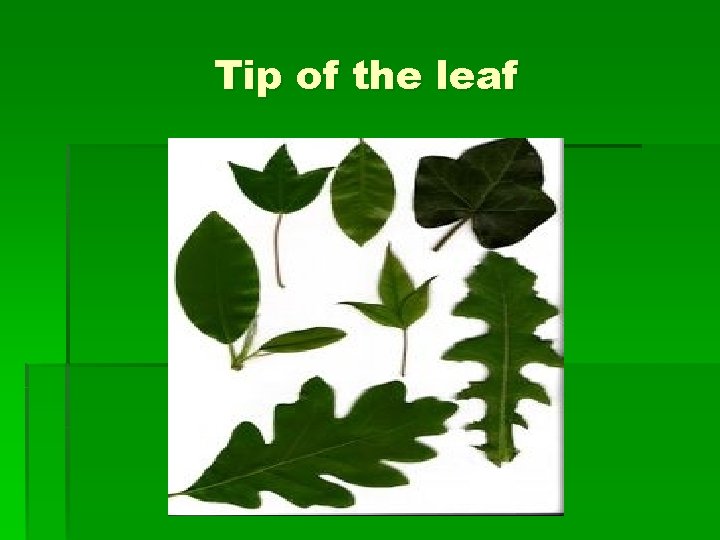
Tip of the leaf
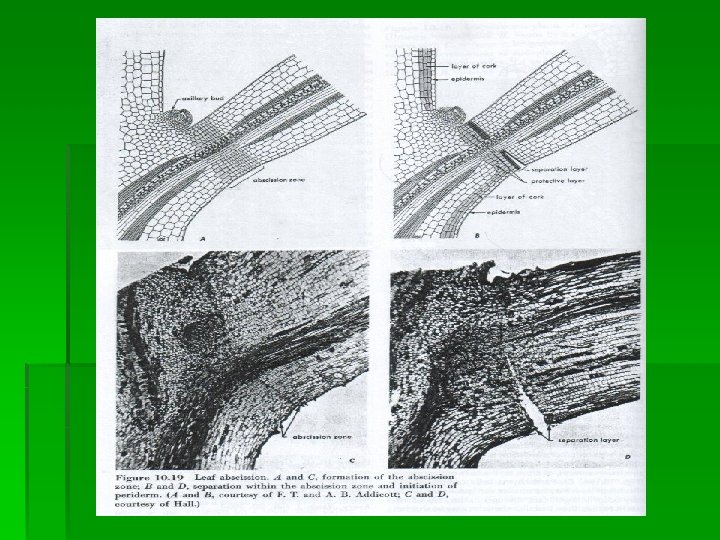
Leaf Abscission § The formation of a definite abscission zone across a petiole or fruit stem is responsible for leaf fall or fruit drop § The function of the abcission zone : - to bring about the fall of the leaf or other plant part - to protect the region of the stem from which the leaf has fallen against insect damage or rot caused by bacteria or fungi