
Leavening Agents Chapter 21 Terms to Remember Baking

Leavening Agents Chapter 21

Terms to Remember: �Baking Powder �Baking Soda �Double-acting baking powder �Fermentation �Quick Breads �Single-acting baking powder
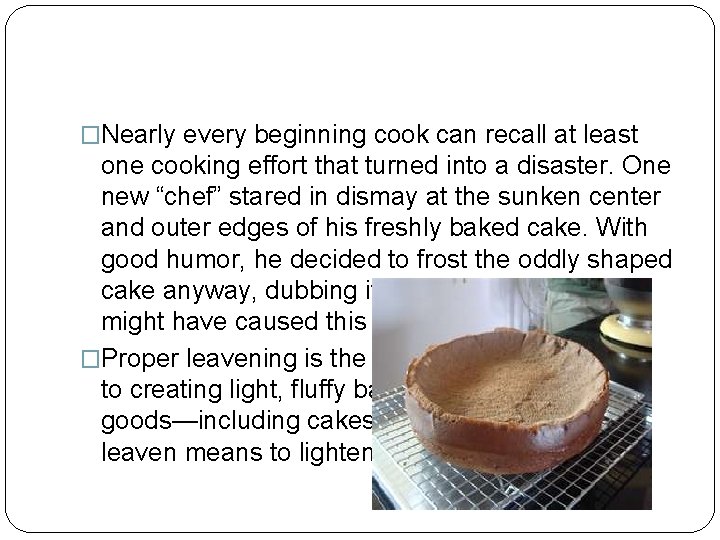
�Nearly every beginning cook can recall at least one cooking effort that turned into a disaster. One new “chef” stared in dismay at the sunken center and outer edges of his freshly baked cake. With good humor, he decided to frost the oddly shaped cake anyway, dubbing it a “volcano cake. ” What might have caused this mishap? �Proper leavening is the key to creating light, fluffy baked goods—including cakes. To leaven means to lighten.
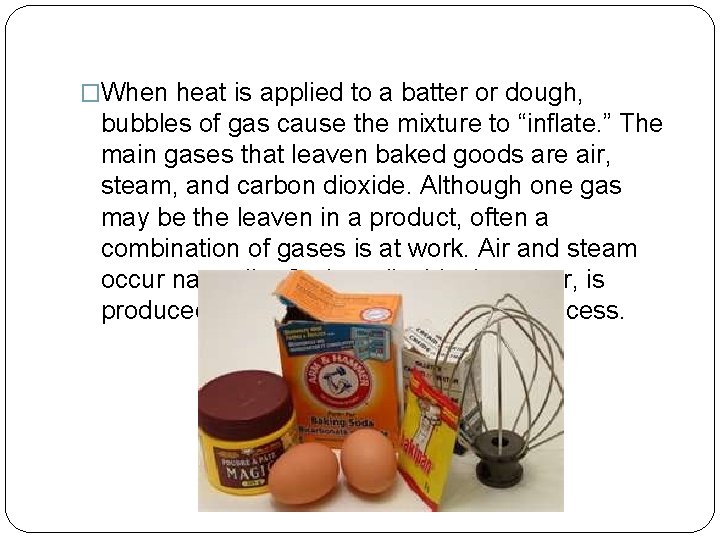
�When heat is applied to a batter or dough, bubbles of gas cause the mixture to “inflate. ” The main gases that leaven baked goods are air, steam, and carbon dioxide. Although one gas may be the leaven in a product, often a combination of gases is at work. Air and steam occur naturally. Carbon dioxide, however, is produced by a chemical or biological process.
Using Air and Steam to Leaven Air and water are as natural to baked goods as they are to you. Air and the steam produced by water are common gases used to leaven many products.
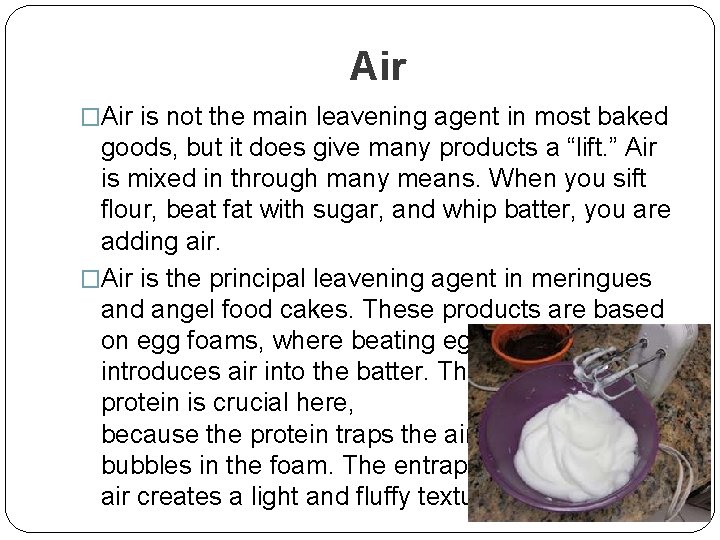
Air �Air is not the main leavening agent in most baked goods, but it does give many products a “lift. ” Air is mixed in through many means. When you sift flour, beat fat with sugar, and whip batter, you are adding air. �Air is the principal leavening agent in meringues and angel food cakes. These products are based on egg foams, where beating egg whites introduces air into the batter. The denaturation of protein is crucial here, because the protein traps the air bubbles in the foam. The entrapped air creates a light and fluffy texture.
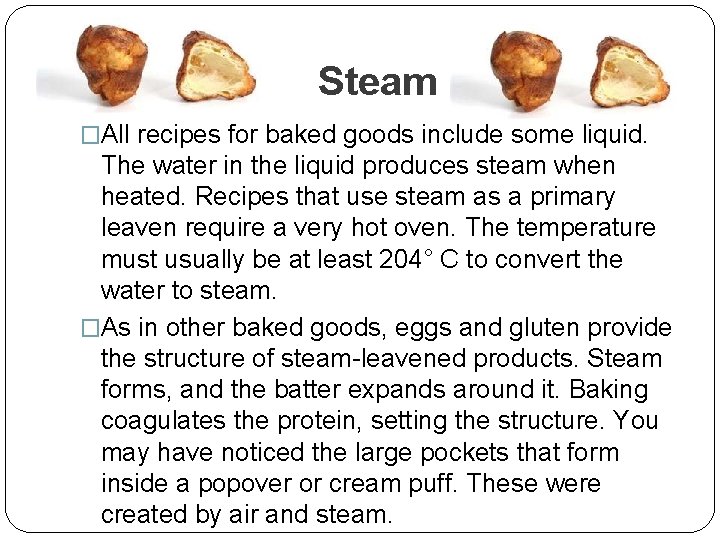
Steam �All recipes for baked goods include some liquid. The water in the liquid produces steam when heated. Recipes that use steam as a primary leaven require a very hot oven. The temperature must usually be at least 204° C to convert the water to steam. �As in other baked goods, eggs and gluten provide the structure of steam-leavened products. Steam forms, and the batter expands around it. Baking coagulates the protein, setting the structure. You may have noticed the large pockets that form inside a popover or cream puff. These were created by air and steam.
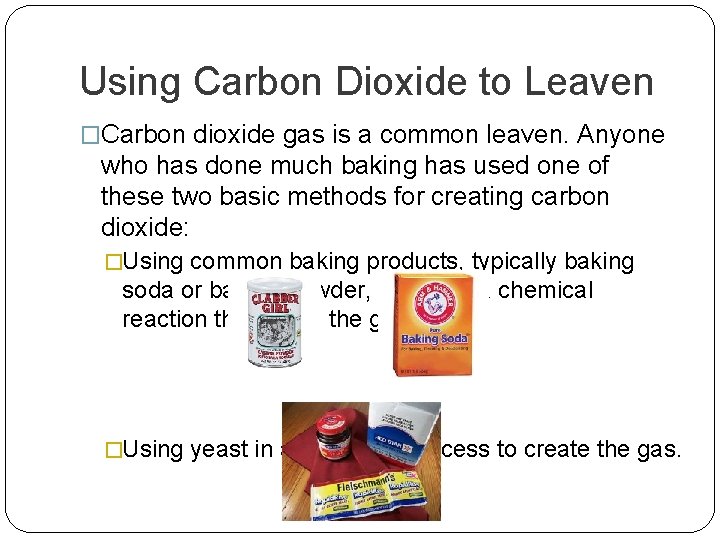
Using Carbon Dioxide to Leaven �Carbon dioxide gas is a common leaven. Anyone who has done much baking has used one of these two basic methods for creating carbon dioxide: �Using common baking products, typically baking soda or baking powder, to create a chemical reaction that yields the gas. �Using yeast in a biological process to create the gas.
Producing CO Chemically 2 �In most cake and cookie recipes, you’ll see a chemical leavening agent in the ingredient list. In the US, only chemical leavening agents that produce carbon dioxide are used. The two most widely used agents are products you may have seen and used—baking soda and baking powder. These products participate in a chemical reaction that produces carbon dioxide for leavening.
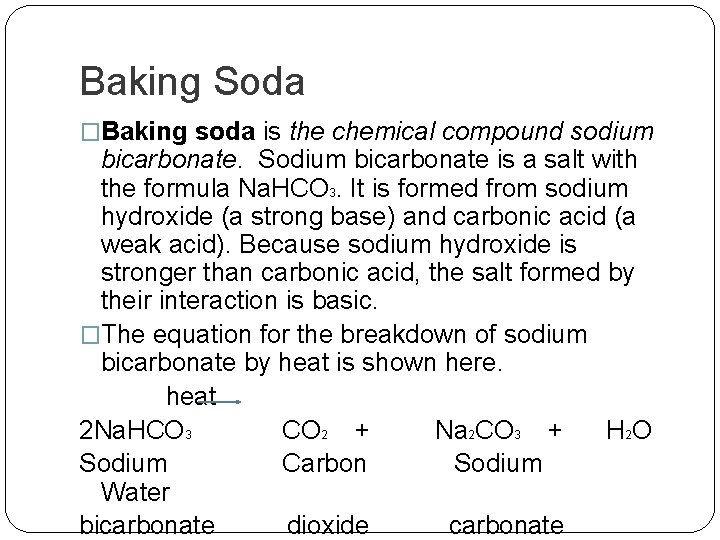
Baking Soda �Baking soda is the chemical compound sodium bicarbonate. Sodium bicarbonate is a salt with the formula Na. HCO 3. It is formed from sodium hydroxide (a strong base) and carbonic acid (a weak acid). Because sodium hydroxide is stronger than carbonic acid, the salt formed by their interaction is basic. �The equation for the breakdown of sodium bicarbonate by heat is shown here. heat 2 Na. HCO 3 CO 2 + Na 2 CO 3 + H 2 O Sodium Carbon Sodium Water bicarbonate dioxide carbonate
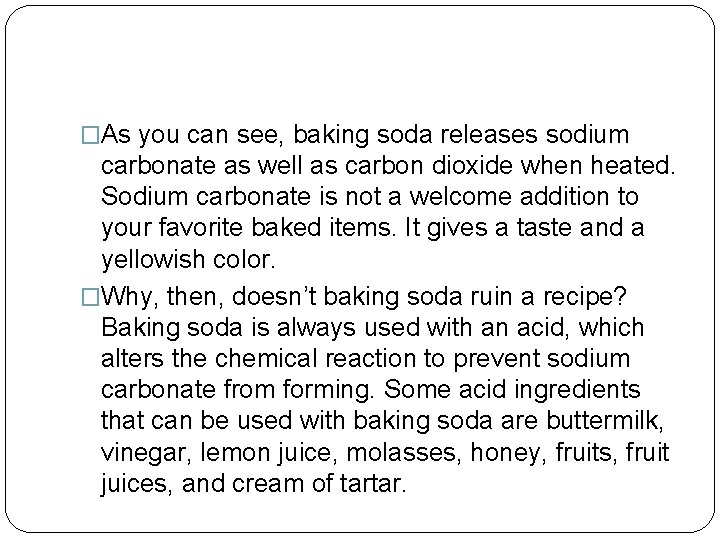
�As you can see, baking soda releases sodium carbonate as well as carbon dioxide when heated. Sodium carbonate is not a welcome addition to your favorite baked items. It gives a taste and a yellowish color. �Why, then, doesn’t baking soda ruin a recipe? Baking soda is always used with an acid, which alters the chemical reaction to prevent sodium carbonate from forming. Some acid ingredients that can be used with baking soda are buttermilk, vinegar, lemon juice, molasses, honey, fruits, fruit juices, and cream of tartar.
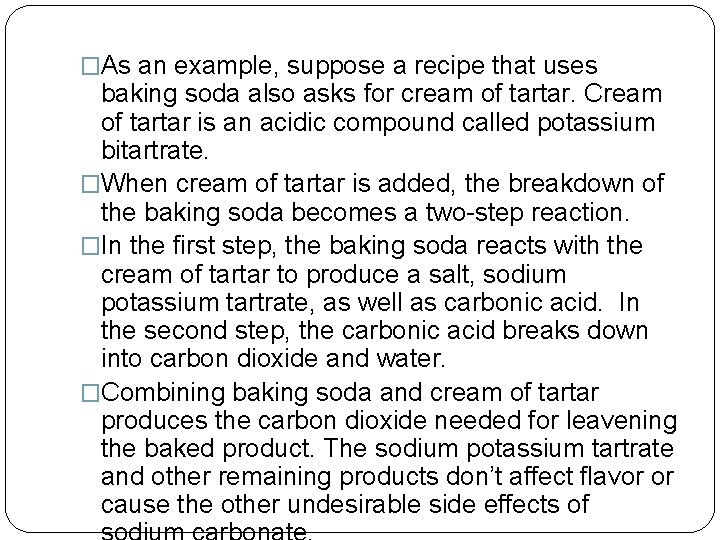
�As an example, suppose a recipe that uses baking soda also asks for cream of tartar. Cream of tartar is an acidic compound called potassium bitartrate. �When cream of tartar is added, the breakdown of the baking soda becomes a two-step reaction. �In the first step, the baking soda reacts with the cream of tartar to produce a salt, sodium potassium tartrate, as well as carbonic acid. In the second step, the carbonic acid breaks down into carbon dioxide and water. �Combining baking soda and cream of tartar produces the carbon dioxide needed for leavening the baked product. The sodium potassium tartrate and other remaining products don’t affect flavor or cause the other undesirable side effects of

Baking Powder �Baking powder is a leavening compound that contains baking soda, dry acids, and starch or some other filler. The filler in baking powder, usually cornstarch or calcium carbonate, absorbs moisture in the air, which helps prevent a chemical reaction from taking place too soon. You can make baking powder by blending baking soda, cream of tartar, and cornstarch, but most people buy it at the store. �Baking powder comes in two types: single-acting and double-acting.

Single-acting baking powder. �As soon as liquid is added to single-acting baking powder, carbon dioxide starts to be released. Water, milk, potato water, orange juice, or other liquids may begin this process. This quick reaction occurs because the acid in baking powder is soluble in a cold liquid. Homemade baking powder is single-acting, but this type is rarely sold in the US.
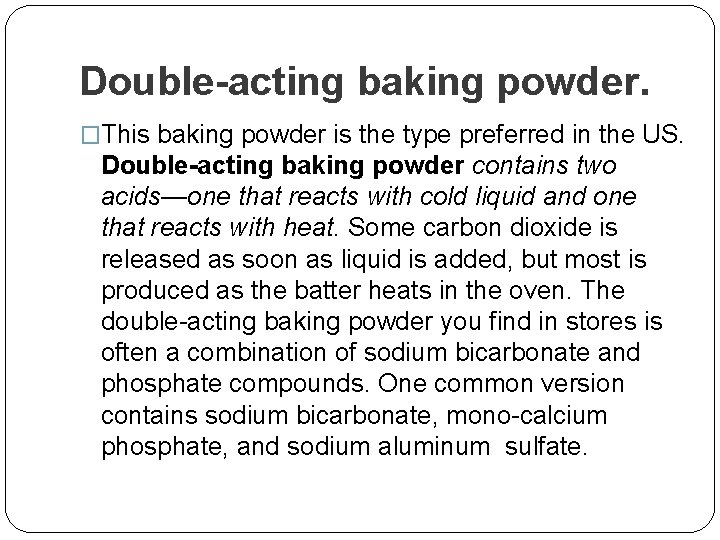
Double-acting baking powder. �This baking powder is the type preferred in the US. Double-acting baking powder contains two acids—one that reacts with cold liquid and one that reacts with heat. Some carbon dioxide is released as soon as liquid is added, but most is produced as the batter heats in the oven. The double-acting baking powder you find in stores is often a combination of sodium bicarbonate and phosphate compounds. One common version contains sodium bicarbonate, mono-calcium phosphate, and sodium aluminum sulfate.
The Strength of Baking Powder �Baking powders vary in the amount of carbon dioxide they release. By federal law, baking powder must yield at least 12 g of carbon dioxide for every 100 g of powder (12 percent). Most powders for home use are 14 percent, while the food industry has higher levels available. Since the carbon dioxide is formed from the breakdown of the baking soda, baking powder must be at least 25 percent baking soda by volume to yield the carbon dioxide needed.
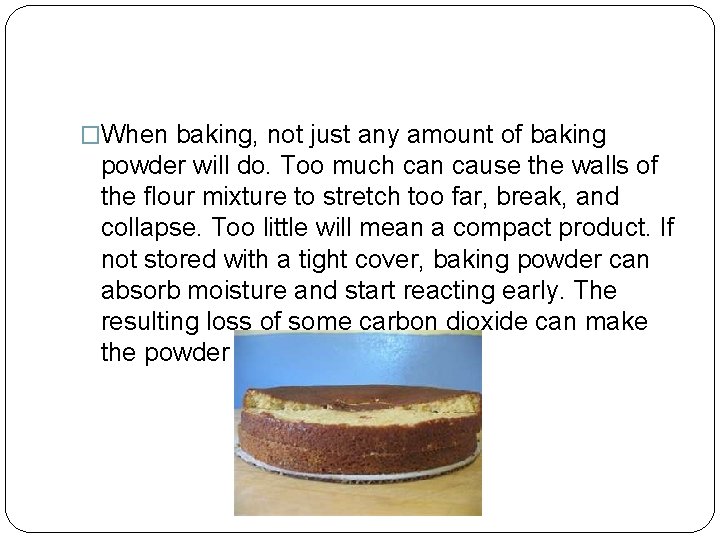
�When baking, not just any amount of baking powder will do. Too much can cause the walls of the flour mixture to stretch too far, break, and collapse. Too little will mean a compact product. If not stored with a tight cover, baking powder can absorb moisture and start reacting early. The resulting loss of some carbon dioxide can make the powder less effective.
Ammonium Bicarbonate �Baking soda and baking powder are the most common chemicals used to produce carbon dioxide during baking. However, other substances are used for this purpose too. One is ammonium bicarbonate, known as baker’s ammonia. As it decomposes, ammonium bicarbonate produces carbon dioxide. �Although it effectively produces carbon dioxide, ammonium bicarbonate is used mostly in crackers and certain types of cookies. Why do you think its use is so limited? The ammonia gas produced may affect the taste of the baked good. In thin products that have a large surface area, the
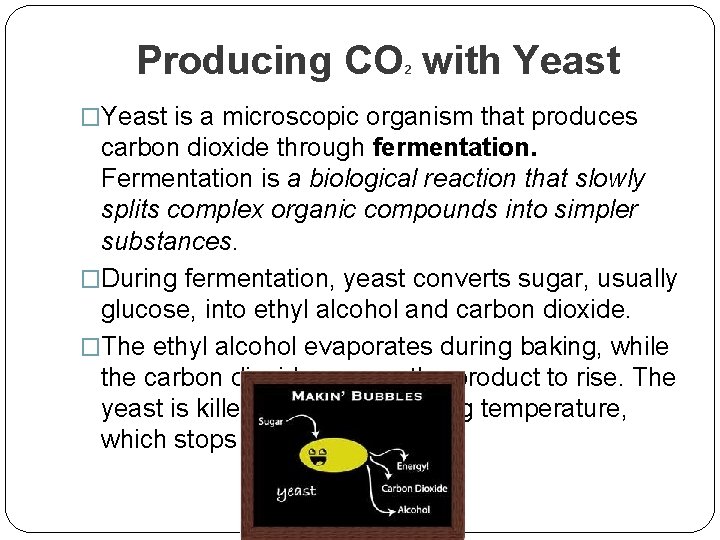
Producing CO with Yeast 2 �Yeast is a microscopic organism that produces carbon dioxide through fermentation. Fermentation is a biological reaction that slowly splits complex organic compounds into simpler substances. �During fermentation, yeast converts sugar, usually glucose, into ethyl alcohol and carbon dioxide. �The ethyl alcohol evaporates during baking, while the carbon dioxide causes the product to rise. The yeast is killed by the high baking temperature, which stops fermentation.
The Origins of Yeast �Yeast is found throughout the environment. Thousands of years ago, perhaps a little yeast landed on some bread dough and started to ferment. The dough would have begun to rise, forming a lighter bread than had been know before. “Yeast power” was soon harnessed. �The ancient Egyptians at first leavened bread by using a yeasty piece of leftover dough. Eventually, they achieved the same result using beer froth, which also contains yeast. The word “yeast” originally meant the froth or sediment of a fermenting liquid.
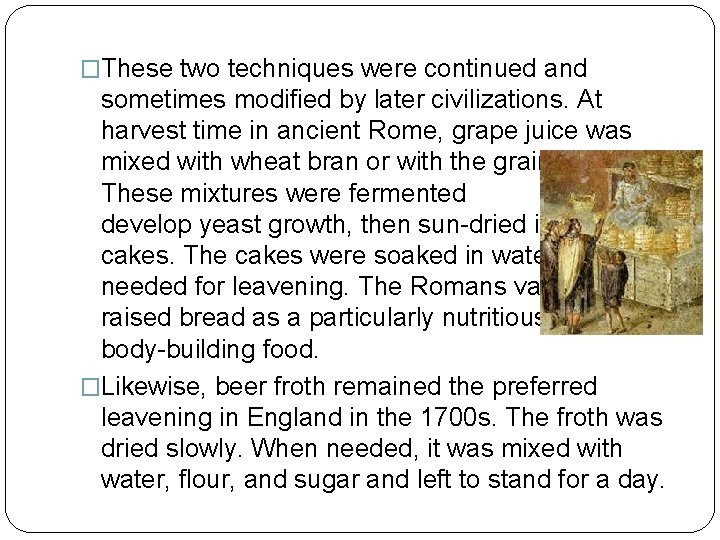
�These two techniques were continued and sometimes modified by later civilizations. At harvest time in ancient Rome, grape juice was mixed with wheat bran or with the grain millet. These mixtures were fermented to develop yeast growth, then sun-dried in cakes. The cakes were soaked in water as needed for leavening. The Romans valued raised bread as a particularly nutritious, body-building food. �Likewise, beer froth remained the preferred leavening in England in the 1700 s. The froth was dried slowly. When needed, it was mixed with water, flour, and sugar and left to stand for a day.
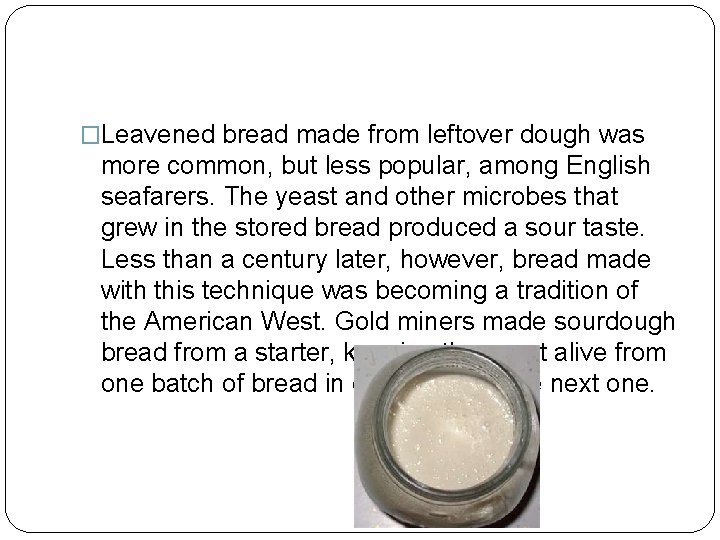
�Leavened bread made from leftover dough was more common, but less popular, among English seafarers. The yeast and other microbes that grew in the stored bread produced a sour taste. Less than a century later, however, bread made with this technique was becoming a tradition of the American West. Gold miners made sourdough bread from a starter, keeping the yeast alive from one batch of bread in order to start the next one.
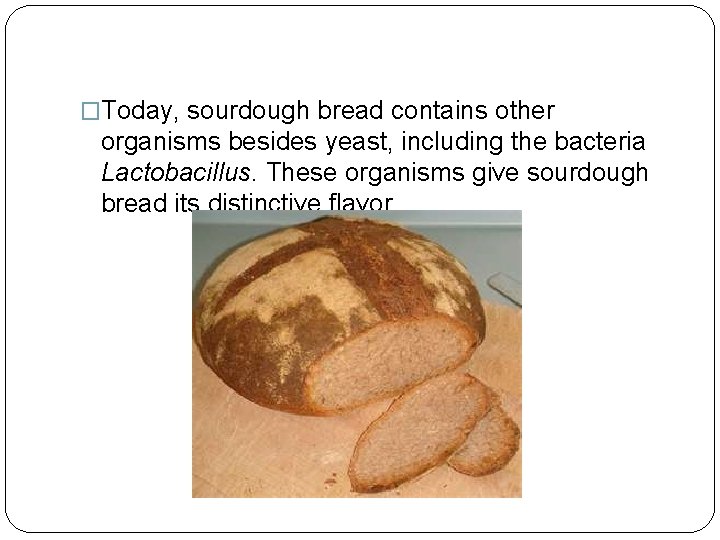
�Today, sourdough bread contains other organisms besides yeast, including the bacteria Lactobacillus. These organisms give sourdough bread its distinctive flavor.
Making Leavened Products Meals and snacks are routinely made more appealing with leavened products. Using leavens to create these products is a skill that builds with practice and understanding.
Batters and Doughs When baking, leavens are used to make many different products. Recipes produce both doughs and batters that use all of the leavening methods you’ve read about. Batters contain more liquid that doughs.
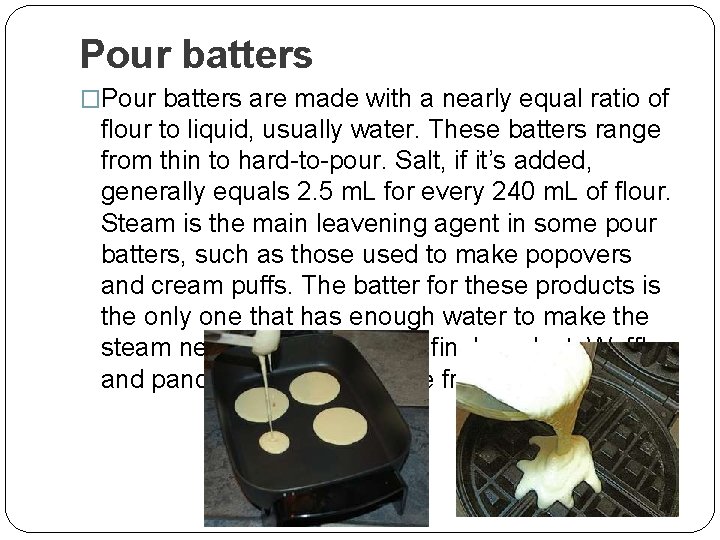
Pour batters �Pour batters are made with a nearly equal ratio of flour to liquid, usually water. These batters range from thin to hard-to-pour. Salt, if it’s added, generally equals 2. 5 m. L for every 240 m. L of flour. Steam is the main leavening agent in some pour batters, such as those used to make popovers and cream puffs. The batter for these products is the only one that has enough water to make the steam needed to puff up the final product. Waffles and pancakes are also made from pour batters.
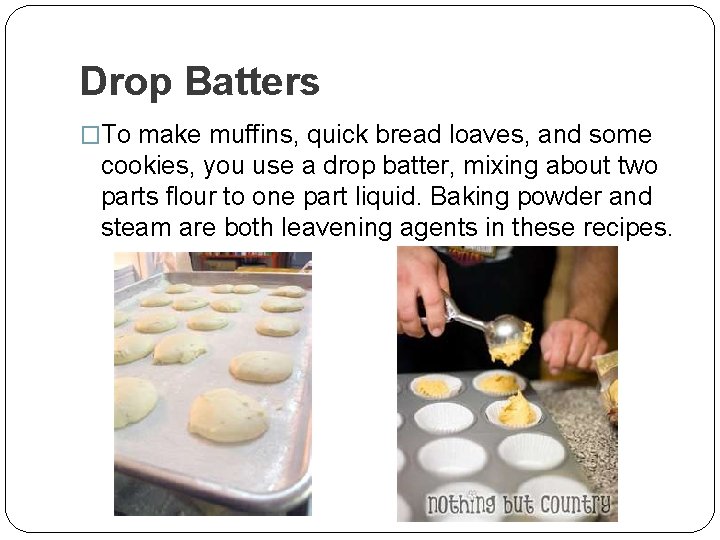
Drop Batters �To make muffins, quick bread loaves, and some cookies, you use a drop batter, mixing about two parts flour to one part liquid. Baking powder and steam are both leavening agents in these recipes.
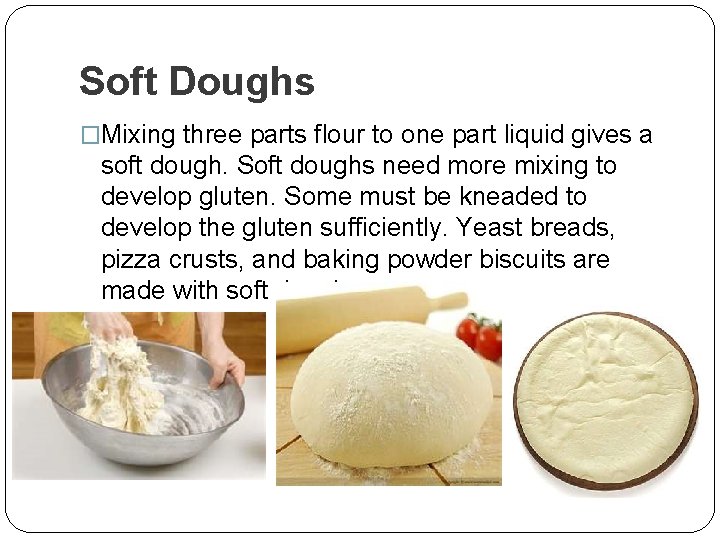
Soft Doughs �Mixing three parts flour to one part liquid gives a soft dough. Soft doughs need more mixing to develop gluten. Some must be kneaded to develop the gluten sufficiently. Yeast breads, pizza crusts, and baking powder biscuits are made with soft doughs.
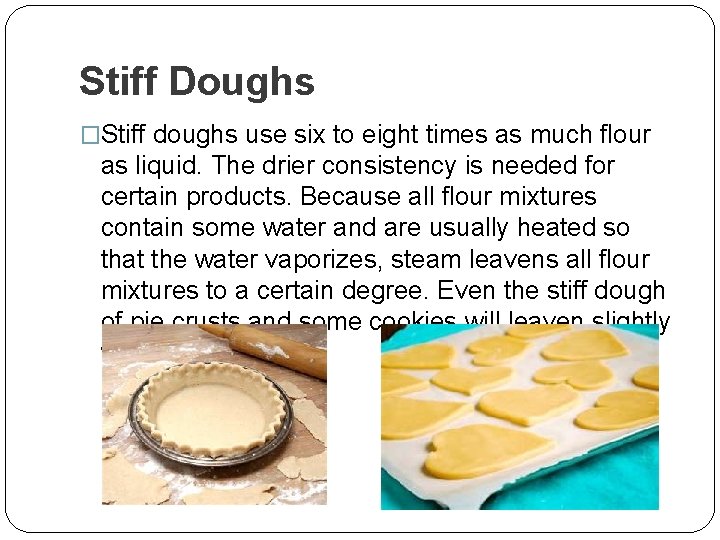
Stiff Doughs �Stiff doughs use six to eight times as much flour as liquid. The drier consistency is needed for certain products. Because all flour mixtures contain some water and are usually heated so that the water vaporizes, steam leavens all flour mixtures to a certain degree. Even the stiff dough of pie crusts and some cookies will leaven slightly with steam.
Making Yeast Products �Yeast bread is made from soft dough. The yeast used is Saccharomyces cerevisiae. It’s sold in both granular and compressed forms. The granular or pellet form is stable for long periods at room temperature due to its low moisture. It’s usually less than 9 percent water by weight. The compressed yeast contains considerably more water—about 70 percent water by weight—and should be refrigerated or frozen. �Besides the yeast, the basic ingredients in these breads are flour, liquid, and salt. Each ingredient has specific purposes.
Flour �The flour in bread provides starch as well as the proteins that produce gluten. Flour varies in its ability to make gluten. For yeast bread, flour with a strong gluten quality produces bread with high volume and fine texture. This is because the gluten traps the starch grains in the flour when the dough is mixed. Then as the bread bakes, these starch grains surround the gas cells and form the solid structure of the bread.
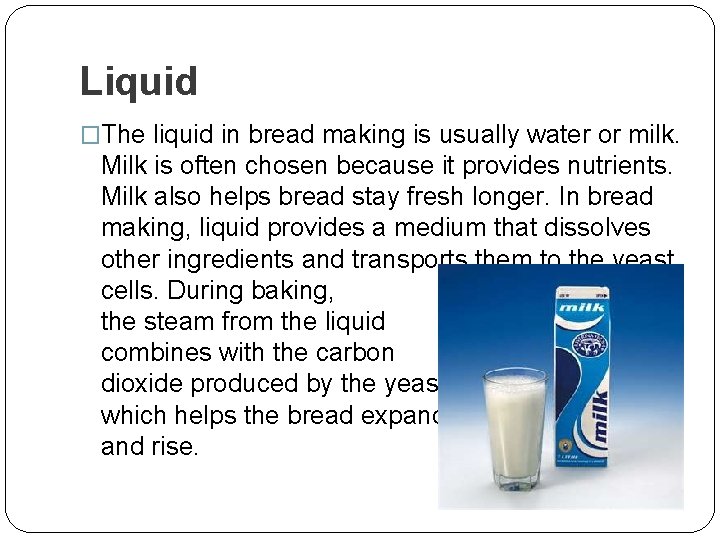
Liquid �The liquid in bread making is usually water or milk. Milk is often chosen because it provides nutrients. Milk also helps bread stay fresh longer. In bread making, liquid provides a medium that dissolves other ingredients and transports them to the yeast cells. During baking, the steam from the liquid combines with the carbon dioxide produced by the yeast, which helps the bread expand rise.
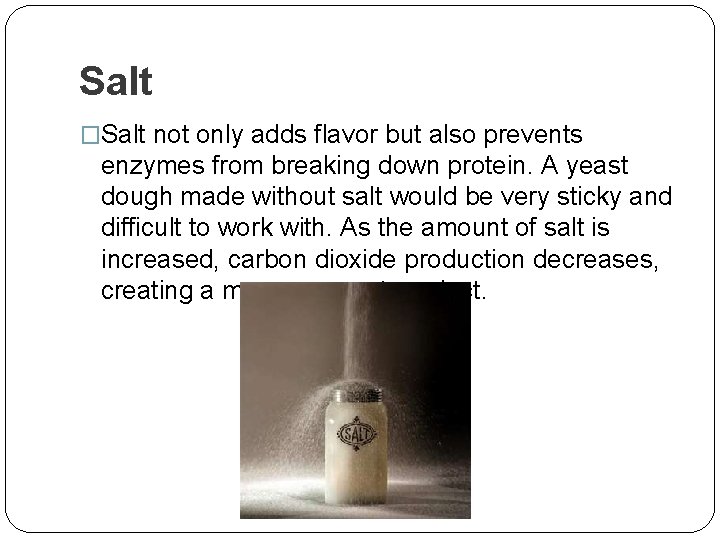
Salt �Salt not only adds flavor but also prevents enzymes from breaking down protein. A yeast dough made without salt would be very sticky and difficult to work with. As the amount of salt is increased, carbon dioxide production decreases, creating a more compact product.
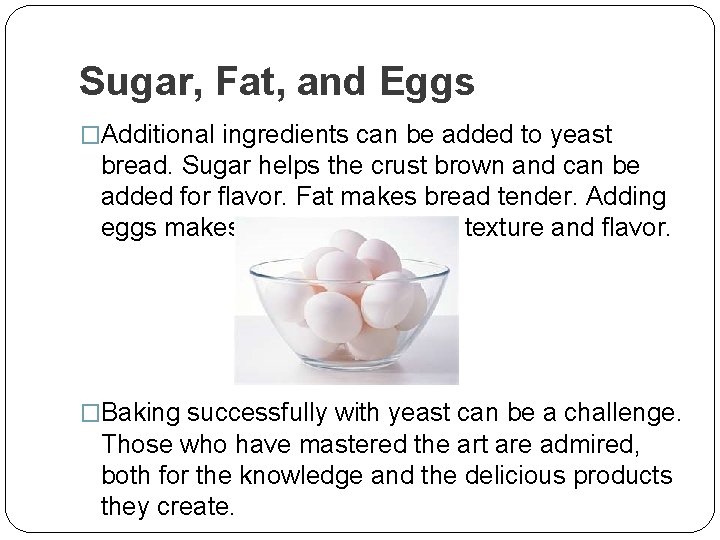
Sugar, Fat, and Eggs �Additional ingredients can be added to yeast bread. Sugar helps the crust brown and can be added for flavor. Fat makes bread tender. Adding eggs makes the bread richer in texture and flavor. �Baking successfully with yeast can be a challenge. Those who have mastered the art are admired, both for the knowledge and the delicious products they create.
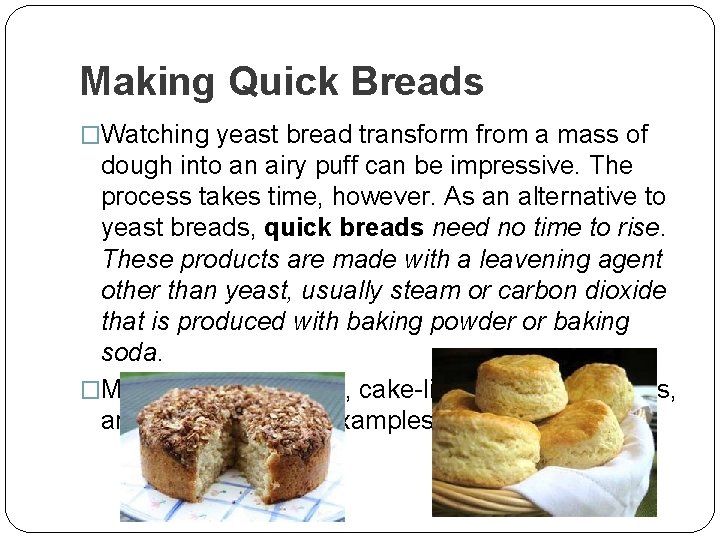
Making Quick Breads �Watching yeast bread transform from a mass of dough into an airy puff can be impressive. The process takes time, however. As an alternative to yeast breads, quick breads need no time to rise. These products are made with a leavening agent other than yeast, usually steam or carbon dioxide that is produced with baking powder or baking soda. �Muffins, coffee cakes, cake-like breads, popovers, and biscuits are all examples of quick breads.
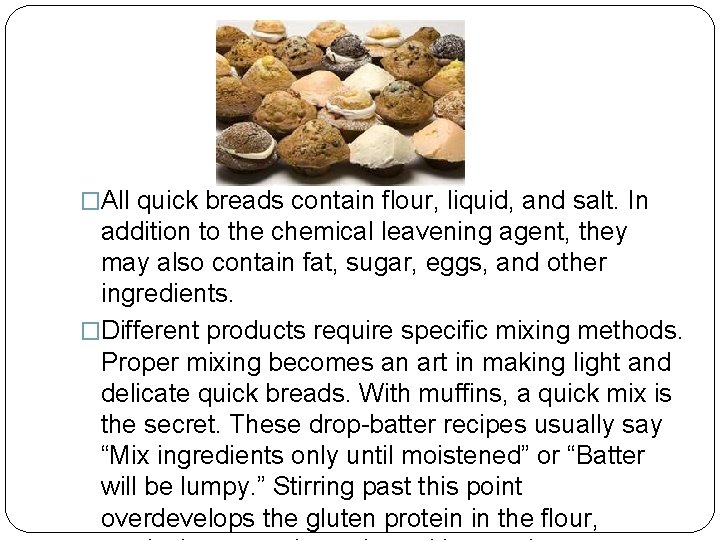
�All quick breads contain flour, liquid, and salt. In addition to the chemical leavening agent, they may also contain fat, sugar, eggs, and other ingredients. �Different products require specific mixing methods. Proper mixing becomes an art in making light and delicate quick breads. With muffins, a quick mix is the secret. These drop-batter recipes usually say “Mix ingredients only until moistened” or “Batter will be lumpy. ” Stirring past this point overdevelops the gluten protein in the flour,
Making Leavened Cakes �What makes a chocolate layer cake moist and tender, while an angel food cake is tall, light, and airy? A skilled baker gets some of the credit. The leavening used also affects a cake’s texture and other properties. Cakes may use any of the leavening agents you’ve read about. �Sheet cakes and layer cakes, traditional favorites at birthday parties, are most often shortened cakes. They contain fats (shortening) and usually a chemical agent as a primary leaven. Air is a minor leavening agent in shortened cakes. It is added when the fat and sugar are beaten together and when the ingredients are blended. Air is also added if the recipe calls for eggs to be beaten separately. Fat and eggs tenderize the
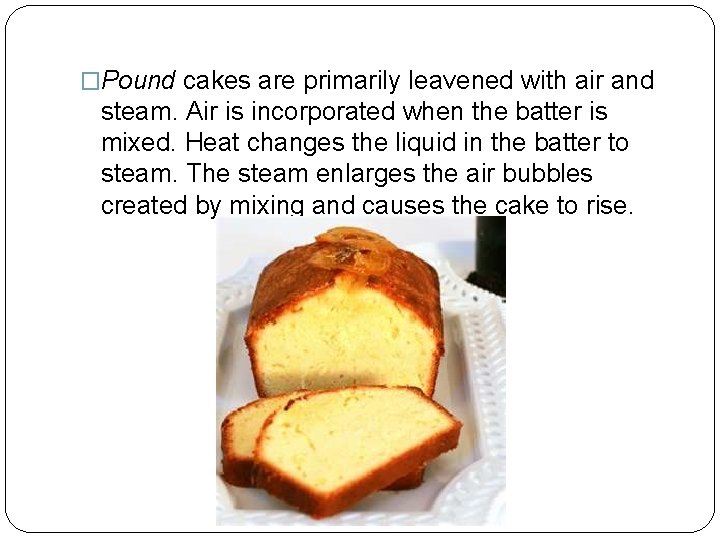
�Pound cakes are primarily leavened with air and steam. Air is incorporated when the batter is mixed. Heat changes the liquid in the batter to steam. The steam enlarges the air bubbles created by mixing and causes the cake to rise.
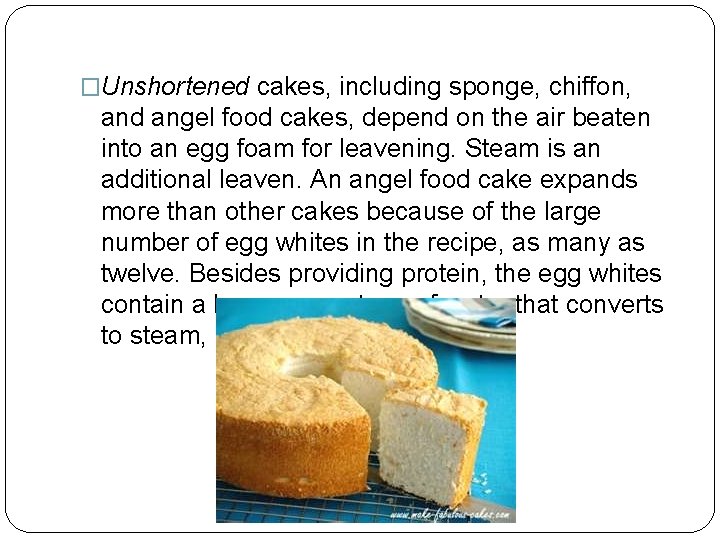
�Unshortened cakes, including sponge, chiffon, and angel food cakes, depend on the air beaten into an egg foam for leavening. Steam is an additional leaven. An angel food cake expands more than other cakes because of the large number of egg whites in the recipe, as many as twelve. Besides providing protein, the egg whites contain a large percentage of water that converts to steam, creating a tall, light cake.
- Slides: 39