
Learning Without Forgetting Approaches for Lifelong Robotic Vision
Learning Without Forgetting Approaches for Lifelong Robotic Vision Zhengwei Wang 1, Eoin Brophy 2 and Tomás E. Ward 2 1. V-SENSE, School of Computer Science and Statistics, Trinity College Dublin. 2. . Insight Centre for Data Analytics, Dublin City University.
Introduction Humans and animals have the capacity to continuously acquire, refine and transfer knowledge throughout their lifetime. This process is known as Lifelong Learning is not easily transferred to Machine Learning and forms parts of Robotic Vision problems. 2
Motivation/Drivers Main problem we are concerned with: • Catastrophic forgetting Caused by: • The distribution of datasets amongst others Can be improved through a few approaches. 1) Regularization 2) Dynamic Architectures 3) Complementary Learning Systems 3
Method We chose Learning without Forgetting (Lw. F) strategy for this work. • Used pre-trained Mobile. Net. V 2, retain weights up to bottleneck layer as Өp. • Train bottleneck from scratch. • Retain Өold that is trained from previous tasks to construct regularization term for new weights Өnew Note: No replay of previous task images. Only the updated weights Өnew is retained after training -> to be used in testing. 4
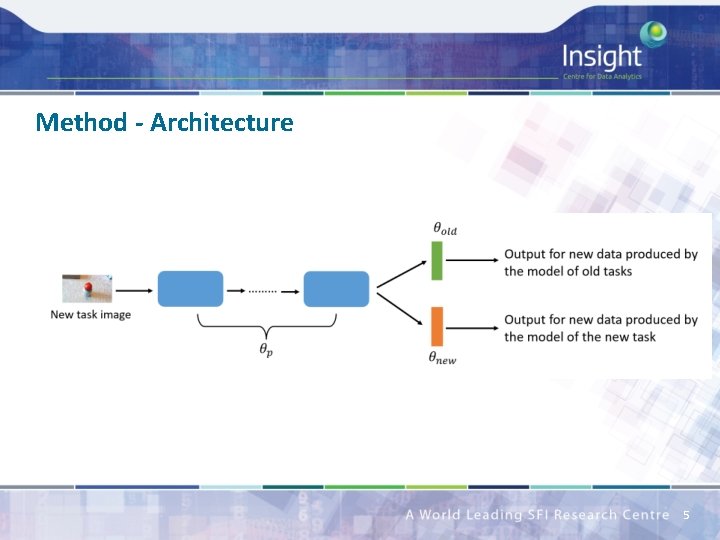
Method - Architecture 5
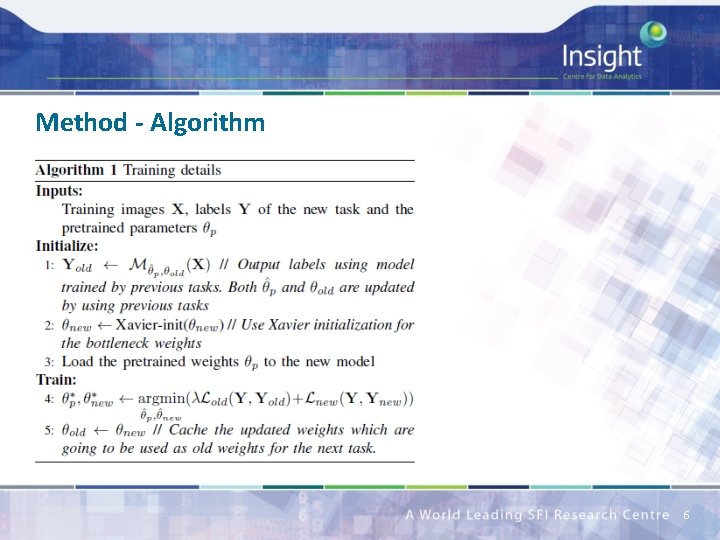
Method - Algorithm 6
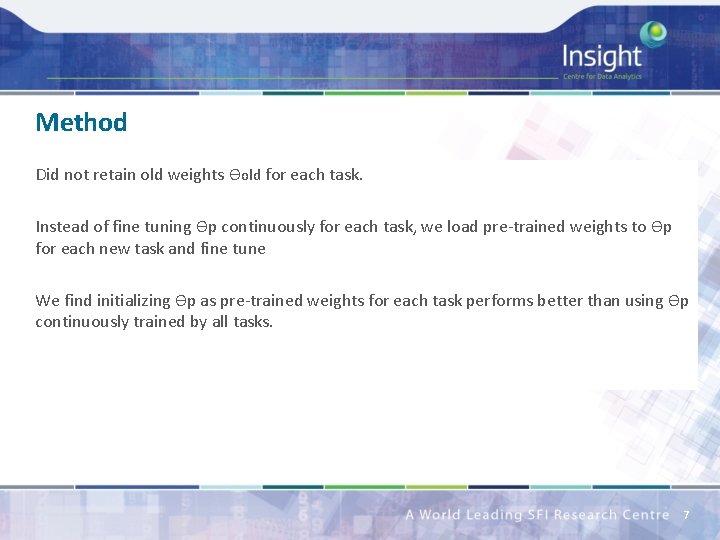
Method Did not retain old weights Өold for each task. Instead of fine tuning Өp continuously for each task, we load pre-trained weights to Өp for each new task and fine tune We find initializing Өp as pre-trained weights for each task performs better than using Өp continuously trained by all tasks. 7
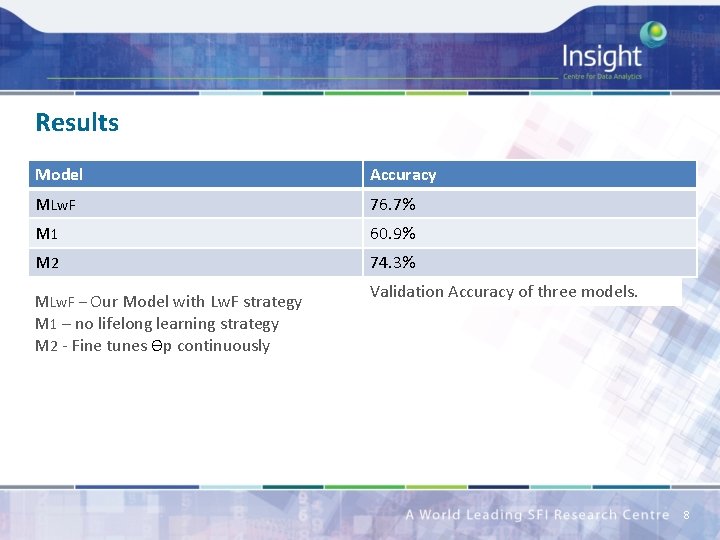
Results Model Accuracy MLw. F 76. 7% M 1 60. 9% M 2 74. 3% MLw. F – Our Model with Lw. F strategy M 1 – no lifelong learning strategy M 2 - Fine tunes Өp continuously Validation Accuracy of three models. 8
Conclusion This approach applies Learning without forgetting to robotic vision tasks in a ‘real-world’ scenario. The core backend is to prevent catastrophic forgetting. We build on the original approaches in order to become more suitable to this challenge. 9
Thank you for listening The team. Zhengwei Eoin Tomás Corresponding email: Zhengwei. wang@tcd. ie 10
- Slides: 10