
Learning with Prototypes CS 771 Introduction to Machine








- Slides: 22
Learning with Prototypes CS 771: Introduction to Machine Learning Nisheeth
2 Supervised Learning Labeled Training Data Supervised Learning Algorithm “dog” “cat” A test image Cat vs Dog Prediction model Predicted Label (cat/dog) Cat vs Dog Prediction model CS 771: Intro to ML
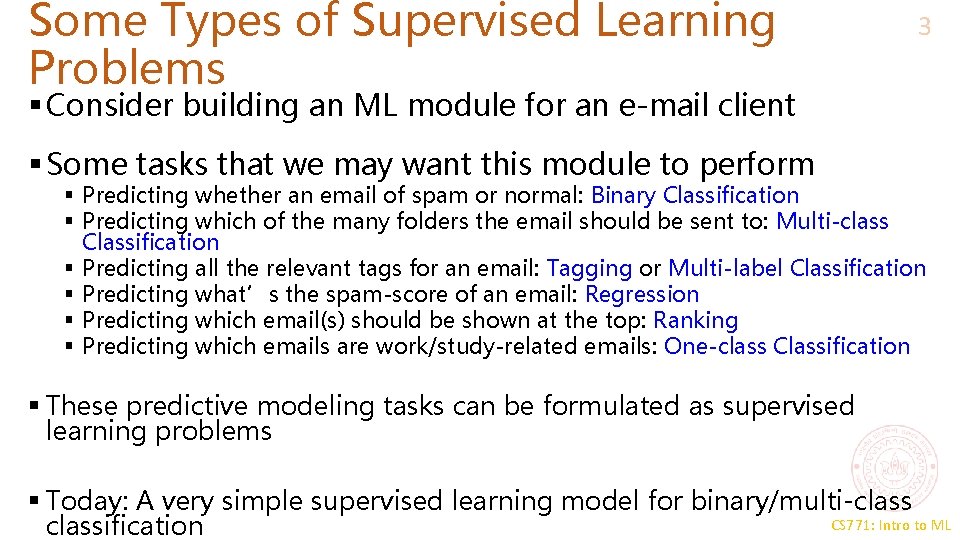
Some Types of Supervised Learning Problems 3 § Consider building an ML module for an e-mail client § Some tasks that we may want this module to perform § Predicting whether an email of spam or normal: Binary Classification § Predicting which of the many folders the email should be sent to: Multi-class Classification § Predicting all the relevant tags for an email: Tagging or Multi-label Classification § Predicting what’s the spam-score of an email: Regression § Predicting which email(s) should be shown at the top: Ranking § Predicting which emails are work/study-related emails: One-class Classification § These predictive modeling tasks can be formulated as supervised learning problems § Today: A very simple supervised learning model for binary/multi-class CS 771: Intro to ML classification
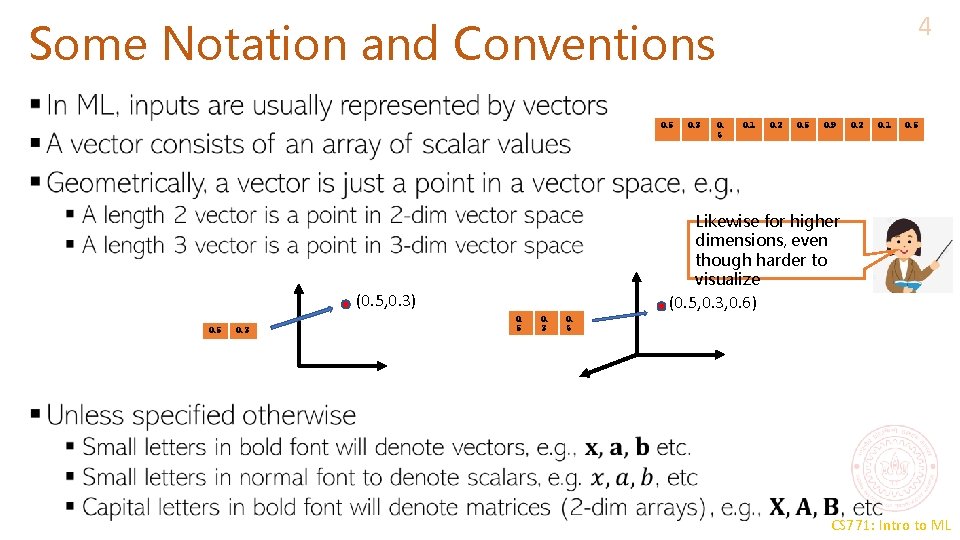
4 Some Notation and Conventions • 0. 5 0. 3 0. 6 0. 1 0. 2 0. 5 0. 9 0. 2 0. 1 0. 5 Likewise for higher dimensions, even though harder to visualize (0. 5, 0. 3) 0. 5 0. 3 (0. 5, 0. 3, 0. 6) 0. 5 0. 3 0. 6 CS 771: Intro to ML
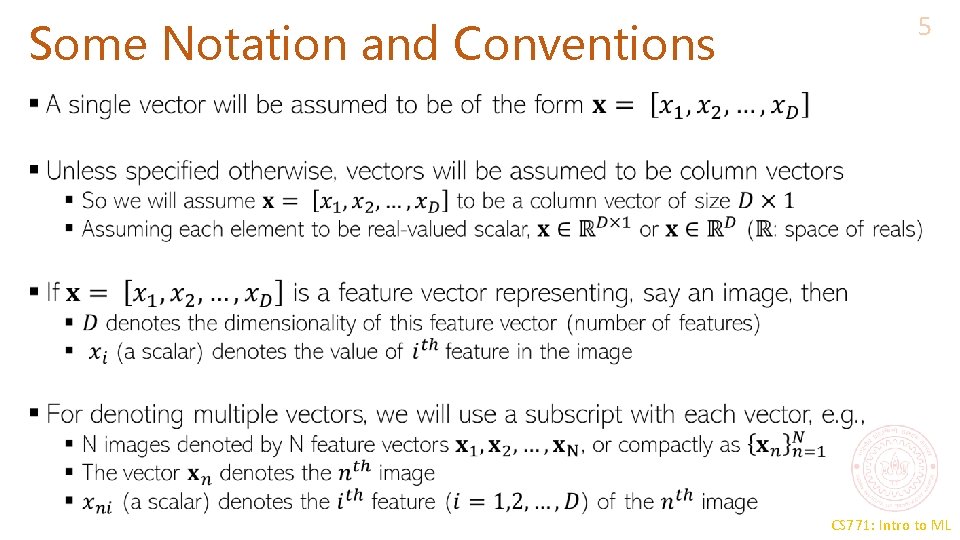
Some Notation and Conventions 5 • CS 771: Intro to ML
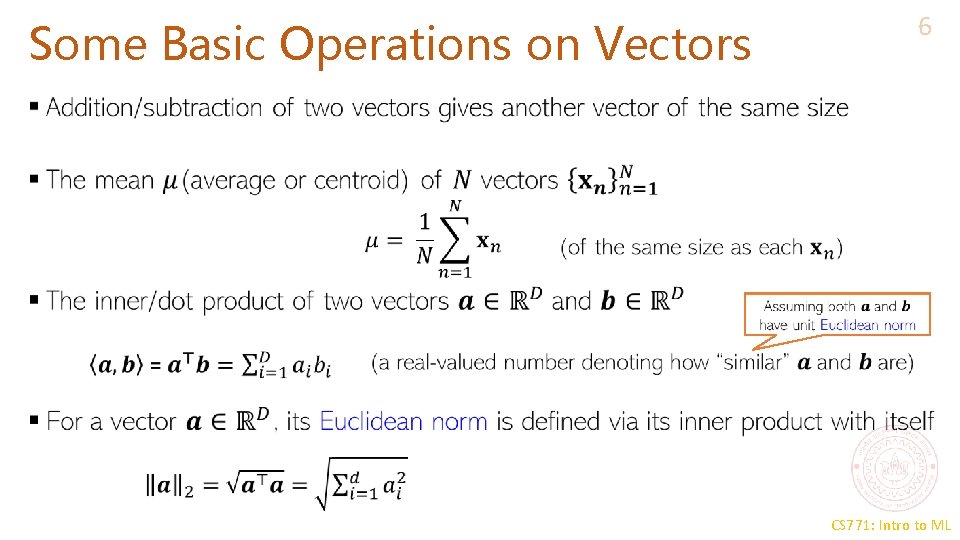
Some Basic Operations on Vectors 6 • CS 771: Intro to ML
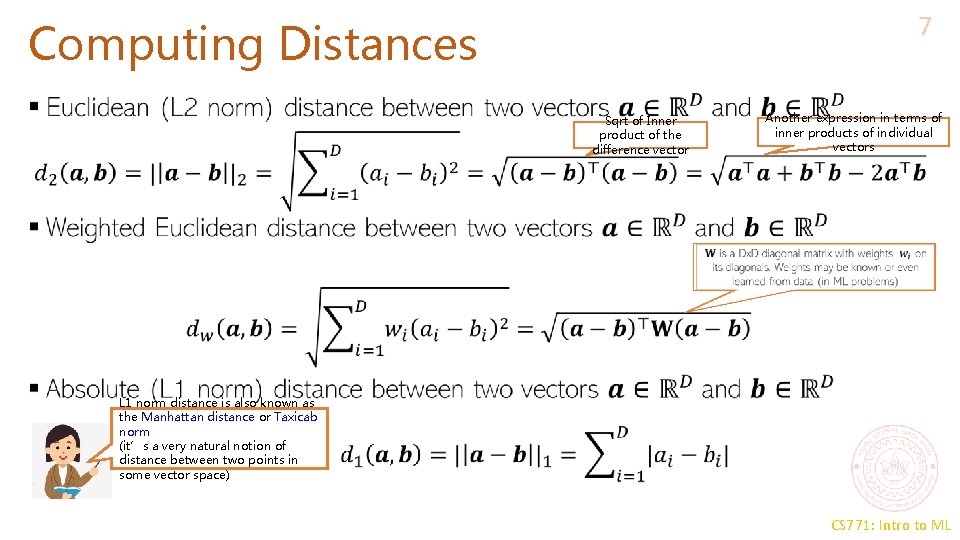
7 Computing Distances • Sqrt of Inner product of the difference vector Another expression in terms of inner products of individual vectors L 1 norm distance is also known as the Manhattan distance or Taxicab norm (it’s a very natural notion of distance between two points in some vector space) CS 771: Intro to ML
8 Our First Supervised Learner CS 771: Intro to ML
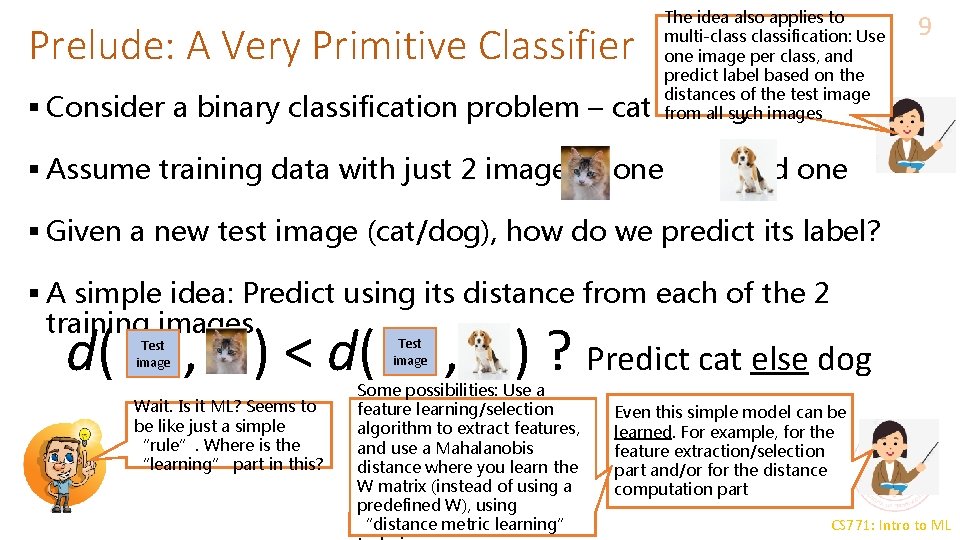
Prelude: A Very Primitive Classifier The idea also applies to multi-classification: Use one image per class, and predict label based on the distances of the test image from all such images 9 § Consider a binary classification problem – cat vs dog § Assume training data with just 2 images – one and one § Given a new test image (cat/dog), how do we predict its label? § A simple idea: Predict using its distance from each of the 2 training images d( Test image , ) < d( Wait. Is it ML? Seems to be like just a simple “rule”. Where is the “learning” part in this? Test image , ) ? Predict cat else dog Some possibilities: Use a feature learning/selection algorithm to extract features, and use a Mahalanobis distance where you learn the W matrix (instead of using a predefined W), using “distance metric learning” Even this simple model can be learned. For example, for the feature extraction/selection part and/or for the distance computation part CS 771: Intro to ML
10 Improving Our Primitive Classifier § Just one input per class may not sufficiently capture variations in a class § A natural improvement can be by using more inputs per class “dog” “cat” “dog” § We will consider two approaches to do this § Learning with Prototypes (Lw. P) § Nearest Neighbors (NN) § Both Lw. P and NN will use multiple inputs per class but in different ways CS 771: Intro to ML
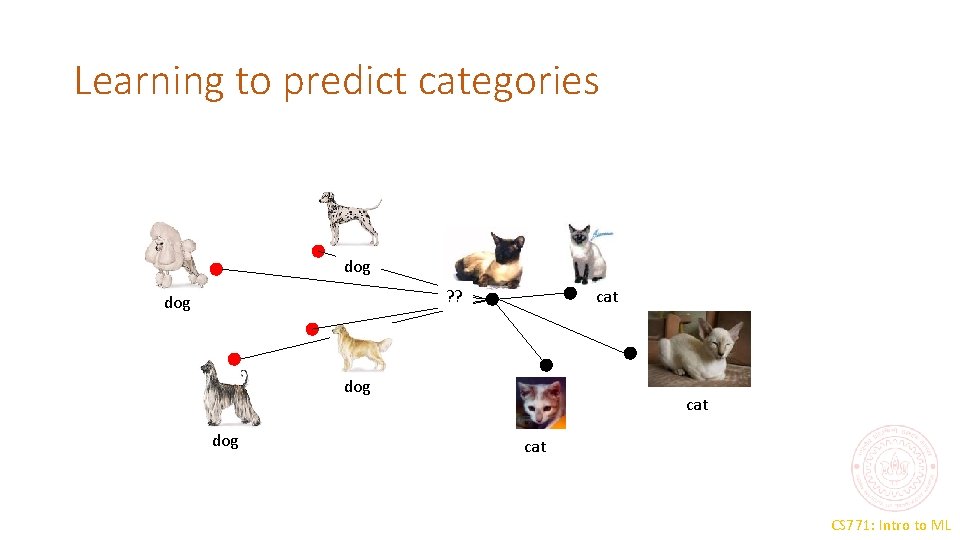
Learning to predict categories dog ? ? dog cat CS 771: Intro to ML
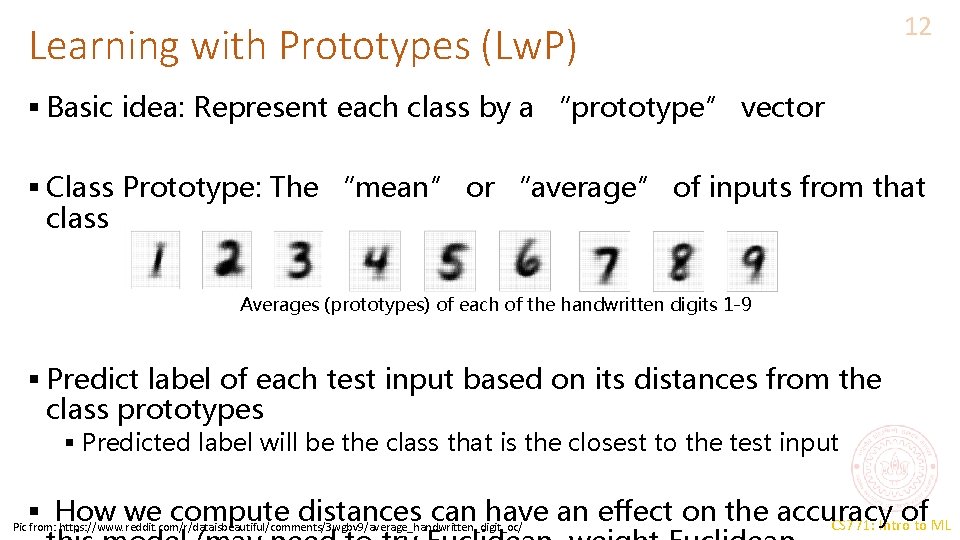
Learning with Prototypes (Lw. P) 12 § Basic idea: Represent each class by a “prototype” vector § Class Prototype: The “mean” or “average” of inputs from that class Averages (prototypes) of each of the handwritten digits 1 -9 § Predict label of each test input based on its distances from the class prototypes § Predicted label will be the class that is the closest to the test input § How we compute distances can have an effect on the accuracy of CS 771: Intro to ML Pic from: https: //www. reddit. com/r/dataisbeautiful/comments/3 wgbv 9/average_handwritten_digit_oc/
Learning with Prototypes (Lw. P): An Illustration 13 • Lw. P straightforwardly generalizes to more than 2 classes as well (multi-classification) – K prototypes for K classes Test example CS 771: Intro to ML
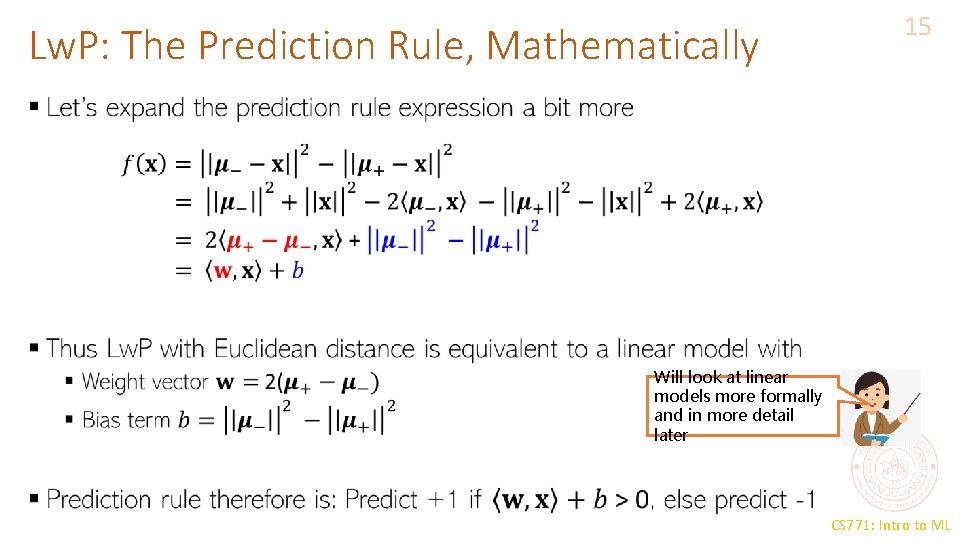
14 Lw. P: The Prediction Rule, Mathematically § What does the prediction rule for Lw. P look like mathematically? § Assume we are using Euclidean distances here CS 771: Intro to ML
Lw. P: The Prediction Rule, Mathematically 15 • Will look at linear models more formally and in more detail later CS 771: Intro to ML
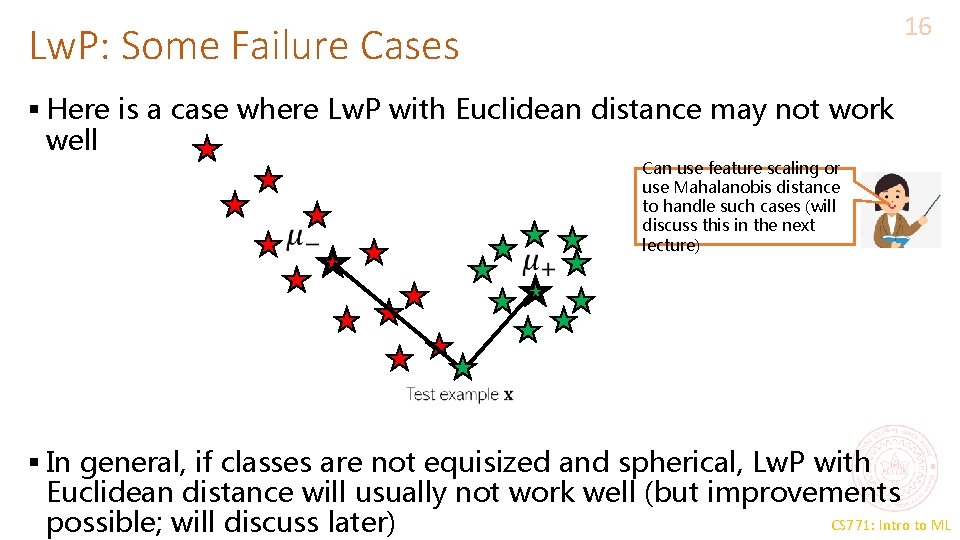
16 Lw. P: Some Failure Cases § Here is a case where Lw. P with Euclidean distance may not work well Can use feature scaling or use Mahalanobis distance to handle such cases (will discuss this in the next lecture) § In general, if classes are not equisized and spherical, Lw. P with Euclidean distance will usually not work well (but improvements CS 771: Intro to ML possible; will discuss later)
17 Lw. P: Some Key Aspects § Very simple, interpretable, and lightweight model § Just requires computing and storing the class prototype vectors § Works with any number of classes (thus for multi-classification as well) § Can be generalized in various ways to improve it further, e. g. , § Modeling each class by a probability distribution rather than just a prototype vector § Using distances other than the standard Euclidean distance (e. g. , Mahalanobis) § With a learned distance function, can work very well even with CS 771: Intro to ML
18 Learning with Prototypes (Lw. P) Prediction rule for Lw. P (for binary classification with Euclidean distance) Decision boundary (perpendicular bisector of line joining the class Exercise: Show that for the bin. classfn case prototype vectors) If Euclidean distance used Can throw away training data after computing the prototypes and just need to keep the model parameters for the test time in such “parametric” models CS 771: Intro to ML
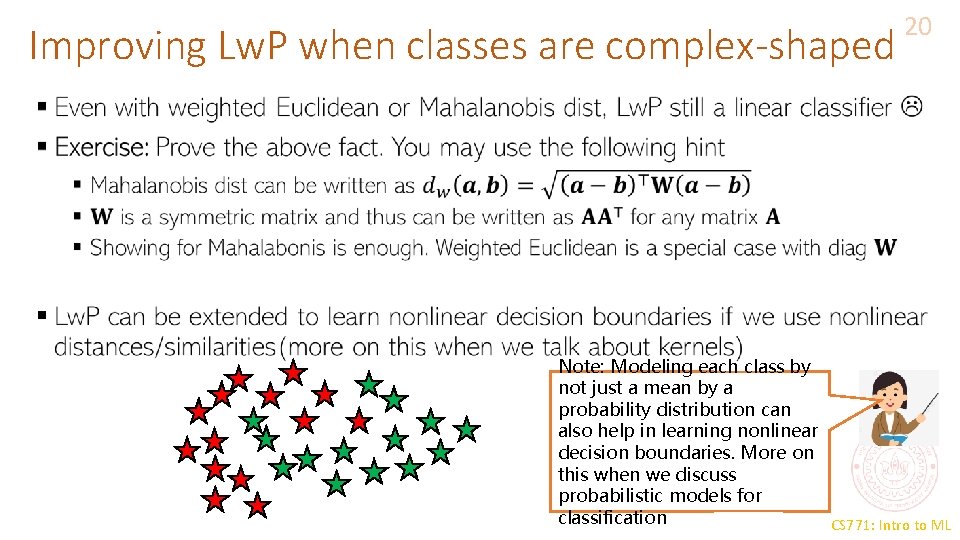
Improving Lw. P when classes are complex-shaped 19 § Using weighted Euclidean or Mahalanobis distance can sometimes help A good W will help bring points from same class closer and move different classes apart W will be a 2 x 2 the symmetric § Note: Mahalanobis distance also has effect of rotating the matrix in this case (chosen by axes which helps us or learned) CS 771: Intro to ML
Improving Lw. P when classes are complex-shaped 20 • Note: Modeling each class by not just a mean by a probability distribution can also help in learning nonlinear decision boundaries. More on this when we discuss probabilistic models for classification CS 771: Intro to ML
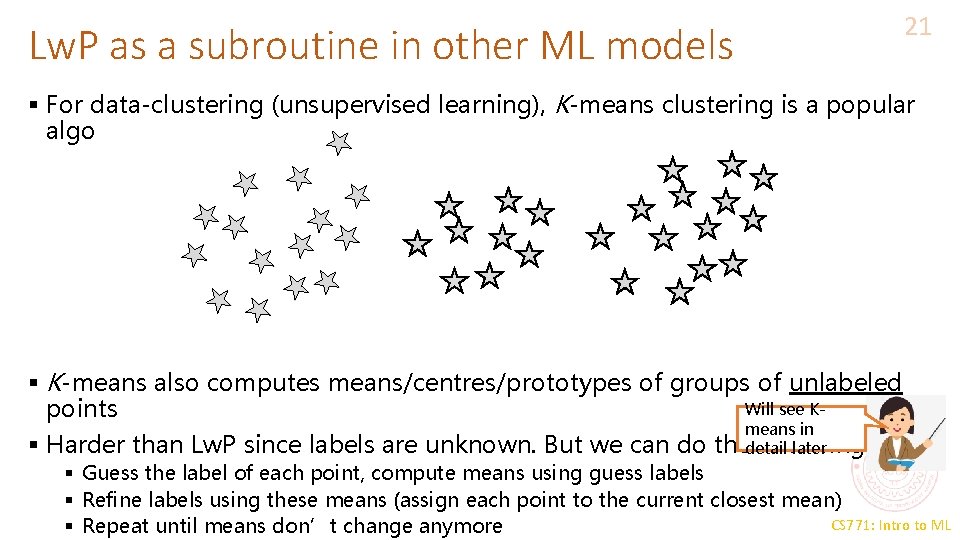
Lw. P as a subroutine in other ML models 21 § For data-clustering (unsupervised learning), K-means clustering is a popular algo § K-means also computes means/centres/prototypes of groups of unlabeled Will see Kpoints means in § Harder than Lw. P since labels are unknown. But we can do thedetail following later § Guess the label of each point, compute means using guess labels § Refine labels using these means (assign each point to the current closest mean) CS 771: Intro to ML § Repeat until means don’t change anymore
Next Lecture 22 § Nearest Neighbors CS 771: Intro to ML