
Learning with Decision Trees Artificial Intelligence CMSC 25000
- Slides: 29
Learning with Decision Trees Artificial Intelligence CMSC 25000 February 20, 2003
Agenda • Learning from examples – Machine learning review – Identification Trees: • • • Basic characteristics Sunburn example From trees to rules Learning by minimizing heterogeneity Analysis: Pros & Cons
Machine Learning: Review • Learning: – Automatically acquire a function from inputs to output values, based on previously seen inputs and output values. – Input: Vector of feature values – Output: Value • Examples: Word pronunciation, robot motion, speech recognition
Machine Learning: Review • Key contrasts: – Supervised versus Unsupervised • With or without labeled examples (known outputs) – Classification versus Regression • Output values: Discrete versus continuous-valued – Types of functions learned • aka “Inductive Bias” • Learning algorithm restricts things that can be learned
Machine Learning: Review • Key issues: – Feature selection: • What features should be used? • How do they relate to each other? • How sensitive is the technique to feature selection? – Irrelevant, noisy, absent feature; feature types – Complexity & Generalization • Tension between – Matching training data – Performing well on NEW UNSEEN inputs
Machine Learning Features • Inputs: – E. g. words, acoustic measurements, financial data – Vectors of features: • E. g. word: letters – ‘cat’: L 1=c; L 2 = a; L 3 = t • Financial data: F 1= # late payments/yr : Integer • F 2 = Ratio of income to expense: Real
Machine Learning Features • Question: – Which features should be used? – How should they relate to each other? • Issue 1: How do we define relation in feature space if features have different scales? – Solution: Scaling/normalization • Issue 2: Which ones are important? – If differ in irrelevant feature, should ignore
Complexity & Generalization • Goal: Predict values accurately on new inputs • Problem: – Train on sample data – Can make arbitrarily complex model to fit – BUT, will probably perform badly on NEW data • Strategy: – Limit complexity of model (e. g. degree of equ’n) – Split training and validation sets • Hold out data to check for overfitting
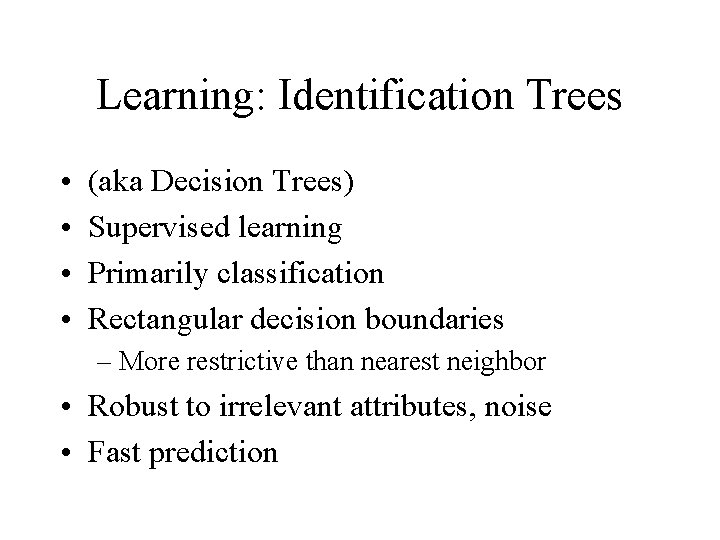
Learning: Identification Trees • • (aka Decision Trees) Supervised learning Primarily classification Rectangular decision boundaries – More restrictive than nearest neighbor • Robust to irrelevant attributes, noise • Fast prediction
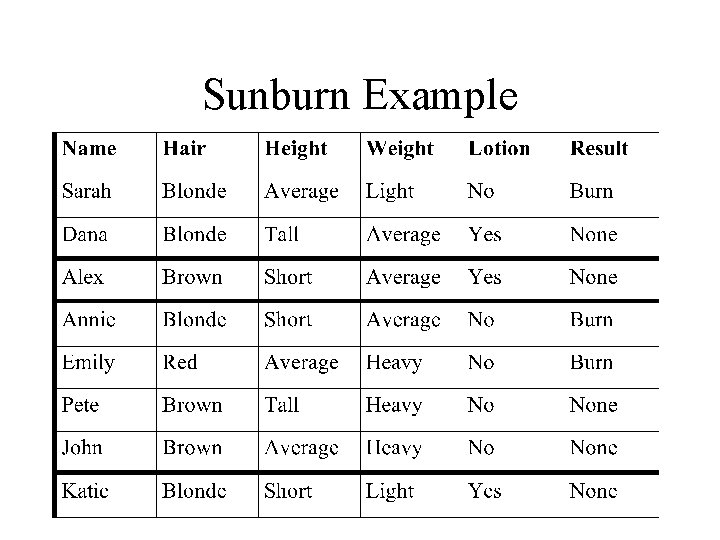
Sunburn Example
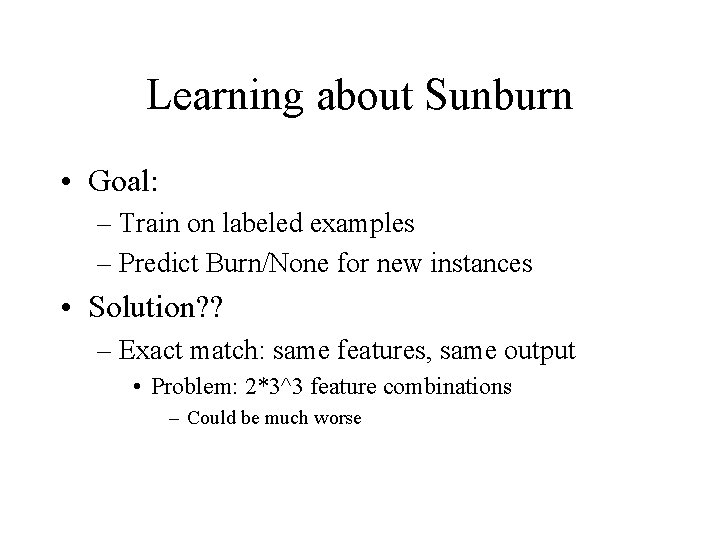
Learning about Sunburn • Goal: – Train on labeled examples – Predict Burn/None for new instances • Solution? ? – Exact match: same features, same output • Problem: 2*3^3 feature combinations – Could be much worse
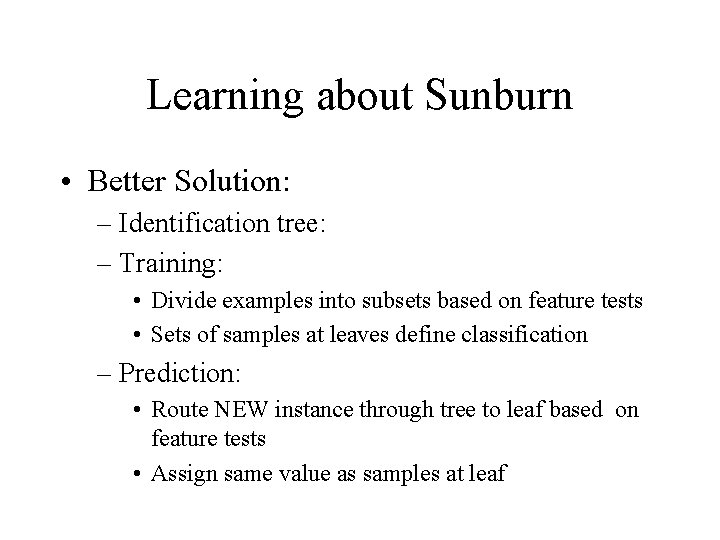
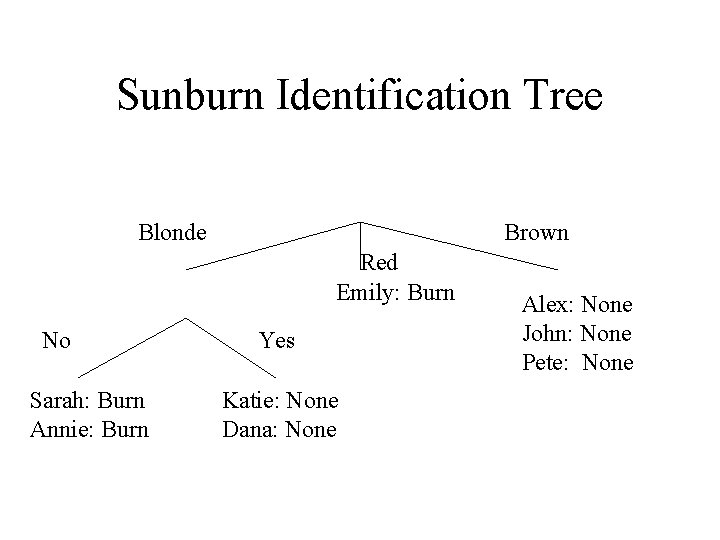
Learning about Sunburn • Better Solution: – Identification tree: – Training: • Divide examples into subsets based on feature tests • Sets of samples at leaves define classification – Prediction: • Route NEW instance through tree to leaf based on feature tests • Assign same value as samples at leaf
Sunburn Identification Tree Blonde Brown Red Emily: Burn No Sarah: Burn Annie: Burn Yes Katie: None Dana: None Alex: None John: None Pete: None
Simplicity • Occam’s Razor: – Simplest explanation that covers the data is best • Occam’s Razor for ID trees: – Smallest tree consistent with samples will be best predictor for new data • Problem: – Finding all trees & finding smallest: Expensive! • Solution: – Greedily build a small tree
Building ID Trees • Goal: Build a small tree such that all samples at leaves have same class • Greedy solution: – At each node, pick test such that branches are closest to having same class • Split into subsets with least “disorder” – (Disorder ~ Entropy) – Find test that minimizes disorder
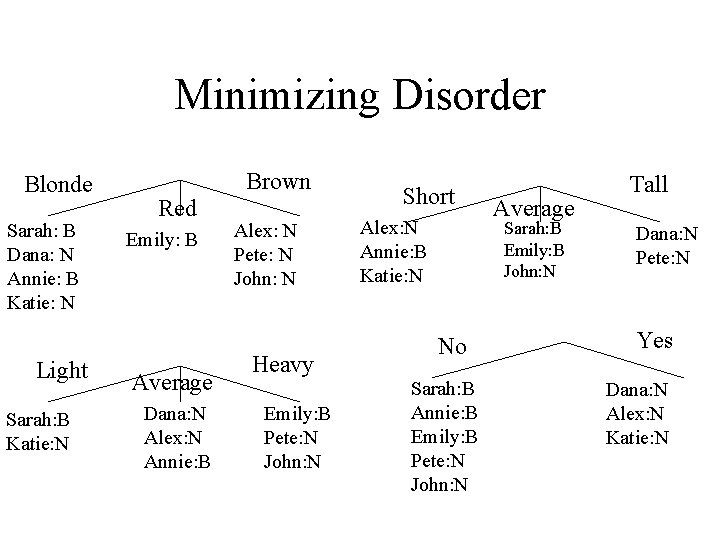
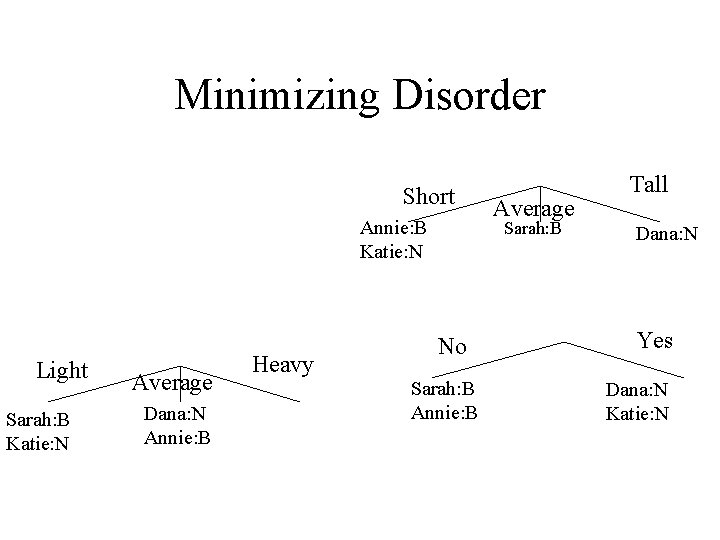
Minimizing Disorder Blonde Sarah: B Dana: N Annie: B Katie: N Light Sarah: B Katie: N Brown Red Emily: B Average Dana: N Alex: N Annie: B Alex: N Pete: N John: N Heavy Emily: B Pete: N John: N Short Alex: N Annie: B Katie: N Average Sarah: B Emily: B John: N No Sarah: B Annie: B Emily: B Pete: N John: N Tall Dana: N Pete: N Yes Dana: N Alex: N Katie: N
Minimizing Disorder Short Annie: B Katie: N Light Sarah: B Katie: N Average Dana: N Annie: B Heavy Average Sarah: B No Sarah: B Annie: B Tall Dana: N Yes Dana: N Katie: N
Measuring Disorder • Problem: – In general, tests on large DB’s don’t yield homogeneous subsets • Solution: – General information theoretic measure of disorder – Desired features: • Homogeneous set: least disorder = 0 • Even split: most disorder = 1
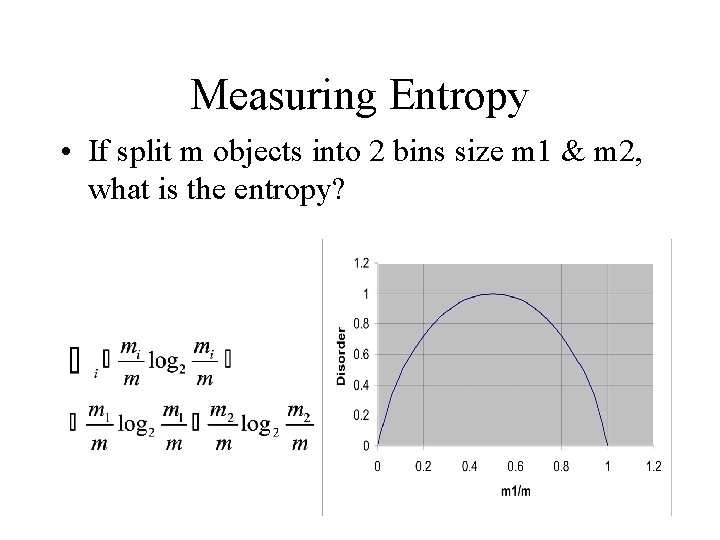
Measuring Entropy • If split m objects into 2 bins size m 1 & m 2, what is the entropy?
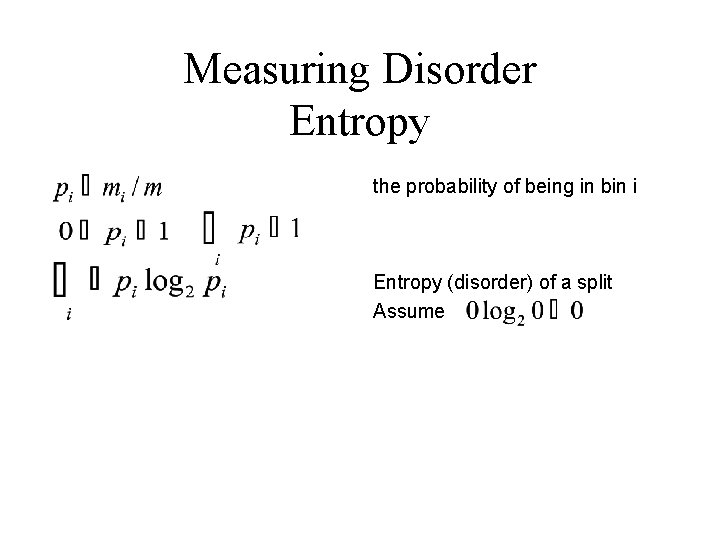
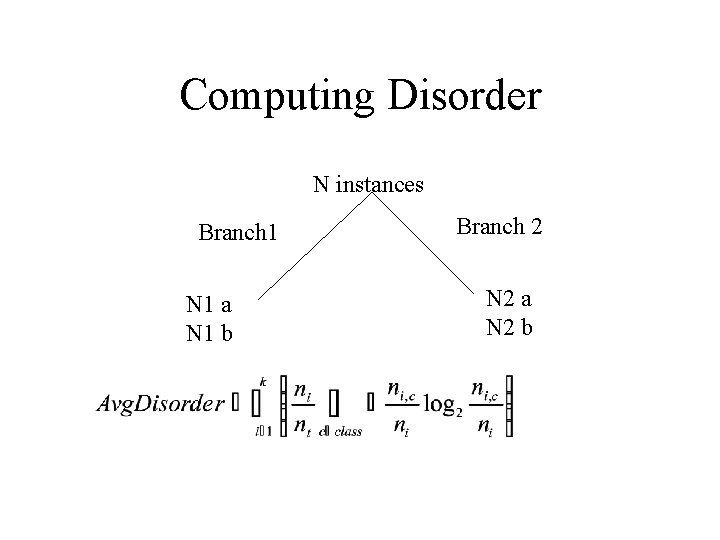
Measuring Disorder Entropy the probability of being in bin i Entropy (disorder) of a split Assume
Computing Disorder N instances Branch 1 N 1 a N 1 b Branch 2 N 2 a N 2 b
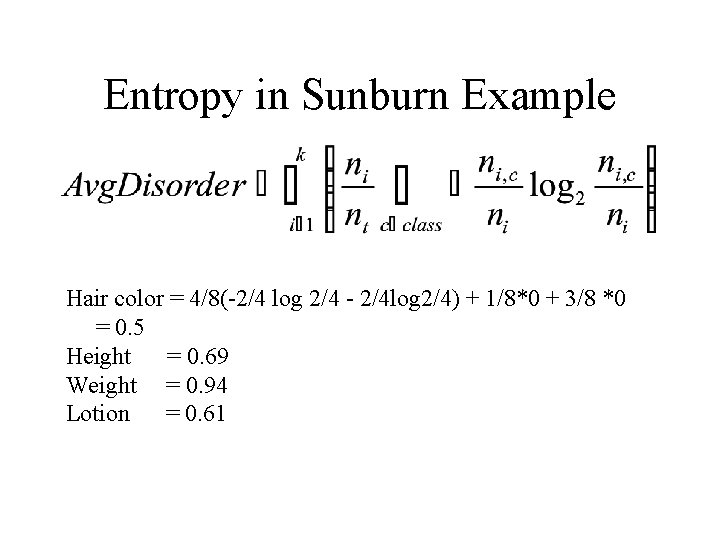
Entropy in Sunburn Example Hair color = 4/8(-2/4 log 2/4 - 2/4 log 2/4) + 1/8*0 + 3/8 *0 = 0. 5 Height = 0. 69 Weight = 0. 94 Lotion = 0. 61
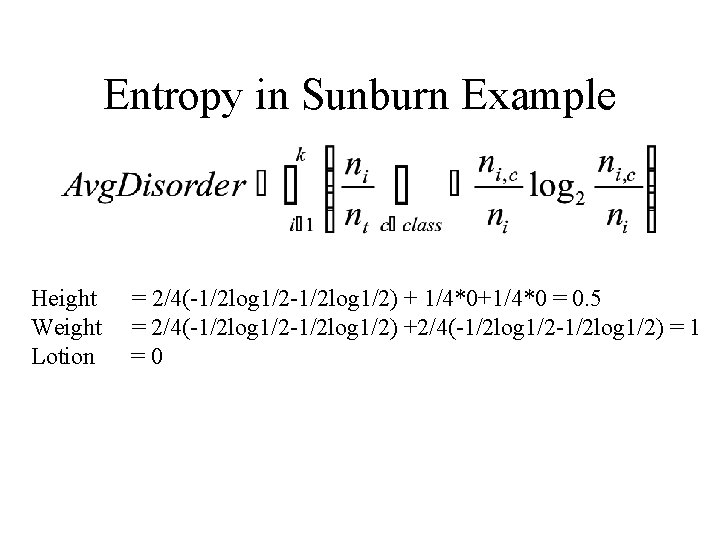
Entropy in Sunburn Example Height Weight Lotion = 2/4(-1/2 log 1/2) + 1/4*0+1/4*0 = 0. 5 = 2/4(-1/2 log 1/2) +2/4(-1/2 log 1/2) = 1 =0
Building ID Trees with Disorder • Until each leaf is as homogeneous as possible – Select an inhomogeneous leaf node – Replace that leaf node by a test node creating subsets with least average disorder • Effectively creates set of rectangular regions – Repeatedly draws lines in different axes
Features in ID Trees: Pros • Feature selection: – Tests features that yield low disorder • E. g. selects features that are important! – Ignores irrelevant features • Feature type handling: – Discrete type: 1 branch per value – Continuous type: Branch on >= value • Need to search to find best breakpoint • Absent features: Distribute uniformly
Features in ID Trees: Cons • Features – Assumed independent – If want group effect, must model explicitly • E. g. make new feature Aor. B • Feature tests conjunctive
From Trees to Rules • Tree: – Branches from root to leaves = – Tests => classifications – Tests = if antecedents; Leaf labels= consequent – All ID trees-> rules; Not all rules as trees
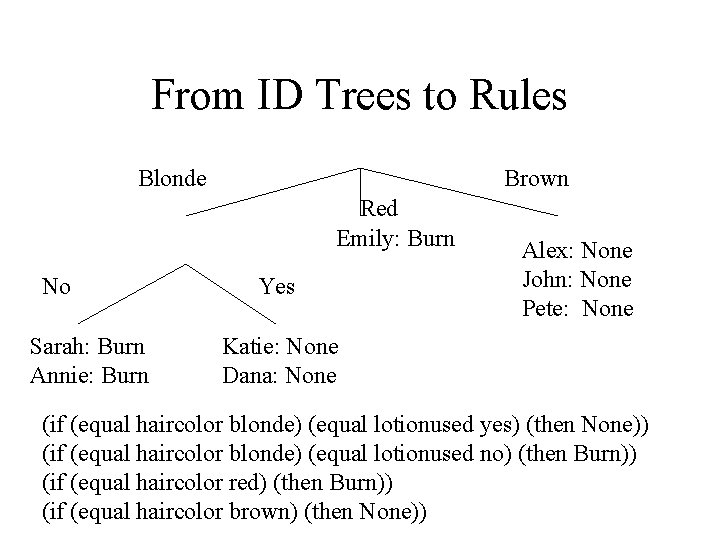
From ID Trees to Rules Blonde Brown Red Emily: Burn No Sarah: Burn Annie: Burn Yes Alex: None John: None Pete: None Katie: None Dana: None (if (equal haircolor blonde) (equal lotionused yes) (then None)) (if (equal haircolor blonde) (equal lotionused no) (then Burn)) (if (equal haircolor red) (then Burn)) (if (equal haircolor brown) (then None))
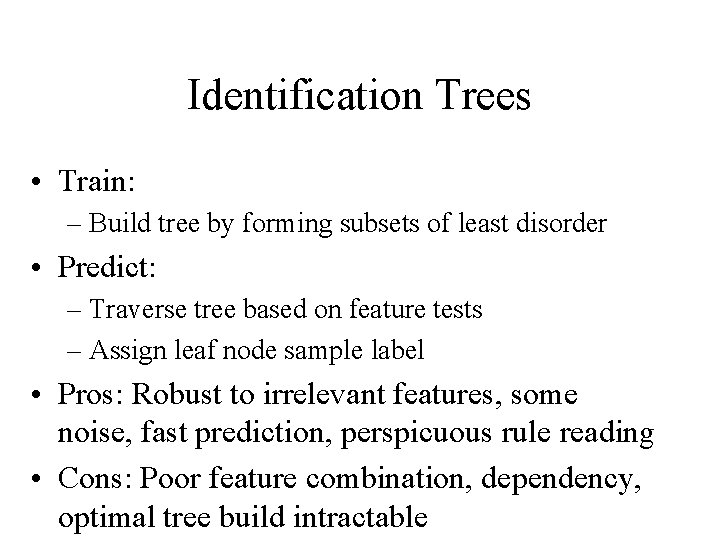
Identification Trees • Train: – Build tree by forming subsets of least disorder • Predict: – Traverse tree based on feature tests – Assign leaf node sample label • Pros: Robust to irrelevant features, some noise, fast prediction, perspicuous rule reading • Cons: Poor feature combination, dependency, optimal tree build intractable