
Learning UNIT4 LEARNING Introduction Learning is a process


- Slides: 34
Learning UNIT-4
LEARNING- Introduction Learning is a process by which new behaviors are acquired. It is generally agreed that learning involves changes in behavior, practicing new behaviors and establishing permanency in the change. Learning is any permanent change in behavior of a person that occurs as result of experience. Learning has taken place if an individual behaves, reacts, respondents as a result of experience in a manner different from the way he formerly behaved.
Nature Of Learning involves a change in behavior, though this change is not necessarily an improvement over previous behavior. It has the connotation of improved, but bad habits, prejudices , stereotypes and work restrictions are also learned. The behavioral change must be relatively permanent. Any temporary change due to fatigue or nay reason is not a part of learning. The behavioral change must be based on some form of practice or experience. Thus, any behavioral change because of physical maturation is not learning. The practice or experience must be reinforced in order for learning to occur. If reinforcement does not accompany the practice or experience , the behavior will disappear.
Components Of Learning There are various components of learning: • Drive • Cue stimuli • Generalization • Discrimination • Responses • Reinforcement • Retention • Extinction • Spontaneous Recovery
Components Of Learning Drive Learning frequently occurs in the presence of drive – any strong stimulus that impels action. Drives are basically of two types -primary (or physiological); and secondary (or psychological). These two categories of drives often interact with each other. Individuals operate under many drives at the same time. To predict a behavior, it is necessary to establish which drives are stimulating the most. Cue Stimuli Cue stimuli are those factors that exist in the environment as perceived by the individual. The idea is to discover the conditions under which stimulus will increase the probability of eliciting a specific response. There may be two types of stimuli with respect to their results in terms of response concerned: generalization and discrimination.
Components Of Learning Generalization occurs when a response is elicited by a similar but new stimulus. If two stimuli are exactly alike, they will have the same probability of evoking a specified response. The principle of generalization has important implications for human learning. Because of generalization, a person does not have to ‘completely relearn each of the new tasks. It allows the members to adapt to overall changing conditions and specific new assignments. The individual can borrow from past learning experiences to adjust more smoothly to new learning situations. Discrimination is a procedure in which an organization learns to emit a response to a stimulus but avoids making the same response to a similar but somewhat different stimulus. Discrimination has wide applications in ‘organizational behavior. For example, a supervisor can discriminate between two equally high producing workers, one with low quality and other with high quality. .
Components Of Learning Responses The stimulus results in responses. Responses may be in the physical form or may be in terms of attitudes, familiarity, perception or other complex phenomena. In the above example, the supervisor discriminates between the worker producing low quality products and the worker producing high quality products, and positively responds only to the quality conscious worker. Reinforcement is a fundamental condition of learning. Without reinforcement, no measurable modification of behavior takes place. Reinforcement may be defined as the environmental event’s affecting the probability of occurrence of responses with which they are associated.
Components Of Learning Retention The stability of learned behavior over time is defined as retention and its contrary is known as forgetting. Some of the learning is retained over a period of time while others may be forgotten.
Factors Affecting Learning There are various factors affecting individual’s learning: 1. Motivation 2. Mental set 3. Nature of learning materials 4. Practice 5. Environment
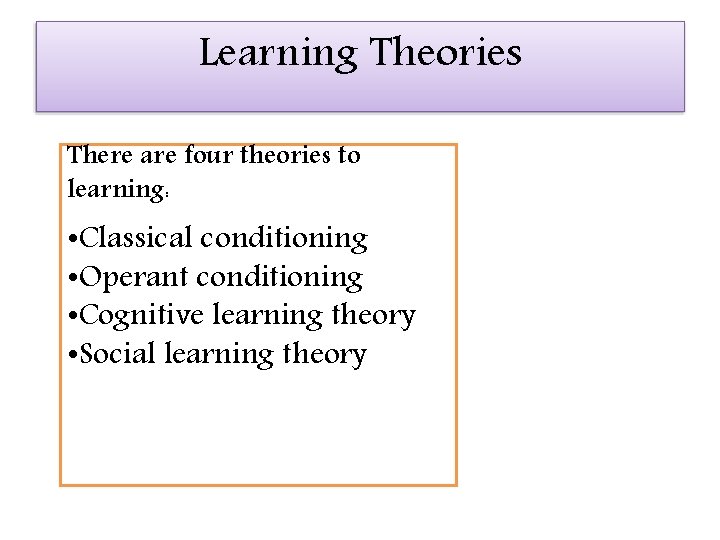
Learning Theories There are four theories to learning: • Classical conditioning • Operant conditioning • Cognitive learning theory • Social learning theory
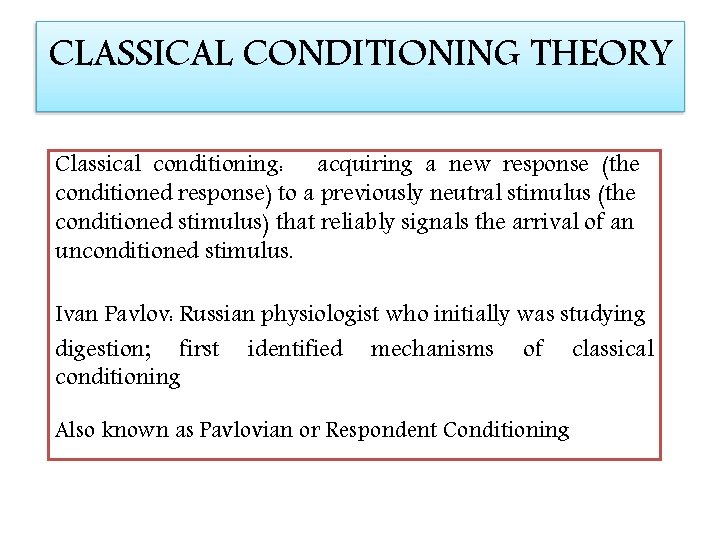
CLASSICAL CONDITIONING THEORY Classical conditioning: acquiring a new response (the conditioned response) to a previously neutral stimulus (the conditioned stimulus) that reliably signals the arrival of an unconditioned stimulus. Ivan Pavlov: Russian physiologist who initially was studying digestion; first identified mechanisms of classical conditioning Also known as Pavlovian or Respondent Conditioning
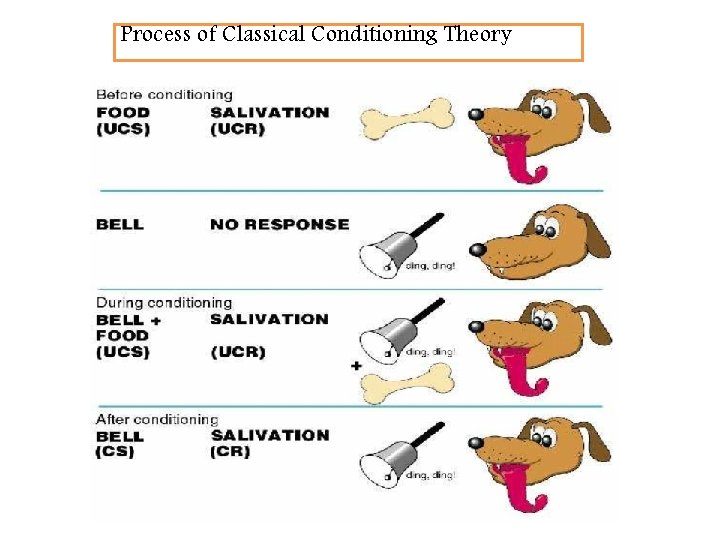
Process of Classical Conditioning Theory
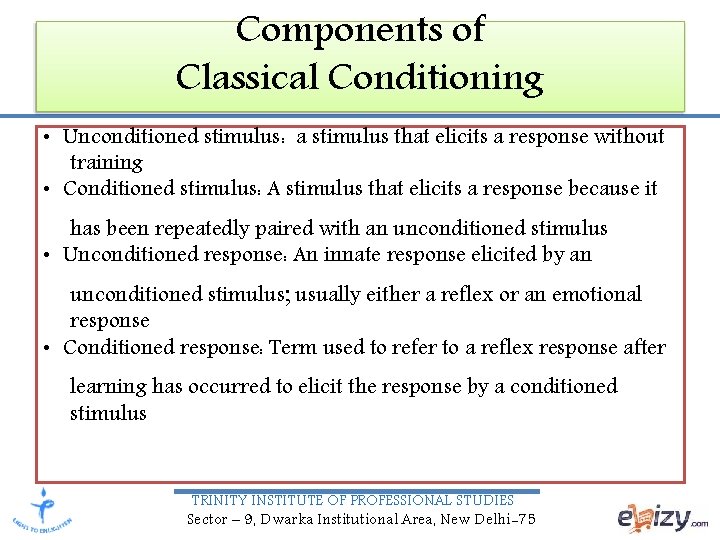
Components of Classical Conditioning • Unconditioned stimulus: a stimulus that elicits a response without training • Conditioned stimulus: A stimulus that elicits a response because it has been repeatedly paired with an unconditioned stimulus • Unconditioned response: An innate response elicited by an unconditioned stimulus; usually either a reflex or an emotional response • Conditioned response: Term used to refer to a reflex response after learning has occurred to elicit the response by a conditioned stimulus TRINITY INSTITUTE OF PROFESSIONAL STUDIES Sector – 9, Dwarka Institutional Area, New Delhi-75
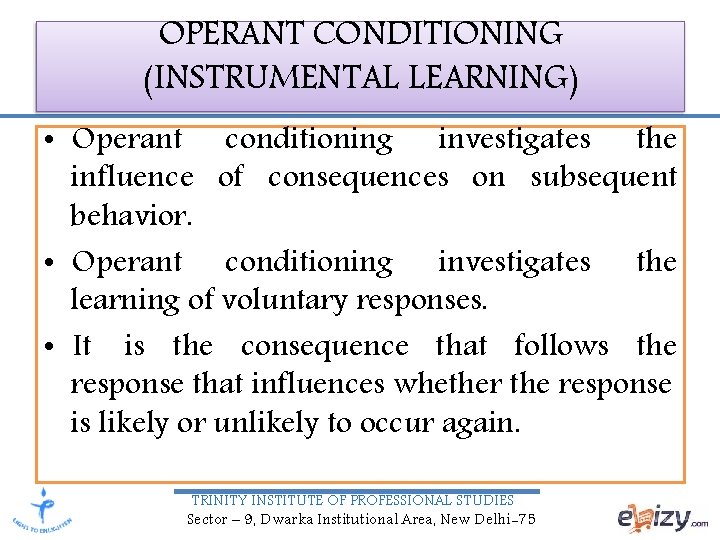
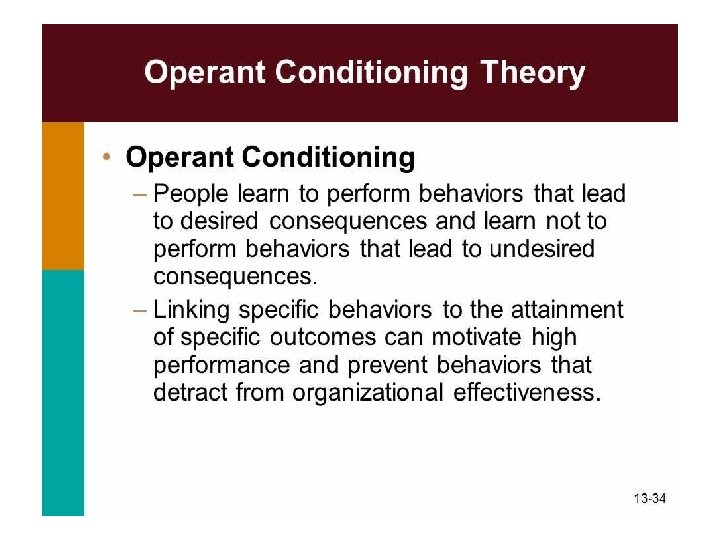
OPERANT CONDITIONING (INSTRUMENTAL LEARNING) • Operant conditioning investigates the influence of consequences on subsequent behavior. • Operant conditioning investigates the learning of voluntary responses. • It is the consequence that follows the response that influences whether the response is likely or unlikely to occur again. TRINITY INSTITUTE OF PROFESSIONAL STUDIES Sector – 9, Dwarka Institutional Area, New Delhi-75
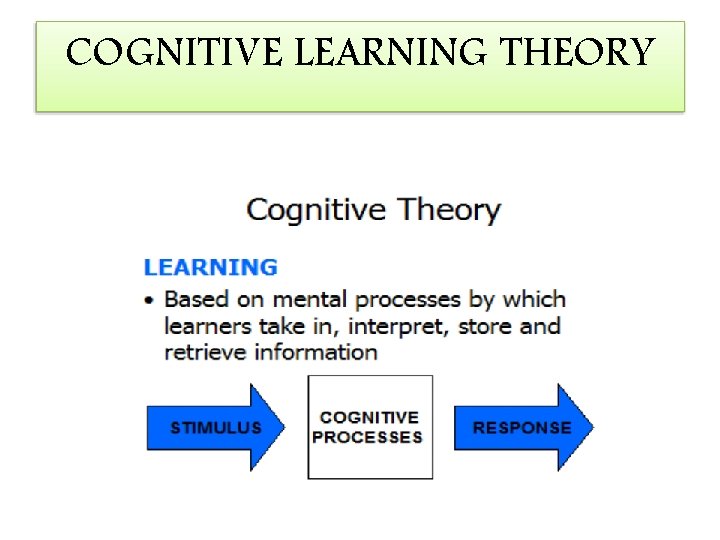
COGNITIVE LEARNING THEORY
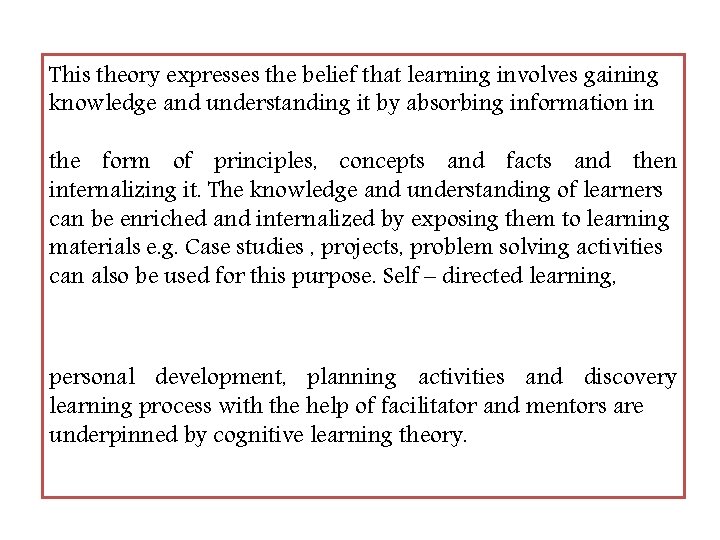
This theory expresses the belief that learning involves gaining knowledge and understanding it by absorbing information in the form of principles, concepts and facts and then internalizing it. The knowledge and understanding of learners can be enriched and internalized by exposing them to learning materials e. g. Case studies , projects, problem solving activities can also be used for this purpose. Self – directed learning, personal development, planning activities and discovery learning process with the help of facilitator and mentors are underpinned by cognitive learning theory.
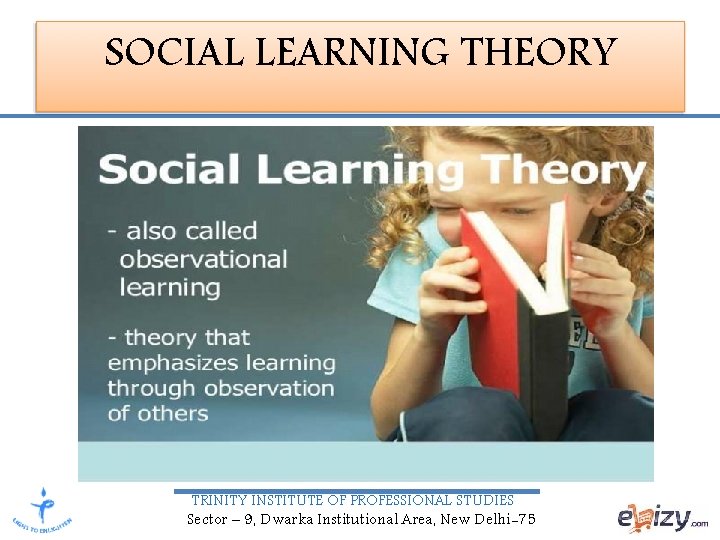
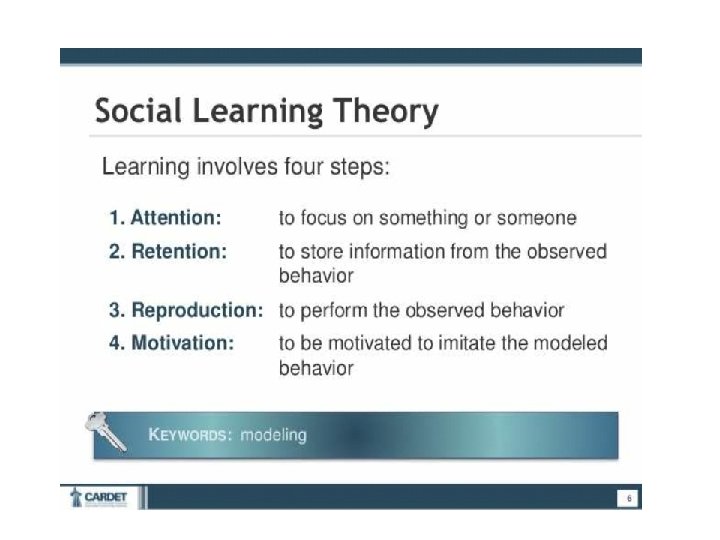
SOCIAL LEARNING THEORY TRINITY INSTITUTE OF PROFESSIONAL STUDIES Sector – 9, Dwarka Institutional Area, New Delhi-75
What Is Behavior Modification? Do you remember being punished as a child? Why do you think your parents did that? Despite what we thought back then, it wasn't because they hated us and enjoyed watching us suffer through a week without television. They merely disapproved of our actions and were hoping to prevent us from repeating them in the future. This is an excellent example of behavior modification.
Behavior modification refers to the techniques used to try and decrease or increase a particular type of behavior or reaction. This might sound very technical, but it's used very frequently by all of us. Parents use this to teach their children right from wrong. Therapists use it to promote healthy behaviors in their patients. Animal trainers use it to develop obedience between a pet and its owner. We even use it in our relationships with friends and significant others. Our responses to them teach them what we like and what we don't.
Origin of the Theory Behavior modification relies on the concept of conditioning. Conditioning is a form of learning. There are two major types of conditioning; classical conditioning and operant conditioning. Classical conditioning relies on a particular stimulus or signal. An example of this would be if a family member came to the kitchen every time you baked cookies because of the delicious smell. The second type is known as operant conditioning, which involves using a system of rewards and/or punishments. Dog trainers use this technique all the time when they reward a dog with a special treat after they obey a command. Behavior modification was developed from these theories because they supported the idea that just as behaviors can be learned, they also can be unlearned. As a result, many different techniques were developed to either assist in eliciting a behavior or stopping it. This is how behavior modification was formed.
Techniques The purpose behind behavior modification is not to understand why or how a particular behavior started. Instead, it only focuses on changing the behavior, and there are various different methods used to accomplish it. This includes: §Positive reinforcement §Negative reinforcement §Punishment §Flooding §Systematic desensitization §Aversion therapy §Extinction
Positive reinforcement is pairing a positive stimulus to a behavior. A good example of this is when teachers reward their students for getting a good grade with stickers. Positive reinforcement is also often used in training dogs. Pairing a click with a good behavior, then rewarding with a treat, is positive reinforcement.
Negative reinforcement is the opposite and is the pairing of a behavior to the removal of a negative stimulus. A child that throws a tantrum because he or she doesn't want to eat vegetables and has his or her vegetables taken away would be a good example.
Punishment is designed to weaken behaviors by pairing an unpleasant stimulus to a behavior. Receiving a detention for bad behavior is a good example of a punishment.
Flooding involves exposing people to fearinvoking objects or situations intensely and rapidly. Forcing someone with a fear of snakes to hold one for 10 minutes would be an example of flooding.
Systematic desensitization is also used to treat phobias and involves teaching a client to remain calm while focusing on these fears. For example someone with an intense fear of bridges might start by looking at a photo of a bridge, then thinking about standing on bridge, and eventually walking over a real bridge.
Aversion therapy is the pairing of an unpleasant stimulus to an unwanted behavior in order to eliminate that behavior. Some people bite their finger nails, and in order to stop this behavior, there’s a clear substance you can paint on your finger nails that makes them taste awful. Painting your nails with it helps stop the behavior of biting nails.
Extinction is the removal of all reinforcements that might be associated with a behavior. This is powerful tool and works well, especially with young children.
Steps in behavioral modification (OB Mod. ) 1. Identify critical behavior In the very first step of behavioral modification, managers must identify the set of desirable and undesirable behavior in the organization. Behavior modification process follows measurement of behavior if behaviors are seen and they can be measured. Supervisor or job holder identifies critical behavior. A behavior audit is conducted to analyze each job. Direct performance behaviors are included that significantly impact performance outcome. 2. Develop baseline data In this step, detail behavior of employees are measured to estimate consequences of their behavior. This step helps to identify desired and undesired behavior in organization. Such data regarding behavior of employees collected before initiating the change process are called base line data.
Steps in behavioral modification (OB Mod. ) 3. Analyze behavioral consequence In this step, behavior shown by employees are analyzed to estimate the future consequences. From this step, managers identify the existing behavioral contingencies, consequences of performance, that is, what happens now to employees who perform at various levels? If an employee works heard, does she/he get a reward or just get tired. Behavior modification recognizes that behavior is influenced by two environmental contingencies: the antecedents that precede behaviors and the consequence that follow behavior. These principles are part of the Antecedents-Behavior-Consequences (A-B-C) model of behavior modification. Antecedents: Antecedents are input factors for behavior i. e. they cause for behavior of employees. Behavior: Behavior are activities shown by employees in organization. Consequences: Consequences is the results or outcomes of antecedent on behavior of employees. OB Mod. focuses on changing undesired behavior of employees into desired behavior as consequences.
Steps in behavioral modification (OB Mod. ) 4. Use intervention strategy Intervention refers interference in existing behavior of employees. Intervention strategy is the main activity in behavioral modification as it prepares plans to initiate some changes which strengthen the desired behavior and weaken the undesired behavior. Intervention strategy changes performance-reward linkage to make high level performance more rewarding. 5. Evaluate performance improvement This is the feedback stage in which success or failure of behavioral modification program is evaluated. Performance of employees before implementation of modification program and after modification program is compared. Managers need to evaluate whether goals of program are attained or not, if yes, at what extent they are attained. This step prepares feedback for the upcoming programs.