
Learning Triadic Influence in Large Social Networks Chenhui

- Slides: 7
Learning Triadic Influence in Large Social Networks Chenhui Zhang*, Sida Gao*, Jie Tang*, Tracy Xiao Liu*, Zhanpeng Fang* and Xu Cheng# *Tsinghua University, Beijing, China #Tencent Corporation, Shenzhen, China
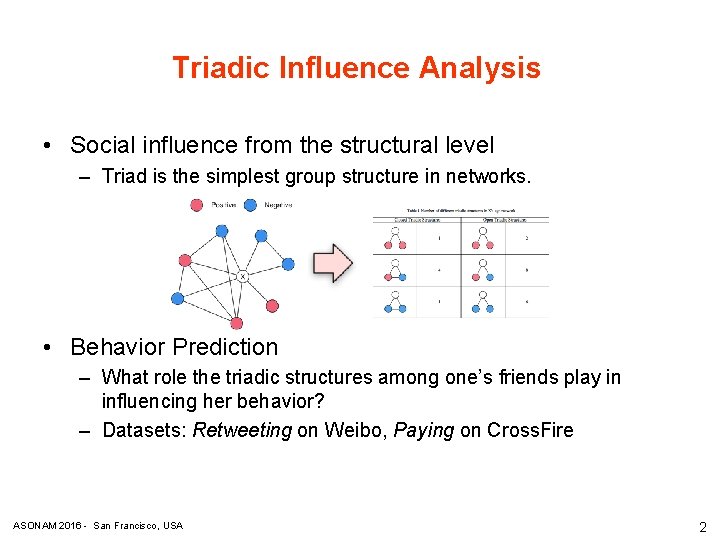
Triadic Influence Analysis • Social influence from the structural level – Triad is the simplest group structure in networks. • Behavior Prediction – What role the triadic structures among one’s friends play in influencing her behavior? – Datasets: Retweeting on Weibo, Paying on Cross. Fire ASONAM 2016 - San Francisco, USA 2
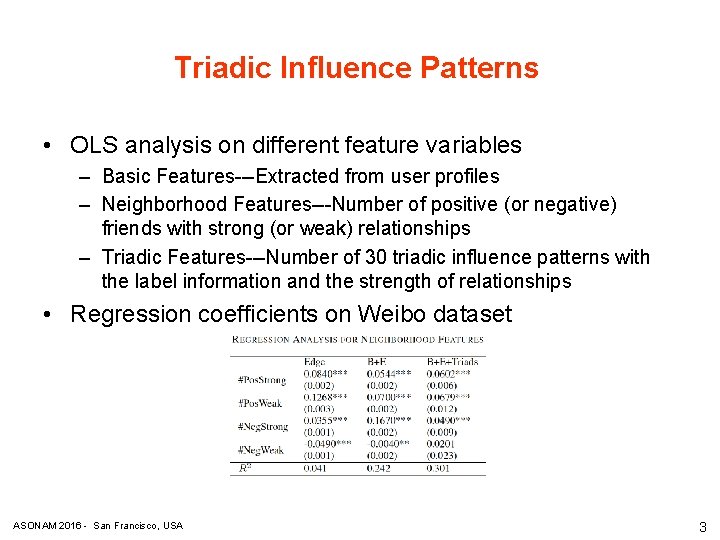
Triadic Influence Patterns • OLS analysis on different feature variables – Basic Features---Extracted from user profiles – Neighborhood Features---Number of positive (or negative) friends with strong (or weak) relationships – Triadic Features---Number of 30 triadic influence patterns with the label information and the strength of relationships • Regression coefficients on Weibo dataset ASONAM 2016 - San Francisco, USA 3
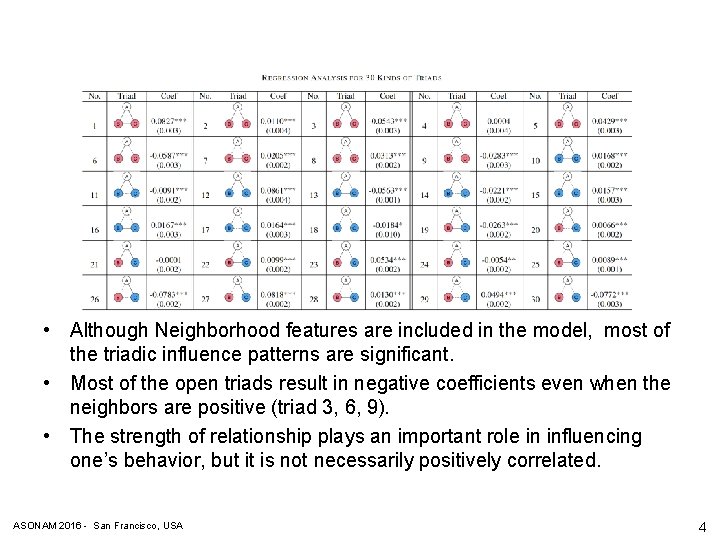
• Although Neighborhood features are included in the model, most of the triadic influence patterns are significant. • Most of the open triads result in negative coefficients even when the neighbors are positive (triad 3, 6, 9). • The strength of relationship plays an important role in influencing one’s behavior, but it is not necessarily positively correlated. ASONAM 2016 - San Francisco, USA 4
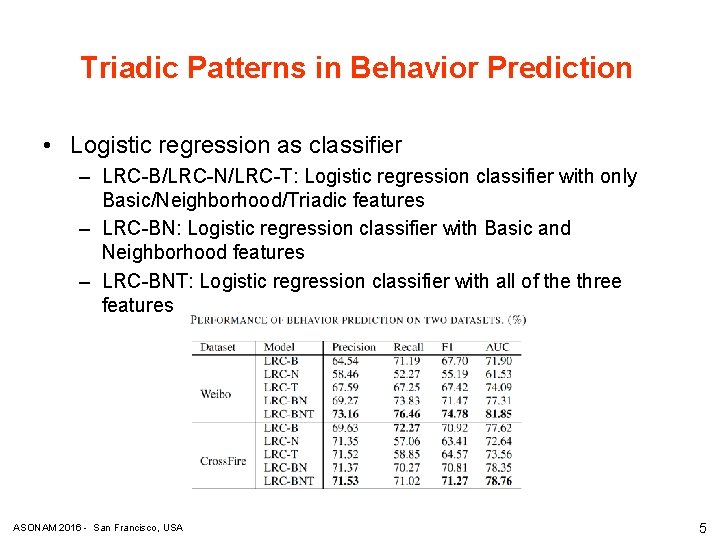
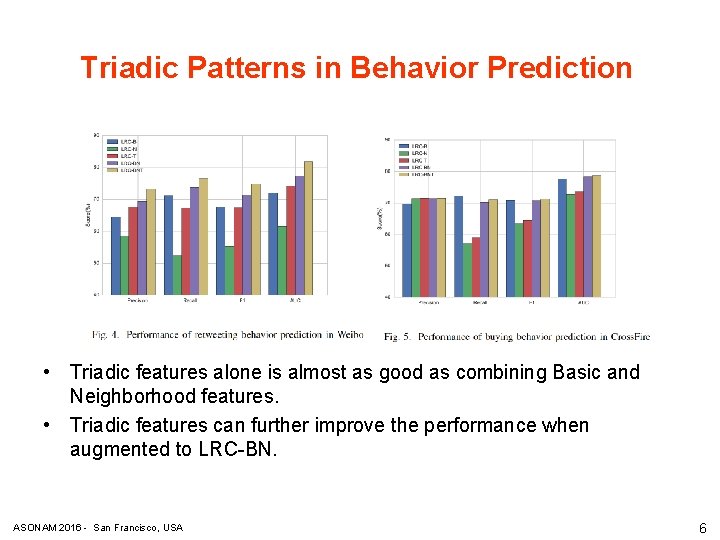
Triadic Patterns in Behavior Prediction • Logistic regression as classifier – LRC-B/LRC-N/LRC-T: Logistic regression classifier with only Basic/Neighborhood/Triadic features – LRC-BN: Logistic regression classifier with Basic and Neighborhood features – LRC-BNT: Logistic regression classifier with all of the three features ASONAM 2016 - San Francisco, USA 5
Triadic Patterns in Behavior Prediction • Triadic features alone is almost as good as combining Basic and Neighborhood features. • Triadic features can further improve the performance when augmented to LRC-BN. ASONAM 2016 - San Francisco, USA 6
Conclusions • Classify triadic influence patterns • Verify the existence of different triadic influence by OLS analysis • Competitive performance in behavior prediction by leveraging the triadic influence ASONAM 2016 - San Francisco, USA 7