
Learning to use the Grammar Hammer A B
Learning to use the Grammar Hammer
A, B, C Noun l When you use three adjectives to describe a noun, separate them with commas: l EX: She wore an itsy, bitsy, polka-dot bikini.
S, conjunction S l l l Sentence, conjunction sentence Conjunctions: – And - Nor – Or - So – For - Yet – But EX: Sally swerved to miss the car, and she hit a tree.
S; S l l l Sentence; Sentence S: I want to attend the University of Florida S: UF has one of the top advertising programs. l S; S: I want to attend the University of Florida; UF has one of the top advertising programs.

S; SC, S l l l Sentence; sentence connector, sentence Sentence connectors: however, therefore, moreover (transitions) EX: Rick went speeding by a police car; however, he was not pulled over. – – – S: Rick went speeding by a police car; SC: however, S: he was not pulled over.
A, B, conjunction C l I love apples, bananas, and carrots. – – l A: Apples B: bananas Conjunction: and EX: C: carrots
NP, Appositive, l l Julie Nye, the only girl in the class, received the highest grade on the math test. Noun Phrase: Julie Nye Appositive (what describes her? ): the only girl in the class The appositive CAN be removed and still makes sense.
NP, Appositive, l l l As a test, if you can take out the questionable phrase from the sentence and it still makes sense, then separate it with commas. EX: Mrs. Cavicchia, previously Ms. Sammons, used to work for Teen People magazine. You CAN remove the phrase between the commas and it still makes sense: Mrs. Cavicchia used to work for Teen People magazine.
LB, S l l Left Branch, Sentence starts with transition, -ly or –ing word Lovingly, she kissed his cheek. Running after the ball, he dove to make the catch. Although she loves tomatoes, she hates ketchup.
Subject and Verb Agreement Bad Swing: An important function of managers are delegating responsibility. l Direct Hit: An important function of managers is delegating responsibility. l The subject of the sentence is function, NOT manager; the verb should describe the action of the subject. l
Subject and Verb Agreement: Plural Subjects joined by and require a plural verb: – Direct Hit: An English teacher and a red pen make a dangerous mix. l To determine a plural verb, replace the subjects with Kate and I l EX: Kate and I make or makes? l
Subject and Verb Agreement: Singular l Require singular verbs: – – – Amounts Anybody Anyone Each Everyone Much No one Other Somebody something l l EX: Two hours is a normal commute for many modern business people. EX: Everyone learns the basics of a language by the age of four.
Subject and Verb Agreement: Singular l l l Titles of written works, company names, films and other works of art require singular verbs. EX: Procter and Gamble is best known for its employee benefits. EX: Writing: Research, Theory and Application is a valuable book for English teachers.
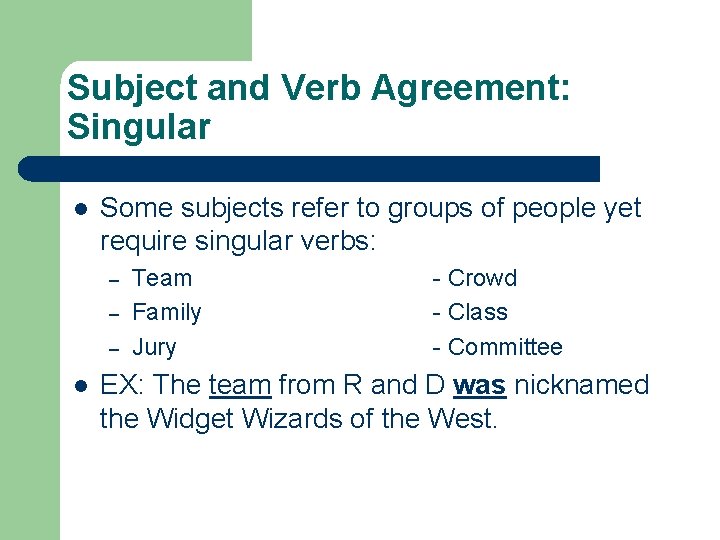
Subject and Verb Agreement: Singular l Some subjects refer to groups of people yet require singular verbs: – – – l Team Family Jury - Crowd - Class - Committee EX: The team from R and D was nicknamed the Widget Wizards of the West.
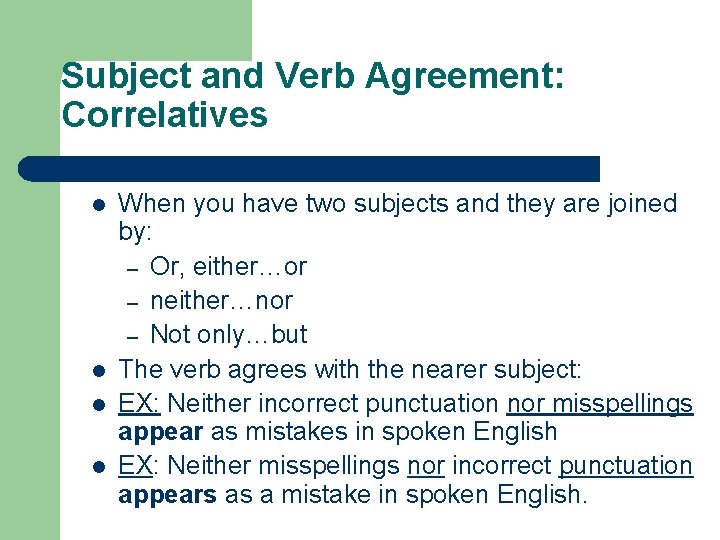
Subject and Verb Agreement: Correlatives l l When you have two subjects and they are joined by: – Or, either…or – neither…nor – Not only…but The verb agrees with the nearer subject: EX: Neither incorrect punctuation nor misspellings appear as mistakes in spoken English EX: Neither misspellings nor incorrect punctuation appears as a mistake in spoken English.
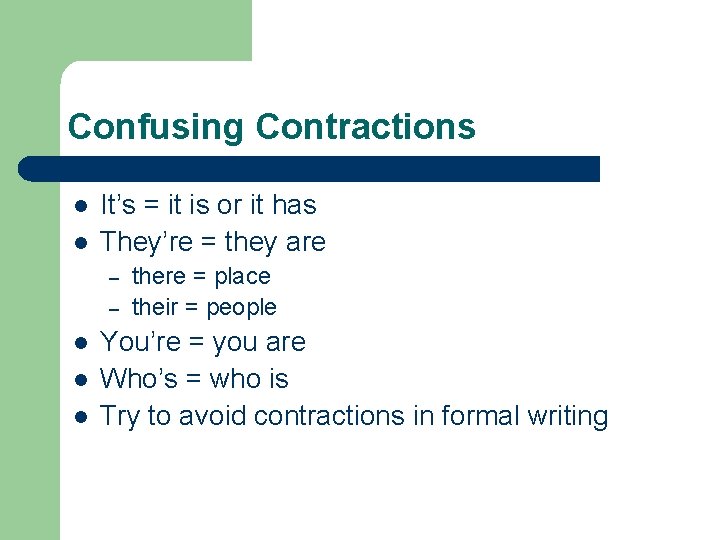
Confusing Contractions l l It’s = it is or it has They’re = they are – – l l l there = place their = people You’re = you are Who’s = who is Try to avoid contractions in formal writing
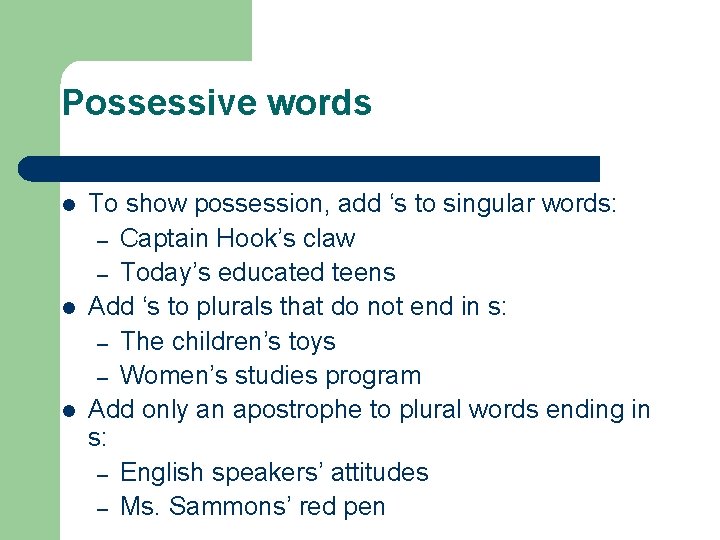
Possessive words l l l To show possession, add ‘s to singular words: – Captain Hook’s claw – Today’s educated teens Add ‘s to plurals that do not end in s: – The children’s toys – Women’s studies program Add only an apostrophe to plural words ending in s: – English speakers’ attitudes – Ms. Sammons’ red pen
Capitalization l l Names of people: John Smith, Jane Doe Specific names of places: the South, Wall Street Names of nationalities, races and languages: Arab, Spanish, Iranian Names of religions, followers and holy books: Islam-Muslims-the Koran / Judaism-Jews-the Talmud
Capitalization (cont’d) l l l Names of organizations and institutions: Rotary Club, United States Senate, University of Florida Names of historical events and documents: the Vietnam War, the Mayflower Compact, the Constitution Days, holidays and months (but not seasons): Friday, Labor Day, July (but not spring, fall, winter summer)

Capitalization (cont’d) l The first, last and all MAJOR words in titles and subtitles: The Country of the Pointed Firs l Trademarks and trade names: Ford Motors, Kmart, Sharp Products The first word in a quoted sentence: He yelled to the bus driver, “Slow down!” l l Geographic areas: Asia, Michigan
Pronouns l l l To test which form of the pronoun is correct, use it without the noun or pronoun it is paired with: Bad swing: The senator’s use of the double negative surprised my students and I. Test: The senator…surprised I. The senator…surprised me. Direct Hit: The senator’s use of the double negative surprised my students and me.
Numbers: l l Spell out numbers between zero and ten Spell out a number if it begins a sentence (try to avoid starting a sentence with a number)
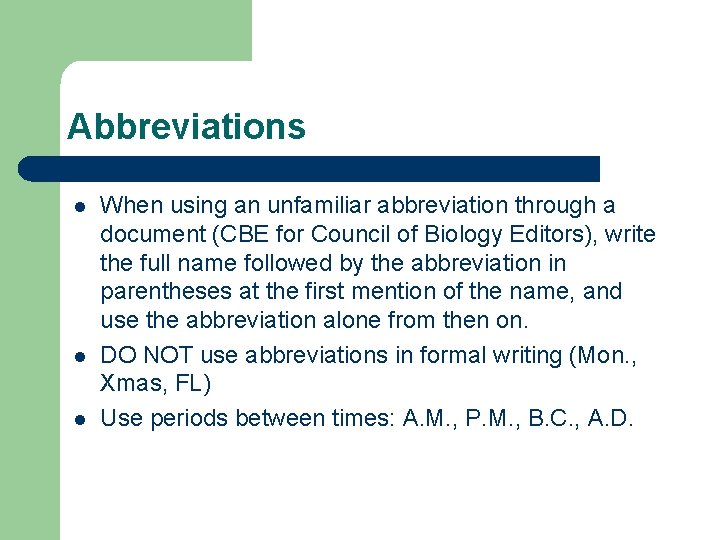
Abbreviations l l l When using an unfamiliar abbreviation through a document (CBE for Council of Biology Editors), write the full name followed by the abbreviation in parentheses at the first mention of the name, and use the abbreviation alone from then on. DO NOT use abbreviations in formal writing (Mon. , Xmas, FL) Use periods between times: A. M. , P. M. , B. C. , A. D.
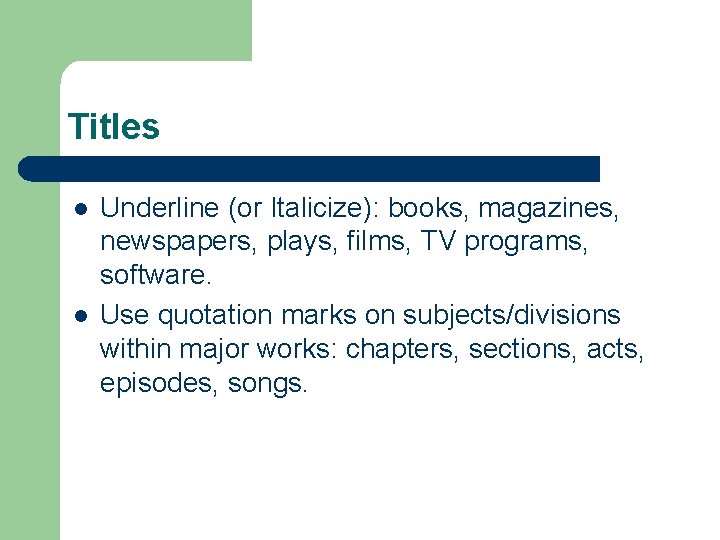
Titles l l Underline (or Italicize): books, magazines, newspapers, plays, films, TV programs, software. Use quotation marks on subjects/divisions within major works: chapters, sections, acts, episodes, songs.
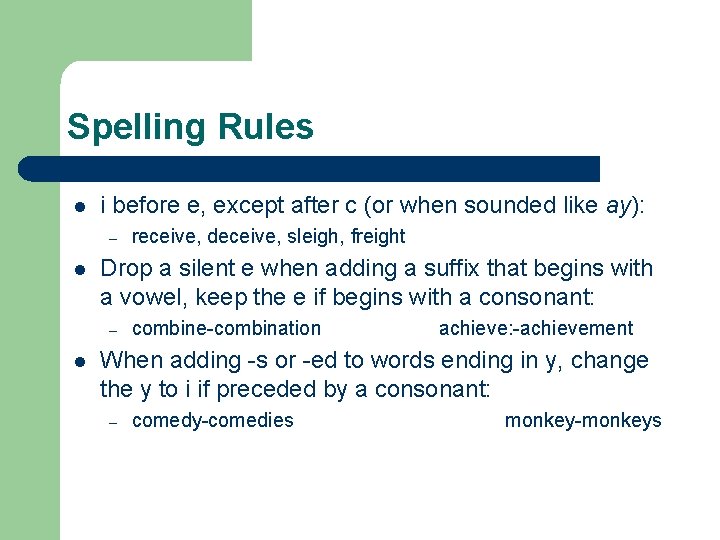
Spelling Rules l i before e, except after c (or when sounded like ay): – l Drop a silent e when adding a suffix that begins with a vowel, keep the e if begins with a consonant: – l receive, deceive, sleigh, freight combine-combination achieve: -achievement When adding -s or -ed to words ending in y, change the y to i if preceded by a consonant: – comedy-comedies monkey-monkeys
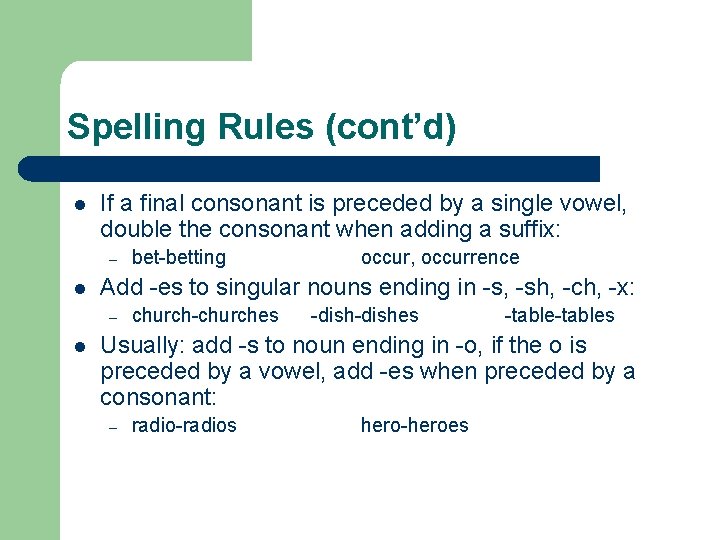
Spelling Rules (cont’d) l If a final consonant is preceded by a single vowel, double the consonant when adding a suffix: – l occur, occurrence Add -es to singular nouns ending in -s, -sh, -ch, -x: – l bet-betting church-churches -dishes -tables Usually: add -s to noun ending in -o, if the o is preceded by a vowel, add -es when preceded by a consonant: – radio-radios hero-heroes
- Slides: 26