
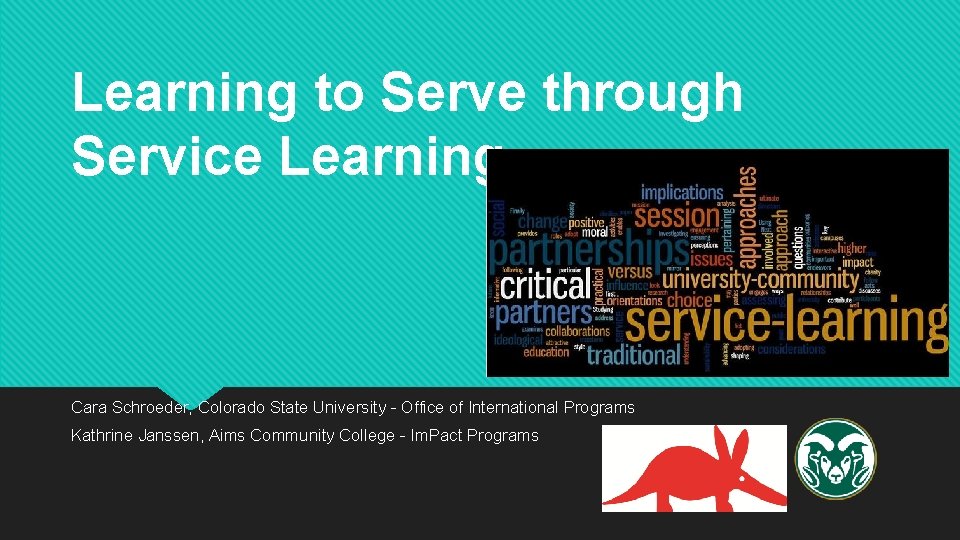
Learning to Serve through Service Learning Cara Schroeder
- Slides: 22
Learning to Serve through Service Learning Cara Schroeder, Colorado State University - Office of International Programs Kathrine Janssen, Aims Community College - Im. Pact Programs
Agenda/Main Ideas 1) What is/isn’t Service Learning? 1) How does/can service learning impact ELLs? 1) How does/can SL look different at different institutions?
Motivation ○ “If a university is a repository for knowledge, then some of this knowledge should spill over to the neighboring community. A university must not be an island where academics reach out to higher and higher levels of knowledge without sharing any of their findings. ” – Muhammad Yunus, author of Banker to the Poor: Micro-lending and the Battle Against World Poverty
Your Experience with Service Learning ○ What is your experience with Service Learning? ○ What benefits has Service Learning brought to your students? ○ What challenges has Service Learning presented? ○ What questions do you have about Service Learning?
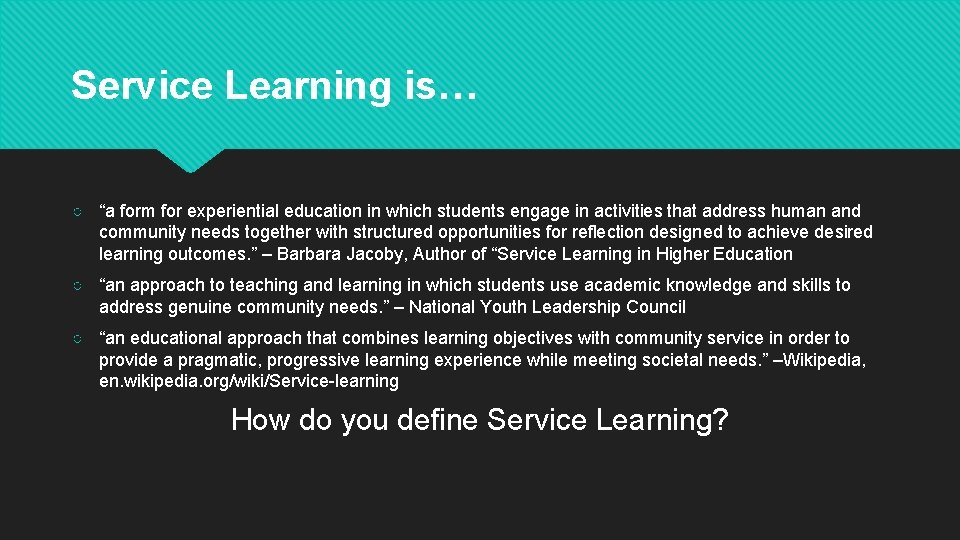
Service Learning is… ○ “a form for experiential education in which students engage in activities that address human and community needs together with structured opportunities for reflection designed to achieve desired learning outcomes. ” – Barbara Jacoby, Author of “Service Learning in Higher Education ○ “an approach to teaching and learning in which students use academic knowledge and skills to address genuine community needs. ” – National Youth Leadership Council ○ “an educational approach that combines learning objectives with community service in order to provide a pragmatic, progressive learning experience while meeting societal needs. ” –Wikipedia, en. wikipedia. org/wiki/Service-learning How do you define Service Learning?
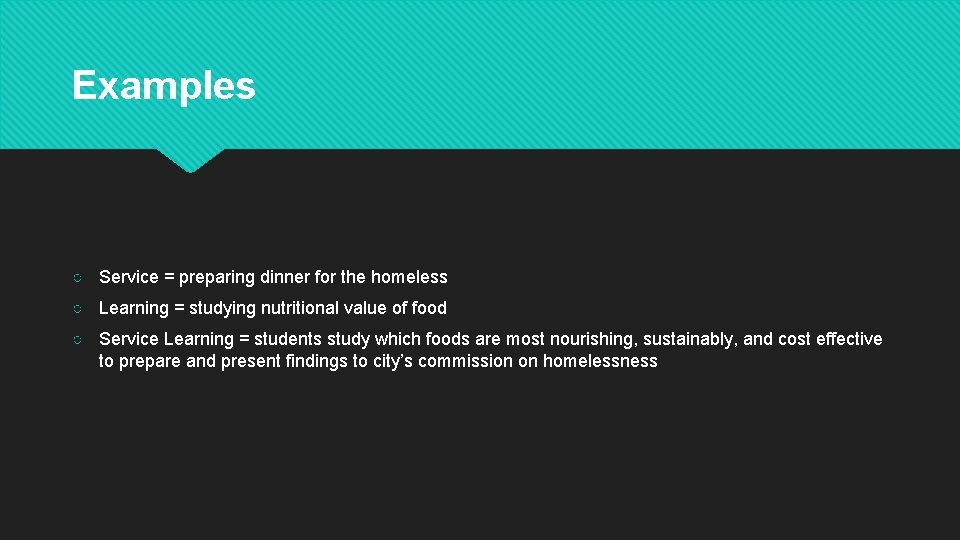
Examples ○ Service = preparing dinner for the homeless ○ Learning = studying nutritional value of food ○ Service Learning = students study which foods are most nourishing, sustainably, and cost effective to prepare and present findings to city’s commission on homelessness
What Isn’t Service Learning? ○ Volunteering (in and of itself) ○ Community Service (again in and of itself) ○ Internships ○ Field Experience Why? ! (Let’s discuss!)
Characteristics of Service Learning ○ Characteristics: ○ Community service (service outcome) ○ Learning goals ○ Benefit to both community served and student learning
Ways Students Learn Through Service Learning: ○ Interpersonal Learning ○ Academic Material (practical application & reflective instruction) ○ Cognitive Development
Benefits of Service Learning ○ Application of knowledge to the betterment of others ○ Problem solving ○ Leadership skills ○ Collaboration ○ Dissemination of information and knowledge
Benefits of Service Learning to ELLs ○ Diversity awareness ○ Personal and academic gain ○ Cross- Cultural Connections ○ Buy-in to the community/Sense of value ○ Meaningful application of language
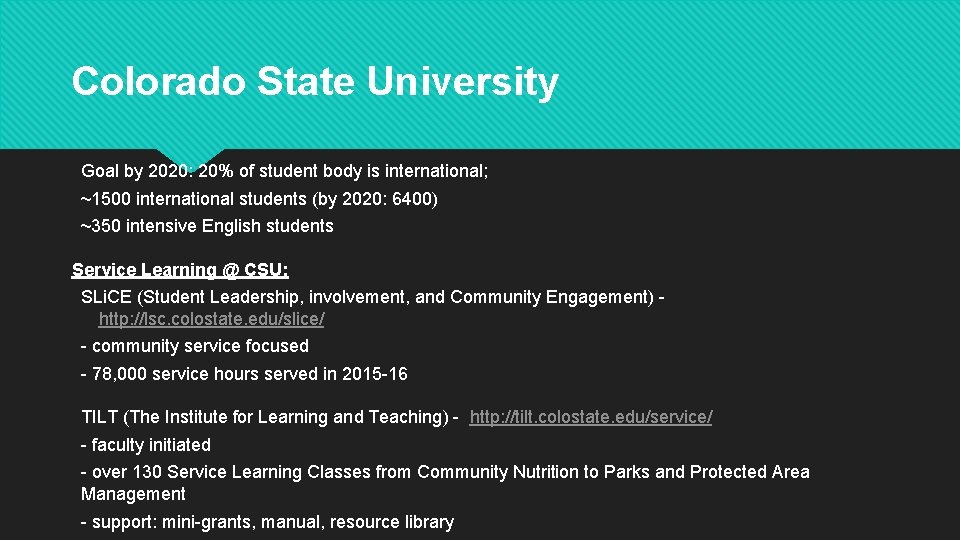
Colorado State University Goal by 2020: 20% of student body is international; ~1500 international students (by 2020: 6400) ~350 intensive English students Service Learning @ CSU: SLi. CE (Student Leadership, involvement, and Community Engagement) http: //lsc. colostate. edu/slice/ - community service focused - 78, 000 service hours served in 2015 -16 TILT (The Institute for Learning and Teaching) - http: //tilt. colostate. edu/service/ - faculty initiated - over 130 Service Learning Classes from Community Nutrition to Parks and Protected Area Management - support: mini-grants, manual, resource library
Aims Community College ○ Approximately 8, 000 students attend the college’s three campuses annually. ○ # international students ○ # PR ○ # other documented ○ Service Learning looks like ○ N/A ○ Committee to start
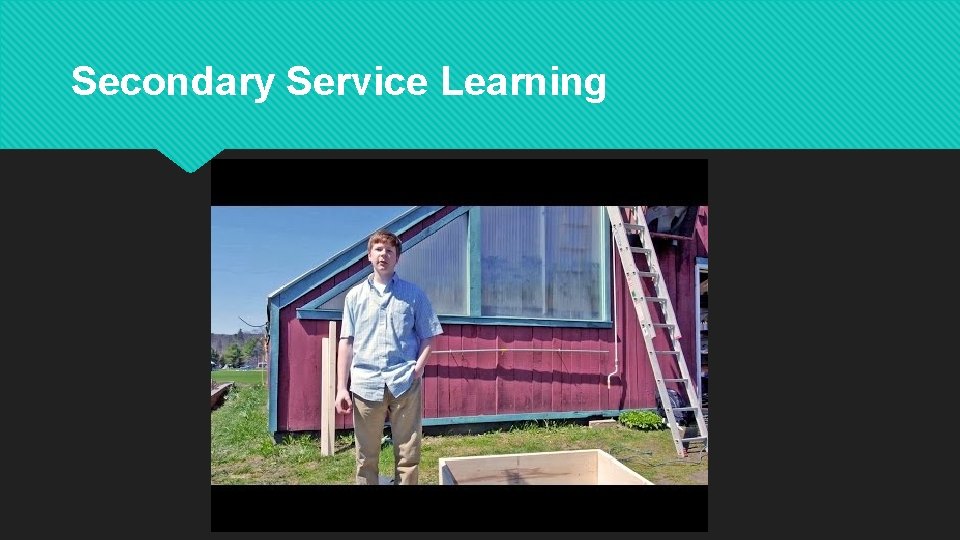
Secondary Service Learning
Different Institutions, Different Looks ○ Your school/community has needs, how can service learning help meet them? ○ How could/does it look at your institution?
Factors to Consider ○ Placement Quality ○ Broad network of community connections ○ Diversity ○ Duration ○ Reflection ○ Academic Forum ○ Students Participating ○ legal status ○ stereotypes ○ socioeconomic status ○ educational motivation
Challenges ○ Inconsistent communication and commitment by faculty ○ Misaligned service outcomes to learning objectives ○ Learning objectives cannot be achieved through available opportunities ○ Student demographics do not match well with client demographics served ○ Scheduling difficulties especially around school breaks and exams ○ Time commitment required vs. needed ○ Measuring student and community benefit ○ Institutional format and support
Challenges Specific to ELLs ○ embarrassment ○ not seeking opportunities to practice English outside of the classroom ○ multi-levels of English proficiency ○ individual vs. group identity
Suggestions (to Challenges) ○ Consistent communication between faculty and organizations ○ Create long-term partnerships between colleges and community organizations ○ Create good matches between students and service opportunities ○ Cultivate culture of service among student population that is supported and fostered by faculty/staff ○ Create transparent ways and incentives for students to engage ○ Build service learning opportunities that build on students’ English or do not rely on it ○ Offer community service opportunities as a gateway to service learning
Action Plan ○ Needs Assessment ○ Communities ○ Students ○ Investment What’s Your Action Plan? !
Questions & Contact What questions do you still have? Cara Schroeder cara. schroeder@colostate. edu Katie Janssen katie. janssen@aims. edu
References Books: Crews, Robin Jeffrey. Higher Education Service-learning Sourcebook. Westport, CT: Oryx, 2002. Print. Eyler, Janet, and Dwight Giles. Where's the Learning in Service-learning? San Francisco: Jossey-Bass, 1999. Print. Jacoby, Barbara. Service-learning in Higher Education: Concepts and Practices. San Francisco: Jossey-Bass, 1996. Print. O'Grady, Carolyn R. Integrating Service Learning and Multicultural Education in Colleges and Universities. Mahwah, NJ: L. Erlbaum Associates, 2000. Print. Rhoads, Robert A. Community Service and Higher Learning: Explorations of the Caring Self. Albany: State U of New York, 1997. Print. Articles: FALASCA, By MARINA. "Learning Language with Context and Purpose: Principles of Good Practice. " ESL Success Through Service-Learning: Principles of Good Practice. N. p. , n. d. Web. 03 Nov. 2016. URL: http: //www. communityworksinstitute. org/cwjonline/articles/aarticles-text/eslandservice_marina. html Useful Resources A-Z, By Subject Index. "Number and Percentage of Public School Students Participating in Programs for English Language Learners, by State: Selected Years, 2003 -04 through 201314. " Number and Percentage of Public School Students Participating in Programs for English Language Learners, by State: Selected Years, 2003 -04 through 2013 -14. N. p. , n. d. Web. 02 Nov. 2016. URL: https: //nces. ed. gov/programs/digest/d 15/tables/dt 15_204. 20. asp Video Edutopia. "Service Learning: Real-Life Applications for Learning. " You. Tube, 2015. Web. 02 Nov. 2016. URL: https: //www. youtube. com/watch? v=7 t 30 ZMX 8 u. Gw