
Learning to See WHAT IS DRAWING What is

- Slides: 16
Learning to See WHAT IS DRAWING?
What is Drawing? Drawing is the processes of communicating an image through marks on a twodimensional surface. Drawings can be created through a variety of medias. How many can you name? Drawings can be create on a variety of medias. Again, how many can you name?
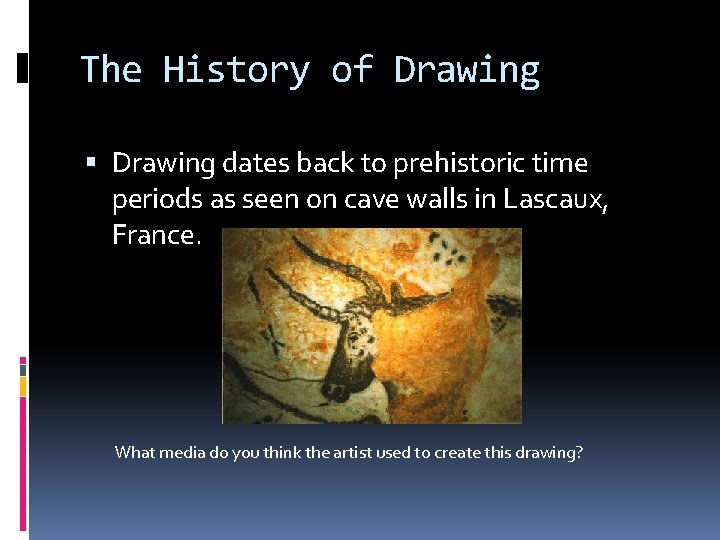
The History of Drawing dates back to prehistoric time periods as seen on cave walls in Lascaux, France. What media do you think the artist used to create this drawing?
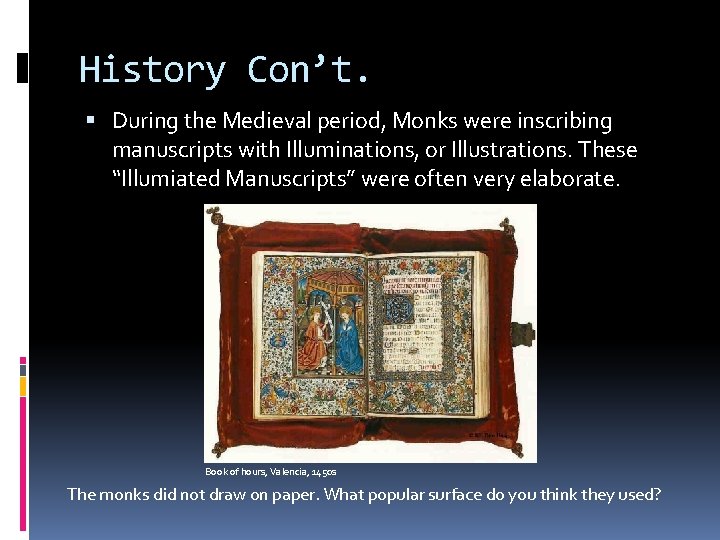
History Con’t. During the Medieval period, Monks were inscribing manuscripts with Illuminations, or Illustrations. These “Illumiated Manuscripts” were often very elaborate. Book of hours, Valencia, 1450 s The monks did not draw on paper. What popular surface do you think they used?
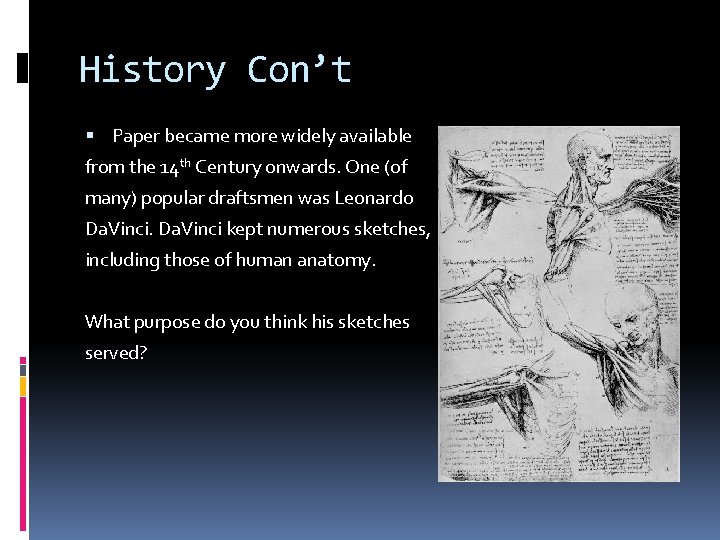
History Con’t Paper became more widely available from the 14 th Century onwards. One (of many) popular draftsmen was Leonardo Da. Vinci kept numerous sketches, including those of human anatomy. What purpose do you think his sketches served?
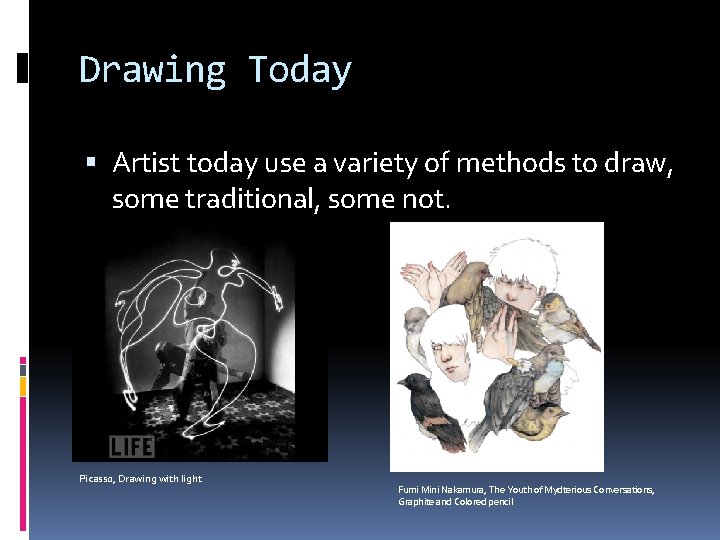
Drawing Today Artist today use a variety of methods to draw, some traditional, some not. Picasso, Drawing with light Fumi Mini Nakamura, The Youth of Mydterious Conversations, Graphite and Colored pencil
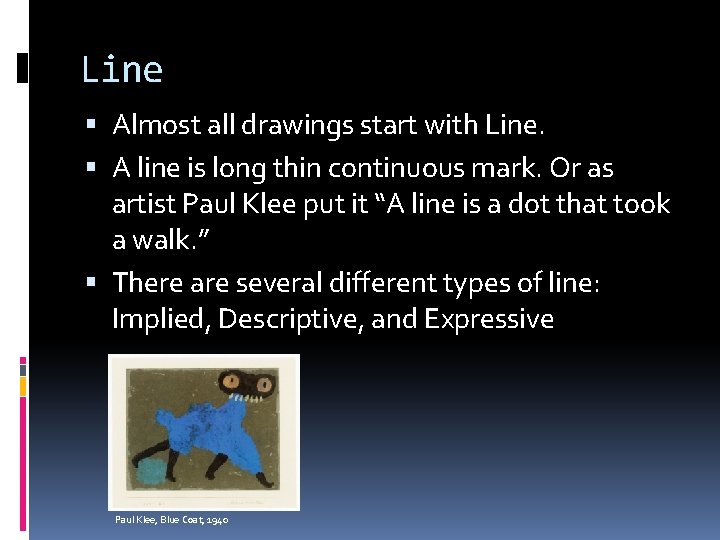
Line Almost all drawings start with Line. A line is long thin continuous mark. Or as artist Paul Klee put it “A line is a dot that took a walk. ” There are several different types of line: Implied, Descriptive, and Expressive Paul Klee, Blue Coat, 1940
Learning to see Ok, so how does an artist get from the 3 D real -life object he’s looking at, to the 2 D drawing of lines on his paper? Artists have to learn to see lines created in the world around us. These lines are called Implied lines because they’re not actually drawn. Implied lines are seen because of changes in color, texture, or value.
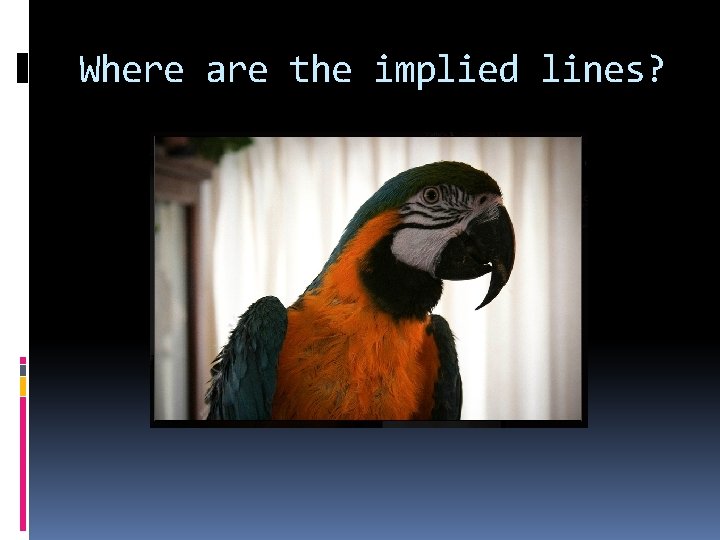
Where are the implied lines?
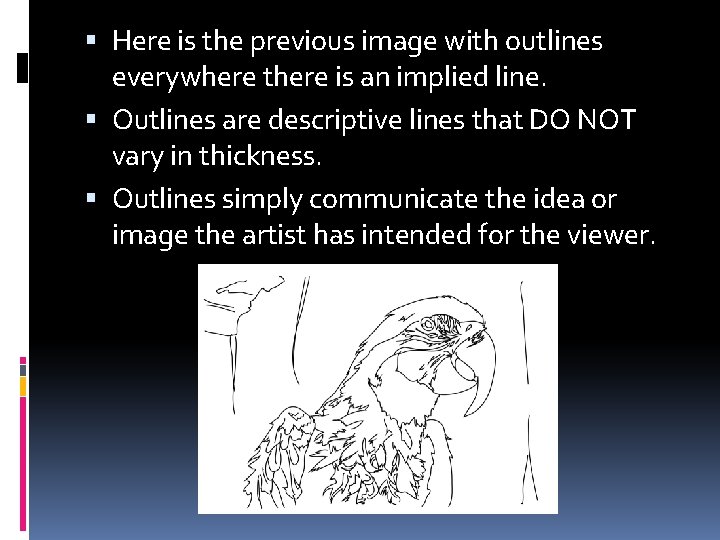
Here is the previous image with outlines everywhere there is an implied line. Outlines are descriptive lines that DO NOT vary in thickness. Outlines simply communicate the idea or image the artist has intended for the viewer.
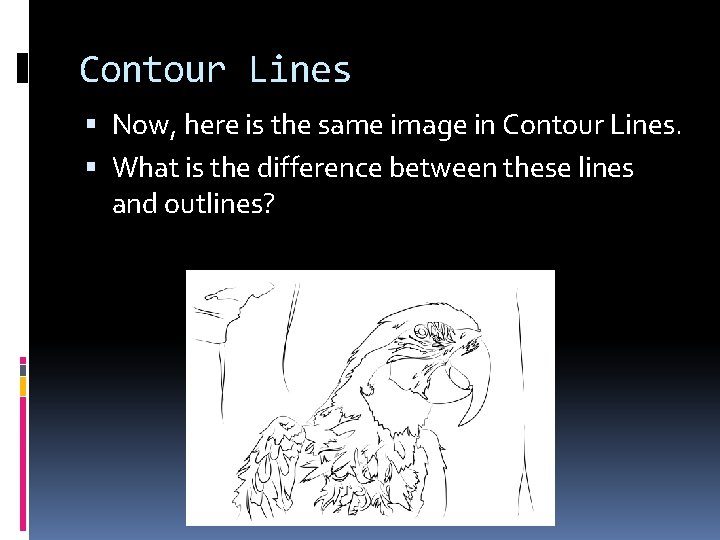
Contour Lines Now, here is the same image in Contour Lines. What is the difference between these lines and outlines?
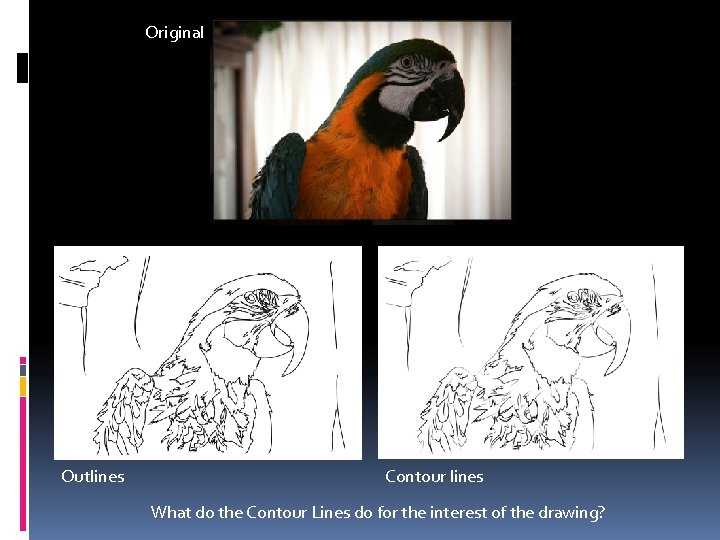
Original Outlines Contour lines What do the Contour Lines do for the interest of the drawing?
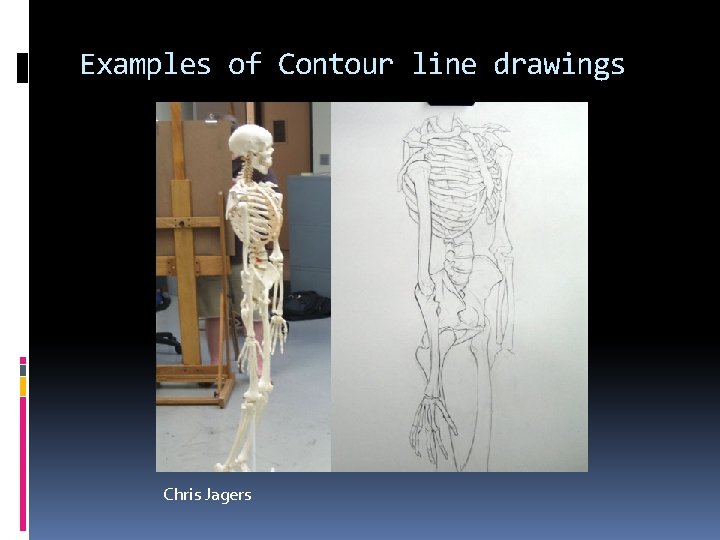
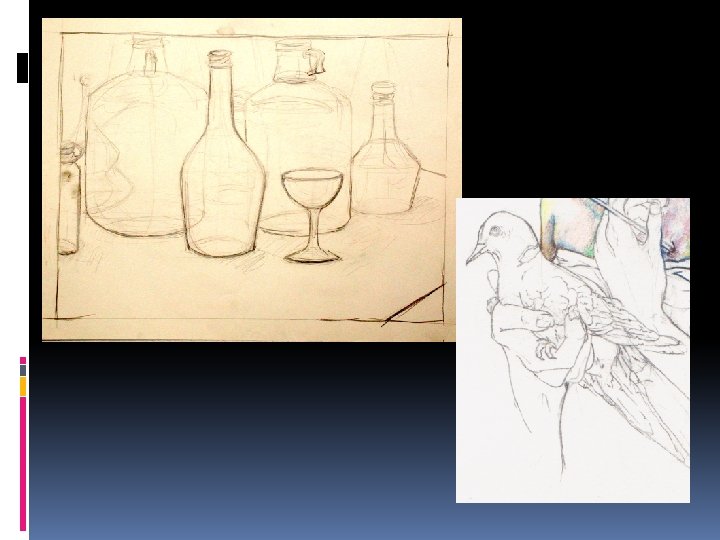
Contour Line Drawing Your first assignment is going to be to create an accurate, pencil, Contour Line, drawing of the still life. You should be looking at the still life about 85% of the time (and conversely, your paper about 15%) When you look at your paper, your pencil should stop moving. All the information you need for your drawing is in front of you! Think about COMPOSITION – How does your work fill the paper?
Examples of Contour line drawings Chris Jagers
So what do you need to do? Draw lightly to start – Plan your composition first ! Work from the general to the specific. NO SHADING! Just contour line, as clean as you can. Focus on what’s in front of you; don’t rely on the idea/symbols of objects in your head.