
LEARNING TO READ AND WRITE IN ENGLISH Presentation
- Slides: 11
LEARNING TO READ AND WRITE IN ENGLISH Presentation: Dr. Faisal Al-Qahtani 1
Focus n n n Children’s early experiences of English as a written language. Language presentation in writing. written language in the home and community First encounter with language as a social activity Learning to read and write. Early literacy experience and later success in education. 2
FIRST ENCOUNTERS n n q Working out the forms, functions and meanings of literacy. Pre-school: different ideas about what learning to read and write involves. Employing strategies: to work out what adults are doing with newspapers, books, pens, etc. Developing some reader-like and writer-like behaviors. Emergent literacy: first discoveries of reading and writing. 3
A collaborative venture The children and the Discovery of literacy: n Characteristics: q Learning n q q q a shared and communal activity. discovery and invention negotiating and sharing Sociocultural context: n q Effect of different cultural settings on learning to write and read a text. 4
Context for literacy n A broad range of literacy practices available. n Concept of literacy: q q variation in meaning and implication in different contexts. Literacy events: n q Differs in form, function, and meaning across cultures, communities, or social groups. Thus: the process of becoming literate in English is difficult to describe in general terms. 5
Introducing Literacy Baby talk or Motherese Early experience of literacy and later development as writers and readers. Literacy practices (p. 79): n n n q q q Domains of literacy: n q n checking the calendar. helping child with his reading book. writing a shopping list. daily living, entertainment, school-related activities, religion, general information, work, interpersonal communication, etc. As well as learning to read and write, Children learn the significant role reading and writing play in social events. 6
Different Paths to Literacy n Ethnographic studies show: q Paths taken to literacy differ from context to another. q Diversity of types of practices that are encouraged for different members of a community across different contexts. q A variety of different values are placed upon literacy across different contexts. n Heath’s Study: q Communities introduce children to different “ways of taking” meaning from literacy events. 7
BECOMING A WRITER Trial of many writing systems n Discovering which suits and which not. q Studies of children’s writing: n Early writing: q n pictorial representation and use of symbols. 8
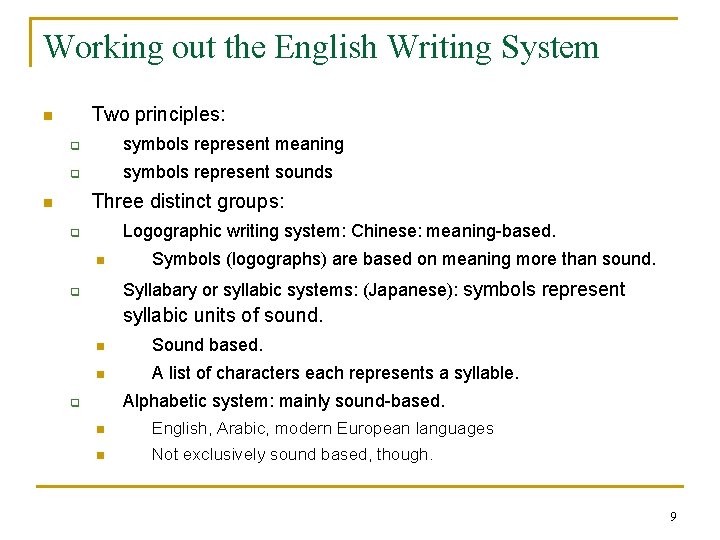
Working out the English Writing System Two principles: n q symbols represent meaning q symbols represent sounds Three distinct groups: n Logographic writing system: Chinese: meaning-based. q n Symbols (logographs) are based on meaning more than sound. Syllabary or syllabic systems: (Japanese): symbols represent q syllabic units of sound. n Sound based. n A list of characters each represents a syllable. Alphabetic system: mainly sound-based. q n English, Arabic, modern European languages n Not exclusively sound based, though. 9
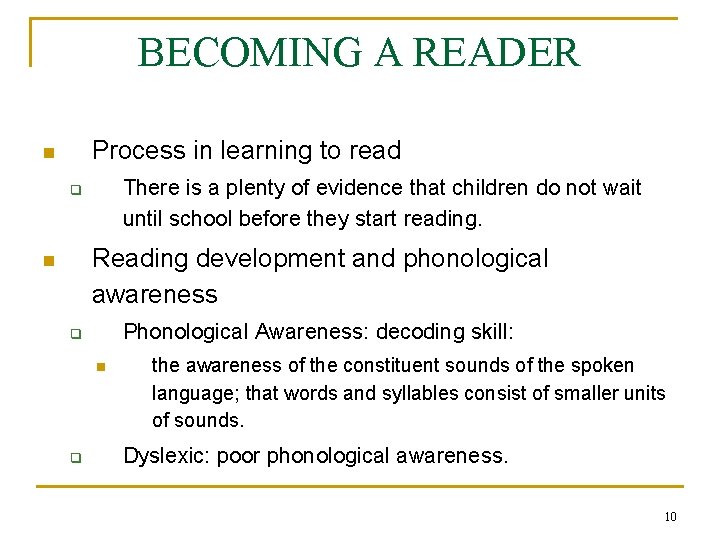
BECOMING A READER Process in learning to read n There is a plenty of evidence that children do not wait until school before they start reading. q Reading development and phonological awareness n Phonological Awareness: decoding skill: q n q the awareness of the constituent sounds of the spoken language; that words and syllables consist of smaller units of sounds. Dyslexic: poor phonological awareness. 10
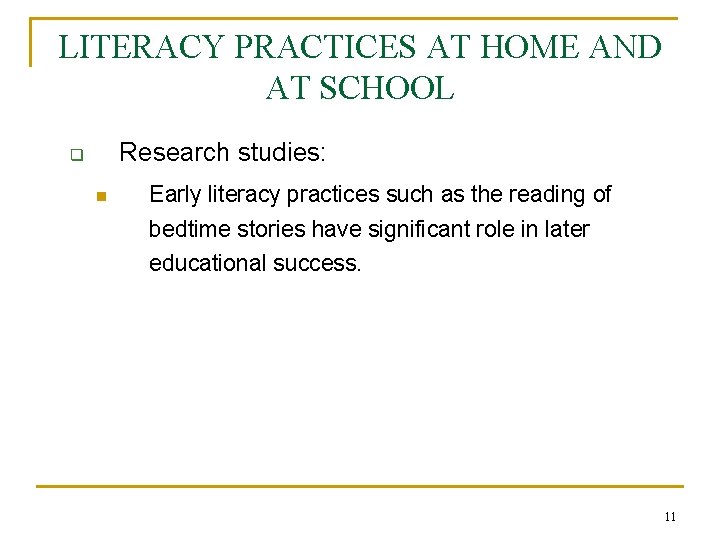
LITERACY PRACTICES AT HOME AND AT SCHOOL Research studies: q n Early literacy practices such as the reading of bedtime stories have significant role in later educational success. 11