
LEARNING TO LISTEN EMPATHY AND EMOTIONAL INTELLIGENCE Deborah
LEARNING TO LISTEN: EMPATHY AND EMOTIONAL INTELLIGENCE Deborah von Hapsburg, Ph. D.
CLASS ACTIVITY 1 (HANDOUT) Please respond to the following patient statements as you normally would. Slide 2 december 21
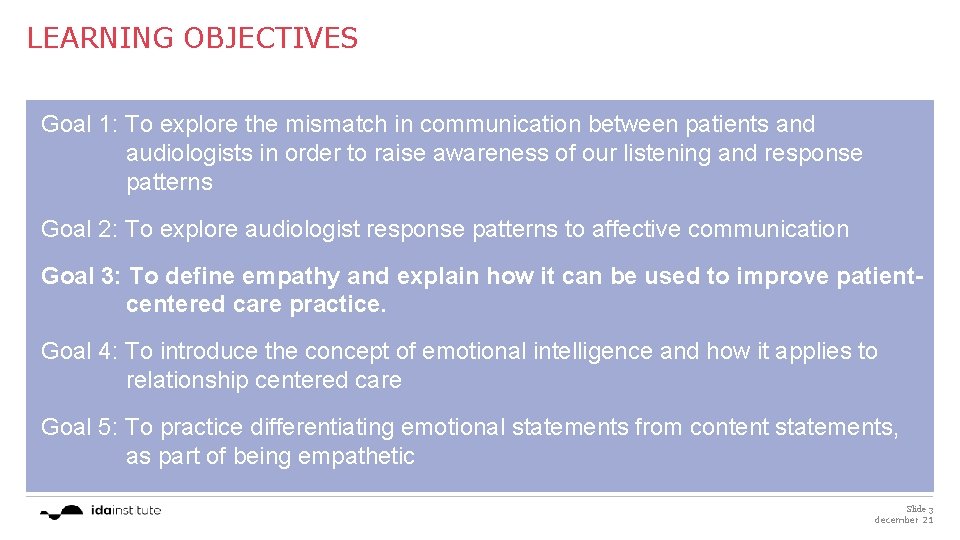
LEARNING OBJECTIVES Goal 1: To explore the mismatch in communication between patients and audiologists in order to raise awareness of our listening and response patterns Goal 2: To explore audiologist response patterns to affective communication Goal 3: To define empathy and explain how it can be used to improve patientcentered care practice. Goal 4: To introduce the concept of emotional intelligence and how it applies to relationship centered care Goal 5: To practice differentiating emotional statements from content statements, as part of being empathetic Slide 3 december 21
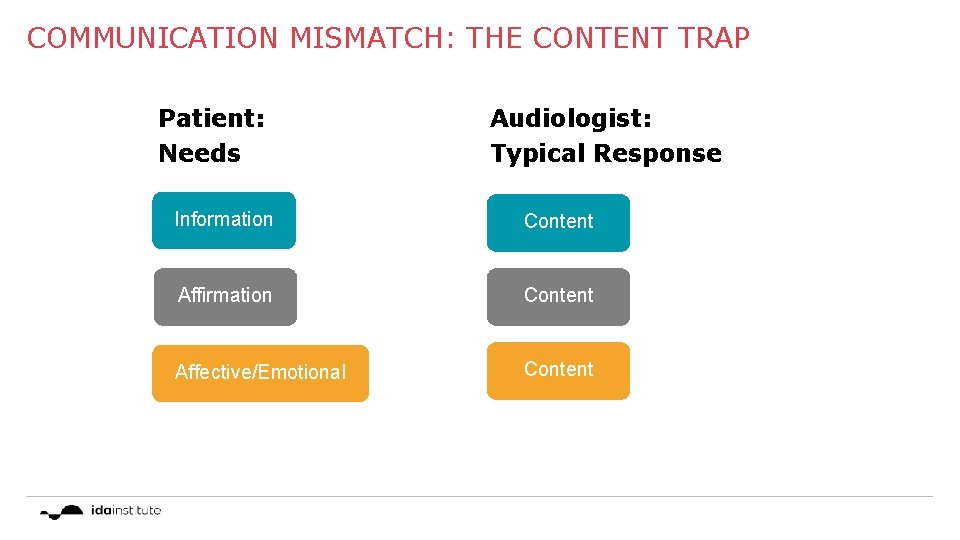
COMMUNICATION MISMATCH: THE CONTENT TRAP Patient: Needs Audiologist: Typical Response Information Content Affirmation Content Affective/Emotional Content
CONTENT TRAP IN ACTION: COMMUNICATION MISMATCH “A mother mentions that her family is depressed about the recent diagnosis of her daughter’s moderate hearing loss. The audiologist responds with reassurances that children with moderate hearing loss do relatively well in academics. ” (English, Lucks, Rojeski, & Hornak, 1999) Slide 5 december 21
WHY DO AUDIOLOGISTS DO THIS? • Not comfortable addressing emotional content • Limited time to explore the emotional mind • We don’t feel prepared or equipped to dive into the emotional mind • We are not aware that emotional content is present (not listening for it) • We may experience decreased empathy to avoid distress • Empathy training is not emphasized in training programs Pitfall of not addressing the affective or emotional needs of our patients is that we fail to build rapport, and consequently this affects outcomes and patient satisfaction. Slide 6 december 21
EMPATHY IS AT THE CORE OF PATIENT-CENTERED CARE Empathic communication skills are associated with: • Increased patient satisfaction • Improved adherence to therapy • Decreased medical errors • Fewer malpractice claims, • Better outcomes • Decreased clinician burnout • Increased physician well-being Slide 7 december 21
WHAT IS EMPATHY? “The essence of empathy is the ability to stand in another’s shoes, to feel what it’s like there and to care about making it better if it hurts. ” (Szalavitz & Perry, 2010) “The ability to imagine yourself in someone else’s position and to intuit what the person is feeling” (Pink, 2006) “Empathy is actually a hypothesis we make about another person based on a combination of visceral, emotional, and cognitive information. . . an attempt to experience the inner life of another while retaining objectivity. ” (Cozolino, 2006) Slide 8 december 21
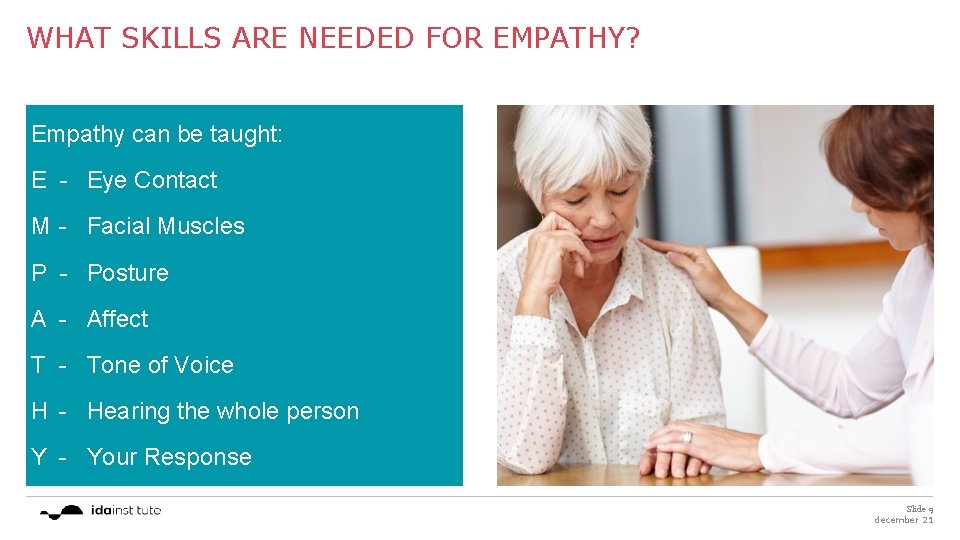
WHAT SKILLS ARE NEEDED FOR EMPATHY? Empathy can be taught: E - Eye Contact M - Facial Muscles P - Posture A - Affect T - Tone of Voice H - Hearing the whole person Y - Your Response Slide 9 december 21
TO SUMMARIZE EMPATHY INVOLVES 1. • • • Identifying an emotion in someone else Listening to what is being said Observing Facial Expressions- Micro and Macro Listening for tone of voice Observing posture and body language 2. • • • Simulating their emotional response Imagining what it feels like Feeling what they may feel (although reduced intensity) Absorbing the context 3. • • • Responding to the others’ emotion Acknowledging Reflecting Caring Slide 10 december 21
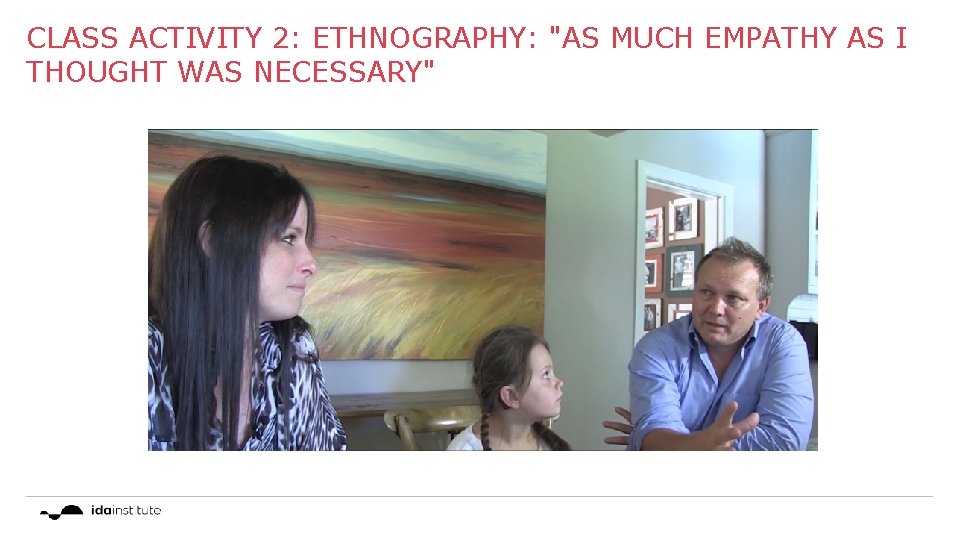
CLASS ACTIVITY 2: ETHNOGRAPHY: "AS MUCH EMPATHY AS I THOUGHT WAS NECESSARY"
WAYS TO RESPOND EMPATHICALLY Active Listening Framing and Sign Posting Reflecting the Content Identifying and Calibrating Emotion Slide 12 december 21
HOW SHOULD WE RESPOND BETTER? • Our responses should reflect the patient’s message. • Our responses should be a “kind of mirror” (Cormier & Hackney, 1999) “We should aim to acknowledge what is there, present, with us. It could be informational, or it could be affective, or both. Our job is to see it and respond with Reflecting the Content acknowledgement and respect. ” (English et al, 1999) Slide 13 december 21
Each person has a thinking mind a feeling mind. Slide 14 december 21
QUALITIES OF EMOTIONAL INTELLIGENCE (EI) • Being aware of your own feelings • The ability to recognize and empathize with others’ emotions • Awareness of the impact of our expression of emotion on others • Sensitivity to cultural rules for expressing emotions • Listening to your own feelings and those of others so you can learn from them Slide 15 december 21
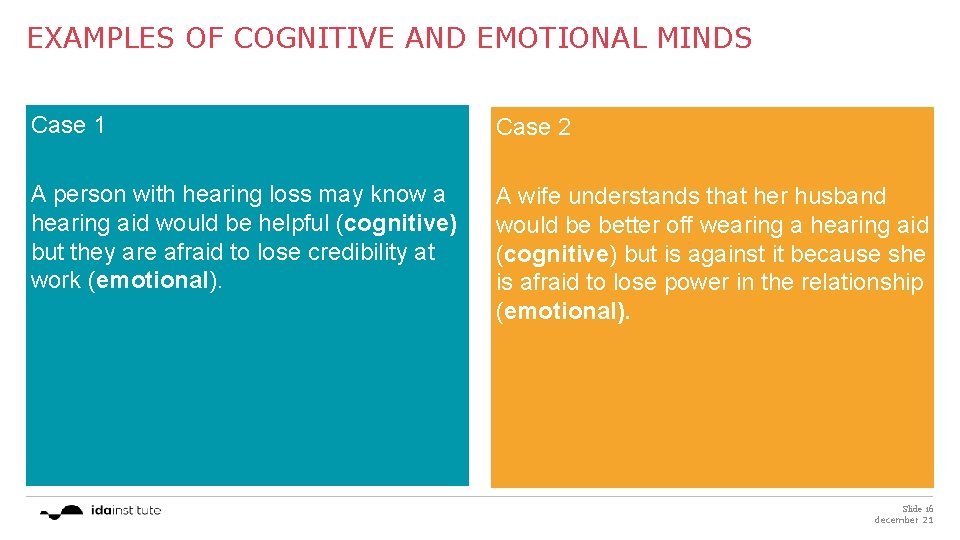
EXAMPLES OF COGNITIVE AND EMOTIONAL MINDS Case 1 Case 2 A person with hearing loss may know a hearing aid would be helpful (cognitive) but they are afraid to lose credibility at work (emotional). A wife understands that her husband would be better off wearing a hearing aid (cognitive) but is against it because she is afraid to lose power in the relationship (emotional). Slide 16 december 21
CAN YOU TELL THE DIFFERENCE? Differentiation - the ability to distinguish between a content message and an affective message. “Effective counseling requires the listener to respond in a way that lets Reflecting the know Content the patient that the nature of either kind of message was heard” English et al (1999) Slide 17 december 21
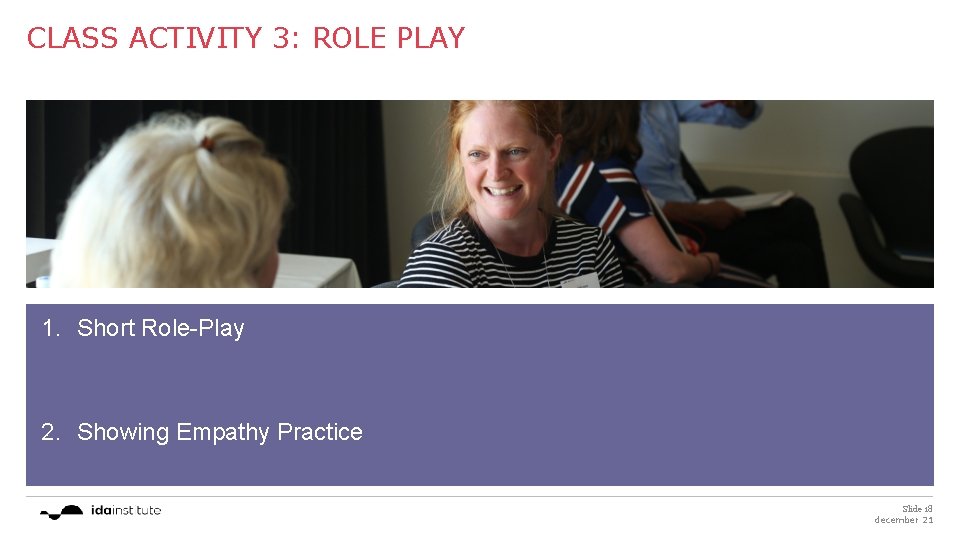
CLASS ACTIVITY 3: ROLE PLAY 1. Short Role-Play 2. Showing Empathy Practice Slide 18 december 21
PERSONAL ADJUSTMENT COUNSELING… …is the type of counseling that allows us to respond to both of these types of messages appropriately …involves different communication skills than those used in informational counseling: • Empathy • Emotional Intelligence • Talking less (yes, this is a skill) • Active listening (are we good listeners? ) • Understanding Motivation Slide 19 december 21
CLASS ACTIVITY (ACTIVITY 1 HANDOUT 2) Without having to respond to the statement. Go back to each of these statements and answer the questions. a. Is there emotional content in this statement? b. What is the emotion and/or its implications? c. My client is feeling ____________ and this makes me feel ______________. And so my impulse is to respond _______. Slide 20 december 21
REFLECTION MOMENT How did this lecture change how you approach a clinical encounter? Slide 21 december 21
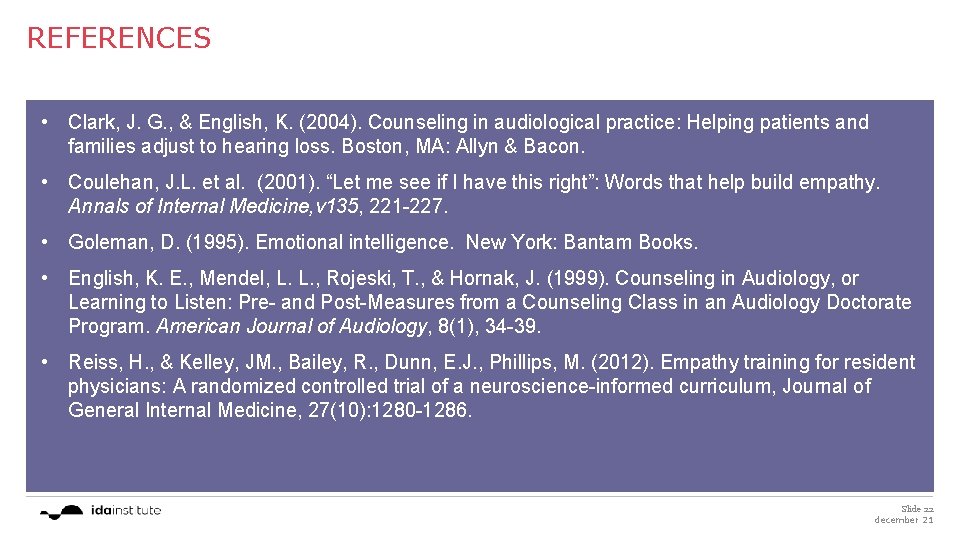
REFERENCES • Clark, J. G. , & English, K. (2004). Counseling in audiological practice: Helping patients and families adjust to hearing loss. Boston, MA: Allyn & Bacon. • Coulehan, J. L. et al. (2001). “Let me see if I have this right”: Words that help build empathy. Annals of Internal Medicine, v 135, 221 -227. • Goleman, D. (1995). Emotional intelligence. New York: Bantam Books. • English, K. E. , Mendel, L. L. , Rojeski, T. , & Hornak, J. (1999). Counseling in Audiology, or Learning to Listen: Pre- and Post-Measures from a Counseling Class in an Audiology Doctorate Program. American Journal of Audiology, 8(1), 34 -39. • Reiss, H. , & Kelley, JM. , Bailey, R. , Dunn, E. J. , Phillips, M. (2012). Empathy training for resident physicians: A randomized controlled trial of a neuroscience-informed curriculum, Journal of General Internal Medicine, 27(10): 1280 -1286. Slide 22 december 21
- Slides: 22