
Learning To Fish A Wearable PointofUse Learning Tool
Learning To Fish A Wearable Point-of-Use Learning Tool for Fishing 1
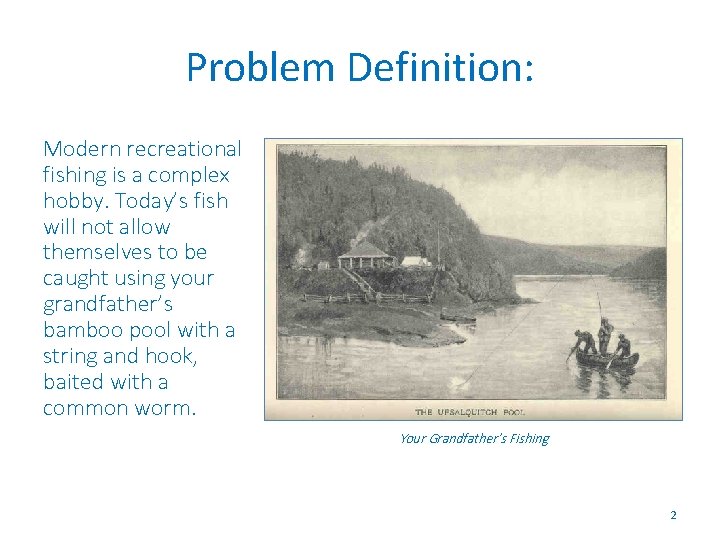
Problem Definition: Modern recreational fishing is a complex hobby. Today’s fish will not allow themselves to be caught using your grandfather’s bamboo pool with a string and hook, baited with a common worm. Your Grandfather’s Fishing 2
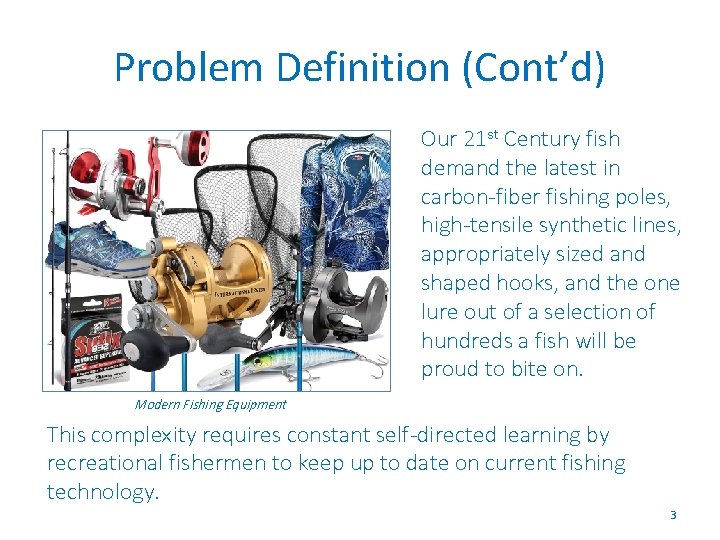
Problem Definition (Cont’d) Our 21 st Century fish demand the latest in carbon-fiber fishing poles, high-tensile synthetic lines, appropriately sized and shaped hooks, and the one lure out of a selection of hundreds a fish will be proud to bite on. Modern Fishing Equipment This complexity requires constant self-directed learning by recreational fishermen to keep up to date on current fishing technology. 3
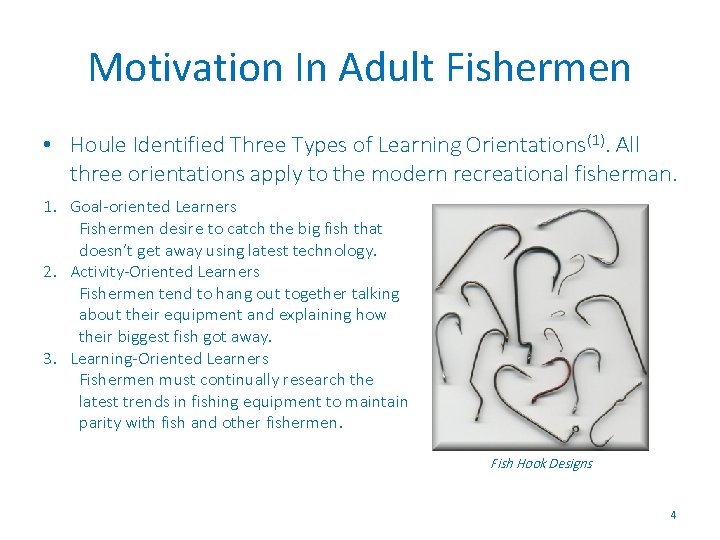
Motivation In Adult Fishermen • Houle Identified Three Types of Learning Orientations(1). All three orientations apply to the modern recreational fisherman. 1. Goal-oriented Learners Fishermen desire to catch the big fish that doesn’t get away using latest technology. 2. Activity-Oriented Learners Fishermen tend to hang out together talking about their equipment and explaining how their biggest fish got away. 3. Learning-Oriented Learners Fishermen must continually research the latest trends in fishing equipment to maintain parity with fish and other fishermen. Fish Hook Designs 4
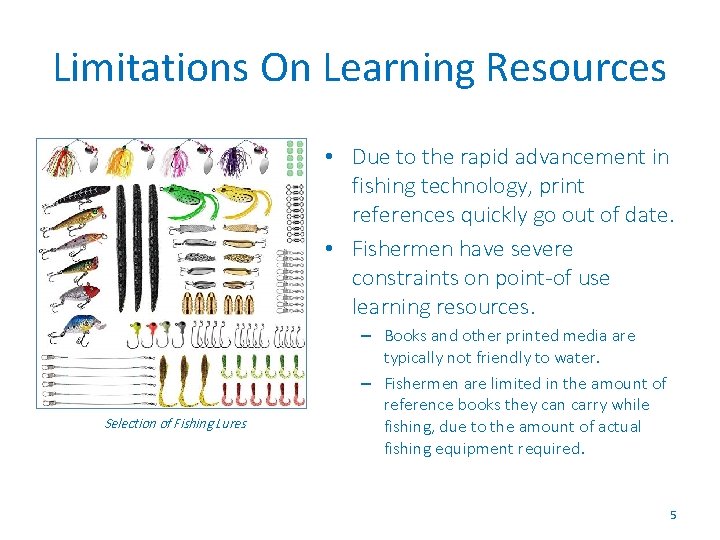
Limitations On Learning Resources • Due to the rapid advancement in fishing technology, print references quickly go out of date. • Fishermen have severe constraints on point-of use learning resources. Selection of Fishing Lures – Books and other printed media are typically not friendly to water. – Fishermen are limited in the amount of reference books they can carry while fishing, due to the amount of actual fishing equipment required. 5

A 21 st Century Solution To meet the demands of 21 st century fish, fishermen require a 21 st century learning tool. The tool should provide information on the correct colorcoordinated equipment needed based upon type of fish desired, water temperature, time of day, currents and tides. It should also be: • Capable of providing self-directed learning in between fishing expeditions. • Capable of providing point-of-use learning during a fishing expedition. • Capable of making visual recording to aid in fish identification. Additional requirements may include providing local regulations on daily catch limits, minimum and maximum size allowed for different fish species, and information on invasive species known to be in an area. Well-Equipped Fisherman 6

Proposed Solution My proposed solution is a digital fishing reference that can be worn on a fisherman’s forearm. This device can be connected to a central fishing database via satellite link for global connectivity. It will be capable of providing real-time learning information for planning a trip, point-of-use information during a fishing trip, and post-fishing debriefing references. A built-in camera can be used to upload images of a caught fish for identification, and record the actual fish size as evidence. It should also be waterproof. The Wearable Fish-O-Pedia 7
References (1) Houle, “Adult Learning Linking Theory and Practice, Sharan & Bierema, Page 151. Also of Note: I employed Wlodkowski’s Integrated Levels of Motivation, first condition of using humor. “Adult Learning Linking Theory and Practice, Sharan & Bierema, page 156 – 157 A Happy Fisherman 8
- Slides: 8