
Learning to Estimate 3 D Hand 1 Pose
- Slides: 20
Learning to Estimate 3 D Hand [1] Pose from Single RGB Images Presented by : Marnim Galib
Challenges • Full 3 D hand pose estimation from single images is difficult because of many ambiguities, strong articulation, and heavy self-occlusion. • Specific sensing equipment like data gloves or markers are used, which restrict the application to limited scenarios. • Also the use of multiple cameras limits the application domain. • Most contemporary works rely on the depth image from a depth camera which also limits the application domain. • Restricted availability of data.
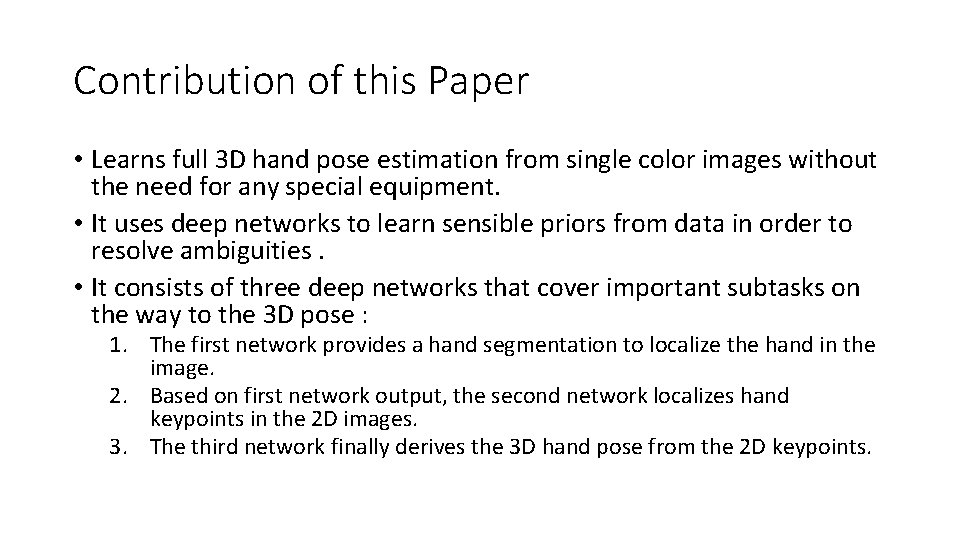
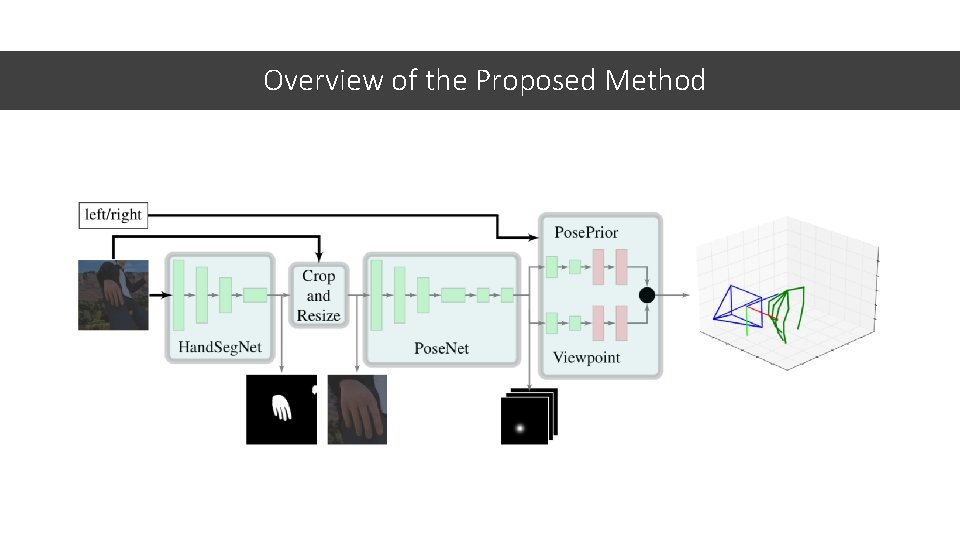
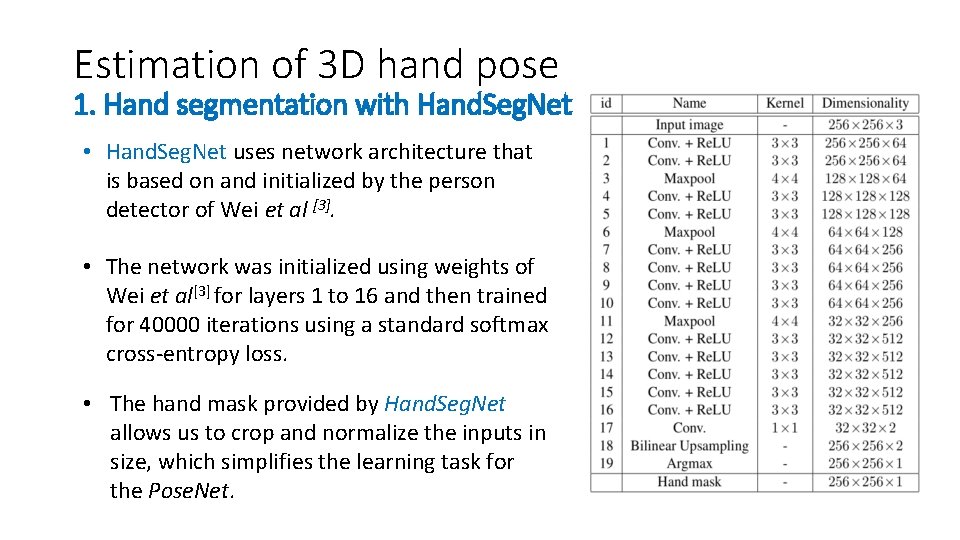
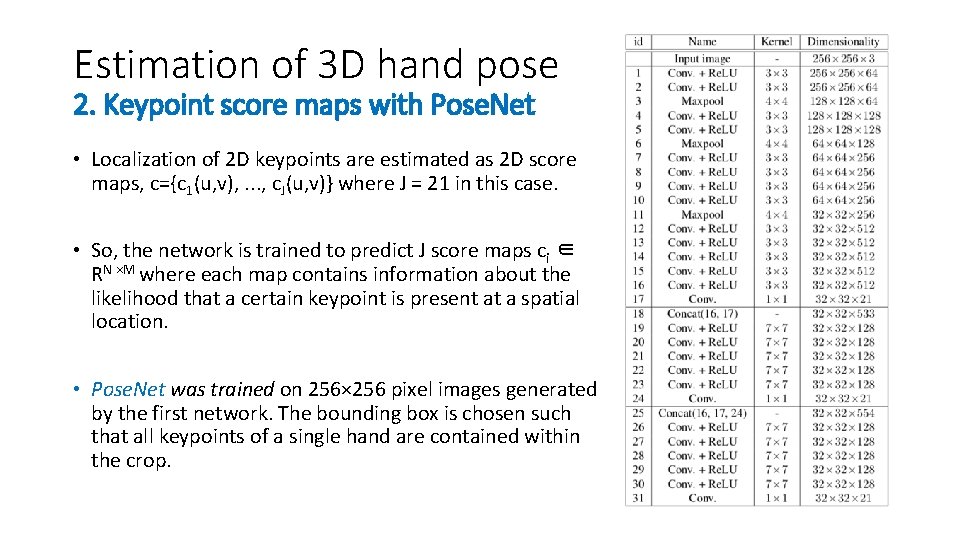
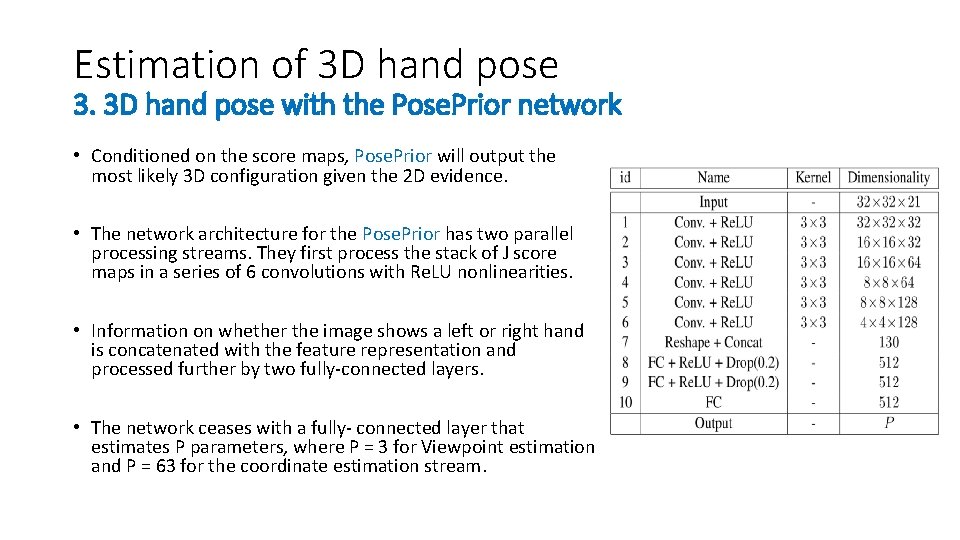
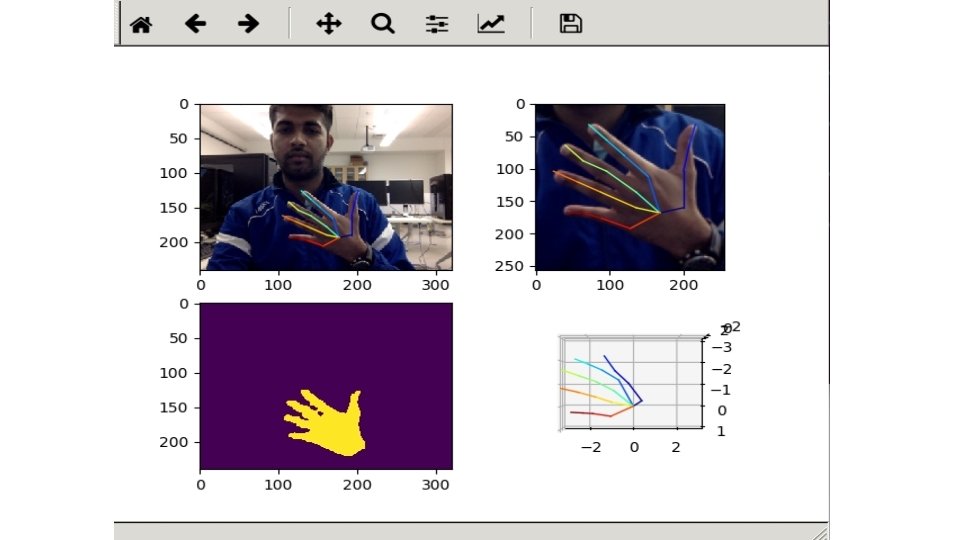
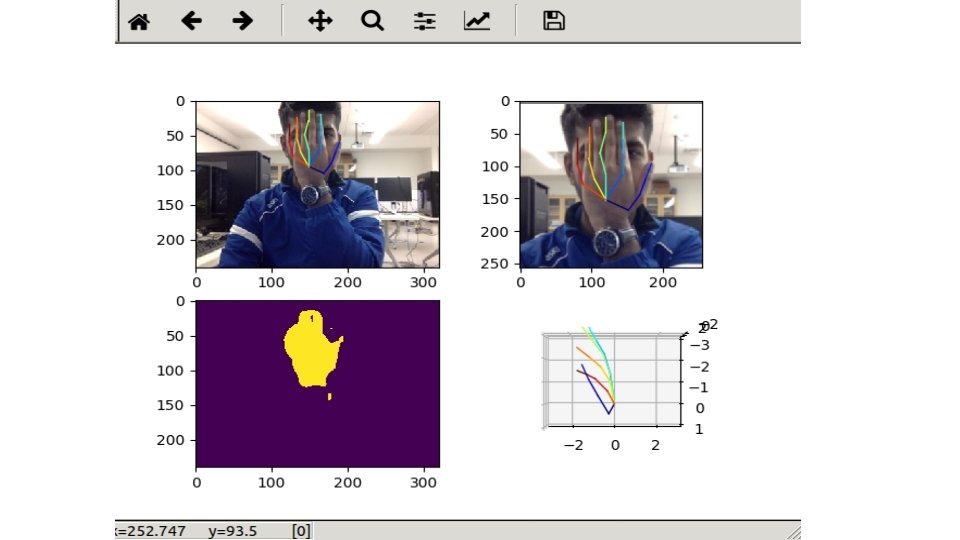
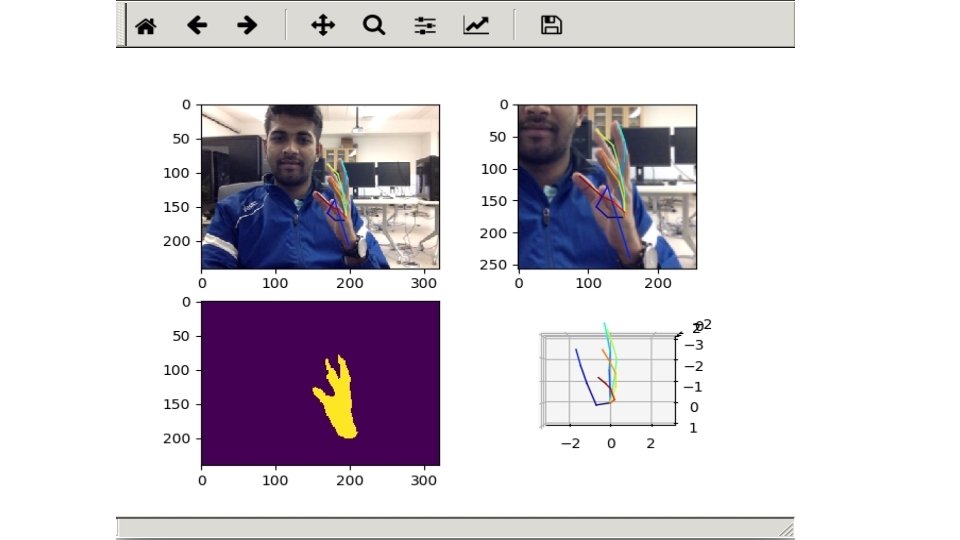
Contribution of this Paper • Learns full 3 D hand pose estimation from single color images without the need for any special equipment. • It uses deep networks to learn sensible priors from data in order to resolve ambiguities. • It consists of three deep networks that cover important subtasks on the way to the 3 D pose : 1. The first network provides a hand segmentation to localize the hand in the image. 2. Based on first network output, the second network localizes hand keypoints in the 2 D images. 3. The third network finally derives the 3 D hand pose from the 2 D keypoints.
Overview of the Proposed Method
Related Works • 2 D Human Pose Estimation : 1. 2. Toshev and Szegedy[2] : directly regresses 2 D cartesian coordinates from color image input. Wei et al. [3] : how convolutional networks can be used for learning image features and image-dependent spatial models for pose estimation. • 3 D Human Pose Estimation : 1. 2. Chen et al. [4] : A nearest neighbor matching of a given 2 D prediction using a database of 2 D to 3 D correspondences. Bogo et al. [5] : optimizes the reprojection error between 3 D joint locations of a statistical body shape model and 2 D prediction. • Hand Pose Estimation : 1. 2. Athitsos and Sclaroff [6] : Proposed a single frame based detection approach based on edge maps and Chamfer matching. Zhou et al. [7] : Estimates angles between bones of kinematic chain instead of Cartesian coordinates.
Hand Pose Representation • Input : A color image I ∈ RN×M× 3 showing a single hand, we want to infer its 3 D pose. • Output : Hand pose defined by a set of coordinates wi = (xi, yi, zi), which describe the locations of J keypoints in 3 D space, i. e. , i ∈ [1, J] with J = 21 in our case.
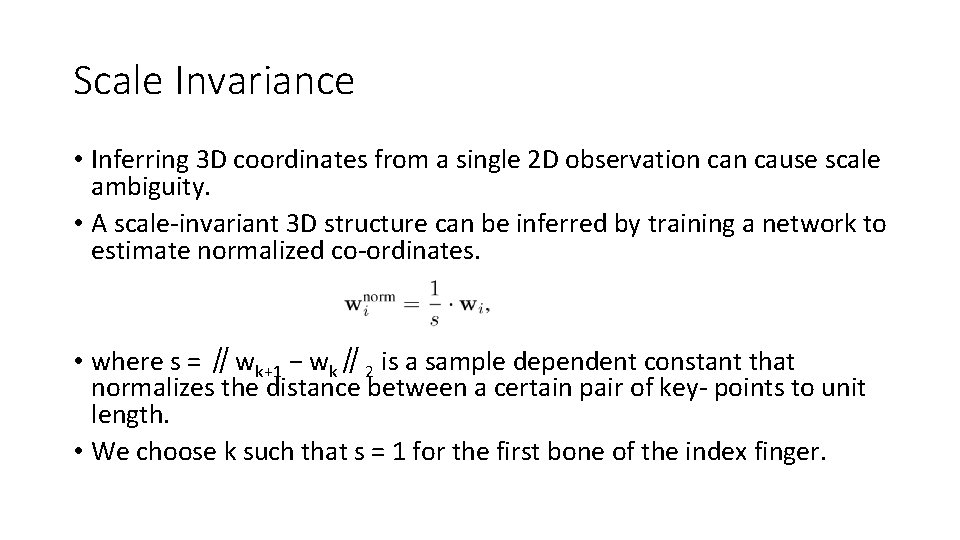
Scale Invariance • Inferring 3 D coordinates from a single 2 D observation cause scale ambiguity. • A scale-invariant 3 D structure can be inferred by training a network to estimate normalized co-ordinates. • where s = ∥wk+1 − wk∥ 2 is a sample dependent constant that normalizes the distance between a certain pair of key- points to unit length. • We choose k such that s = 1 for the first bone of the index finger.
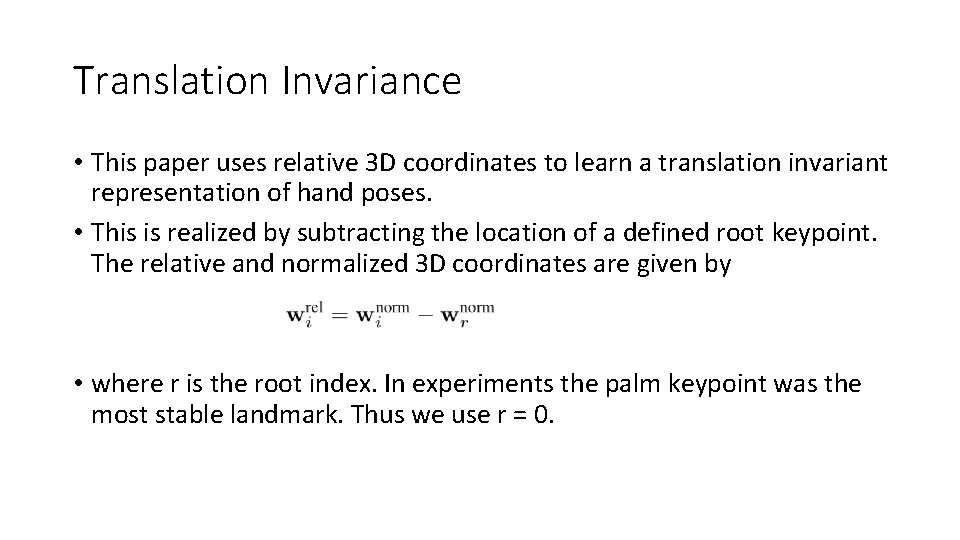
Translation Invariance • This paper uses relative 3 D coordinates to learn a translation invariant representation of hand poses. • This is realized by subtracting the location of a defined root keypoint. The relative and normalized 3 D coordinates are given by • where r is the root index. In experiments the palm keypoint was the most stable landmark. Thus we use r = 0.
Estimation of 3 D hand pose 1. Hand segmentation with Hand. Seg. Net • Hand. Seg. Net uses network architecture that is based on and initialized by the person detector of Wei et al [3]. • The network was initialized using weights of Wei et al[3] for layers 1 to 16 and then trained for 40000 iterations using a standard softmax cross-entropy loss. • The hand mask provided by Hand. Seg. Net allows us to crop and normalize the inputs in size, which simplifies the learning task for the Pose. Net.
Estimation of 3 D hand pose 2. Keypoint score maps with Pose. Net • Localization of 2 D keypoints are estimated as 2 D score maps, c={c 1(u, v), . . . , c. J(u, v)} where J = 21 in this case. • So, the network is trained to predict J score maps ci ∈ RN ×M where each map contains information about the likelihood that a certain keypoint is present at a spatial location. • Pose. Net was trained on 256× 256 pixel images generated by the first network. The bounding box is chosen such that all keypoints of a single hand are contained within the crop.
Estimation of 3 D hand pose 3. 3 D hand pose with the Pose. Prior network • Conditioned on the score maps, Pose. Prior will output the most likely 3 D configuration given the 2 D evidence. • The network architecture for the Pose. Prior has two parallel processing streams. They first process the stack of J score maps in a series of 6 convolutions with Re. LU nonlinearities. • Information on whether the image shows a left or right hand is concatenated with the feature representation and processed further by two fully-connected layers. • The network ceases with a fully- connected layer that estimates P parameters, where P = 3 for Viewpoint estimation and P = 63 for the coordinate estimation stream.
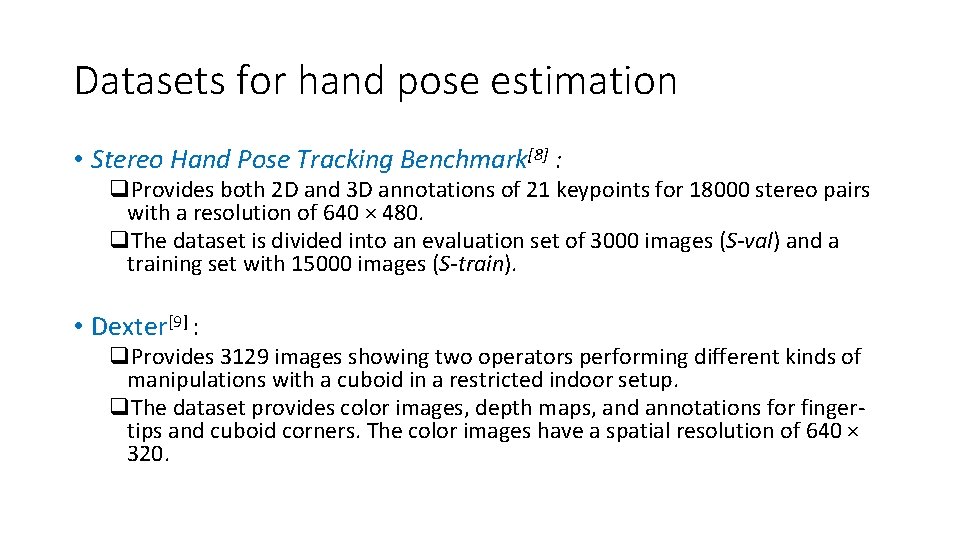
Datasets for hand pose estimation • Stereo Hand Pose Tracking Benchmark[8] : q. Provides both 2 D and 3 D annotations of 21 keypoints for 18000 stereo pairs with a resolution of 640 × 480. q. The dataset is divided into an evaluation set of 3000 images (S-val) and a training set with 15000 images (S-train). • Dexter[9] : q. Provides 3129 images showing two operators performing different kinds of manipulations with a cuboid in a restricted indoor setup. q. The dataset provides color images, depth maps, and annotations for finger- tips and cuboid corners. The color images have a spatial resolution of 640 × 320.
Rendered hand pose dataset • The previous datasets are not sufficient for training a deep network due to limited variation, number of available samples, and partially incomplete annotation. • This rendered dataset is built upon 20 different characters performing 39 actions. The data is split into a validation set (R-val) and a training set (Rtrain), where a character or action can exclusively be in one of the sets but not in the other. • The proposed split results into 16 characters performing 31 actions for training and 4 characters with 8 actions in the validation set. • In total the dataset for this experiment provides 41258 images for training and 2728 images for evaluation with a resolution of 320 × 320 pixels. All samples come with full annotation of a 21 keypoint skeleton model of each hand.
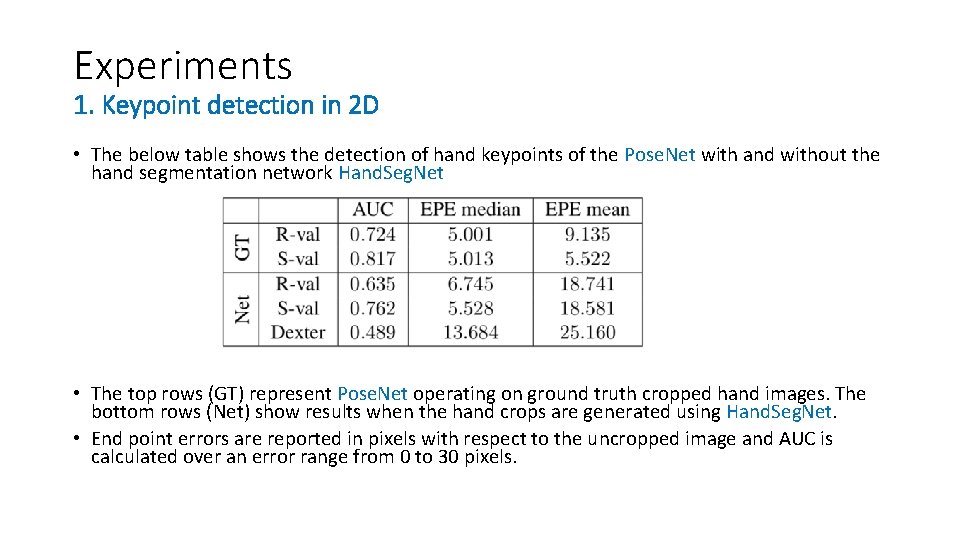
Experiments 1. Keypoint detection in 2 D • The below table shows the detection of hand keypoints of the Pose. Net with and without the hand segmentation network Hand. Seg. Net • The top rows (GT) represent Pose. Net operating on ground truth cropped hand images. The bottom rows (Net) show results when the hand crops are generated using Hand. Seg. Net. • End point errors are reported in pixels with respect to the uncropped image and AUC is calculated over an error range from 0 to 30 pixels.
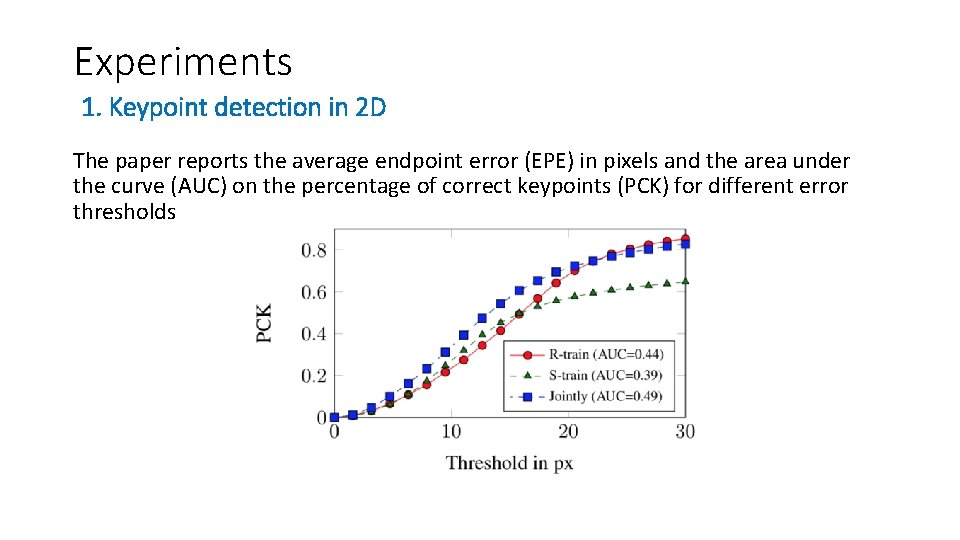
Experiments 1. Keypoint detection in 2 D The paper reports the average endpoint error (EPE) in pixels and the area under the curve (AUC) on the percentage of correct keypoints (PCK) for different error thresholds
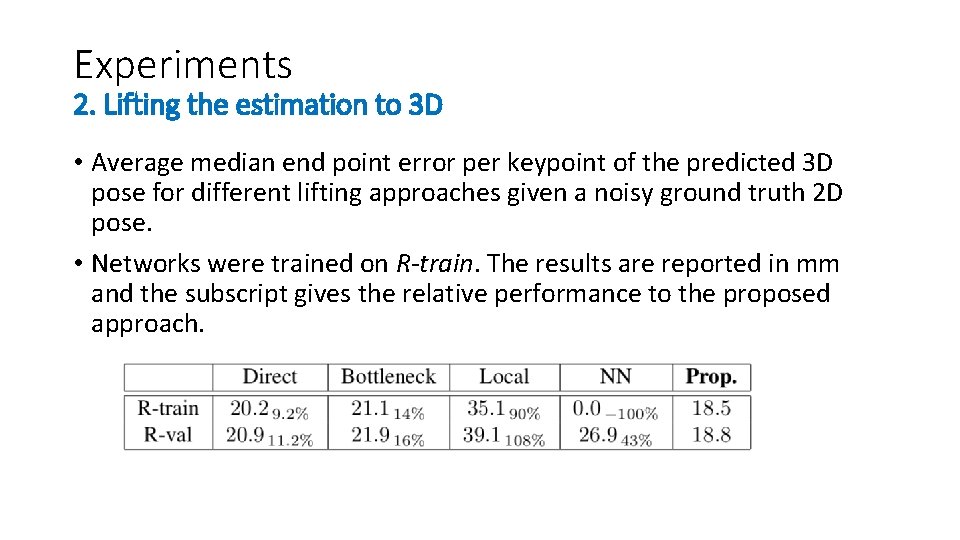
Experiments 2. Lifting the estimation to 3 D • Average median end point error per keypoint of the predicted 3 D pose for different lifting approaches given a noisy ground truth 2 D pose. • Networks were trained on R-train. The results are reported in mm and the subscript gives the relative performance to the proposed approach.
References 1. Christian Zimmermann, Thomas Brox. Learning to Estimate 3 D Hand Pose from Single RGB Images. In Proc. of the IEEE Conf. on International Conference on Computer Vision(ICCV), 2017. 2. M. Andriluka, L. Pishchulin, P. V. Gehler, and B. Schiele. 2 d human pose estimation: New benchmark and state of the art analysis. In Proc. of the IEEE Conf. on Computer Vision and Pattern Recognition (CVPR), pages 3686– 3693, 2014. 3. Shih-En Wei, Varun Ramakrishna, Takeo Kanade, and Yaser Sheikh. Convolutional pose machines. In Proc. of the IEEE Conf. on Computer Vision and Pattern Recognition (CVPR), pages 4724– 4732, 2016. 4. C. H. Chen and D. Ramanan. 3 d Human Pose Estimation = 2 d Pose Estimation+ Matching. ar. Xiv preprint ar. Xiv: 1612. 06524, 2016. 5. F. Bogo, A. Kanazawa, C. Lassner, P. Gehler, J. Romero, and M. J. Black. Keep it SMPL: Automatic estimation of 3 d human pose and shape from a single image. In European Conference on Computer Vision, pages 561– 578. Springer, 2016. V. Athitsos and S. Sclaroff. Estimating 3 d hand pose from a cluttered image. In Proc. of the IEEE Conf. on Computer Vision and Pattern Recognition (CVPR), volume 2, pages II– 432. IEEE, 2003. 7. X. Zhou, Q. Wan, W. Zhang, X. Xue, and Y. Wei. Model- based deep hand pose estimation. pages 2421– 2427, 2016. 8. J. Zhang, J. Jiao, M. Chen, L. Qu, X. Xu, and Q. Yang. 3 d Hand Pose Tracking and Estimation Using Stereo Matching. ar. Xiv preprint ar. Xiv: 1610. 07214, 2016. 9. S. Sridhar, F. Mueller, M. Zollho fer, D. Casas, A. Oulasvirta, and C. Theobalt. Real-time joint tracking of a hand ma- nipulating an object from rgb-d input. In Proc. of the Eu- rop. Conf. on Computer Vision (ECCV), 2016.