
Learning Through Participation in Different Activity systems A

- Slides: 23
Learning Through Participation in Different Activity systems A study of distance learners in a teacher education programme in Iceland Thuridur Jóhannsdóttir Scottish Educational Research Association Annual Conference. Royal George Hotel, Perth Scotland. 25 -27 November 2004 25. 11. 04 SERA - Perth, Scotland
Reframing distance learning • Work in contemporary societies is characterized by polycontextuality - people involved in multiple communities of practice • People need to learn to cross boundaries between communities - interesting focus for study • Frame factors – space and time resisting to change • In distance education many of the frame factors disappear, while others change • Which possibilities this brings for breaking down the isolation of traditional school learning from the students’ actual life 25. 11. 04 SERA - Perth, Scotland 2
The Study: Research on distance education • Programme for initial teacher training in the Iceland University of Education from the perspective of teacher students living and working in remote rural areas • The aim is to explore how one particular case in teacher education can be explained and understood with a focus on distance learning from an activity theoretical perspective • Especially the concepts participation in different activity systems and transfer as a result of boundary crossing 25. 11. 04 SERA - Perth, Scotland 3
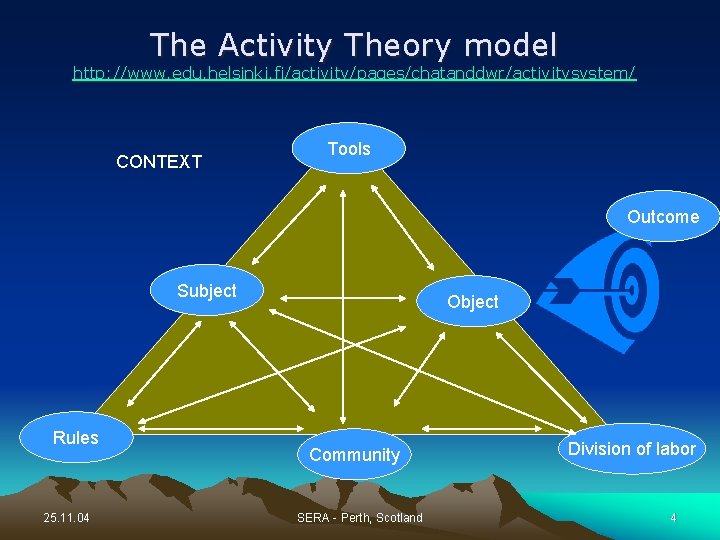
The Activity Theory model http: //www. edu. helsinki. fi/activity/pages/chatanddwr/activitysystem/ CONTEXT Tools Outcome Subject Rules 25. 11. 04 Object Community SERA - Perth, Scotland Division of labor 4
Historical phase • Analysis of intervews with three women in the first enrolment using Internet, started 1993 • Rules for admission were living in the country-side were lack of teachers were problem, teaching experience and a position in local schools • The new ICT was used to justify and realize the programme 25. 11. 04 SERA - Perth, Scotland 5
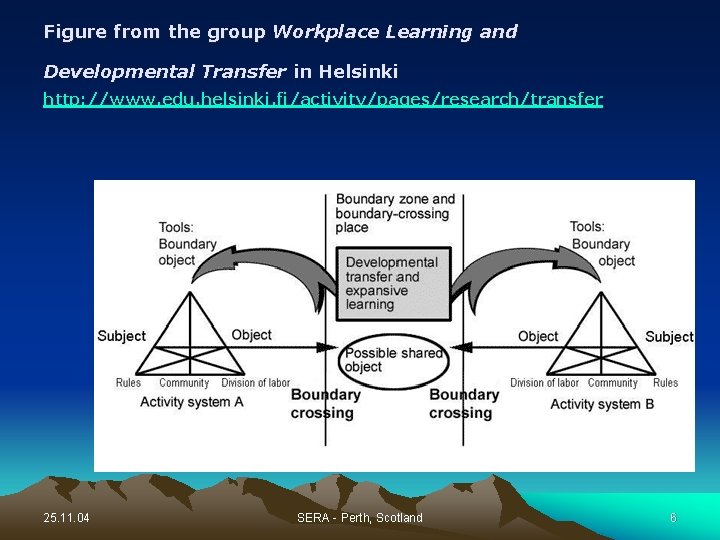
Figure from the group Workplace Learning and Developmental Transfer in Helsinki http: //www. edu. helsinki. fi/activity/pages/research/transfer 25. 11. 04 SERA - Perth, Scotland 6
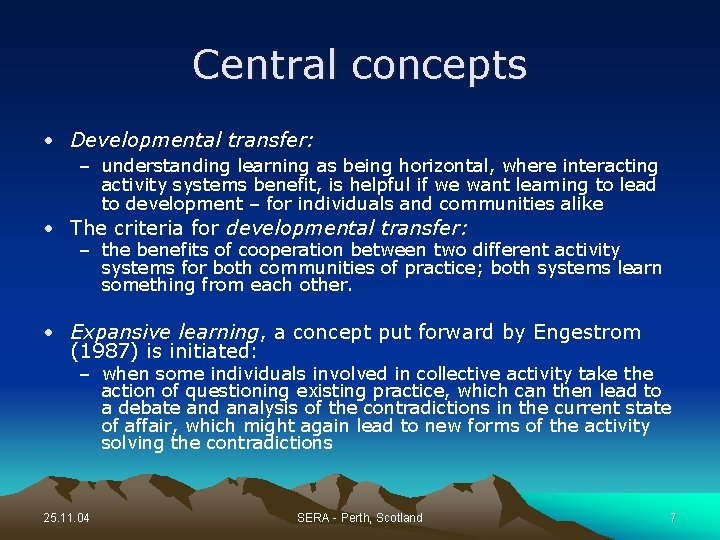
Central concepts • Developmental transfer: – understanding learning as being horizontal, where interacting activity systems benefit, is helpful if we want learning to lead to development – for individuals and communities alike • The criteria for developmental transfer: – the benefits of cooperation between two different activity systems for both communities of practice; both systems learn something from each other. • Expansive learning, a concept put forward by Engestrom (1987) is initiated: – when some individuals involved in collective activity take the action of questioning existing practice, which can then lead to a debate and analysis of the contradictions in the current state of affair, which might again lead to new forms of the activity solving the contradictions 25. 11. 04 SERA - Perth, Scotland 7
Methods, participants, context • 3 currently enrolled distance students interviewed + one principal – All located in fishing villages or towns ranging from 200 to 900 inhabitants • Their narratives through an AT lens – See if it enhnaces understanding to i. Interpret the distance learning in the light of activity theory • Their participation in different activity systems will be discussed – How they move between systems and cross boundarys – What seems to enhance transfer from one system to another – The possibilities of the activity system as well as the individual learner to develop - learn - expand ? 25. 11. 04 SERA - Perth, Scotland 8
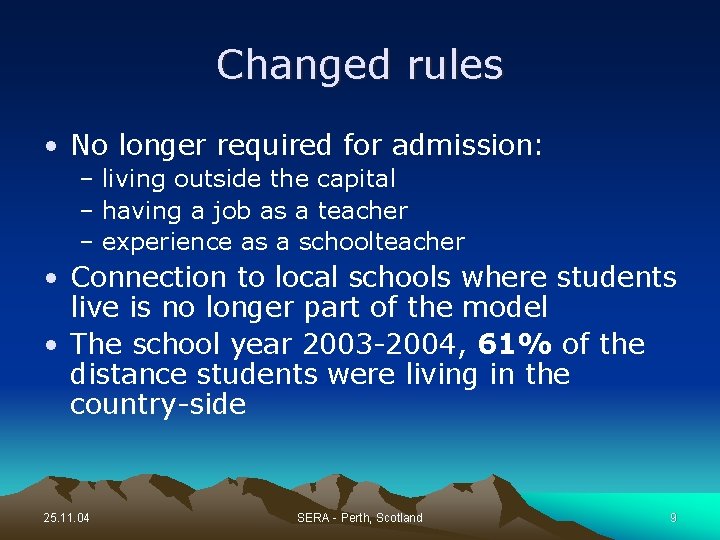
Changed rules • No longer required for admission: – living outside the capital – having a job as a teacher – experience as a schoolteacher • Connection to local schools where students live is no longer part of the model • The school year 2003 -2004, 61% of the distance students were living in the country-side 25. 11. 04 SERA - Perth, Scotland 9
Who are the actors? Sara age 34 – in her second year of the programme when interviewed February and May 2004 – experience of being a support teacher with disabled pupils + one year as class teacher – Has a teacher job at a school of 150 pupils in a fishing village of ca 900 inhabitans – the only teacher at the school and in the village in her enrolment 25. 11. 04 SERA - Perth, Scotland 10
Who are the actors? Emma (31) and Samuel (45) • had just finished their first year in the programme when interviewed in May 2004 – some experience of teaching – have occupations as teachers in a small school of approximately 40 pupils and 5 teachers including the principal – in a fishing village of ca 250 inhabitants and many immigrants – 25% of the pupils in the school do not speak Icelandic as their first language. 25. 11. 04 SERA - Perth, Scotland 11
Why? What are the motvies? • Sara encouraged by pupils and parents got enough self-confidence to want to be a teacher • Samuel, is in his forties, his family has its origins in the village and he wants to continue living the village and seeks for a not so wet job as that of a fisherman • Emma likes the teacher job and thinks that the most motivating force behind the studies has to be the interest to continue to learn • Both Emma and Samuel have school-pricipals in their nearest family - mother and brother. • 25. 11. 04 SERA - Perth, Scotland 12
What and how do they learn? Sara • Describes with enthusiasm how she has been applying what she has learned in her classroom teaching • How the studies have made her more secure in what she is doing – with the pupils and – in the cooperation with the parents • For Sara the learning management system (Web. CT) on the web is great • She indicates she is learning a lot from her costudents´ inputs and discussion on the web 25. 11. 04 SERA - Perth, Scotland 13
What and how do they learn? Samuel and Emma • More diverse solutions in their classroom teaching • More secure in the discussion with the other teachers in the staff • They have started to think differently about the nature of the school as a place for children to be in and what learning is about, e. g. questioning the assessment methods of schools • Do not stress the importance of the learning management system • They have been very important mates for each other, being able to discuss and work together on assignments 25. 11. 04 SERA - Perth, Scotland 14
Multiple Activty systems • The dist. ed. Programme – The on-campus sessions – The LMS (learning management system) on the web – The teaching practice • The local schools – The 25. 11. 04 classroom teaching teachers´ staff-room community of parents regional community of teachers SERA - Perth, Scotland 15
Defining central activities: Between classroom and virtual community on the web? • Sara thinks she learns most from practial assignments which she can use in the classroom • She says that she learns by participating in discussion on the Web. CT • She transfers what she learns to her practice in the classoom and in communication with parents • Not just a simple transfer of knowlegde – she is externalizing what she has learned by developing new practice in the classroom and with the parents 25. 11. 04 SERA - Perth, Scotland 16
Emma and Sam: Moving between which systems? • Listen to what teachers say on-campus sessions and on-line – but critically • Teaching practice offers new rules, new object and a new division of labor – learned the difference between idealized teaching methods and reality • They seem to externalize their learning – to the classroom – and also to professional discussion in the school and the community of regional teachers 25. 11. 04 SERA - Perth, Scotland 17
Sam and Emma: boundary crossing ? • Discussion and collaboration • To have each other for social discussion as well as collaboration on assignments • They are critical towards discussion on the web – often just reproducing texts in the books they are supposed to read • Critical towards teaching methods of the university teachers – Paradoxes in theory and praxis 25. 11. 04 SERA - Perth, Scotland 18
Developmental transfer? • Some early distance students acted as boundary-crossers and change agents which resulted in developed praxis in the schools • The importance of the culture of the relevant activity system to be receptive to development 25. 11. 04 SERA - Perth, Scotland 19
Distance students as active participants • Theese three students have all found their ways to move between te different activity systems in which they are meant to participate • In the programme they are obliged to participate – on-campus sessions, teaching practice and in the web-based activities between on-campus sessions • At home they apply their knowledge and know-how from the programme differently and in different activity systems • Some use the classroom others the local school – depending on which spaces they have admittance to • Distance students are actors in their local communities and there they externalize what they learn and thereby develop the relevant activity system – be it receptive to changes 25. 11. 04 SERA - Perth, Scotland 20
Resistance to change • Why was Sara’s space limited to the classroom and parents of her pupils? • Interview with the pricipal confirmed that there was a resistance • Lack of willingness to open up and collaborate • The teachers would listen to Sara’s new ideas and methods but that was it • The principal was aware of she was really doing good things with her pupils but. . . • Explore both personal and institutional factors further 25. 11. 04 SERA - Perth, Scotland 21
Openness to change • Why do Sam and Emma seem able to act in a wider arena? • Both personal and institutional factors • Two distance students in a group of five teachers • Only one formally qualified teacher • The distance students act as their small school’s voice in a regional meetings of professional teachers 25. 11. 04 SERA - Perth, Scotland 22
Valuable knowledge • The teacher education university planning the distance programme should be aware of the situation in which the teahcer students are engaged in • Plan the learning actions and teaching actions in order to support learning for the kind of boundary crossing, students living in remote places are exposed to • Developmental transfer should be the goal 25. 11. 04 SERA - Perth, Scotland 23