
Learning through Experimentation CS 246 Mining Massive Datasets
- Slides: 44
Learning through Experimentation CS 246: Mining Massive Datasets Jure Leskovec, Stanford University http: //cs 246. stanford. edu
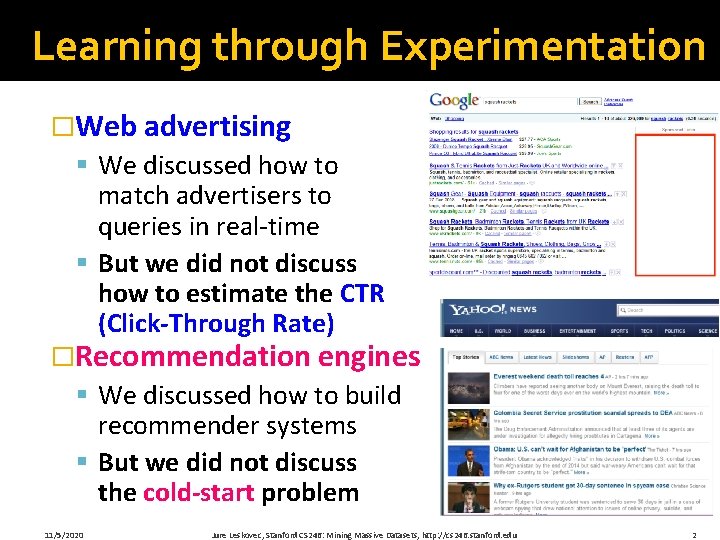
Learning through Experimentation �Web advertising § We discussed how to match advertisers to queries in real-time § But we did not discuss how to estimate the CTR (Click-Through Rate) �Recommendation engines § We discussed how to build recommender systems § But we did not discuss the cold-start problem 11/5/2020 Jure Leskovec, Stanford CS 246: Mining Massive Datasets, http: //cs 246. stanford. edu 2
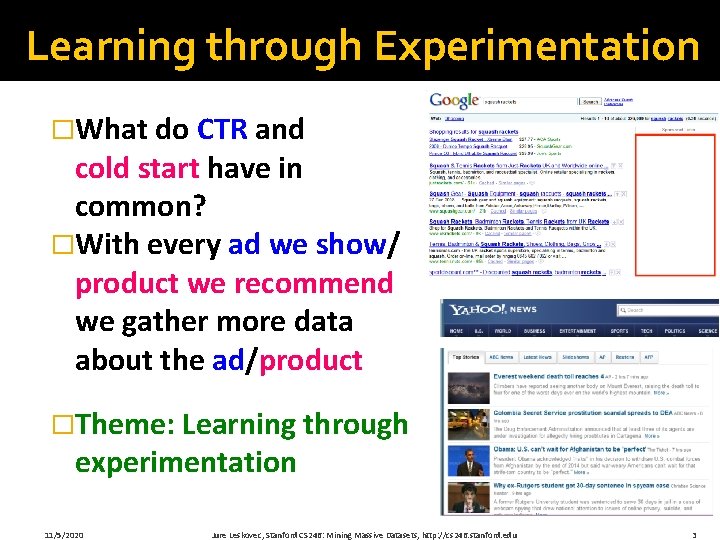
Learning through Experimentation �What do CTR and cold start have in common? �With every ad we show/ product we recommend we gather more data about the ad/product �Theme: Learning through experimentation 11/5/2020 Jure Leskovec, Stanford CS 246: Mining Massive Datasets, http: //cs 246. stanford. edu 3
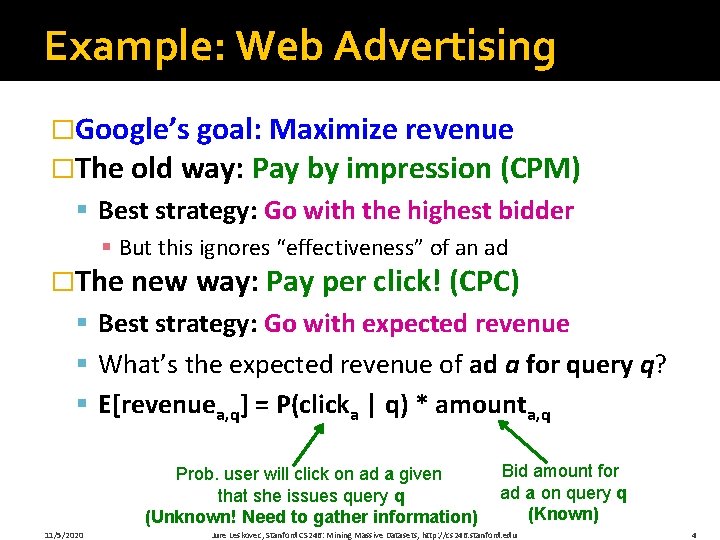
Example: Web Advertising �Google’s goal: Maximize revenue �The old way: Pay by impression (CPM) § Best strategy: Go with the highest bidder § But this ignores “effectiveness” of an ad �The new way: Pay per click! (CPC) § Best strategy: Go with expected revenue § What’s the expected revenue of ad a for query q? § E[revenuea, q] = P(clicka | q) * amounta, q Prob. user will click on ad a given that she issues query q (Unknown! Need to gather information) 11/5/2020 Bid amount for ad a on query q (Known) Jure Leskovec, Stanford CS 246: Mining Massive Datasets, http: //cs 246. stanford. edu 4
Other Applications �Clinical trials: § Investigate effects of different treatments while minimizing patient losses �Adaptive routing: § Minimize delay in the network by investigating different routes �Asset pricing: § Figure out product prices while trying to make most money 11/5/2020 Jure Leskovec, Stanford CS 246: Mining Massive Datasets, http: //cs 246. stanford. edu 5
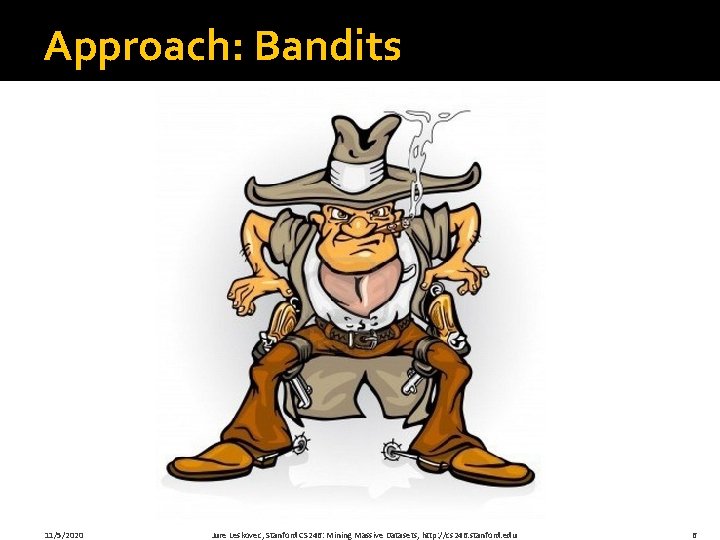
Approach: Bandits 11/5/2020 Jure Leskovec, Stanford CS 246: Mining Massive Datasets, http: //cs 246. stanford. edu 6
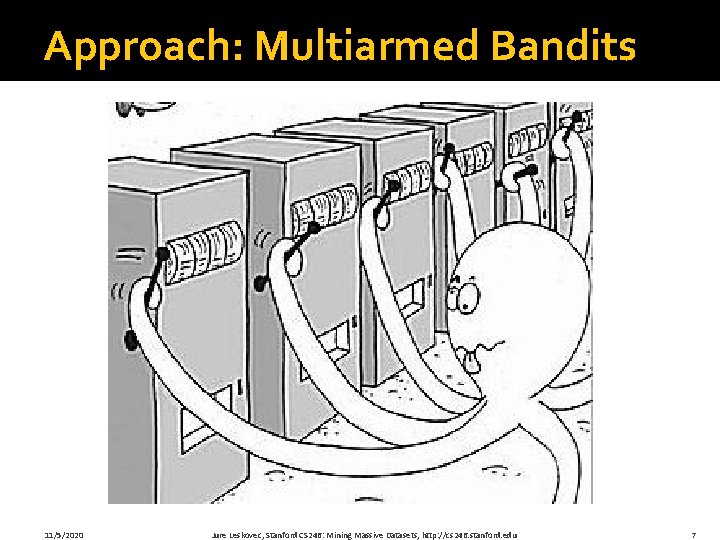
Approach: Multiarmed Bandits 11/5/2020 Jure Leskovec, Stanford CS 246: Mining Massive Datasets, http: //cs 246. stanford. edu 7
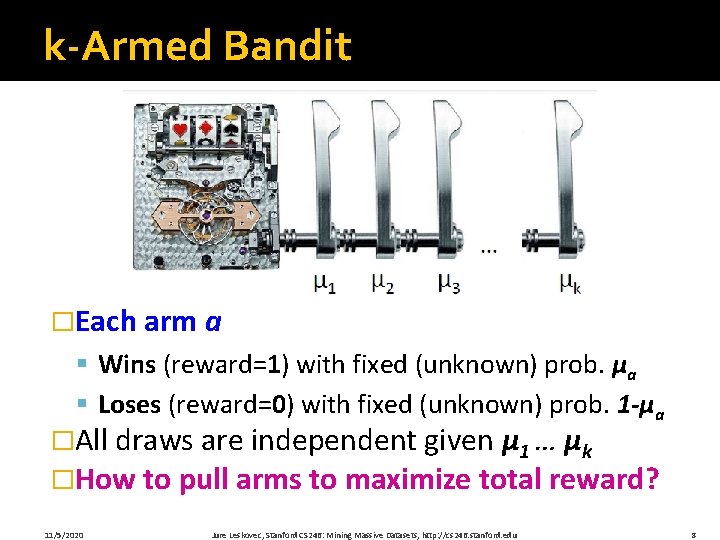
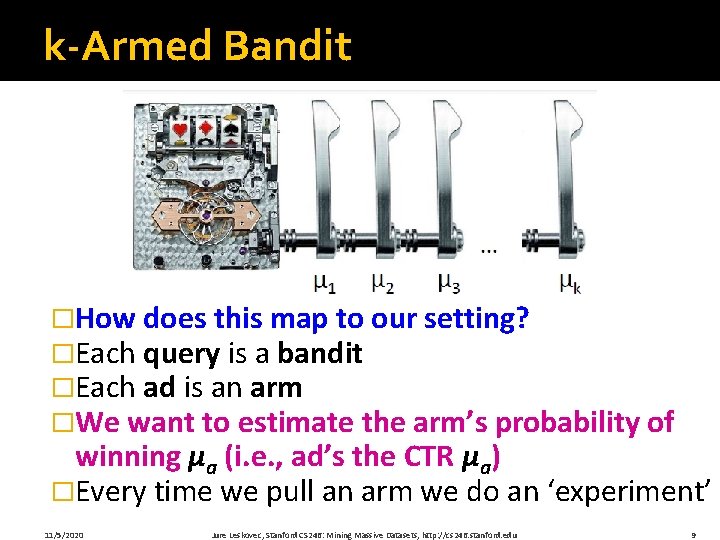
k-Armed Bandit �Each arm a § Wins (reward=1) with fixed (unknown) prob. μa § Loses (reward=0) with fixed (unknown) prob. 1 -μa �All draws are independent given μ 1 … μk �How to pull arms to maximize total reward? 11/5/2020 Jure Leskovec, Stanford CS 246: Mining Massive Datasets, http: //cs 246. stanford. edu 8
k-Armed Bandit �How does this map to our setting? �Each query is a bandit �Each ad is an arm �We want to estimate the arm’s probability of winning μa (i. e. , ad’s the CTR μa) �Every time we pull an arm we do an ‘experiment’ 11/5/2020 Jure Leskovec, Stanford CS 246: Mining Massive Datasets, http: //cs 246. stanford. edu 9
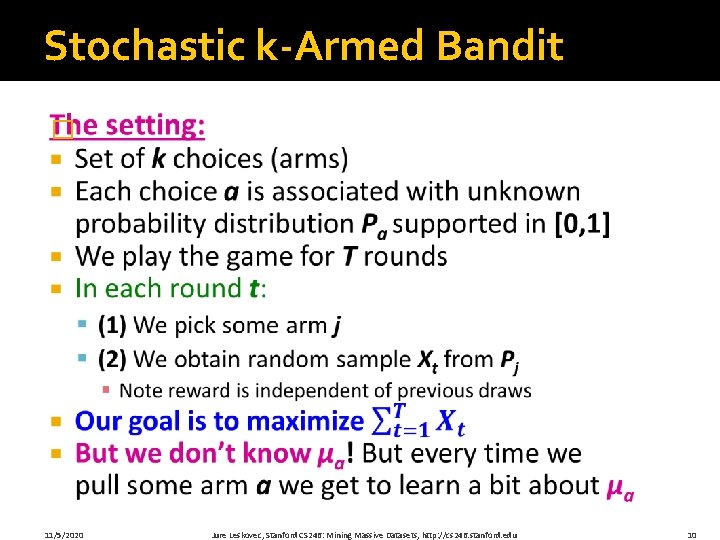
Stochastic k-Armed Bandit � 11/5/2020 Jure Leskovec, Stanford CS 246: Mining Massive Datasets, http: //cs 246. stanford. edu 10
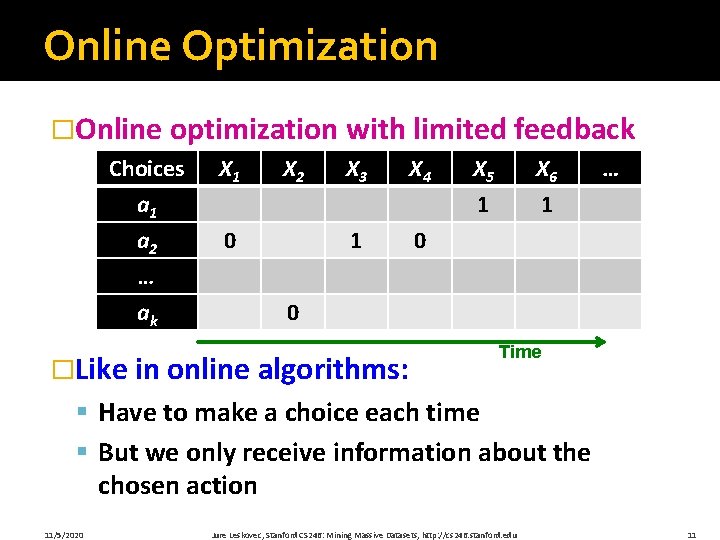
Online Optimization �Online optimization with limited feedback Choices a 1 a 2 … ak X 1 X 2 0 X 3 X 4 1 0 X 5 1 X 6 1 … 0 �Like in online algorithms: Time § Have to make a choice each time § But we only receive information about the chosen action 11/5/2020 Jure Leskovec, Stanford CS 246: Mining Massive Datasets, http: //cs 246. stanford. edu 11
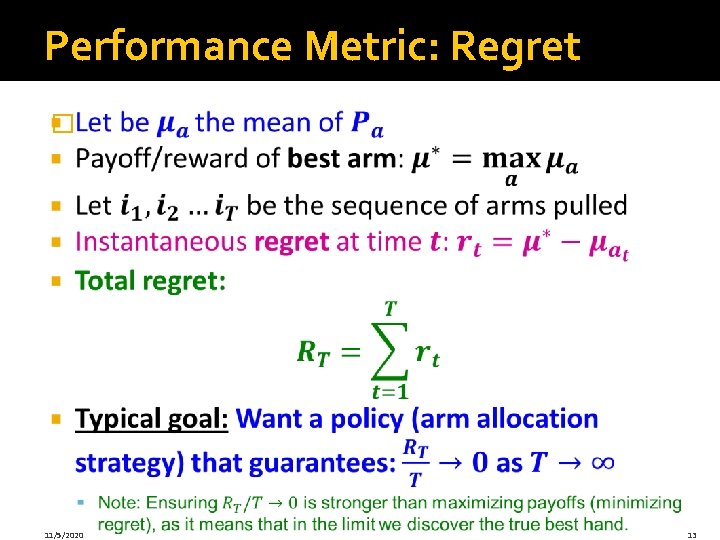
Solving the Bandit Problem �Policy: a strategy/rule that in each iteration tells me which arm to pull § Hopefully policy depends on the history of rewards �How to quantify performance of the algorithm? Regret! 11/5/2020 Jure Leskovec, Stanford CS 246: Mining Massive Datasets, http: //cs 246. stanford. edu 12
Performance Metric: Regret � 11/5/2020 13
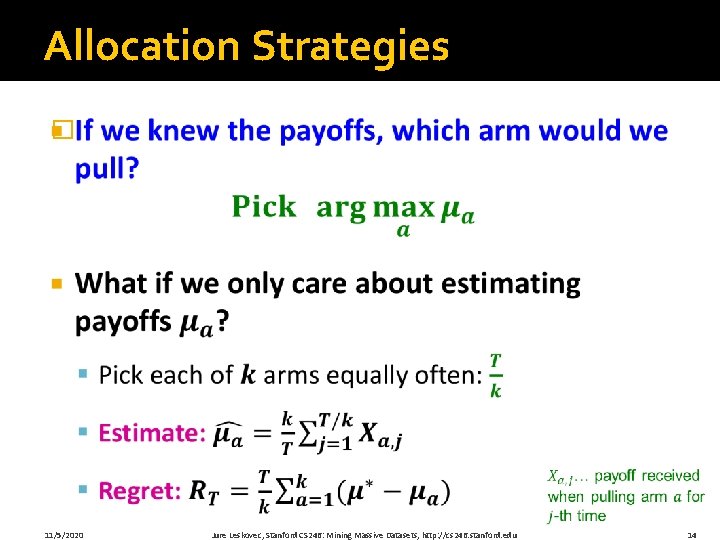
Allocation Strategies � 11/5/2020 Jure Leskovec, Stanford CS 246: Mining Massive Datasets, http: //cs 246. stanford. edu 14
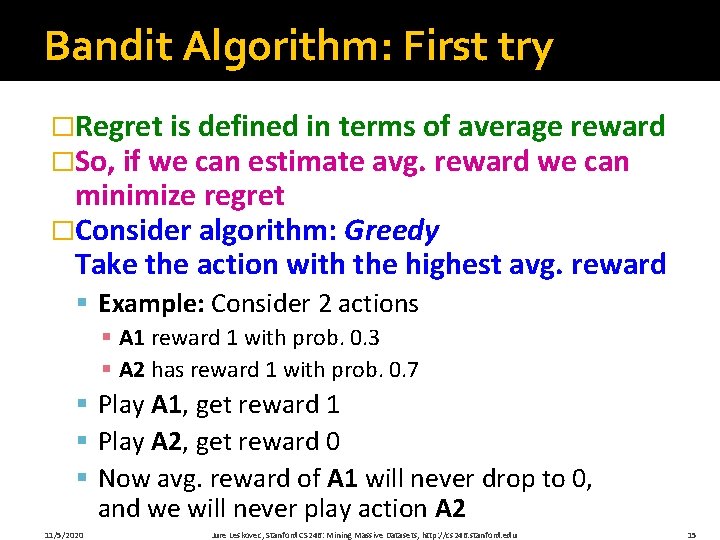
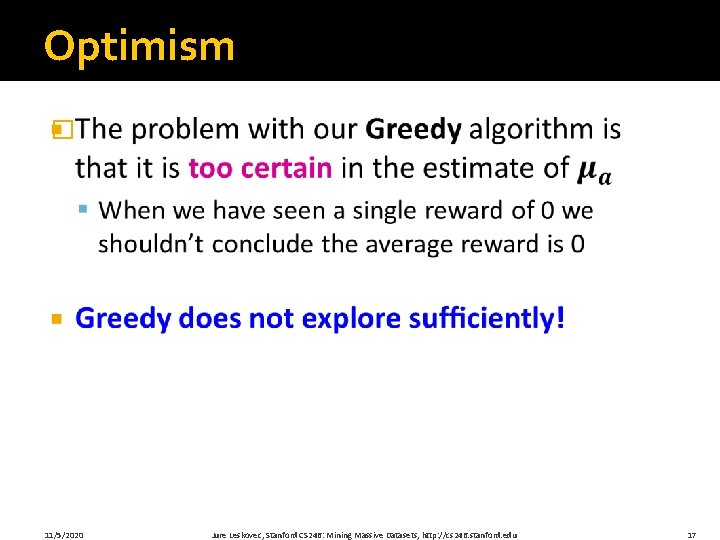
Bandit Algorithm: First try �Regret is defined in terms of average reward �So, if we can estimate avg. reward we can minimize regret �Consider algorithm: Greedy Take the action with the highest avg. reward § Example: Consider 2 actions § A 1 reward 1 with prob. 0. 3 § A 2 has reward 1 with prob. 0. 7 § Play A 1, get reward 1 § Play A 2, get reward 0 § Now avg. reward of A 1 will never drop to 0, and we will never play action A 2 11/5/2020 Jure Leskovec, Stanford CS 246: Mining Massive Datasets, http: //cs 246. stanford. edu 15
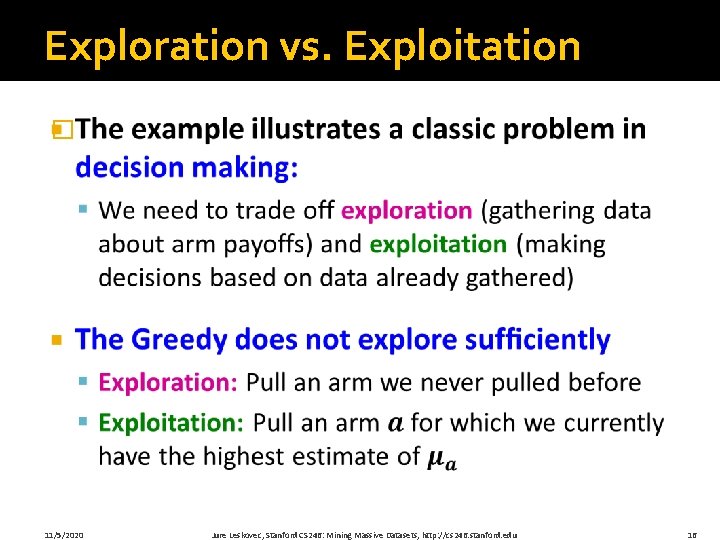
Exploration vs. Exploitation � 11/5/2020 Jure Leskovec, Stanford CS 246: Mining Massive Datasets, http: //cs 246. stanford. edu 16
Optimism � 11/5/2020 Jure Leskovec, Stanford CS 246: Mining Massive Datasets, http: //cs 246. stanford. edu 17
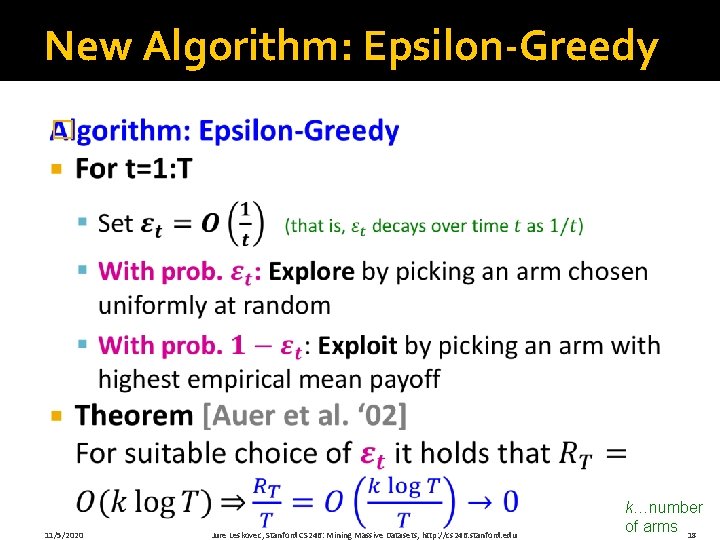
New Algorithm: Epsilon-Greedy � 11/5/2020 Jure Leskovec, Stanford CS 246: Mining Massive Datasets, http: //cs 246. stanford. edu k…number of arms 18
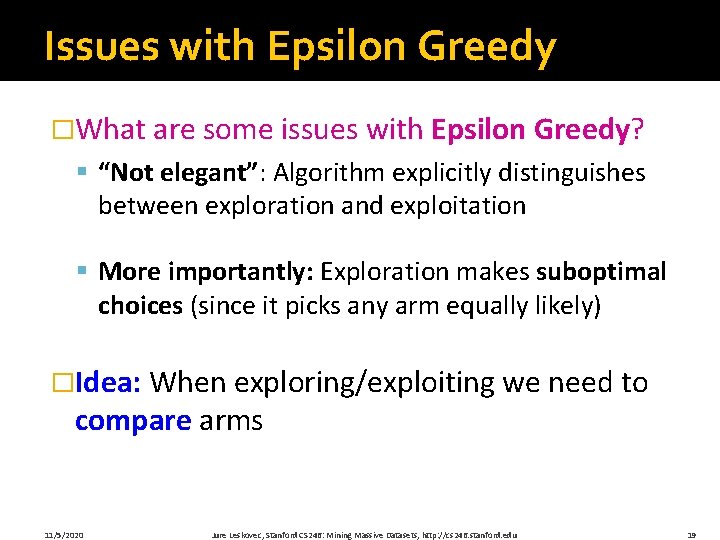
Issues with Epsilon Greedy �What are some issues with Epsilon Greedy? § “Not elegant”: Algorithm explicitly distinguishes between exploration and exploitation § More importantly: Exploration makes suboptimal choices (since it picks any arm equally likely) �Idea: When exploring/exploiting we need to compare arms 11/5/2020 Jure Leskovec, Stanford CS 246: Mining Massive Datasets, http: //cs 246. stanford. edu 19
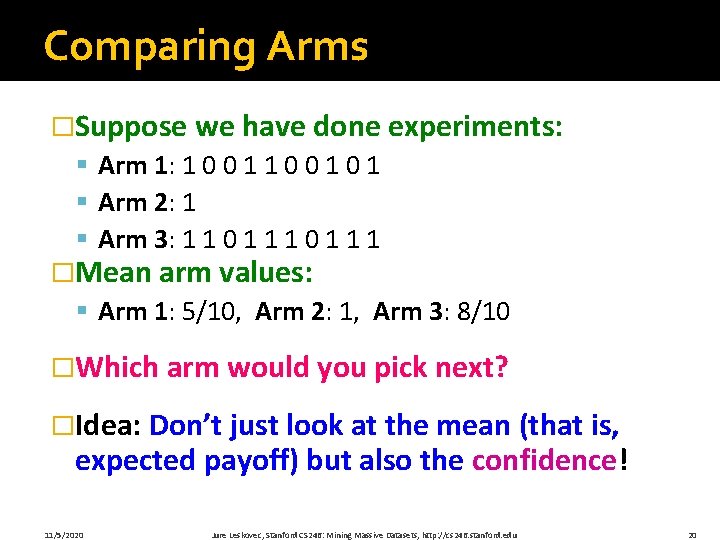
Comparing Arms �Suppose we have done experiments: § Arm 1: 1 0 0 1 0 1 § Arm 2: 1 § Arm 3: 1 1 0 1 1 1 �Mean arm values: § Arm 1: 5/10, Arm 2: 1, Arm 3: 8/10 �Which arm would you pick next? �Idea: Don’t just look at the mean (that is, expected payoff) but also the confidence! 11/5/2020 Jure Leskovec, Stanford CS 246: Mining Massive Datasets, http: //cs 246. stanford. edu 20
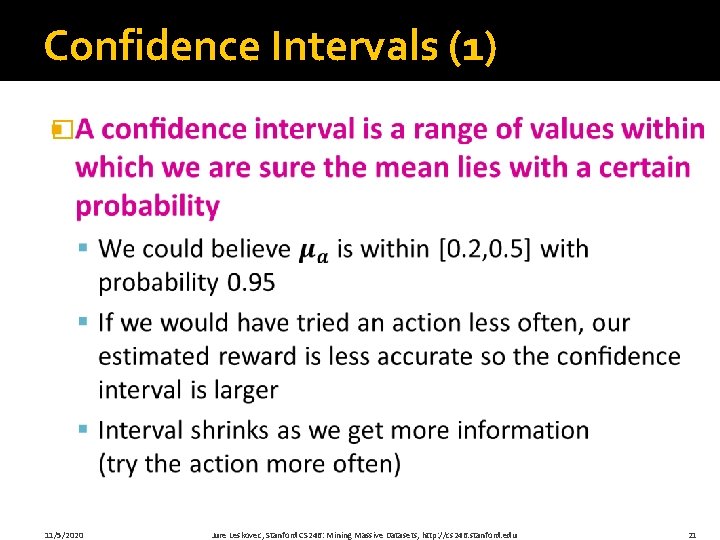
Confidence Intervals (1) � 11/5/2020 Jure Leskovec, Stanford CS 246: Mining Massive Datasets, http: //cs 246. stanford. edu 21
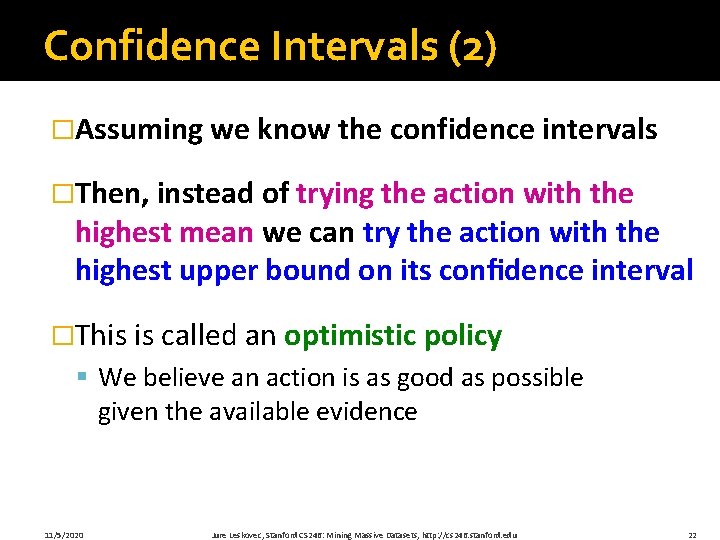
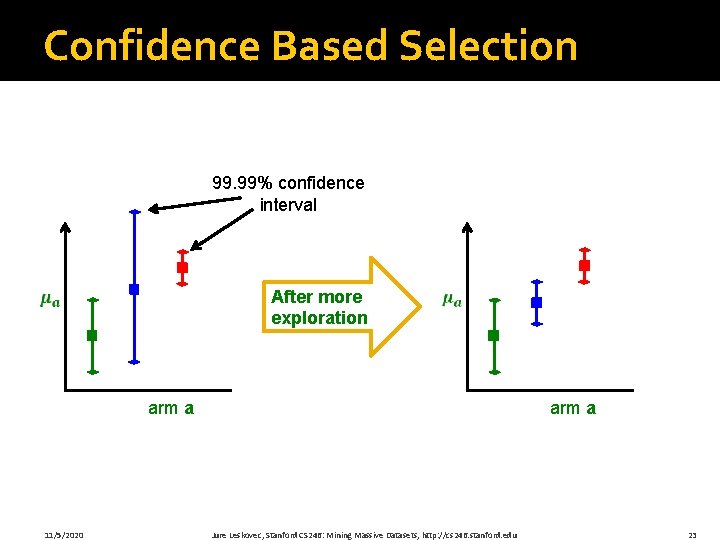
Confidence Intervals (2) �Assuming we know the confidence intervals �Then, instead of trying the action with the highest mean we can try the action with the highest upper bound on its confidence interval �This is called an optimistic policy § We believe an action is as good as possible given the available evidence 11/5/2020 Jure Leskovec, Stanford CS 246: Mining Massive Datasets, http: //cs 246. stanford. edu 22
Confidence Based Selection 99. 99% confidence interval After more exploration arm a 11/5/2020 arm a Jure Leskovec, Stanford CS 246: Mining Massive Datasets, http: //cs 246. stanford. edu 23
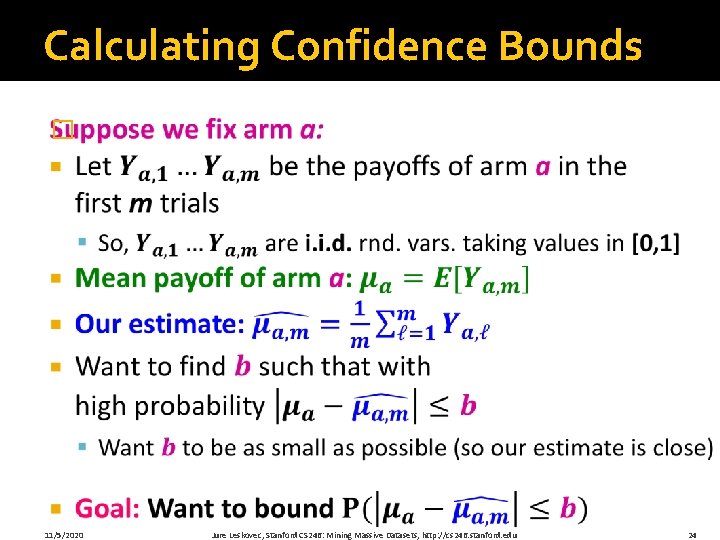
Calculating Confidence Bounds � 11/5/2020 Jure Leskovec, Stanford CS 246: Mining Massive Datasets, http: //cs 246. stanford. edu 24
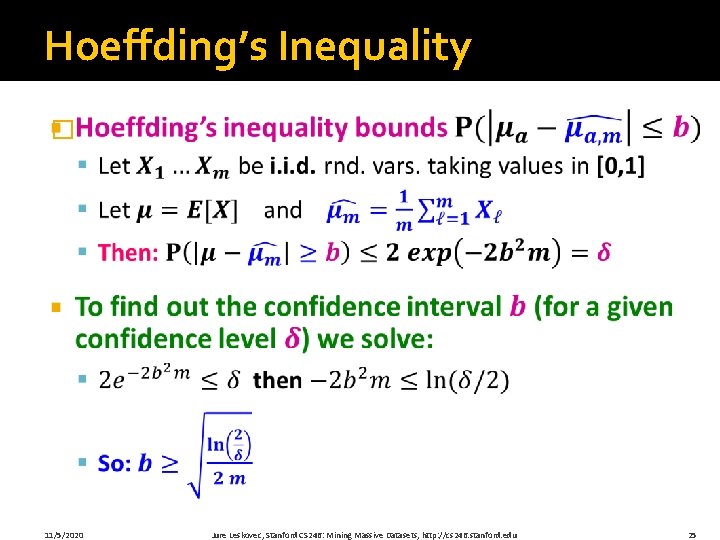
Hoeffding’s Inequality � 11/5/2020 Jure Leskovec, Stanford CS 246: Mining Massive Datasets, http: //cs 246. stanford. edu 25
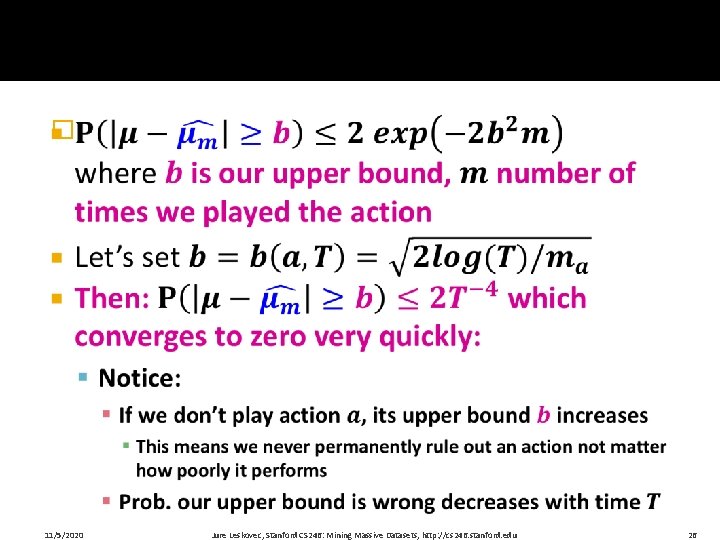
� 11/5/2020 Jure Leskovec, Stanford CS 246: Mining Massive Datasets, http: //cs 246. stanford. edu 26
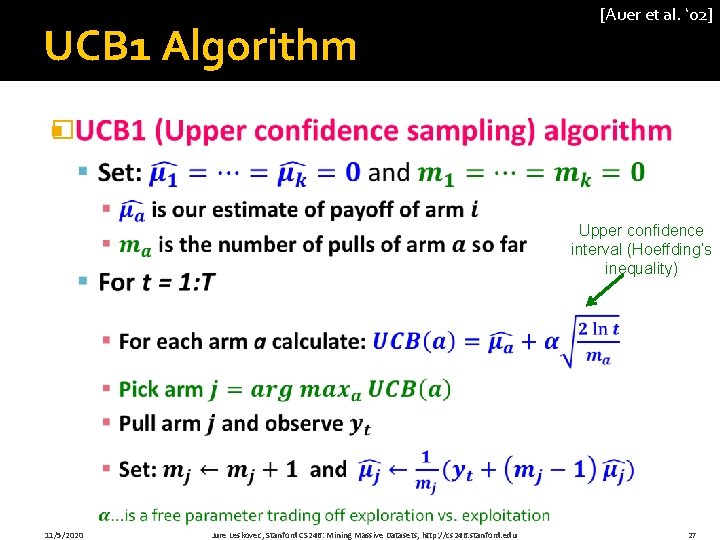
UCB 1 Algorithm [Auer et al. ‘ 02] � Upper confidence interval (Hoeffding’s inequality) 11/5/2020 Jure Leskovec, Stanford CS 246: Mining Massive Datasets, http: //cs 246. stanford. edu 27
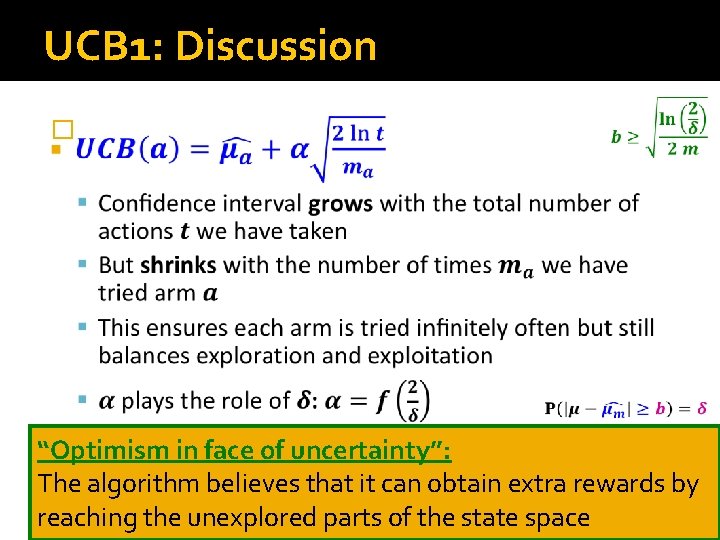
UCB 1: Discussion � “Optimism in face of uncertainty”: The algorithm believes that it can obtain extra rewards by reaching the unexplored parts of the state space 11/5/2020 Jure Leskovec, Stanford CS 246: Mining Massive Datasets, http: //cs 246. stanford. edu 28
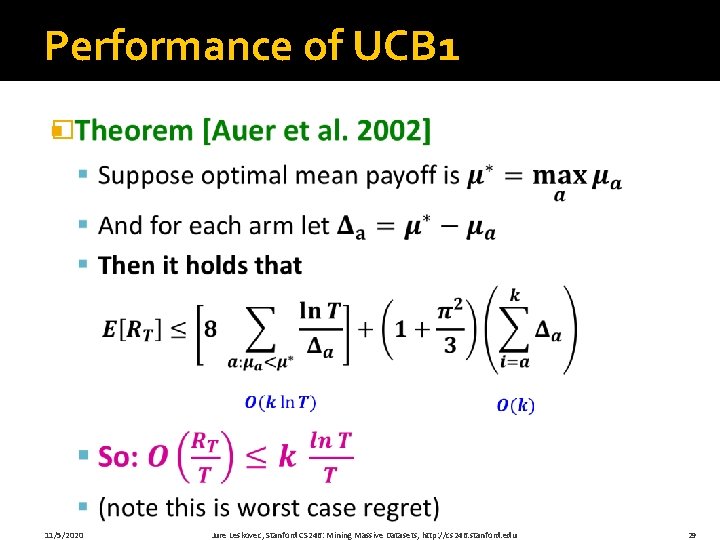
Performance of UCB 1 � 11/5/2020 Jure Leskovec, Stanford CS 246: Mining Massive Datasets, http: //cs 246. stanford. edu 29
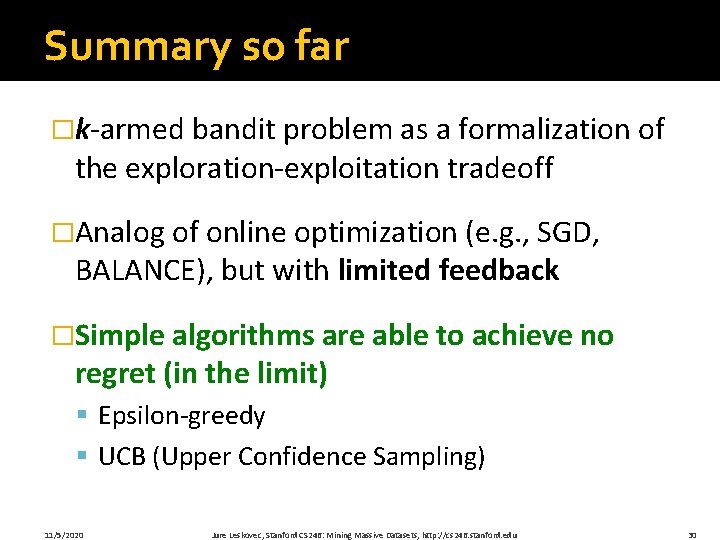
Summary so far �k-armed bandit problem as a formalization of the exploration-exploitation tradeoff �Analog of online optimization (e. g. , SGD, BALANCE), but with limited feedback �Simple algorithms are able to achieve no regret (in the limit) § Epsilon-greedy § UCB (Upper Confidence Sampling) 11/5/2020 Jure Leskovec, Stanford CS 246: Mining Massive Datasets, http: //cs 246. stanford. edu 30
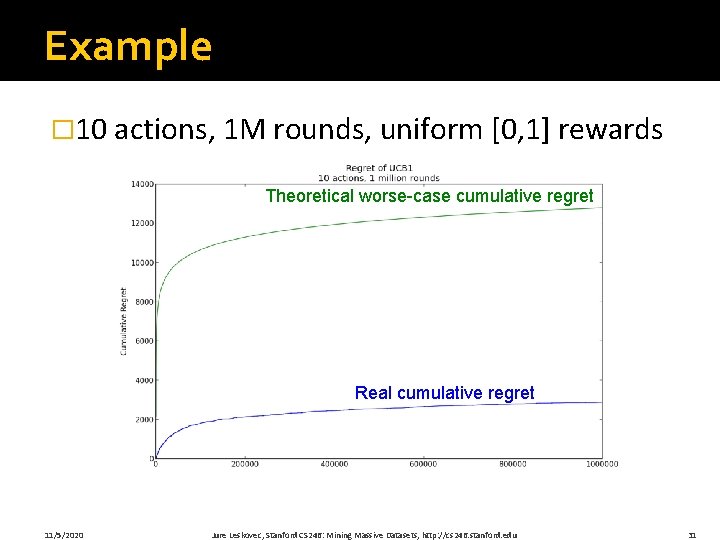
Example � 10 actions, 1 M rounds, uniform [0, 1] rewards Theoretical worse-case cumulative regret Real cumulative regret 11/5/2020 Jure Leskovec, Stanford CS 246: Mining Massive Datasets, http: //cs 246. stanford. edu 31
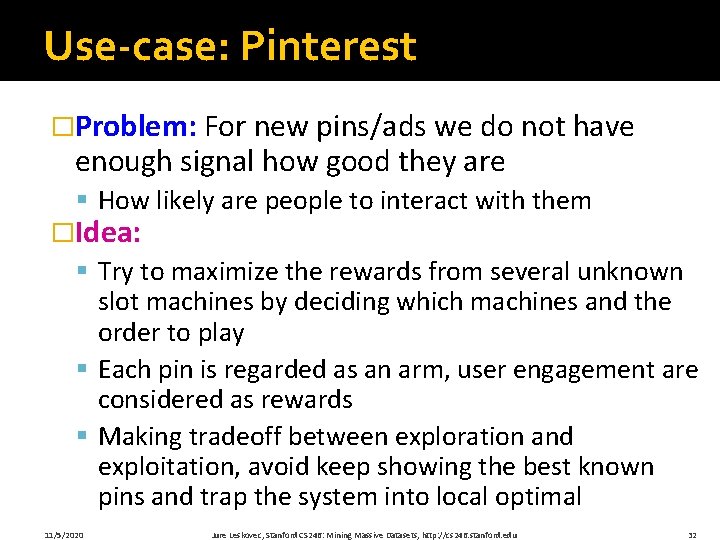
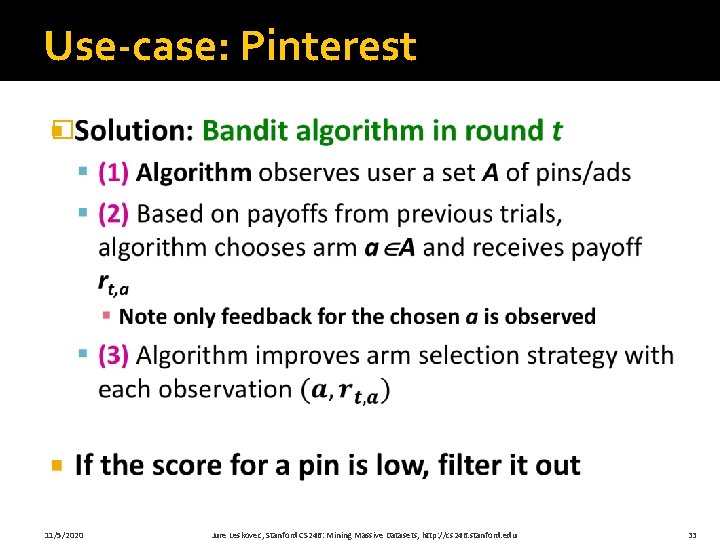
Use-case: Pinterest �Problem: For new pins/ads we do not have enough signal how good they are § How likely are people to interact with them �Idea: § Try to maximize the rewards from several unknown slot machines by deciding which machines and the order to play § Each pin is regarded as an arm, user engagement are considered as rewards § Making tradeoff between exploration and exploitation, avoid keep showing the best known pins and trap the system into local optimal 11/5/2020 Jure Leskovec, Stanford CS 246: Mining Massive Datasets, http: //cs 246. stanford. edu 32
Use-case: Pinterest � 11/5/2020 Jure Leskovec, Stanford CS 246: Mining Massive Datasets, http: //cs 246. stanford. edu 33
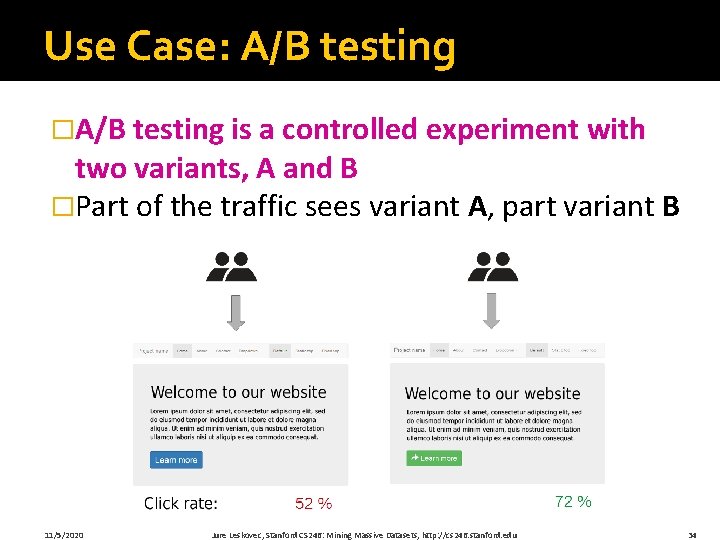
Use Case: A/B testing �A/B testing is a controlled experiment with two variants, A and B �Part of the traffic sees variant A, part variant B 11/5/2020 Jure Leskovec, Stanford CS 246: Mining Massive Datasets, http: //cs 246. stanford. edu 34
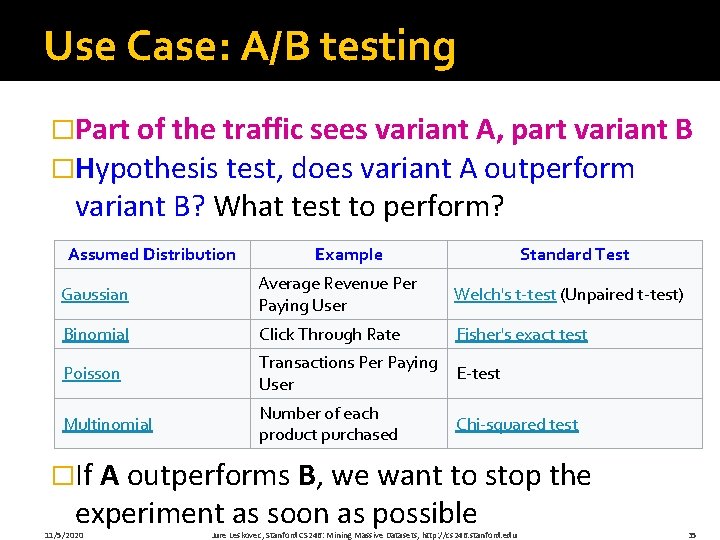
Use Case: A/B testing �Part of the traffic sees variant A, part variant B �Hypothesis test, does variant A outperform variant B? What test to perform? Assumed Distribution Example Standard Test Gaussian Average Revenue Per Paying User Welch's t-test (Unpaired t-test) Binomial Click Through Rate Fisher's exact test Poisson Transactions Per Paying E-test User Multinomial Number of each product purchased Chi-squared test �If A outperforms B, we want to stop the experiment as soon as possible 11/5/2020 Jure Leskovec, Stanford CS 246: Mining Massive Datasets, http: //cs 246. stanford. edu 35
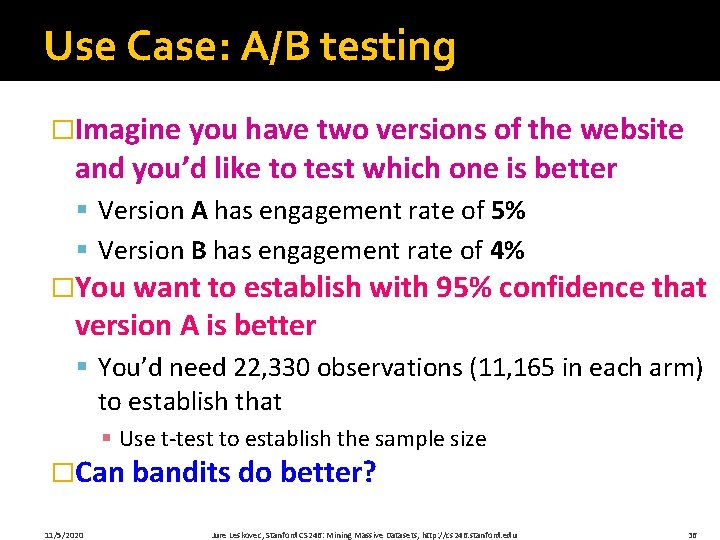
Use Case: A/B testing �Imagine you have two versions of the website and you’d like to test which one is better § Version A has engagement rate of 5% § Version B has engagement rate of 4% �You want to establish with 95% confidence that version A is better § You’d need 22, 330 observations (11, 165 in each arm) to establish that § Use t-test to establish the sample size �Can bandits do better? 11/5/2020 Jure Leskovec, Stanford CS 246: Mining Massive Datasets, http: //cs 246. stanford. edu 36
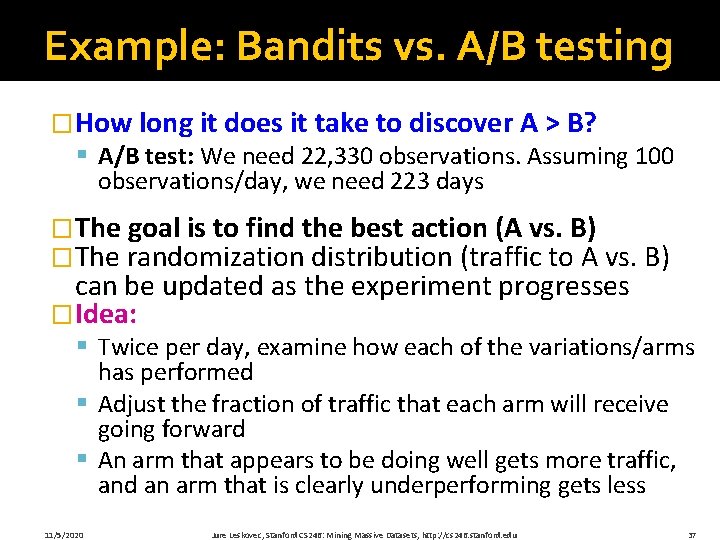
Example: Bandits vs. A/B testing �How long it does it take to discover A > B? § A/B test: We need 22, 330 observations. Assuming 100 observations/day, we need 223 days �The goal is to find the best action (A vs. B) �The randomization distribution (traffic to A vs. B) can be updated as the experiment progresses �Idea: § Twice per day, examine how each of the variations/arms has performed § Adjust the fraction of traffic that each arm will receive going forward § An arm that appears to be doing well gets more traffic, and an arm that is clearly underperforming gets less 11/5/2020 Jure Leskovec, Stanford CS 246: Mining Massive Datasets, http: //cs 246. stanford. edu 37
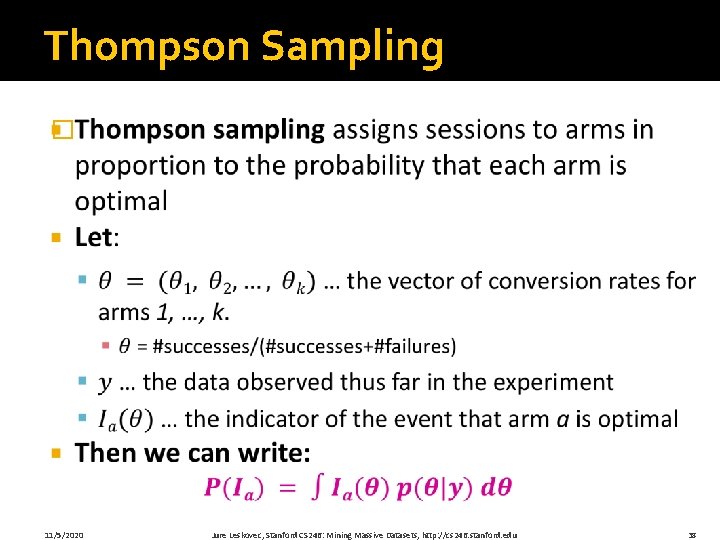
Thompson Sampling � 11/5/2020 Jure Leskovec, Stanford CS 246: Mining Massive Datasets, http: //cs 246. stanford. edu 38
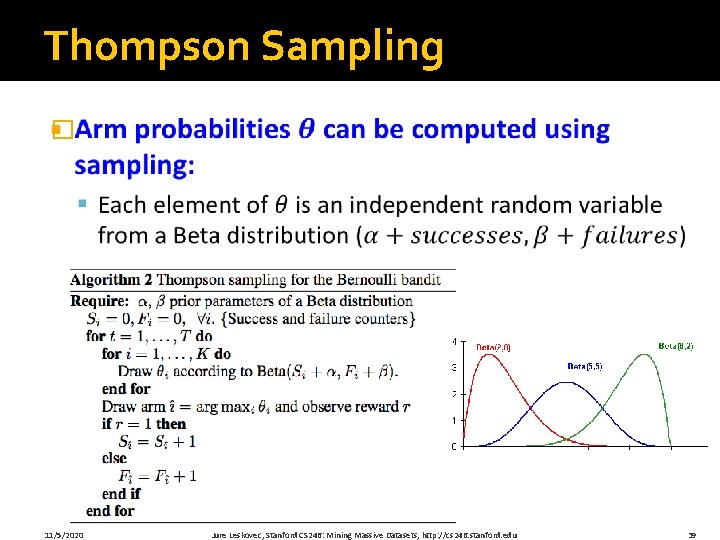
Thompson Sampling � 11/5/2020 Jure Leskovec, Stanford CS 246: Mining Massive Datasets, http: //cs 246. stanford. edu 39
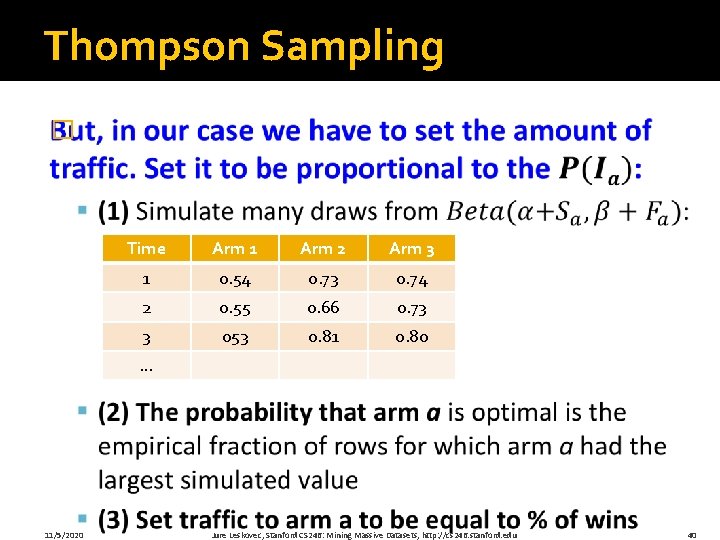
Thompson Sampling � Time Arm 1 Arm 2 Arm 3 1 0. 54 0. 73 0. 74 2 0. 55 0. 66 0. 73 3 053 0. 81 0. 80 … 11/5/2020 Jure Leskovec, Stanford CS 246: Mining Massive Datasets, http: //cs 246. stanford. edu 40
Use Case: A/B testing �Imagine you have two versions of the website and you’d like to test which one is better § Version A has engagement rate of 5% § Version B has engagement rate of 4% �You want to establish with 95% confidence that version A is better § You’d need 22, 330 observations (11, 165 in each arm) to establish that § Use t-test to establish the sample size �Can bandits do better? 11/5/2020 Jure Leskovec, Stanford CS 246: Mining Massive Datasets, http: //cs 246. stanford. edu 41
Example A/B test: We need 22, 330 observations. Assuming 100 observations/day, we need 223 days �On 1 st day about 50 sessions are assigned to each arm �Suppose A got really lucky on the first day, and it appears to have a 70% chance of being superior �Then we assign it 70% of the traffic on the second day, and the variant B gets 30% �At the end of the 2 nd day we accumulate all the traffic we’ve seen so far (over both days), and recompute the probability that each arm is best 11/5/2020 Jure Leskovec, Stanford CS 246: Mining Massive Datasets, http: //cs 246. stanford. edu 42
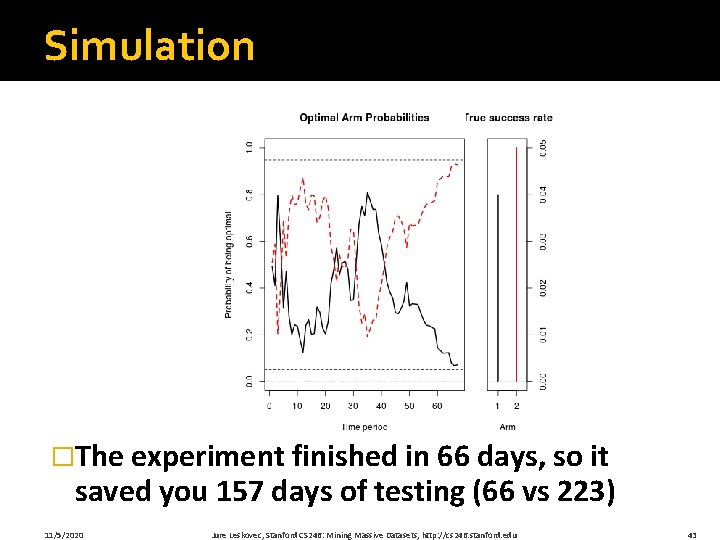
Simulation �The experiment finished in 66 days, so it saved you 157 days of testing (66 vs 223) 11/5/2020 Jure Leskovec, Stanford CS 246: Mining Massive Datasets, http: //cs 246. stanford. edu 43
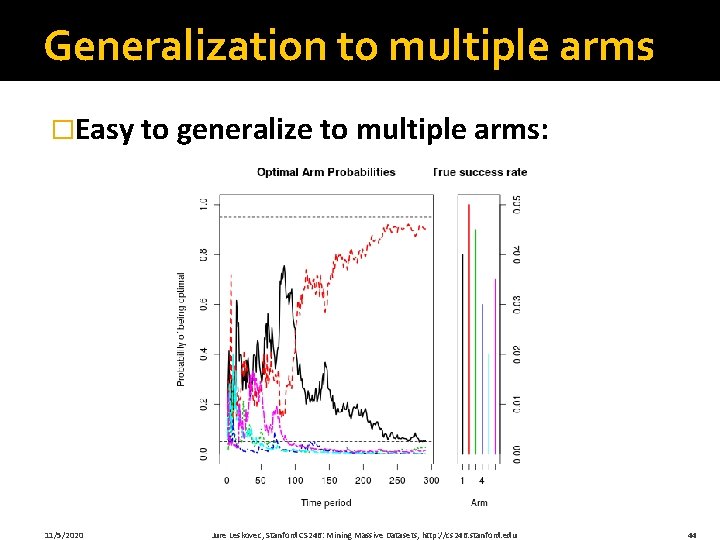
Generalization to multiple arms �Easy to generalize to multiple arms: 11/5/2020 Jure Leskovec, Stanford CS 246: Mining Massive Datasets, http: //cs 246. stanford. edu 44