
Learning Theory From Social to Cognition Kimberley A
Learning Theory From Social to Cognition Kimberley A. Clow kclow 2@uwo. ca http: //instruct. uwo. ca/psychology/257 e-570 Office Hour: Thursdays 2 -3 pm Office: S 302
Outline w Social & Cognitive Factors • • • w Reciprocal Determinism Person-Situation Interaction Goal Directed Behaviourism Locus of Control Self-Efficacy Self-Regulation Dysfunctional Personalities • Changing Personality
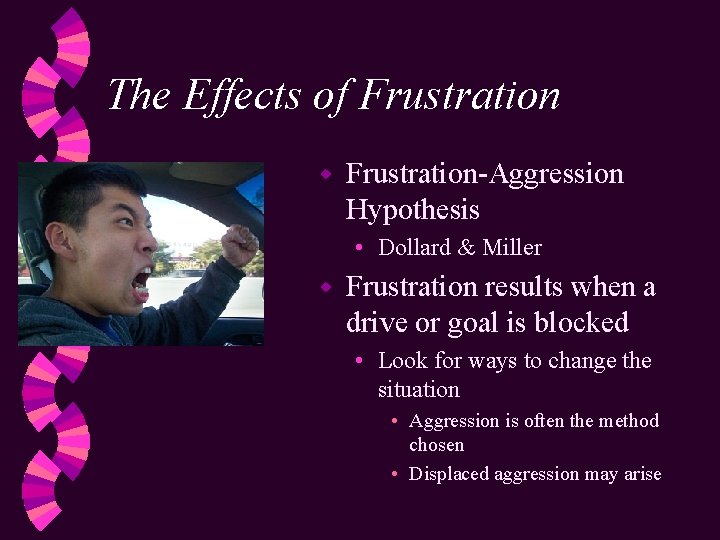
The Effects of Frustration w Frustration-Aggression Hypothesis • Dollard & Miller w Frustration results when a drive or goal is blocked • Look for ways to change the situation • Aggression is often the method chosen • Displaced aggression may arise
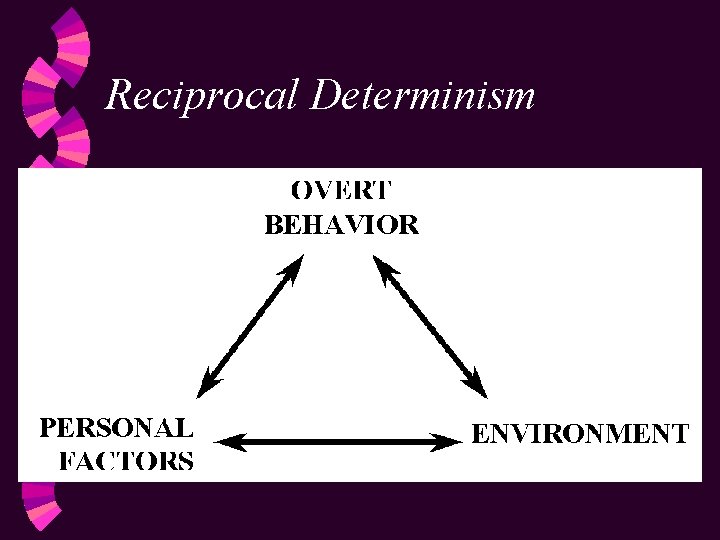
Reciprocal Determinism
Person-Situation Interaction w Mischel’s theory centers on the apparent INCONSISTENCY of behaviour • Behaviour is not consistent across situations • Not all effects of personality • Everyone does not behave the same in the same situation • Not all effects of environment • Consistency Paradox
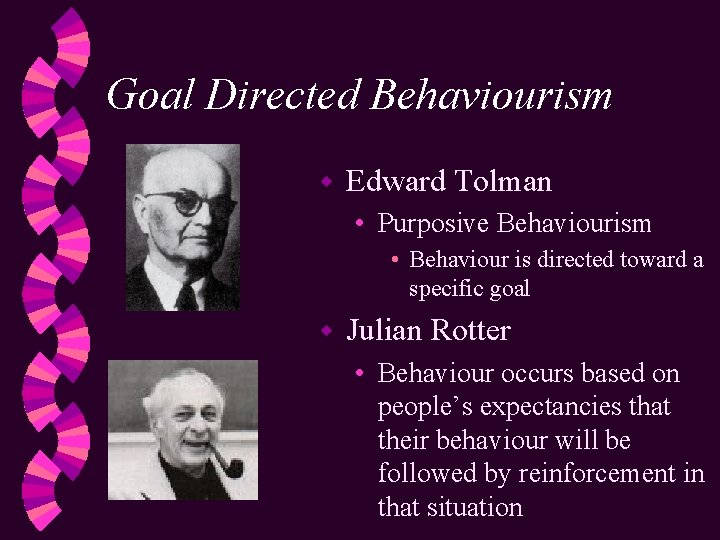
Goal Directed Behaviourism w Edward Tolman • Purposive Behaviourism • Behaviour is directed toward a specific goal w Julian Rotter • Behaviour occurs based on people’s expectancies that their behaviour will be followed by reinforcement in that situation
Generalized Expectancies w Needs • Behaviours that move us toward a goal w Types of Needs • • • Recognition-Status Dominance Independence Protection-Dependency Love & Affection Physical Comfort
Answer ‘Yes’ or ‘No’ 1. 2. 3. 4. 5. 6. 7. 8. 9. I need to be kept informed about news events People make a difference in controlling crime. Have you ever had a good-luck charm? Marriage is largely a gamble for most people. It is important for me to vote. My life seems like a series of random events. I earn the respect and honours I receive. Are some people just born lucky? Persistence and hard work usually lead to success
10. 11. 12. 13. 14. 15. 16. Other people usually control my life. Most things that affect my health happen to me by accident. Do you believe that wishing can make good things happen? Do you think it's better to be smart than to be lucky? Do you believe that when bad things are going to happen they are just going to happen no matter what you try to do to stop them? When I get what I want it’s usually because I worked hard for it. When I make plans I am almost certain to make them work.
17. 18. 19. 20. 21. 22. 23. I prefer games involving some luck over games requiring pure skills. I can learn almost anything if I set my mind to it. My major accomplishments are entirely due to my hard work and ability. I usually don’t set goals because I have a hard time following through on them. Competition discourages excellence. Often people get ahead just by being lucky. On any sort of exam or competition I like to know how well I do relatively to every one else.
Scoring w Internal Control • Yes • 1, 2, 5, 7, 9, 13, 15, 16, 18, 19, 23 • No • 3, 4, 6, 8, 10, 11, 12, 14, 17, 20, 21, 22, 24 w External Control • Yes • 3, 4, 6, 8, 10, 11, 12, 14, 17, 20, 21, 22, 24 • No • 1, 2, 5, 7, 9, 13, 15, 16, 18, 19, 23
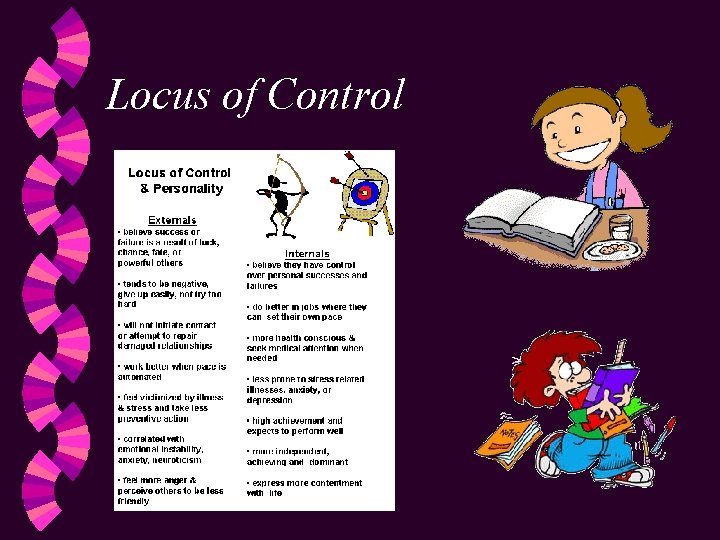
Locus of Control
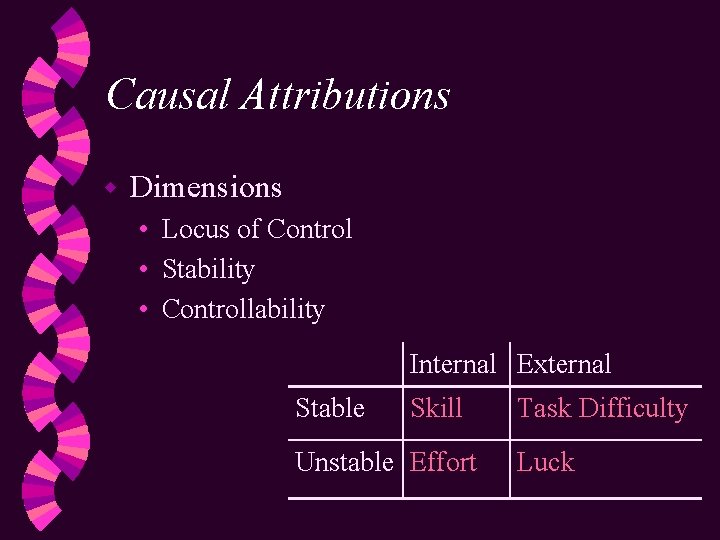
Causal Attributions w Dimensions • Locus of Control • Stability • Controllability Internal External Stable Skill Unstable Effort Task Difficulty Luck
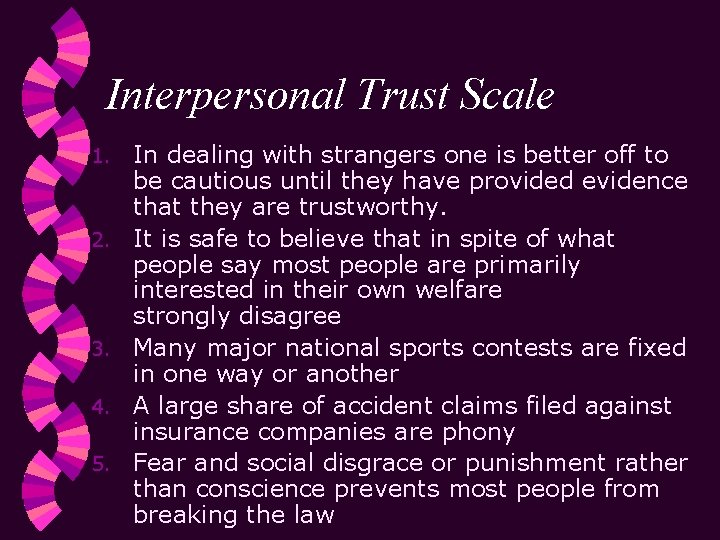
Interpersonal Trust Scale 1. 2. 3. 4. 5. In dealing with strangers one is better off to be cautious until they have provided evidence that they are trustworthy. It is safe to believe that in spite of what people say most people are primarily interested in their own welfare strongly disagree Many major national sports contests are fixed in one way or another A large share of accident claims filed against insurance companies are phony Fear and social disgrace or punishment rather than conscience prevents most people from breaking the law
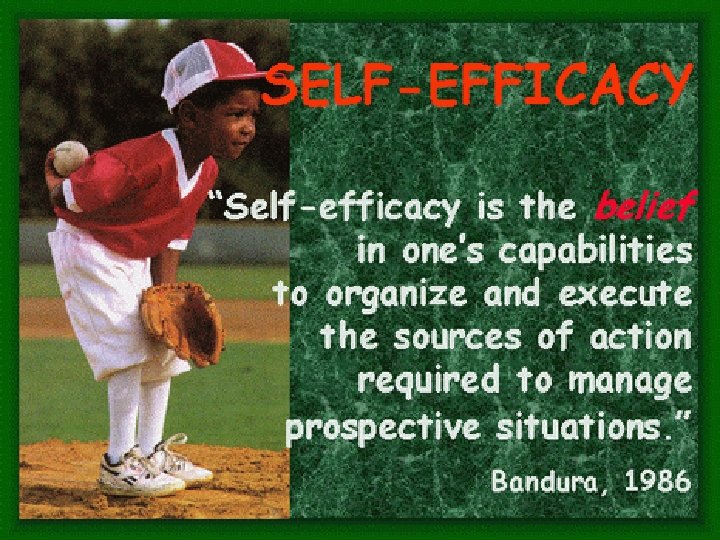
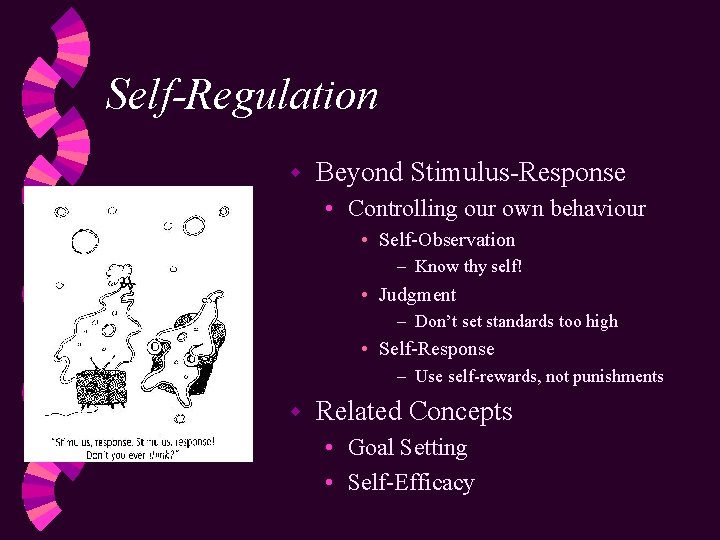
Self-Regulation w Beyond Stimulus-Response • Controlling our own behaviour • Self-Observation – Know thy self! • Judgment – Don’t set standards too high • Self-Response – Use self-rewards, not punishments w Related Concepts • Goal Setting • Self-Efficacy
Social Learning Person Variables w Cognitive Affective Units • All those psychological, social, & physiological aspects that allow us to interact with our environment with some amount of stability & consistency w Types • • • Encoding Strategies Competencies Expectancies & Beliefs Goals & Values Affective Responses
Summary of Social-Cognitive Factors w Personality develops through an interaction • Internal factors • Behaviour • Environment w Goal Directed Behaviour • Expectancies Self-Regulatory Capabilities w Self-Reflective Capability w • Self-Efficacy
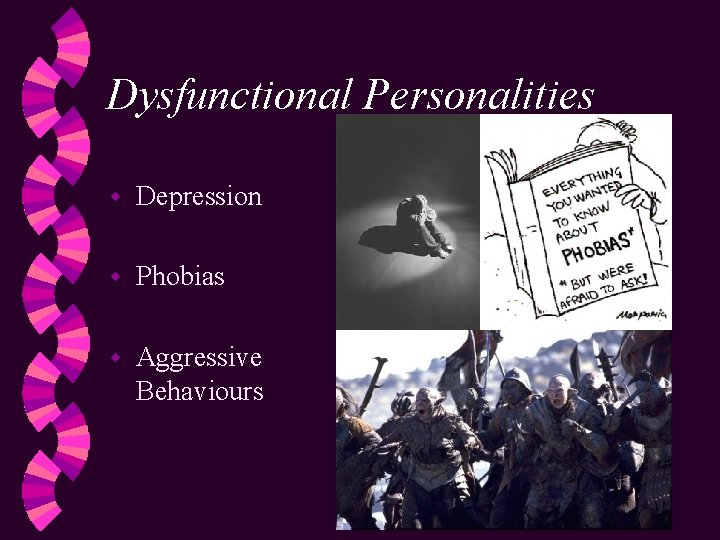
Dysfunctional Personalities w Depression w Phobias w Aggressive Behaviours
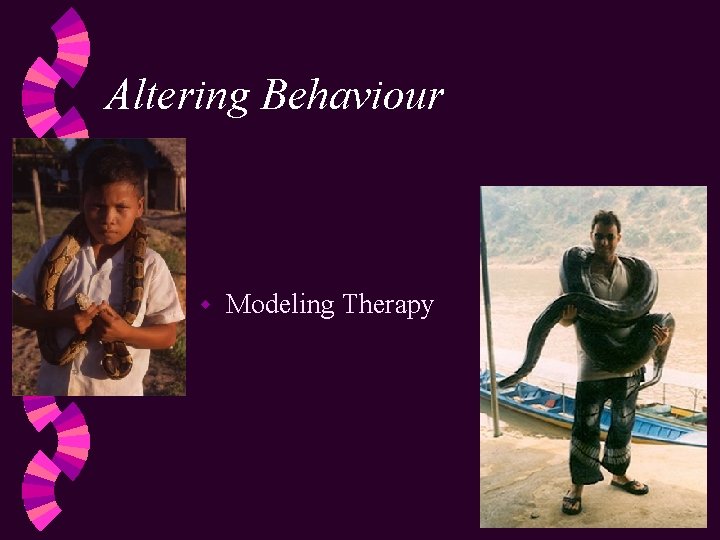
Altering Behaviour w Modeling Therapy
Strengths & Weaknesses w Strengths • Add cognition into behaviourism • Effects of beliefs • Learning can occur through indirect experience • Solid theory with research support • Detailed hypotheses and specific variables w Weaknesses • Does not take traits or biology into account • More to a person than the sum of his or her learning
- Slides: 21