
LEARNING THEORIESTHEORISTS TIMELINE By Sage Mauritson Plato consists
LEARNING THEORIES/THEORISTS TIMELINE By: Sage Mauritson
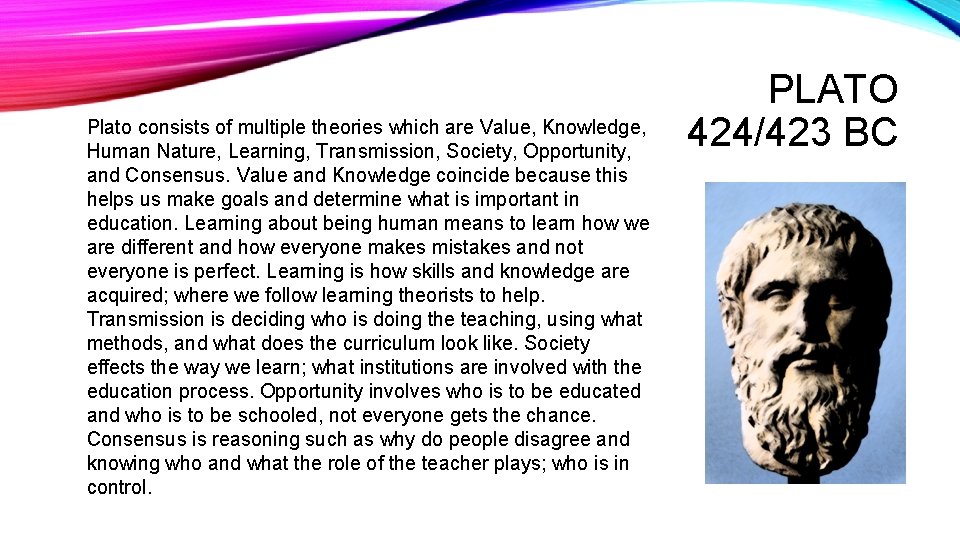
Plato consists of multiple theories which are Value, Knowledge, Human Nature, Learning, Transmission, Society, Opportunity, and Consensus. Value and Knowledge coincide because this helps us make goals and determine what is important in education. Learning about being human means to learn how we are different and how everyone makes mistakes and not everyone is perfect. Learning is how skills and knowledge are acquired; where we follow learning theorists to help. Transmission is deciding who is doing the teaching, using what methods, and what does the curriculum look like. Society effects the way we learn; what institutions are involved with the education process. Opportunity involves who is to be educated and who is to be schooled, not everyone gets the chance. Consensus is reasoning such as why do people disagree and knowing who and what the role of the teacher plays; who is in control. PLATO 424/423 BC
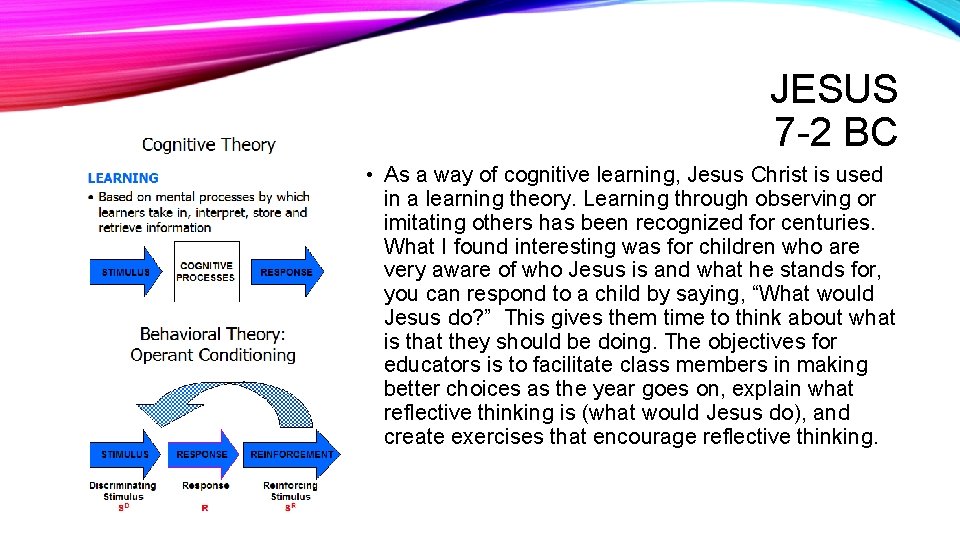
JESUS 7 -2 BC • As a way of cognitive learning, Jesus Christ is used in a learning theory. Learning through observing or imitating others has been recognized for centuries. What I found interesting was for children who are very aware of who Jesus is and what he stands for, you can respond to a child by saying, “What would Jesus do? ” This gives them time to think about what is that they should be doing. The objectives for educators is to facilitate class members in making better choices as the year goes on, explain what reflective thinking is (what would Jesus do), and create exercises that encourage reflective thinking.
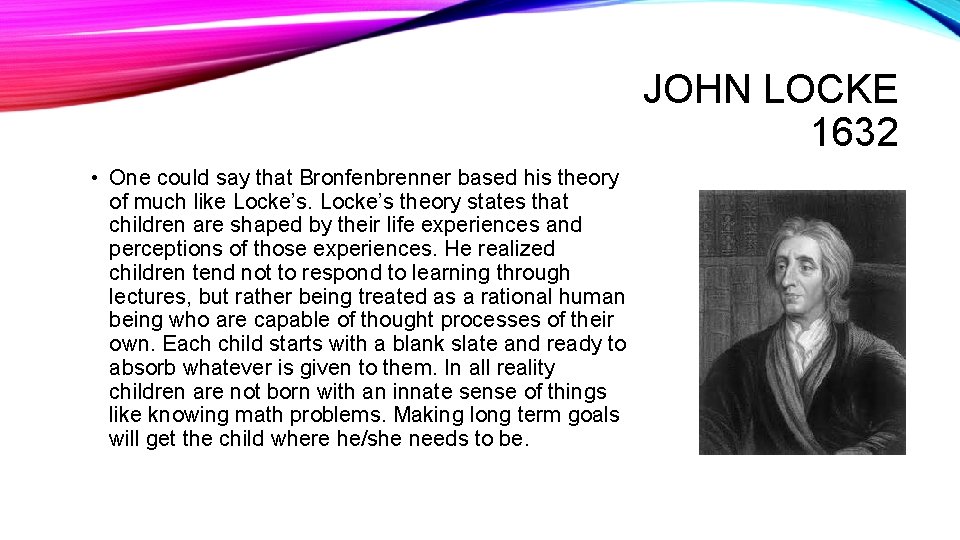
JOHN LOCKE 1632 • One could say that Bronfenbrenner based his theory of much like Locke’s theory states that children are shaped by their life experiences and perceptions of those experiences. He realized children tend not to respond to learning through lectures, but rather being treated as a rational human being who are capable of thought processes of their own. Each child starts with a blank slate and ready to absorb whatever is given to them. In all reality children are not born with an innate sense of things like knowing math problems. Making long term goals will get the child where he/she needs to be.
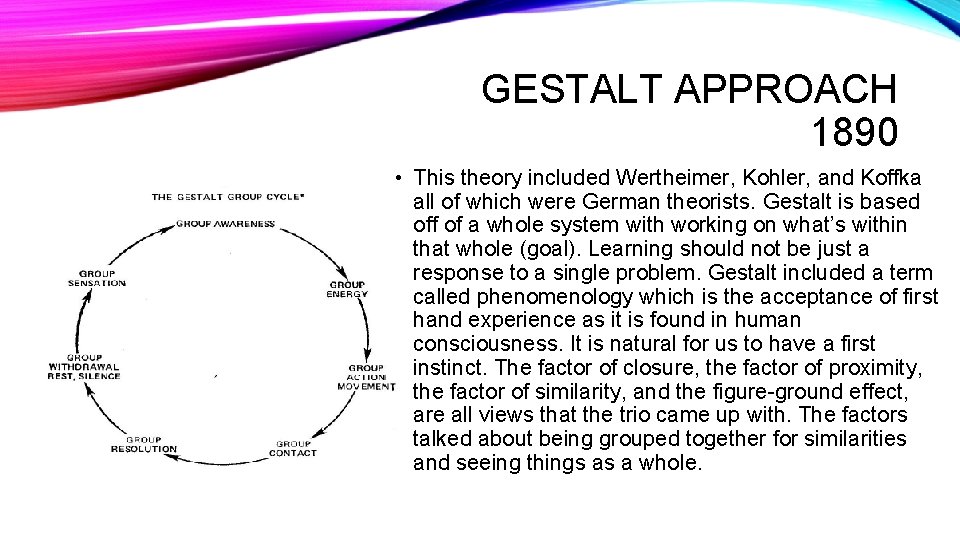
GESTALT APPROACH 1890 • This theory included Wertheimer, Kohler, and Koffka all of which were German theorists. Gestalt is based off of a whole system with working on what’s within that whole (goal). Learning should not be just a response to a single problem. Gestalt included a term called phenomenology which is the acceptance of first hand experience as it is found in human consciousness. It is natural for us to have a first instinct. The factor of closure, the factor of proximity, the factor of similarity, and the figure-ground effect, are all views that the trio came up with. The factors talked about being grouped together for similarities and seeing things as a whole.
LEV VYGOTSKY 1896 • Vygotsky’s theory of social development is all based off of the way children interact socially. Its starts off very basic by children just learning memorization. The theory then gets deeper into development by children learning concepts. Another part of his theory is about the zone of proximal development (ZPD), a level of development attained when children engage in social behavior. Vygotsky is all about cognitive development which can be compared to Piaget and Bruner’s constructivist theories.
JEAN PIAGET 1896 • He believed that children are unable to accomplish tasks until they experience what life has to offer. He focused merely on the developmental process of children’s education. He understood how children learn by observing, listening, and understanding. Through assimilation and accommodation children learn to adapt to the world.
B. F. SKINNER 1904 • Skinner’s learning theory is based off of responses children have towards changes in behavior. The way children respond produces consequences. Normally when rewarded by responding to a situation it is conditioned or normal. Reinforcement is the one thing that strengthens the desired response. The theory also goes along with negative reinforcing- bad behavior will decrease through bad grades and or talking to the person and encouraging them to try something new.
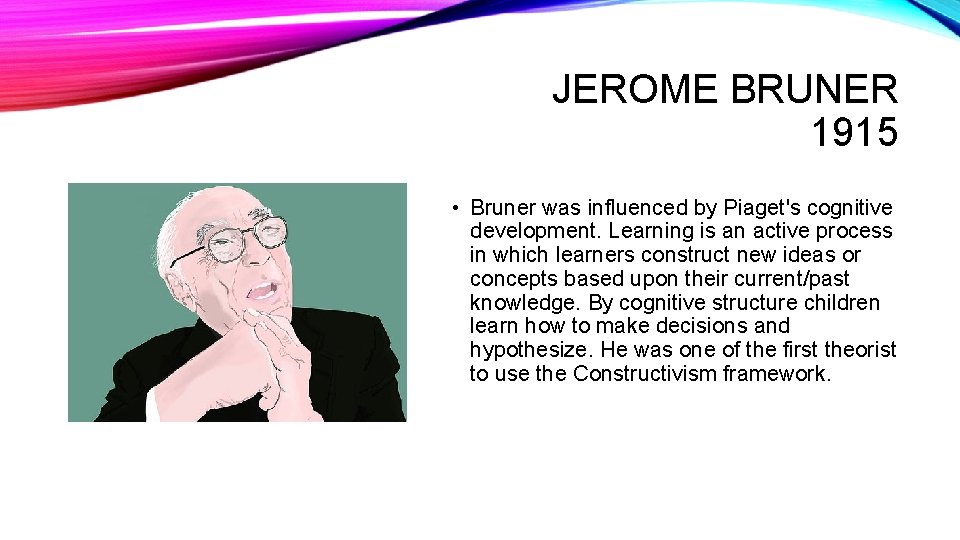
JEROME BRUNER 1915 • Bruner was influenced by Piaget's cognitive development. Learning is an active process in which learners construct new ideas or concepts based upon their current/past knowledge. By cognitive structure children learn how to make decisions and hypothesize. He was one of the first theorist to use the Constructivism framework.
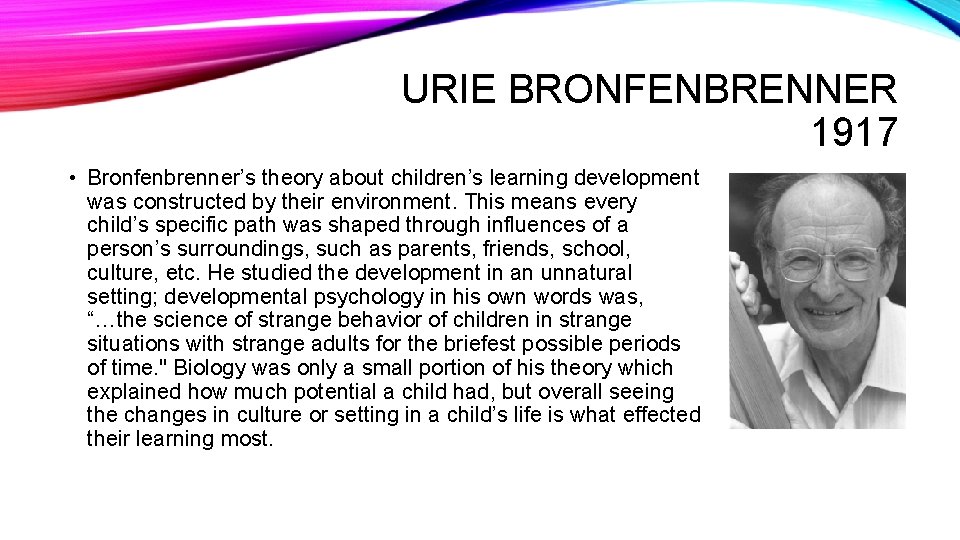
URIE BRONFENBRENNER 1917 • Bronfenbrenner’s theory about children’s learning development was constructed by their environment. This means every child’s specific path was shaped through influences of a person’s surroundings, such as parents, friends, school, culture, etc. He studied the development in an unnatural setting; developmental psychology in his own words was, “…the science of strange behavior of children in strange situations with strange adults for the briefest possible periods of time. " Biology was only a small portion of his theory which explained how much potential a child had, but overall seeing the changes in culture or setting in a child’s life is what effected their learning most.
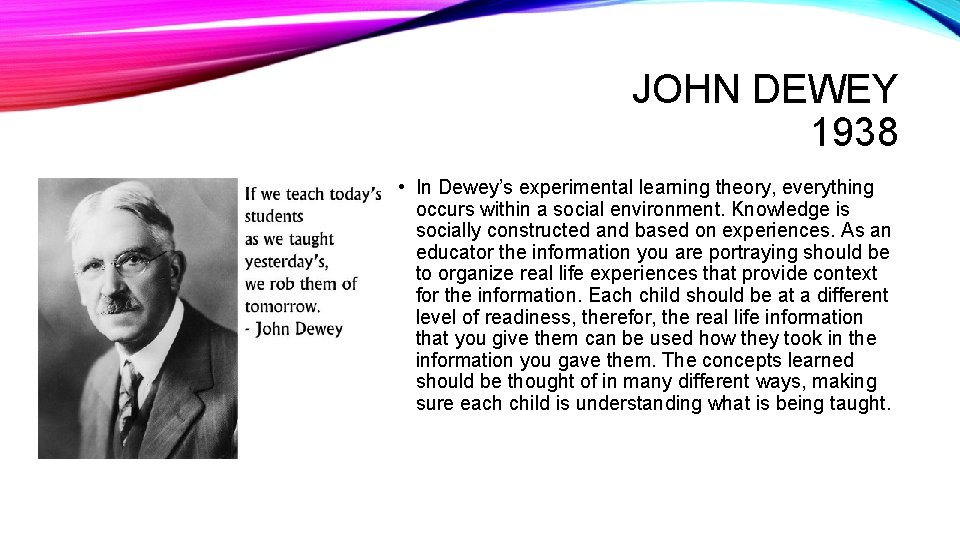
JOHN DEWEY 1938 • In Dewey’s experimental learning theory, everything occurs within a social environment. Knowledge is socially constructed and based on experiences. As an educator the information you are portraying should be to organize real life experiences that provide context for the information. Each child should be at a different level of readiness, therefor, the real life information that you give them can be used how they took in the information you gave them. The concepts learned should be thought of in many different ways, making sure each child is understanding what is being taught.
SYNTHESIZE • I truly feel that John Locke did a great job realizing that the environment plays a huge role in how children develop and learn. For example, a child from a low income family may not get as many learning opportunities as a child who comes from wealth and has an education that is paid for getting higher quality. I also like that he gives children a blank slate, an educator must not have thoughts that a child is going to be a problem because of what is said in his portfolio from teachers in the past, there may be underlying issue and it is my job to figure out how that child learns best. He also believes that children do not learn by lecture, where as I will be doing a more hands on approach that comes with reasoning. Jesus’s theory said to learn by imitating and it helps to work in groups, which I will also being doing this. I will start off by showing children what they should be doing so they have an idea where to start. Also getting ideas from other children will be fun for them, teach creative thinking, and help build social skills and relationships.
- Slides: 12