
LEARNING THEORIES Jessie Shoemaker Behaviorism Concept that all
LEARNING THEORIES Jessie Shoemaker
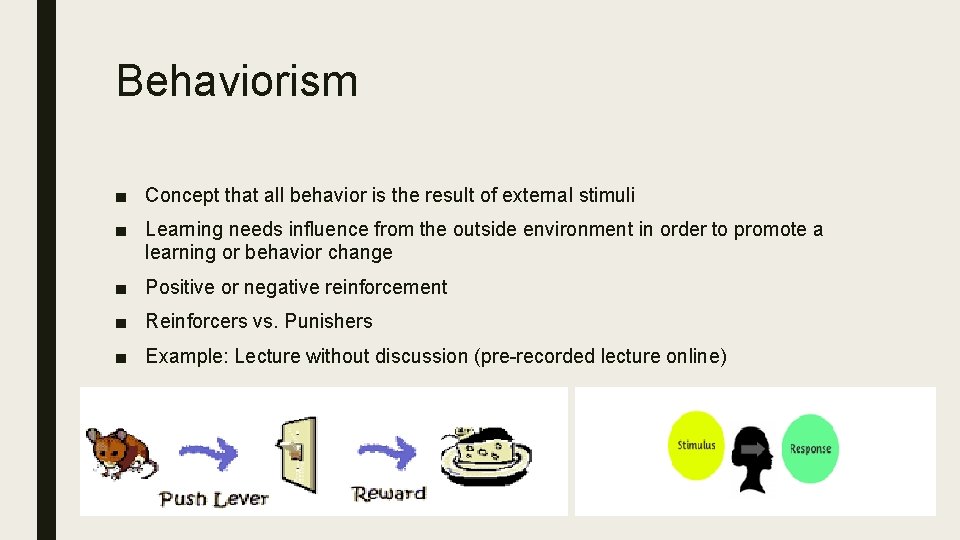
Behaviorism ■ Concept that all behavior is the result of external stimuli ■ Learning needs influence from the outside environment in order to promote a learning or behavior change ■ Positive or negative reinforcement ■ Reinforcers vs. Punishers ■ Example: Lecture without discussion (pre-recorded lecture online)


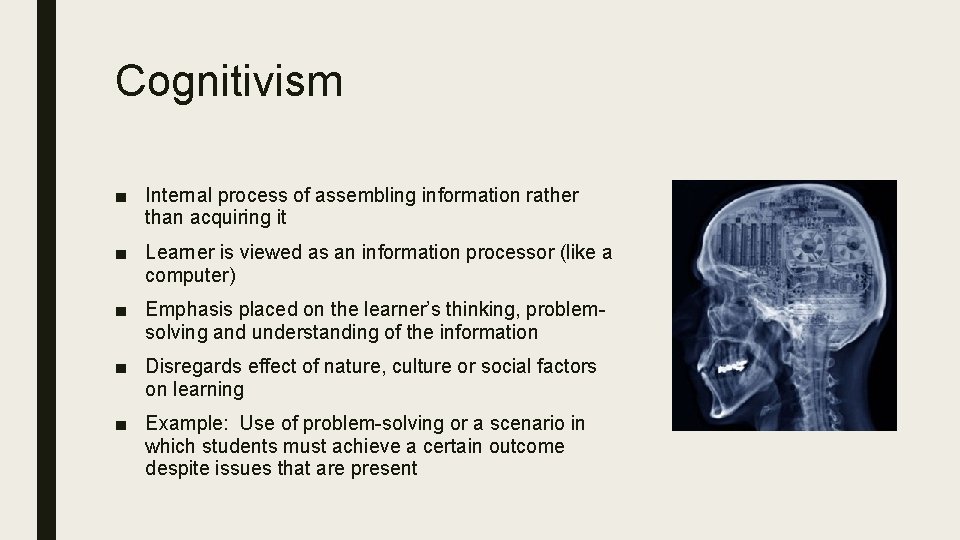
Cognitivism ■ Internal process of assembling information rather than acquiring it ■ Learner is viewed as an information processor (like a computer) ■ Emphasis placed on the learner’s thinking, problemsolving and understanding of the information ■ Disregards effect of nature, culture or social factors on learning ■ Example: Use of problem-solving or a scenario in which students must achieve a certain outcome despite issues that are present
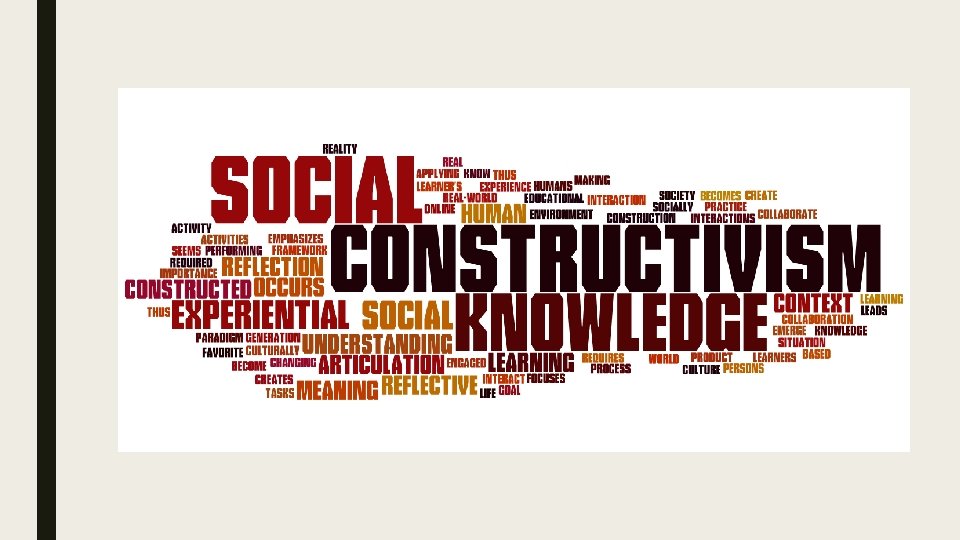
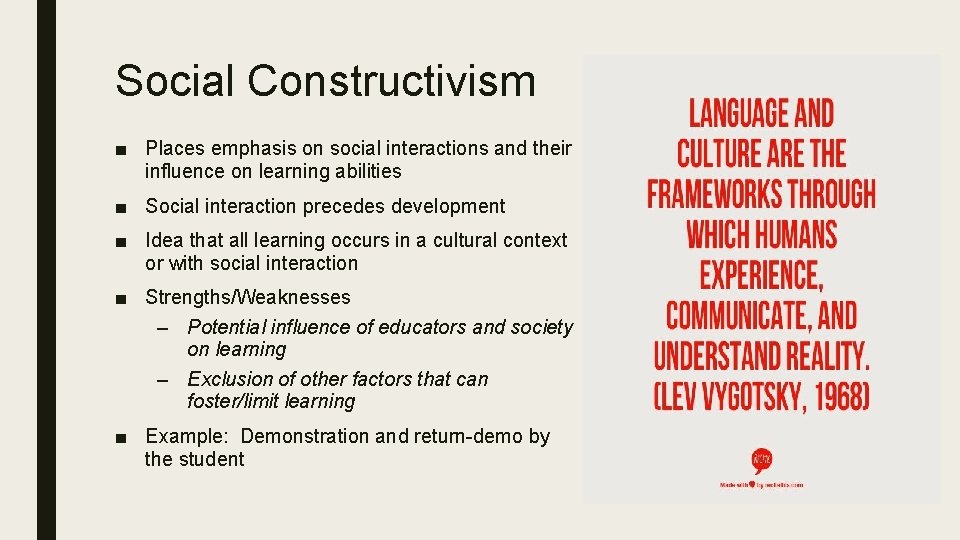
Social Constructivism ■ Places emphasis on social interactions and their influence on learning abilities ■ Social interaction precedes development ■ Idea that all learning occurs in a cultural context or with social interaction ■ Strengths/Weaknesses – Potential influence of educators and society on learning – Exclusion of other factors that can foster/limit learning ■ Example: Demonstration and return-demo by the student

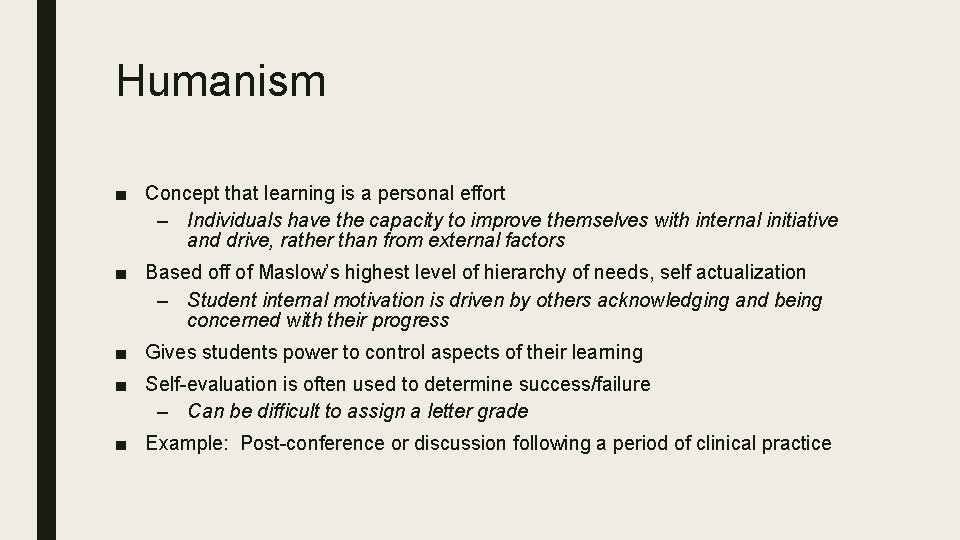
Humanism ■ Concept that learning is a personal effort – Individuals have the capacity to improve themselves with internal initiative and drive, rather than from external factors ■ Based off of Maslow’s highest level of hierarchy of needs, self actualization – Student internal motivation is driven by others acknowledging and being concerned with their progress ■ Gives students power to control aspects of their learning ■ Self-evaluation is often used to determine success/failure – Can be difficult to assign a letter grade ■ Example: Post-conference or discussion following a period of clinical practice
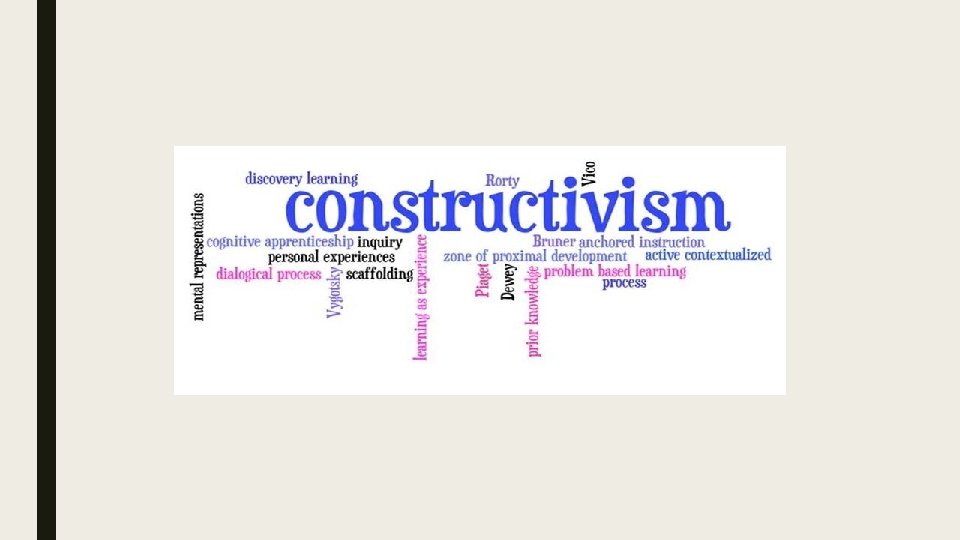
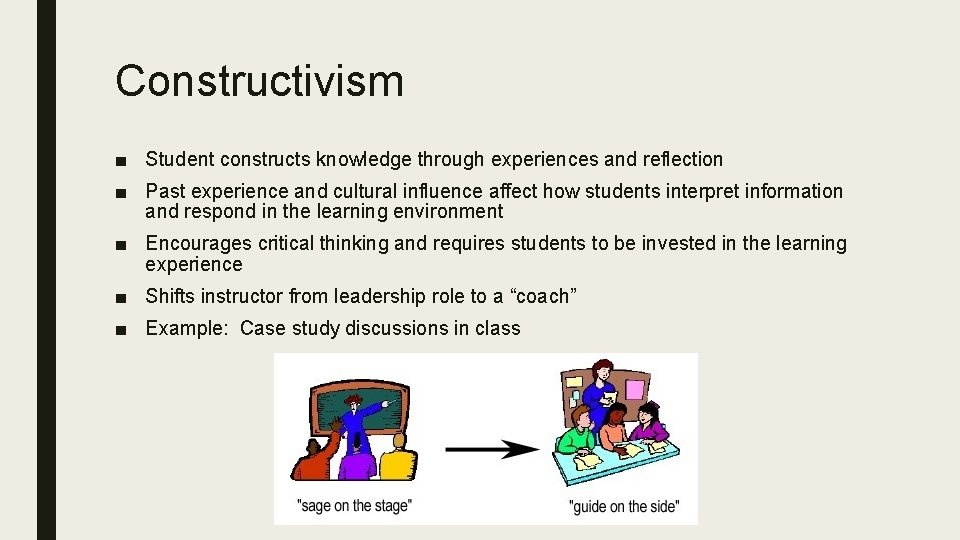
Constructivism ■ Student constructs knowledge through experiences and reflection ■ Past experience and cultural influence affect how students interpret information and respond in the learning environment ■ Encourages critical thinking and requires students to be invested in the learning experience ■ Shifts instructor from leadership role to a “coach” ■ Example: Case study discussions in class
Brain-Based Learning
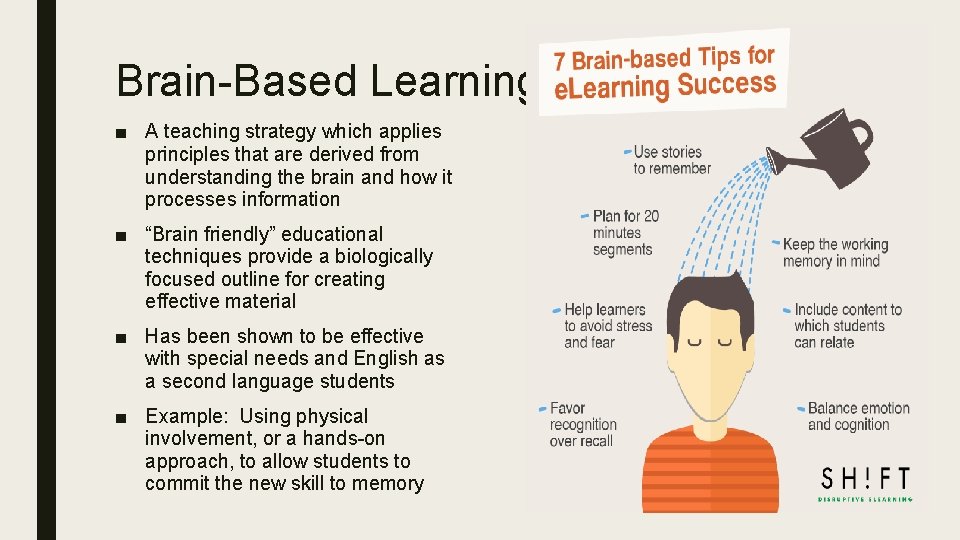
Brain-Based Learning ■ A teaching strategy which applies principles that are derived from understanding the brain and how it processes information ■ “Brain friendly” educational techniques provide a biologically focused outline for creating effective material ■ Has been shown to be effective with special needs and English as a second language students ■ Example: Using physical involvement, or a hands-on approach, to allow students to commit the new skill to memory
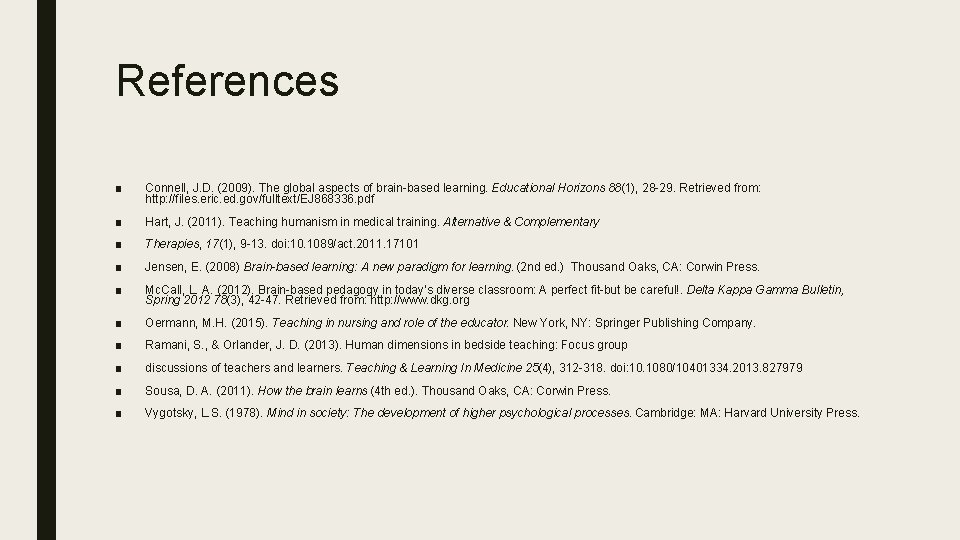
References ■ Connell, J. D. (2009). The global aspects of brain-based learning. Educational Horizons 88(1), 28 -29. Retrieved from: http: //files. eric. ed. gov/fulltext/EJ 868336. pdf ■ Hart, J. (2011). Teaching humanism in medical training. Alternative & Complementary ■ Therapies, 17(1), 9 -13. doi: 10. 1089/act. 2011. 17101 ■ Jensen, E. (2008) Brain-based learning: A new paradigm for learning. (2 nd ed. ) Thousand Oaks, CA: Corwin Press. ■ Mc. Call, L. A. (2012). Brain-based pedagogy in today’s diverse classroom: A perfect fit-but be careful!. Delta Kappa Gamma Bulletin, Spring 2012 78(3), 42 -47. Retrieved from: http: //www. dkg. org ■ Oermann, M. H. (2015). Teaching in nursing and role of the educator. New York, NY: Springer Publishing Company. ■ Ramani, S. , & Orlander, J. D. (2013). Human dimensions in bedside teaching: Focus group ■ discussions of teachers and learners. Teaching & Learning In Medicine 25(4), 312 -318. doi: 10. 1080/10401334. 2013. 827979 ■ Sousa, D. A. (2011). How the brain learns (4 th ed. ). Thousand Oaks, CA: Corwin Press. ■ Vygotsky, L. S. (1978). Mind in society: The development of higher psychological processes. Cambridge: MA: Harvard University Press.
- Slides: 16